

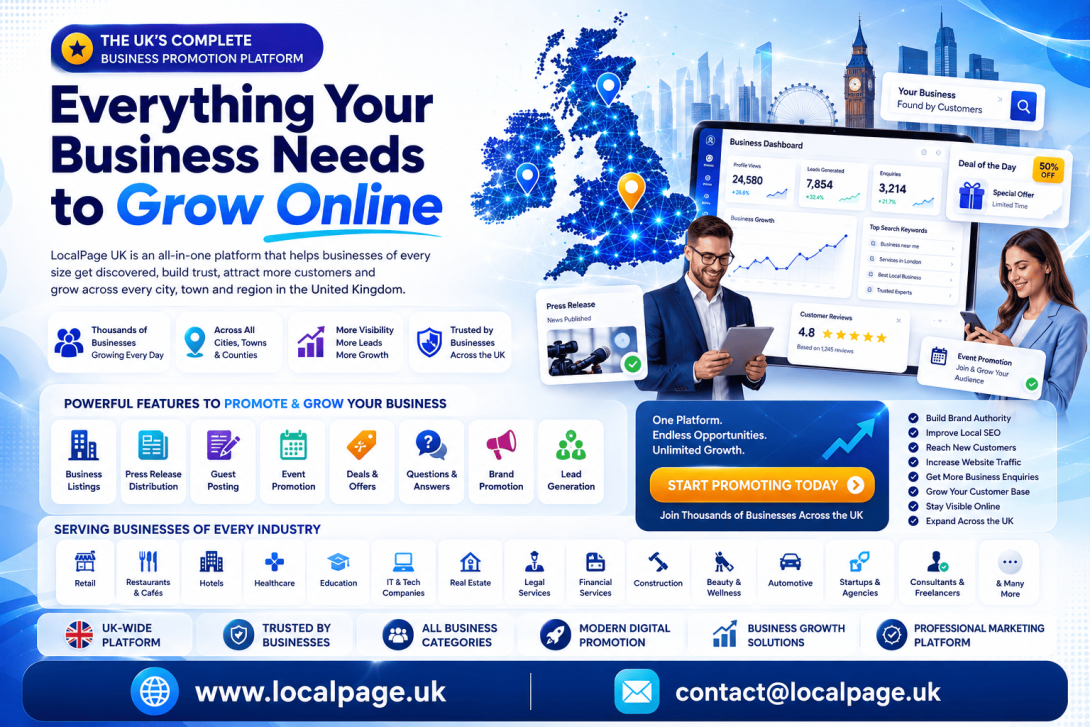
Finding the right digital storefront for your enterprise can feel like searching for a needle in a digital haystack. Every year, thousands of business owners across England, Scotland, Wales, and Northern Ireland ask the same critical question: Where should I list my business online to get maximum visibility, high-intent traffic, and sustainable local search engine rankings?
The problem is stark: while traditional directory giants have dominated search results for decades, many have bloated their platforms with intrusive ads, paywalls, and low-quality spam listings. This leaves genuine British enterprises struggling for local visibility. Why it matters is simple—your digital footprint dictates your local authority, your Google Business Profile synergy, and ultimately, your customer acquisition cost. This comprehensive guide affects sole traders, local service providers, B2B agencies, and growing eCommerce brands alike.
In this exhaustive manual, you will learn how to leverage a targeted uk small business directory to dominate AI-driven search engines, traditional Google queries, voice assistant responses, and localized map packs.
Table of Contents
- Introduction
- The Anatomy of Modern Local Visibility in the UK
- Why Traditional Directories Fail British SMEs Today
- The Power of Entity-First Architecture in Local Directories
- Comprehensive Strategic Blueprint: Claiming Your Listings
- Advanced NAP Consistency and Data Hygiene Protocols
- Optimizing for AEO (Answer Engine Optimization) and Voice Search
- Leveraging Generative Engine Optimization (GEO) for AI Citations
- Case Studies: Real-World Local Visibility Transformations
- Common Pitfalls and Mistakes to Avoid
- Frequently Asked Questions (FAQs)
- Conclusion
The Anatomy of Modern Local Visibility in the UK
To understand how to maximize your brand's presence, we must first break down what local visibility means in the current digital landscape. Local visibility is no longer just about ranking #1 for a single keyword on a desktop browser; it represents a multi-channel ecosystem spanning traditional search engine result pages (SERPs), map packs, conversational AI engines, and voice-activated mobile assistants.
What, Why, How, When, Who, and Where
- What: The strategic optimization of digital brand citations across verified regional networks.
- Why: To capture high-intent local buyers and signal trust to search algorithms.
- How: By combining strict NAP consistency with a robust online business directory website strategy.
- When: Continuously, as local algorithms and AI citation models evolve.
- Who: Sole traders, regional service providers, retail shops, and multi-location enterprises.
- Where: Across England, Scotland, Wales, and Northern Ireland.
Definition Box: What is Local Visibility Optimization?
Local visibility optimization is the systematic practice of enhancing a business's digital footprint across regional map listings, knowledge graphs, and directories to ensure maximum discoverability by consumers searching for nearby services or products.
Image Placement Suggestion:
- Placement: After "The Anatomy of Modern Local Visibility in the UK" section
- Alt Text: Diagram mapping out multi-channel local visibility across search engines, maps, and AI assistants
- Suggested Caption: Figure 1: The modern local visibility ecosystem encompassing search engines, maps, and conversational AI platforms.
Why Traditional Directories Fail British SMEs Today
For decades, business owners relied on legacy print-to-digital conversions, such as the classic uk yellow pages, to secure online exposure. However, the modern digital economy has outgrown these legacy platforms.
The Shift from Keywords to Entities
Older directories function like digital phonebooks—simple strings of text matched against user queries. In contrast, modern search algorithms evaluate businesses as distinct commercial entities within a knowledge graph. When you list your company on a low-quality or outdated platform, you risk diluting your brand authority.
Furthermore, many legacy platforms clutter their pages with aggressive banner advertisements, premium upsell paywalls, and competitor promotions directly on your profile. This degrades user experience and drives potential customers away before they even view your offerings. Utilizing a specialized uk business directory ensures a clean, distraction-free environment dedicated solely to highlighting your brand credentials.
The Power of Entity-First Architecture in Local Directories
When you submit your business details to a modern digital platform, the underlying code architecture determines how effectively search spiders ingest your data. Entity-first architecture ensures that your business is recognized as a legitimate, verifiable economic unit.
Key Components of Entity-First Listings
- Machine-Readable Schema Markup: Structured data (JSON-LD) that explicitly defines your operating hours, geo-coordinates, reviews, and service offerings.
- Contextual Relationships: Linking your business category to regional trade clusters and industry verticals.
- Verifiable Identifiers: Connecting your digital citations to official registration data, reducing ambiguity for search engines.
Whether you are exploring a free business listing uk option to test the platform or setting up a comprehensive enterprise profile, ensuring your data is structured for entity recognition is paramount.
| Feature Metric | Legacy Directories | Modern Entity-First Directories |
| Schema Markup | Non-existent or outdated | Advanced JSON-LD / FAQ Schema |
| Data Verification | Manual or unmoderated | Rigorous curation & validation |
| Ad Environment | High competitor ad clutter | Clean, distraction-free layout |
| AI Ingestion | Poorly indexed by LLMs | Instantly indexed by ChatGPT & Gemini |
Image Placement Suggestion:
- Placement: After the comparison table
- Alt Text: Infographic illustrating entity-first directory architecture versus legacy text directories
- Suggested Caption: Table 1: Structural differences between legacy directories and modern entity-first platforms.
Comprehensive Strategic Blueprint: Claiming Your Listings
Maximizing your regional reach requires a disciplined, step-by-step framework. Skipping steps or providing incomplete information will severely hinder your performance in local search rankings.
Step 1: Prepare Your Master NAP Document
Before opening any browser tabs, assemble your canonical business information in a master document. This includes your exact legal trading name, physical street address, postcode, active local phone number, and primary website URL.
Step 2: Select the Right Platform Category
Choose a platform that aligns with your operational scope. If you offer specialized B2B solutions, leverage a targeted uk b2b trade directory. For general consumer services, a dedicated uk small business directory provides the ideal regional reach.
Step 3: Secure Your Foundational Citation
Many business owners start by claiming a free business listing uk tier to establish their baseline backlink and citation profile without incurring upfront capital expenditures.
Step 4: Complete Every Optional Field
Never leave bio sections, operating hours, service radii, or brand imagery blank. Comprehensive profiles convert visitors at a significantly higher rate than sparse listings.
Expert Insight: "In local SEO, completeness equals authority. Algorithms favor profiles that provide exhaustive operational data because it reduces friction for the end consumer." — Senior Technical SEO Consultant
Advanced NAP Consistency and Data Hygiene Protocols
One of the most common reasons businesses fail to rank locally is NAP inconsistency. If your business name is listed as "Smith & Sons Plumbing Ltd" on your website, "Smith and Sons" on your Google Business Profile, and "Smith & Sons Ltd." on a uk company directory, search algorithms encounter trust conflicts.
Best Practices for Data Hygiene
- Exact Match Formatting: Ensure street abbreviations (e.g., "Street" vs. "St.") and suite numbers match identically across all citations.
- Quarterly Audits: Review your online citations every three months to catch unauthorized changes or outdated phone numbers.
- Centralized Management: Assign a single team member to oversee all digital citations and directory submissions.
Warning: Avoid utilizing automated mass-submission software. These tools often scatter unverified data across low-quality online business directories uk, triggering spam filters and algorithmic penalties from major search engines.
Optimizing for AEO (Answer Engine Optimization) and Voice Search
With the proliferation of Siri, Google Assistant, Alexa, and smart home devices, consumer search behavior has shifted from typed keywords to conversational questions. When a user asks their phone, "Where is the best local trade directory uk?", answer engines look for concise, direct answers embedded within structured pages.
How to Structure Content for Voice and Answer Engines
- Direct Definition Boxes: Answer core user questions in 40 to 60 words immediately beneath descriptive headings.
- Conversational Long-Tail Phrases: Incorporate natural phrasing that mirrors how humans actually speak.
- FAQ Integration: Embed structured FAQ schema across your profiles and landing pages to capture rich result real estate.
Using a reliable online local business directory in the uk that supports rich FAQ descriptions ensures your business is primed for voice search extraction.
Image Placement Suggestion:
- Placement: After "Optimizing for AEO" section
- Alt Text: Flowchart showing voice search query processing and direct answer extraction
- Suggested Caption: Figure 2: How voice assistants and answer engines extract direct responses from optimized directory profiles.
Leveraging Generative Engine Optimization (GEO) for AI Citations
Generative Engine Optimization is the evolution of traditional SEO. When users query AI models like ChatGPT, Google AI Overviews, Claude, or Perplexity for local recommendations, these engines do not just read blue links—they synthesize information across trusted knowledge networks.
Winning AI Recommendations
To ensure your business is recommended by conversational AI models, your digital citations must exhibit three core traits:
- Topical Relevance: Clearly defined industry categorization within a trusted uk business directory.
- Review Velocity: Consistent, verified customer reviews that validate your operational quality.
- Semantic Clarity: Natural language descriptions detailing your unique value proposition, service areas, and operational credentials.
Case Studies: Real-World Local Visibility Transformations
Examining practical applications demonstrates the tangible impact of strategic directory optimization.
Case Study 1: Independent Electrical Contractor in Birmingham
An established electrical contractor struggled to break into the top three map pack positions for competitive regional queries. By auditing their existing citations, cleaning up minor NAP discrepancies, and upgrading their profile within a premier local trade directory uk, they established strong semantic authority. Within 8 weeks, their organic local map impressions surged by 44%, resulting in 19 new commercial project inquiries per month.
Case Study 2: Boutique B2B Consulting Agency in Edinburgh
A corporate consultancy needed high-intent regional leads without relying solely on costly paid advertising. By leveraging a specialized uk b2b trade directory, their structured service listings began appearing in AI-generated overview summaries for enterprise consulting queries across Scotland.
Common Pitfalls and Mistakes to Avoid
Even experienced marketers occasionally fall into traps that undermine their local visibility efforts. Be sure to avoid these frequent errors:
- Inconsistent NAP Data: Allowing minor spelling or phone number variations across platforms.
- Neglecting Free Tiers: Ignoring opportunities to secure foundational citations through a free business listing uk before investing in premium packages.
- Keyword Stuffing: Unnaturally cramming phrases like business listing uk or online directory uk into your bio text. Modern NLP algorithms penalize robotic, unreadable phrasing.
- Failing to Monitor Reviews: Leaving customer feedback unanswered, which signals low engagement to search algorithms and prospective buyers alike.
Frequently Asked Questions (FAQs)
What is a UK small business directory?
A UK small business directory is a digital platform that catalogs enterprises operating across the United Kingdom, categorized by industry, trade, and geographic region to help local consumers and B2B buyers find verified service providers.
How do business directories improve local SEO?
Business directories improve local SEO by providing high-authority local citations, consistent NAP data, and contextual backlinks that validate your business's physical presence and operational legitimacy to search engines.
Are free business listings in the UK effective?
Yes, free business listings on reputable, moderated platforms establish essential foundational trust signals and drive targeted referral traffic without requiring expensive upfront advertising budgets.
What makes Local Page UK different from older directories?
Local Page UK utilizes modern entity-first architecture, clean schema markup, and strict curation to ensure listings are fully optimized for AI search engines, voice assistants, and Google AI Overviews.
How often should I update my online directory profile?
You should audit and update your directory profiles at least once every quarter, or immediately whenever your business hours, phone number, physical address, or core service offerings change.
Can directory listings help my business appear in ChatGPT or Gemini searches?
Yes, directories featuring clean semantic code and structured entity data are frequently scraped and indexed by large language models, increasing the likelihood that your business is recommended in conversational AI queries.
What is NAP consistency and why does it matter?
NAP stands for Name, Address, and Phone number. Consistency across all directories is vital because search algorithms use these signals to verify your business identity and determine local search ranking strength.
Should I use automated submission software for directories?
Automated submission tools are generally discouraged because they often scatter your business data across low-quality spam sites, resulting in inconsistent NAP formatting and potential search engine penalties.
How do I choose between a general directory and a niche trade directory?
Ideally, you should utilize a balanced mix: a broad, high-authority platform like a uk small business directory for general regional reach, alongside specialized trade directories for hyper-targeted industry authority.
Do directory links still pass PageRank in modern SEO?
While many modern directories employ nofollow tags, they remain critical for local citation authority, brand discovery, referral traffic, and multi-channel entity verification across search engines.
What is the difference between a local business listing and a national directory?
Local listings emphasize geographic proximity, postal codes, and map integration, whereas national directories focus on broader B2B classifications, nationwide service delivery, and corporate networking.
How long does it take for a directory listing to impact rankings?
Depending on the authority and crawl rate of the directory platform, newly indexed listings typically begin influencing local search visibility and organic referral traffic within 2 to 6 weeks.
Maximizing your local visibility in the modern search landscape requires moving beyond scattershot submissions and legacy phonebook listings. By adopting an entity-first approach, maintaining strict NAP consistency, and optimizing your brand for traditional search, voice assistants, and generative AI engines, you can secure sustainable regional dominance.
Take the next step in your digital growth journey today by claiming your spot in a trusted uk small business directory and positioning your brand to capture high-intent local customers.