
Introduction
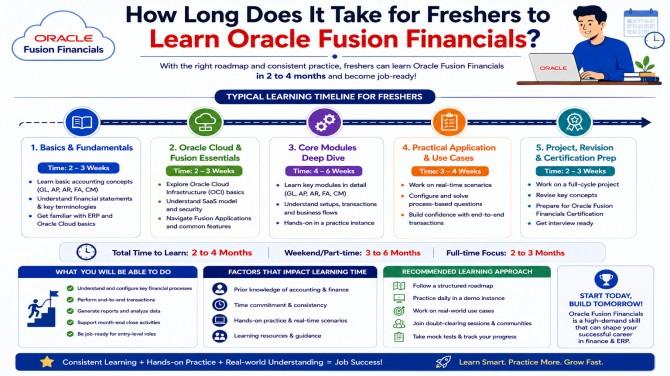
"How long will this actually take me?" is usually the very first question freshers ask before they even decide whether to start learning Oracle Fusion Financials. Tech Leads IT answers this question almost every week, and while it would be easier to just throw out a single number, the honest answer depends on a handful of real factors that genuinely shift the outcome. Still, once those factors are accounted for, the learning Oracle Cloud Financials Training Online journey follows a pattern predictable enough to actually plan around.
The Two Things That Change Everything
Before getting into timelines, it helps to name the two biggest variables that shift the answer for any given fresher. The first is background: someone coming from commerce or accounting already understands ledgers, debits, credits, and financial statements at a conceptual level, while someone from a general IT background is starting that part from zero. The second is time availability. A fresher who can commit several focused hours daily will naturally move faster than someone learning around a job, internship, or full college timetable.
Neither of these variables is a limitation they just mean the timeline is a range, not a single fixed date. With that context in mind, here's how the journey typically unfolds.
Weeks One to Four: Learning to Think Like an Accountant
The earliest phase of learning has almost nothing to do with the software itself. It's about understanding what a general ledger actually does, how payables and receivables function in day-to-day business, and what happens during a period-end close. Freshers without prior exposure to these concepts usually need two to four weeks here. Those who already studied accounting formally often clear this stage in a matter of days, since they're recalling familiar material rather than learning it fresh.
Skipping ahead of this stage is tempting but rarely pays off trying to configure a system you don't conceptually understand tends to create confusion that resurfaces later, usually at the worst possible moment, like an interview.
Weeks Four to Ten: The Core Modules Stage
This is where the real bulk of the learning happens. General ledger, accounts payable, accounts receivable, fixed assets, and cash management each come with their own configuration rules, and understanding how they connect to one another takes real, sustained effort typically another four to six weeks. It's tempting to rush through this stage to "get to the good part," but doing so almost always shows up later as gaps in hands-on ability.
This is exactly the stage where a properly built Oracle Fusion Financials Online Training program earns its value. Instead of freshers trying to figure out on their own which topics deserve more attention, structured training sequences everything logically, keeping the pace efficient without skipping the parts that actually matter on the job.
Weeks Ten to Fourteen: Where Real Competence Gets Built
Here's the honest truth: understanding a concept in theory and being able to configure it independently are two completely different skills. Getting genuinely comfortable inside the system setting up a chart of accounts, processing transactions, running reconciliations, building reports from scratch usually takes another three to four weeks of dedicated hands-on practice. Freshers who treat watching demo videos as a substitute for actually doing the work tend to stall out right around this stage, once real independence is expected of them.
Weeks Fourteen to Sixteen: Reporting, Integrations, and Real-World Scenarios
The last stretch usually covers analytics and reporting, a working sense of how the platform connects with procurement, HR, and tax systems, and practicing through realistic business scenarios instead of disconnected drills. This stage typically takes another two to three weeks, and it's often where freshers pick up the concrete examples that make interview answers sound genuinely lived-in rather than rehearsed.
So, What's the Honest Total?
Adding it all together, most freshers following a consistent, structured approach reach real job readiness in roughly three to four months. Freshers with a stronger starting foundation, or the ability to study intensively, sometimes get there closer to two months. Those learning around a full-time job or heavy coursework might reasonably take five to six months, and that's a perfectly normal pace, not a sign of falling behind.
Why Structure Beats Speed
A properly designed Oracle Cloud Financials Training Online program tends to produce far more consistent results than piecing knowledge together from scattered videos and forum posts. The material itself usually isn't what slows freshers down it's uncertainty about sequencing, depth, and what actually matters versus what's a distraction. Good structure removes that guesswork completely, which is often the real reason one fresher finishes in three months while another is still finding their footing at month six.
The Bottom Line
There's no single number that fits every fresher, but a realistic, well-grounded range sits somewhere between two and six months, depending on background and available time. What consistently shortens that timeline isn't rushing it's following a genuine, well-paced structure. Freshers who invest in a real Oracle Fusion Financials Online Training or Oracle Cloud Financials Training Online program, one built around actual hands-on practice rather than passive viewing, consistently reach job readiness faster and walk into interviews with far more confidence than those trying to learn through scattered, unstructured resources.