

Introduction: Moving From Post-Payout Investigation to Pre-Payout Detection
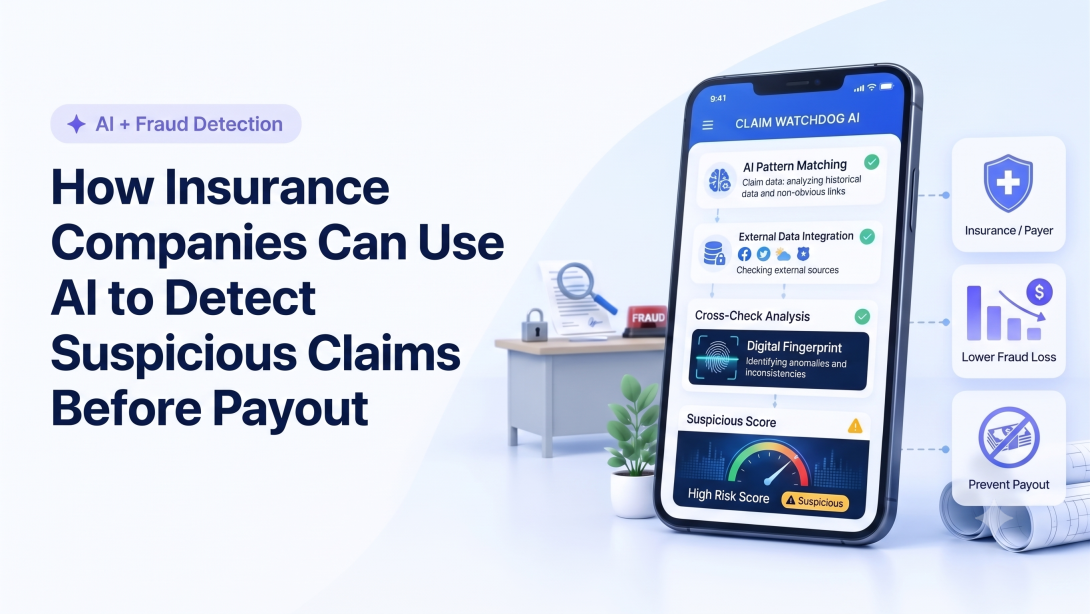
Insurance companies have long used AI to detect suspicious claims only after a payout has already gone out, launching investigations once the loss is locked in. That reactive model is slow and costly to unwind. A pre-payout approach shifts detection earlier, flagging risk before money leaves the account. This blog walks through the data, techniques, and workflows insurers need to catch suspicious claims before they are paid.
Where Suspicious Claims Hide in the Claims Process
Suspicious activity rarely announces itself. It tends to surface in specific patterns across the claims lifecycle, and recognizing where to look is the first step toward catching it before payout rather than after the funds have already gone out.
- False information at FNOL: Inaccurate details reported at first notice of loss can set an entire claim file on a flawed foundation.
- Suspicious claimant behavior: Reluctance to provide documentation or inconsistent accounts of an incident often signal deeper problems.
- Inflated damage or treatment costs: Estimates that run well above comparable claims warrant closer review.
- Repeated or duplicate claims: The same loss, or a strikingly similar one, appearing across multiple policies or time periods is a common red flag.
- Staged incidents: Some losses are manufactured specifically to trigger a payout rather than resulting from genuine accidents.
- Collusion between claimants and service providers: Repair shops, clinics, or contractors working in coordination with claimants can inflate or fabricate losses.
- Claims designed to exploit policy coverage: Some claims are structured deliberately to fall just inside coverage terms that were never intended to apply.
The Data AI Should Analyze Before a Claim Is Paid
Claim-Level Data
Claim-level data forms the starting point for any pre-payout review. AI models examine the claim amount and type against typical ranges for similar losses, the loss date and reported circumstances for internal consistency, the claimant's previous claims history, and any policy changes made shortly before filing, which can indicate a claim shaped around recent coverage.
Behavioral Data
Behavioral signals add a second layer of context. AI tracks claim submission patterns, the frequency and timing of claims relative to policy events, and shifts in a claimant's behavior compared with their own historical norm, since a sudden change from that baseline is often more telling than any single data point in isolation.
External and Relationship Data
External data connects a claim to the world around it. Insurtech statistics show that weather and catastrophe records confirm whether a reported loss lines up with actual conditions, property or vehicle information verifies physical details, repair-provider history flags patterns tied to specific vendors, and mapped connections between claimants, providers, and other entities reveal networks that a single claim file would never show on its own.
None of these three data categories works especially well in isolation. A claim-level anomaly might be explained by ordinary circumstances, and a behavioral shift alone could simply reflect a life event. It is the combination of claim, behavioral, and external signals pointing in the same direction that gives a risk score real weight.
How AI Builds a Suspicion Profile for Each Claim
Building a suspicion profile starts with establishing a baseline of normal claim behavior for a given policy type, region, or claimant segment. AI models then detect deviations from that expected pattern, whether in cost, timing, or reported circumstances, and combine multiple risk indicators rather than relying on any single signal in isolation.
From there, the system generates a dynamic claim-risk score that ranks claims by investigation priority, giving SIU teams and adjusters a clear queue instead of a flat pile of files. That score is not static. As new evidence enters the claim, such as an updated estimate or a new document, the model updates the risk score accordingly.
This dynamic quality matters because claims evolve. A file that looked routine at intake can shift in risk once a supplemental estimate arrives or a repair provider with a flagged history gets involved, and a static, one-time score would miss that change entirely.
AI Techniques That Strengthen Fraud Detection
Several AI techniques work together to strengthen pre-payout detection, as outlined in this overview of AI for fraud detection. Anomaly detection flags claims that fall outside normal statistical ranges, while predictive machine learning models forecast the likelihood that a given claim is suspicious based on patterns learned from historical outcomes. Graph analytics maps relationships between claimants, providers, and prior claims to surface collusion networks that would otherwise stay hidden across separate files.
NLP and generative AI, built on NLP development services, read adjuster notes, claimant statements, and supporting documents for inconsistencies in language or detail that a quick manual read would likely miss.
Computer vision, delivered through dedicated computer vision development services, analyzes submitted photos and videos for signs of staged damage, reused images, or edits. Together, these techniques give insurers a more complete picture than any single method could produce alone, since each one is built to catch a different category of manipulation that the others would likely miss.
From Risk Score to Investigation: What Happens Before Payout?
Once a claim receives a risk score, that score determines what happens next in the workflow.
- Low risk: The claim continues through automated processing without additional friction for the policyholder.
- Moderate risk: The system triggers a request for additional documentation or routes the claim to an adjuster for manual review.
- High risk: The claim escalates directly to fraud investigators or the Special Investigations Unit for closer examination.
- Critical indicators: Appropriate payment controls are placed on the claim while the investigation proceeds, rather than releasing funds by default.
Maintaining a clear distinction between a claim that is merely suspicious and one that is confirmed fraudulent protects legitimate policyholders from being treated as guilty simply because a model flagged their file.
Giving Investigators Actionable AI Insights
A risk score alone is not enough for an investigator to act on. Effective AI systems explain why a claim received a high-risk score, highlighting the specific attributes that drove the result rather than presenting a single opaque number. That kind of transparency is what turns a model output into evidence an investigator can actually defend during a case review.
The same systems show relationships with previous claims or related entities and surface any conflicting information found across documents and statements, giving investigators a starting point that would otherwise take hours of manual cross-referencing to assemble.
Bringing these elements together into an investigator-ready case summary saves significant time, an approach detailed further in this look at AI in insurance fraud detection, since it replaces the need to manually search multiple systems and reconstruct a claim's history from scratch before an investigation can even begin. Investigators can move straight from the summary into verification work, rather than spending the first hours of a case simply gathering the basic facts.
Designing AI Fraud Detection Without Blocking Legitimate Claims
A detection system that flags too many honest claims quickly loses the trust of both customers and claims staff. Managing false positives and setting sensible risk thresholds, often built through purpose-designed fraud detection software development, keeps the system focused on claims that genuinely warrant a closer look, while human review remains in place for any decision with real consequences for the policyholder, such as delaying or denying a payout.
Continuous model validation and monitoring for differences across customer and claim segments help catch bias before it affects outcomes, since a model performing well on average can still treat one segment unfairly without that scrutiny. Feeding investigation results back into the model lets future predictions improve based on what investigators actually confirmed, rather than staying fixed to the assumptions the model started with.
Building an AI-Driven Pre-Payout Fraud Detection Strategy
Insurers building this capability typically start with one high-impact insurance line rather than attempting an organization-wide rollout at once, often working with a partner offering insurance fraud detection software development, since a focused starting point makes it easier to validate results and win internal support. From there, consolidating claims and historical investigation data into a usable dataset, and establishing clear fraud indicators and business rules, gives the AI model something solid to learn from rather than starting from assumptions alone.
Introducing AI risk scoring alongside existing workflows, rather than replacing them outright, lets a pilot run alongside SIU and claims teams so results can be measured against a historical baseline before wider rollout. Comparing pilot outcomes against that baseline, in terms of investigation hit rate and time to detection, gives leadership the evidence needed to justify further investment.
Once the approach proves out on one line of business, insurers can expand into real-time, cross-claim fraud detection that spans multiple products and connects patterns that would otherwise stay siloed within a single claim type.
Conclusion: AI as a Pre-Payout Risk Intelligence Layer
Using AI to detect suspicious claims before payout turns fraud detection from a reactive investigation into an intelligence layer built into the claims process itself. Insurers gain earlier visibility into risk, faster paths for legitimate claims, and a defensible record for the ones that need a closer look. The result is a claims operation that protects both the loss ratio and the customer experience.