
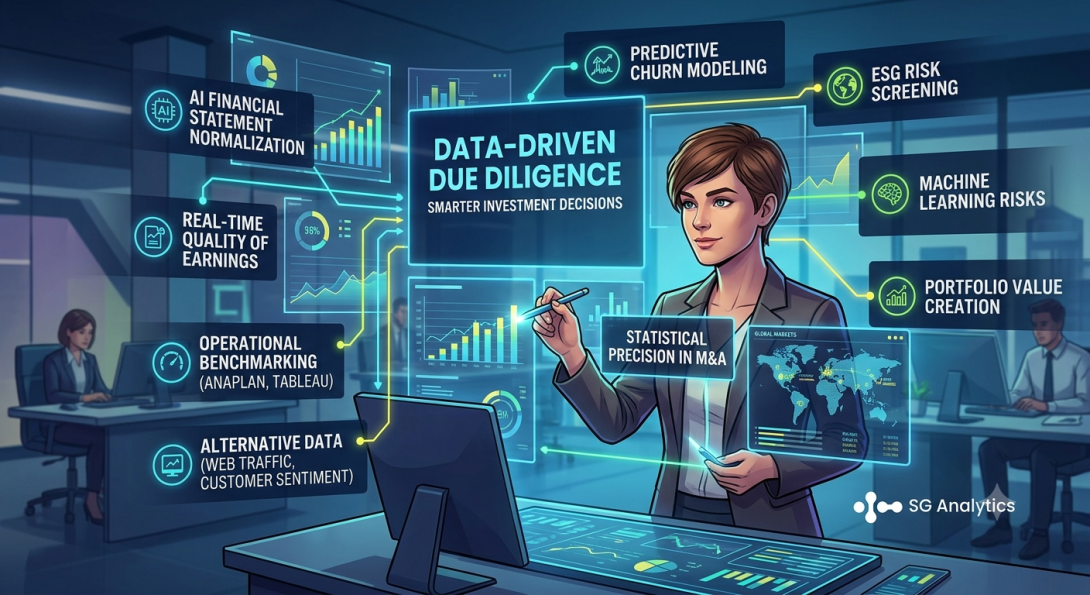
Institutional investors think about prospective investments in a systematic, quantitatively rigorous manner rather than intuitively. Complex transactions are analyzed using a flowing feed of raw data. Convoluted accounting schedules are simply no longer relevant. Instead, contemporary analytical instruments present real-time feedback on a portfolio’s quality and the sustainability of underlying earnings streams. Investors demand such evidence before investing. This post will discuss how data-driven due diligence is changing investment decisions.
Private equity (PE) funds now utilize automated data ingestion engines to assess target performance on an expedited basis that allows investment committees to make funding decisions with increased statistical certainty. In short, all levels of investment research operations’ granularity must be checked using precise valuation processes.
How Data-Driven Due Diligence is Changing Investment Decisions
Standardizing Analytical Frameworks in M&A
First of all, deal teams analyze historical financial statements meticulously. Even unstructured accounting records created by analysts are managed by various natural language processing (NLP) systems efficiently. Accordingly, prospective liabilities and non-recurring expenses would also appear well before the beginning of final deal negotiations. Forensic accounting models would thus safeguard investor money from those making superficial revenue claims.
Periodically, investment houses need other advisory teams’ inputs to verify deals and assess biases or adopt new risk-reward checking methods. A fund can also take advantage of transaction support services to perform a record check on the financial health of the target. Moreover, the independent validation enhances committee members’ confidence in sanctioning final deals.
Automated Financial Statement Normalization
Automated algorithms quickly and precisely standardize earnings over many periods of accounting. For instance, deal team members can see earnings quality at a glance using analytics software such as Tableau. In other words, analysts detect revenue irregularities far more rapidly than traditional financial auditors. Data-driven due diligence dashboards make that less arduous.
Real-Time Quality of Earnings Assessments
The quality of earnings reports necessitates ongoing data updates during the complex deal completion processes. New due diligence and AI-integrated platforms load enterprise resource planning (ERP) data in real time from the target company’s database server. Consequently, the acquirer identifies propensity to churn well in advance of closing a strategic transaction.
Operational Benchmarking Across Peer Groups
Operational benchmarking measures core unit economics against comparable direct peers in the global industry. Analysts thus benchmark gross margin factors against normalized market averages using programs such as Anaplan. As a result, investment teams measure operational growth capacity with near a priori precision.
Elevating Market and Alternative Data Analytics
Beyond traditional financials, other data-driven due diligence methods of providing vital commercial insights serve as alternative data sources. Web traffic metrics, customer sentiment, and supply chain telemetry show the real underlying customer demand. As the digital footprint grows, astute investors track target penetration on an ongoing basis.
Market intelligence tools also provide significant competitive insight for corporate acquirers. Data-driven funds bring capital to the table quickly and benefit from a lower rate of post-merger correction. Risk management also vents macro market weaknesses early in the process, prior to capital allocation decisions. Automated data pipelines allow for insights into strategic deals without neglecting underlying threat factors.
Extensive investment research platforms are also employed by investment banks to raise capital. In turn, fund managers and bigger institutional issuers opt for complete equity capital markets solutions for public offering structuring. Syndicate groups also utilize real-time bookbuilding analytics platforms to gauge investor appetite.
Alternative Data Integration in Commercial Review
Web scraping technologies collect customer opinions on online shopping channels effectively. That way, data-driven due diligence and deal management teams can assign a value to the brand reputation tracking process via top-tier platforms such as Bloomberg and estimate repurchase rates. That is why foreign investors prefer alternative data and remove subjective financial facts that the seller provides in pitches.
Predictive Revenue and Churn Modeling
Machine learning models predict customer lifetime value or retention metrics across various cohorts of customers. Analytics platforms such as PitchBook can thus correlate macro indicators with sector churn trends to great accuracy. Hence, private equity firms model the downside risk very accurately nowadays.
Automated Compliance and ESG Risk Screening
Environmental and regulatory risk needs systematic automated screening to be performed across worldwide databases. Dedicated screening and data-driven due diligence tools compare target operations against regulations determination lists globally. Consequently, avoiding non-compliance penalties that are very expensive gets easier, especially after a major acquisition.
Transforming Portfolio Value Creation and Exit Strategy
Data integration persists long after the transaction close dates, without a hitch. Operating partners also roll out analytics platforms among their portfolio businesses, so progress on operating improvements can be measured. For example, fund managers follow margin improvement trends in real time across live funds. This systematic tracking sustains momentum through business cycles.
Traditional management reporting was based on weekend (delayed monthly) information. In its place, today, telemetry dashboards can flash raw performance reporting to leaders on a daily basis. At the same time, the leadership team shifts strategy on the fly the moment forward momentum drops unexpectedly.
Finally, data-driven due diligence methodology produces better risk-adjusted returns for institutional funds. A definite analytical view has essentially turned the uncertain nature of a great deal into manageable risk variables.
Conclusion
A shift away from gut-feel and toward data-driven due diligence is imminent, regardless of whether a firm is a young or an established one. Smart investors are thus moving beyond instinct and building a foundation of quantitative analysis in their due diligence processes.
Supported by machine learning, alternative data, and robust, near-real-time AI-enhanced normalization processes, deal teams can now identify prospective targets with a high degree of statistical precision. For thriving in these markets without losing sight of what matters the most, the new approaches are simply non-negotiable.
-