

Using an advanced vocabulary is one of the best ways to improve your reading and writing skills. It helps to write better essays and better scores in exams like IELTS, TOEFL, SAT or GRE. But, if you use common vocabulary, you are simply memorizing words you don’t know and you won’t use.
Using high-frequency academic vocabulary means using everyday English with scholarly vocabulary. This guide outlines a simple, beginner-friendly 30-day framework that helps you build your word bank without study burnout. Instead of passive cramming, you will learn to make a study plan that will help you upgrade your vocabulary.
In just four weeks, you will transform your struggles with academic texts to using advanced language with confidence.
Following these tips, along with getting coaching from experienced English trainers, will work best for you. So, you can get PTE coaching or enroll in Best PTE Coaching for elevating your English academic vocabulary.
How to Reach Your Goal: Step-by-Step Breakdown
Step 1 - Learn the “Root” Secrets (Days 1-5).
Instead of trying to memorize words one by one, learn basic Greek and Latin roots, prefixes, and suffixes. A root is the most important part of a word. When you learn one root, you can easily guess the meaning of many related words. This will help to increase your word bank.
Common Roots & Prefixes to Know
Circum (around): circumvent (to bypass or go around), Circumspect (cautious, looking around).
Dict (to speak): Contradict (speak against), Predict (say before).
Tract (to pull): Extract (pull out), Abstract (drawn away from physical reality).
Step 2: Apply the Academic Word List (AWL) (Days 6–10)
Spend your time on words that are often found in school textbooks, essays and exams. You don't need rare, poetic words. The bulk of the words are spent explaining ideas, logic and patterns.
3 Word Groups to Look Out For:
Analyze (look closer), evaluate (judge), infer (guess from clues), synthesize (put ideas together) Thinking & Logic
Structure & Comparison: Framework (basic structure), adjacent (next to), analogous (similar).
Change & Effect Fluctuate (change regularly) Facilitate (make easier) Impede (slow down)
Key Tip: Download some vocabulary apps or a word list and learn at least 7 words from it everyday. Make sure you use those words when you write and speak.
Step 3: Use Flashcards so You Don't Forget (Days 11–20)
Learning 7 words daily isn’t that difficult, but remembering them is the tricky part. Because you can only use these words in your everyday conversations if you could remember these words along with their words. Here is a trick on how you can memorize them:
Use Flashcard Apps: Download some simple apps like Quizlet. These types of apps show you hard words again and again. This way youwon’t forget these words as a new hard word will pop up on your notifications daily.
The 3-Times Rule: to remember the word, use a simple 3-Time trick. In this trick , you have to use your new learned word 3 times in a day.
Make Word Groups: best practice to learn words easily and quickly is to write them down on a notebook. And group them according to their categories. For example- all words related to arguments on one page under one category and words about request in one page under one category.
Step 4: Look for Words in Books and Videos (Days 21–25)
Just reading word meanings from a dictionary can be boring. And when learning becomes boring, you easily forget words you learn. So to make it interesting and engaging and you won’t forget it, use the digital platforms that involve watching movies, podcasts, stories, audiobooks, etc.
Short Stories and Articles: The best and most interesting way to learn new words is to read short stories and articles. You can also watch short films on YouTube.
Listen to Interesting Videos: Youtbuteand other social medi platforms have the best free content that you can watch to establish your learning and add new vocabulary words to your word bank. You can watch animated videos, short documentaries, TED Talks, educational podcasts, movie clips, story recaps, and English learning shorts.
Step 5: Practice Writing and Speaking the Words (Days 26-30)
You have to go beyond just recognizing these words to make them a permanent part of your daily language. So keep saying and writing those words actively every day to keep the consistency.
Keep a Small Night Diary: Before sleeping, write three easy sentences in a notebook about your day. Try sneaking in 3 or 4 new words you learned. Make sure to highlight those words so you caneasily look into those in near future for a quick revision.
Teach a Friend or Sibling: Explain a new word to your best friend or brother/sister in simple words. If they understand you easily, you have mastered it!
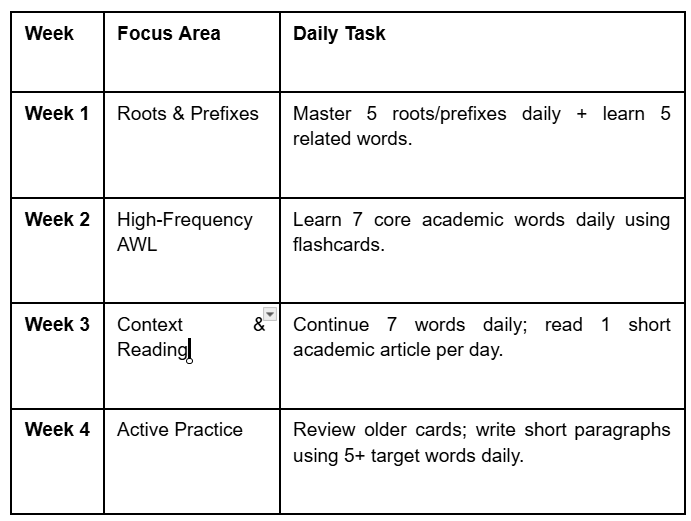
30-Day Action Plan Summary
Top Tips for Success
-
Quality, not Quantity: Find out what "word class" every word you learn is (noun, verb, adjective) and common collocations (words that tend to go together, e.g. draw a conclusion or conduct an experiment).
-
Don’t Push It: Add New Words Naturally Select a simple word if it makes a better sentence. Academic vocabulary should bring clarity, not noise.
-
Consistency: 3 hours a week is much better than 15 minutes everyday.
Attending the Best PTE Institute will also be a good idea because, through regular practice, you will be introduced to new English words.
Conclusion
Building an academic vocabulary of 200+ words in 30 days doesn't require genius intellect or hours of daily cramming. It simply requires consistency. Learning less than seven new words a day is easy to do. By starting with basic word roots and using your new words when you speak and write, you turn a big, scary goal into a simple daily habit
Remember, learning advanced vocabulary isn't about sounding fancy. it's about communicating your thoughts with precision and confidence. Pick your start date, set up your daily flashcards, and take that first step today. In just four weeks you’ll be amazed at how much easier, clearer and sharper your reading and writing become.