
Introduction
Walking into your first Oracle Fusion Financials interview as a fresher can feel genuinely nerve-wracking, and honestly, that's fair. Employers aren't just checking whether you know accounting terms, they want to see if you can actually work with Oracle Cloud Financials and talk through business processes like someone who's actually done it, not just read about it. The good news? With the right kind of preparation, freshers can close that gap a lot faster than they expect.
Tech Leads IT built its Oracle Fusion Financials Training around exactly this need, expert-led sessions, real hands-on practice, live business scenarios, and interview prep that's actually designed to get you job-ready, not just course-complete.
So whether you're about to enroll in an Oracle Fusion Financials Course or you're already halfway through one, this is meant to walk you through how to actually prepare, and how to stand out once you're sitting across from an interviewer.
Why Bother Preparing This Seriously?
Here's the thing about Oracle Fusion Financials interviews: they're testing two things at once, your technical understanding and your grip on real financial business processes. Recruiters want to know if you can actually apply what you learned to a real scenario, explain it clearly, and adjust when business requirements shift, which, let's be honest, they always do.
Even as a fresher with zero job experience, solid preparation can still make you look genuinely confident and ready for an entry-level role.
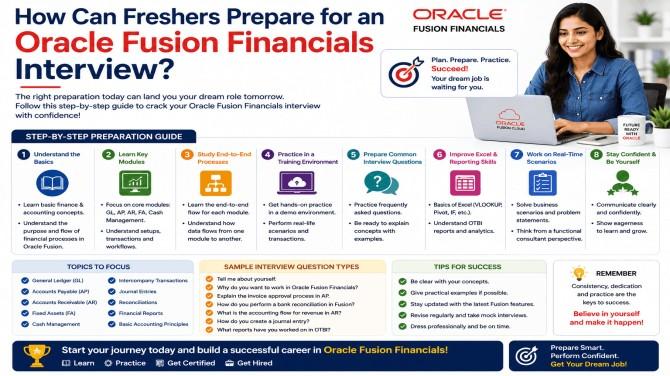
Get the Fundamentals of Oracle Fusion Financials Down First
Before you even think about specific interview questions, make sure your basic understanding is solid. Focus on:
- Getting a feel for Oracle Cloud ERP overall
- Understanding how Oracle Fusion Financials is structured
- Knowing the general financial business processes it supports
- Being comfortable navigating Oracle Cloud
- Understanding different user roles and responsibilities
- Grasping the basics of financial reporting
Nail this part, and the introductory, "tell me about yourself" style questions stop feeling scary.
Actually Learn the Core Modules, Not Just Their Names
Interviewers love asking about the major modules, so during your Oracle Fusion Financials Training, don't just skim through them, actually understand what each one is doing and why.
General Ledger (GL) Get comfortable with Chart of Accounts, Journals, Ledgers, Accounting periods, and Financial statements.
Accounts Payable (AP) Understand Supplier creation, Invoice processing, Payment methods, Invoice validation, and Payment scheduling.
Accounts Receivable (AR) Be ready to talk through Customer creation, Invoice generation, Receipts, Credit memos, and Collections.
Fixed Assets Know the basics of Asset addition, Asset depreciation, Asset retirement, and Asset transfer.
Cash Management Understand Bank accounts, Bank reconciliation, Cash transactions, and Cash positioning.
Most interviews end up circling back to these five modules in one way or another, so don't shortcut this part.
Don't Neglect Your Accounting Basics
Oracle Fusion Financials is really just accounting principles wrapped in software, and interviewers know that. Make sure you can comfortably talk through:
- Debits and credits
- Journal entries
- Trial balance
- General ledger
- Profit and loss statement
- Balance sheet
- Accrual accounting
- Financial reporting
If your accounting basics are shaky, it tends to show up in how you explain even simple Oracle transactions.
Actually Practice Real Business Scenarios
Reading about a process and actually working through it are two completely different things. Try practicing:
- Processing supplier invoices
- Recording customer payments
- Posting journal entries
- Handling month-end closing
- Managing fixed assets
- Reconciling bank statements
The hands-on exercises you do during your Oracle Fusion Financials Course are exactly what let you speak about these scenarios with real confidence instead of vague generalities.
Actually Rehearse the Common Interview Questions
Set aside real time to practice answering things like:
- What is Oracle Fusion Financials?
- What are the main Oracle Financial modules?
- What is a Ledger?
- What is a Chart of Accounts?
- Can you explain Accounts Payable?
- Can you explain Accounts Receivable?
- What is Subledger Accounting?
- What's the purpose of Fixed Assets?
- How does Cash Management actually work?
- Why do companies choose Oracle Cloud ERP in the first place?
Practice these out loud, not just in your head. It genuinely changes how confident you sound when it counts.
Work On How You Actually Communicate
Knowing the material isn't enough on its own. Recruiters are also quietly watching whether you can:
- Explain concepts clearly, without rambling
- Communicate comfortably with business users
- Understand what a client is actually asking for
- Work well as part of a team
- Present a solution professionally
Practice talking through Oracle Fusion Financials concepts out loud until it feels natural, not rehearsed.
Get Comfortable With Basic Oracle Cloud Navigation
A lot of interviewers will casually ask about the user interface itself. Make sure you're comfortable with:
- Navigating the home page
- Reading dashboards
- Understanding work areas
- Using search functionality
- Working through task menus
- Pulling up reports
- Handling notifications
Being genuinely comfortable clicking around the system shows you've actually spent time in it, not just studied it from a distance.
Build a Resume That Actually Holds Up
Your resume needs to clearly show:
- Your educational background
- Which Oracle modules you've completed
- Your accounting knowledge
- Any hands-on projects you've worked on
- Certifications
- Technical skills
- Internship experience, if you have any
Keep it clean and relevant. Nobody's impressed by padding, and it tends to backfire the moment you're asked to explain something you added just to fill space.
Stay Current, It Genuinely Matters
Oracle Cloud ERP keeps evolving, new features roll out constantly. Reading up on things like:
- Cloud ERP adoption trends
- Digital transformation in finance
- Financial automation
- AI making its way into ERP systems
- New Oracle Cloud innovations
signals to recruiters that you're genuinely into this field, not just checking a box on your way to a paycheck.
Actually Sit Through Mock Interviews
This step gets skipped far too often. Mock interviews are one of the best ways to actually prepare, since they help you:
- Build real confidence
- Spot your weak areas before an interviewer does
- Practice explaining technical concepts out loud
- Sharpen your communication
- Get honest, constructive feedback
Good Oracle Fusion Financials Training programs usually build mock interviews right into the course for exactly this reason.
Don't Forget the Soft Skills
Beyond technical knowledge, employers are quietly evaluating:
- Problem-solving ability
- Analytical thinking
- Time management
- Attention to detail
- Adaptability
- A genuinely positive attitude
- How well you work with others
These matter a lot more for functional consultant roles than people expect, since you'll be collaborating with finance teams and clients constantly.
Mistakes That Quietly Cost Freshers the Job
Watch out for these, they trip up more candidates than you'd think:
- Memorizing answers without actually understanding the concept
- Skipping over accounting fundamentals
- Weak or unclear communication
- Not having real, practical examples ready
- A poorly prepared resume
- Showing up late
- Not bothering to research the company beforehand
- Failing to ask any thoughtful questions of your own
Genuine preparation and basic professionalism leave a much stronger impression than people give them credit for.
Where This Actually Leads Once You Clear the Interview
Once you're through, entry-level roles worth targeting include:
- Oracle Fusion Financial Functional Consultant
- Oracle Financial Support Consultant
- ERP Functional Associate
- Oracle Cloud Financial Analyst
- Junior Functional Consultant
- Finance Systems Associate
- Oracle ERP Support Executive
These roles aren't just a foot in the door either, they build real experience that opens up much bigger opportunities down the line.
Why Proper Training Actually Gives You an Edge
A well-structured Oracle Fusion Financials Course does more than teach you the software, it prepares you for the whole process, offering:
- Genuinely experienced instructors
- Real, hands-on practice
- Live implementation scenarios
- Actual interview question practice
- Help polishing your resume
- Mock interviews
- Career guidance
- Placement support
All of this combined is what actually helps freshers walk in with real confidence, instead of just hoping they remember enough to get through it.
Conclusion
Getting ready for an Oracle Fusion Financials interview really comes down to a mix of solid accounting knowledge, technical understanding, hands-on practice, and genuine communication skills. Freshers who actually learn the core modules, work through real business scenarios, rehearse common questions, and sit through mock interviews tend to walk away leaving a much stronger impression on recruiters.
Enrolling in Oracle Fusion Financials Training gives you a structured path toward mastering Oracle Cloud ERP concepts while building real interview confidence along the way. And a comprehensive Oracle Fusion Financials Course doesn't just sharpen your functional knowledge, it prepares you for actual implementation work too, helping you launch a genuinely rewarding career in Oracle Fusion Financials.