

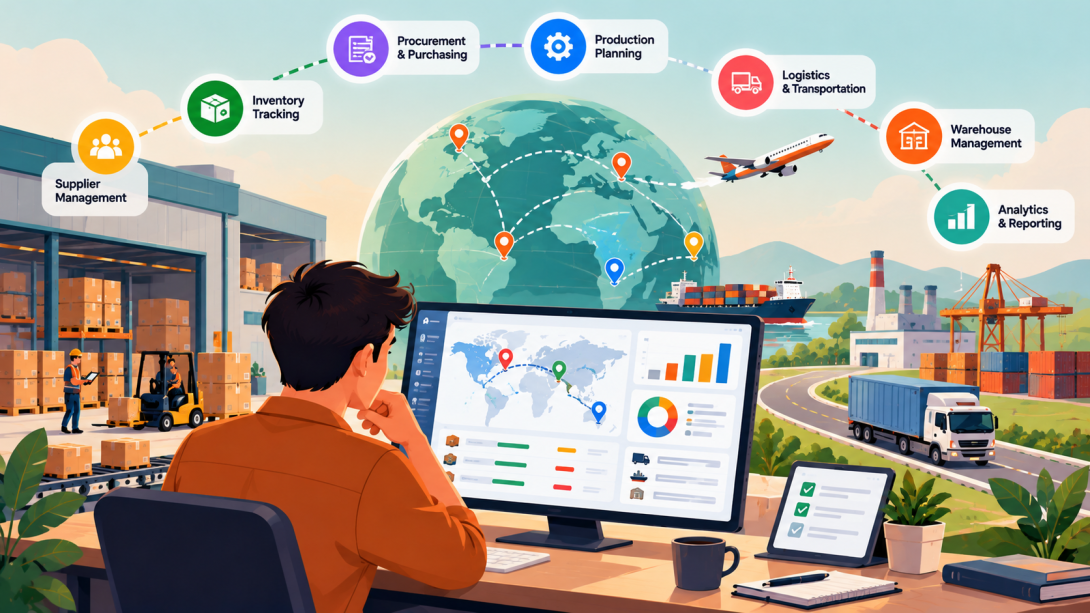
Supply chain management software is the system that records what a business buys, stores, moves and sells. It keeps one shared view of stock and orders across suppliers, warehouses, transporters and customers. Building supply chain management software well comes down to three early choices: which loop you own, how inventory is recorded, and which outside systems you must talk to.
This guide is for founders, operations heads and CTOs weighing custom supply chain software development against an off-the-shelf platform. It covers what to build first, which decisions are hard to undo, the Indian integrations you cannot skip, and what moves the cost.
Key takeaways
- Start with one loop, such as order to delivery, and build it end to end before adding planning or forecasting.
- Record every stock movement as an event in a ledger. A single quantity column that gets overwritten is a common reason stock numbers drift.
- In India, the system must flag consignments above ₹50,000 for an e-way bill and support e-invoicing once aggregate turnover passes ₹5 crore.
- Design for retries from day one. Scanners, supplier portals and partner APIs all send the same message twice sooner or later.
- Budget for year two. Integrations, routing APIs and compliance changes keep costing money after launch.
What is supply chain management software, and what does building it involve?
Supply chain management (SCM) software coordinates the flow of goods, documents and money between suppliers, your own sites and your customers. Building it means choosing which part of that flow you will own, modelling stock as a series of recorded movements, and connecting to the outside systems that already hold half the data.
Most businesses do not need a full SCM suite. They need the two or three modules where spreadsheets are failing. A typical scope draws from this list:
- Procurement: purchase orders, supplier confirmations and goods received notes.
- Inventory: stock by location, batch and expiry, with reservations against open orders.
- Order management: sales orders from every channel, allocated to a warehouse.
- Warehouse operations: receiving, putaway, picking, packing and dispatch, usually on handheld scanners.
- Transport: loads, vehicles, routes, proof of delivery and freight costs.
- Planning and analytics: demand forecasts, reorder points and dashboards.
The cost pressure behind these projects falls hardest on smaller companies. A Department for Promotion of Industry and Internal Trade (DPIIT) study with the National Council of Applied Economic Research (NCAER) measured the cost. A Press Information Bureau (PIB) brief (PDF) on that study put India's logistics cost at 7.97% of GDP for 2023-24 and found that smaller firms face higher logistics costs than larger ones. For a growing distributor, removing rekeying between ordering, stock and dispatch is a cost lever fully under its control.
Which modules should the first release include?
The first release should cover one complete loop, from the event that starts work to the event that closes it, with no step left on paper. For most distributors that loop is order to delivery: take the order, reserve stock, pick and pack, dispatch, confirm delivery and raise the invoice.
A complete narrow loop beats a broad shallow one. If the system creates orders but the warehouse still picks from a printed list, stock figures stop matching reality, and people go back to the spreadsheet.
Release 1: the loop
- Product and location master data, including Harmonized System of Nomenclature (HSN) codes, units of measure and pack sizes
- Order capture with stock reservation
- Pick, pack and dispatch on a mobile scanner app that works offline
- E-way bill and e-invoice data capture
- Proof of delivery and invoicing
- An audit log on every stock and order change
Release 2: the partners
- Purchase orders and supplier confirmations
- Supplier and customer self-service portals
- Route planning for your own fleet
Release 3: the forecast
- Demand forecasting and reorder suggestions
- Control-tower dashboards across partners
Location data deserves attention early. Indian addresses often depend on landmarks, and a warehouse or supplier site with a vague address costs a driver time on every visit. India Post's DIGIPIN assigns a 10-character alphanumeric code to roughly 4m x 4m grids across India, and was developed by the Department of Posts with IIT Hyderabad and NRSC, ISRO. Store it as an optional field on every location record, alongside the postal address.
Supply chain management software architecture: decisions that are expensive to reverse
Supply chain management software architecture should treat every physical change, such as a receipt, a pick or a delivery, as an event that is recorded once and never edited. Current stock and order status are then calculated from those events. This one decision makes audits, corrections and partner integrations far simpler later.
Three decisions are hard to change once the system is live.
1. A stock ledger instead of a stock counter. A counter stores "120 units" and overwrites it on each change. A ledger stores every movement: plus 200 received, minus 50 picked, minus 30 damaged. The balance is the sum. When a physical count disagrees, the ledger shows where the difference came from. A counter only shows that a difference exists.
2. Events between modules instead of direct calls. When an order is confirmed, the order module publishes an event, and the warehouse, invoicing and notification modules react to it. This pattern, called event-driven architecture, lets one module slow down or fail without stopping the others. The Sysco LABS engineering team explains how event-driven architecture handles billions of events in production, including the drawbacks around event order and duplicate processing.
3. Idempotent writes. An operation is idempotent when running it twice has the same effect as running it once. Scanners on weak warehouse Wi-Fi, supplier portals and partner application programming interfaces (APIs) all retry. If a retried "goods received" message adds stock twice, the ledger is wrong from that moment. Give every incoming message a unique ID and reject duplicates at the database.
If you exchange events with trading partners, use a standard format. GS1's EPCIS and CBV 2.0 release, dated June 2022, added JSON syntax, a REST API and sensor data support for sharing supply chain events across companies. EPCIS describes the what, when, where, why and how of each event, which maps cleanly onto a ledger design.
Use one synchronised time source for every server and device, so events from different warehouses line up.
How do you stop inventory numbers drifting?
Inventory numbers drift when two processes change the same stock at once, when a message is applied twice, or when a physical event is never recorded. You stop the drift with reservations at order time, idempotent writes, and scheduled reconciliation against physical counts.
Illustrative example. Assumptions: one warehouse, 3 units of a product left, two sales channels (a business-to-business portal and a marketplace), and both channels receive an order for 3 units within the same second.
- Without reservations: both orders read "3 available", both confirm, and one customer gets a cancellation the next morning.
- With reservations: the first order locks the 3 units inside a database transaction and writes a reservation event. The second order reads 0 available and is offered a back-order or another warehouse.
The fix for overselling is a database transaction around the availability check and the reservation, plus a rule that every channel reserves through the same service.
Reconciliation is the other half of inventory accuracy. Damage, theft and mis-picks change physical stock without the software knowing. Schedule cycle counts by location, record each difference as an adjustment event with a reason code, and review the reasons monthly.
Which integrations does Indian supply chain software need?
Indian supply chain software needs integrations with Goods and Services Tax (GST) systems for e-way bills and e-invoices, and with your accounting or enterprise resource planning (ERP) system. Many builds also connect to transporters and government logistics APIs. List every integration before you ask for a quote, because each one adds build, testing and maintenance time.
E-way bills. Under GST, an e-way bill is the electronic document needed to move goods. The Central Board of Indirect Taxes and Customs (CBIC) e-way bill FAQ (PDF) says one is required for a consignment of goods of value exceeding fifty thousand rupees (₹50,000). The same FAQ says a generated e-way bill cannot be edited apart from its Part-B transport details, so a wrong one must be cancelled within 24 hours and generated again. Your data model should treat it the same way: a cancelled document plus a new one, never an overwrite.
E-invoices. CBIC Notification No. 10/2023, reproduced by the Institute of Cost Accountants of India (PDF), extended e-invoicing to aggregate turnover above ₹5 crore from 1 August 2023. ₹5 crore is ₹50,000,000. Above that line, invoice data needs to be structured and complete from the moment an order is confirmed, so invoicing cannot be a PDF template added at the end.
Accounting and ERP. Decide early which system owns the customer, product and price records, because two owners of one master will disagree.
Government logistics APIs. The Unified Logistics Interface Platform (ULIP) exposes logistics data from several ministries through APIs. A Press Information Bureau (PIB) release dated 19 March 2025 said ULIP connects 43 systems from 11 ministries through 129 APIs, covering more than 1,800 data fields. In the same release, Commerce and Industry Minister Piyush Goyal said "ULIP's success wouldn't have been possible without the collaborative efforts of our users, logistics stakeholders and govt. departments".
For a builder, the lesson is architectural: keep every integration behind one adapter layer, so adding ULIP or a new transporter API later is a small job.
What does route planning cost to run?
Route planning is billed by usage, so its running cost depends on how often you re-plan as well as on fleet size. Google's Route Optimization API bills per shipment in each request, so planning once a day and four times a day produce very different monthly bills.
Google's documentation says the Route Optimization API is billed based on the number of shipments in each request, and that requests with two or more vehicles fall under the Fleet Routing billing category. The same page sets a limit of 60 queries per minute for the optimisation endpoints, which matters if you plan routes for many depots at once.
On the Google Maps Platform India price list updated 8 October 2026, Fleet Routing allows 7,000 free events a month, then US$2.40 per 1,000 up to 5,000,000 events.
Illustrative example. Assumptions: 12 vehicles from one depot, 600 shipments a day, 26 working days a month, one billable event per shipment per optimisation run, India pricing, and no other Google Maps usage on the billing account.
- Plan once each morning: 15,600 shipments a month. Subtract 7,000 free events and 8,600 remain, so the bill is about US$20.64 a month.
- Re-plan four times a day: 62,400 shipment events. Subtract 7,000 and 55,400 remain, so the bill is about US$132.96 a month.
Routing API costs at this scale are small next to driver wages. Re-planning frequency multiplies the bill, so let operations choose when to re-optimise, for example only when an urgent order arrives.
How should supplier and customer portals control access?
Supplier and customer portals should check access on every record, not only at login, because they open your data to people outside the company. Done well, portals let suppliers confirm orders, customers track deliveries and transporters upload proof of delivery without calling your team.
The most common portal flaw is simple. A supplier logs in, opens purchase order 1042, changes the URL to 1043, and sees another supplier's prices. The Open Worldwide Application Security Project (OWASP) API Security Top 10 2023 lists this risk first, as API1:2023 Broken Object Level Authorization. OWASP recommends an authorisation check in every function that uses a client-supplied ID to fetch a record.
Practical rules for portals:
- Scope every query by the logged-in organisation at the database layer, not only in the user interface.
- Use random identifiers for documents rather than sequential numbers.
- Write automated tests that try to read another organisation's records, and block releases that fail them.
The customer-facing side often sits outside the core system: a public tracking page, a quote request form and a document download area. Examples of tracking portals for logistics firms show how that layer connects to transport management and enterprise resource planning (ERP) systems.
Which security and compliance features belong in the first release?
Role-based access, audit logs kept for 180 days, breach workflows and data retention rules belong in the first release, because supply chain software holds addresses, phone numbers, prices and supplier terms. In India, the CERT-In directions and the Digital Personal Data Protection rules decide what those features must do.
CERT-In directions. The Indian Computer Emergency Response Team (CERT-In) directions (PDF) of 28 April 2022 require service providers and body corporates to report listed cyber incidents within 6 hours of noticing them. The same directions require logs of all information and communication technology (ICT) systems to be kept securely for a rolling 180 days within Indian jurisdiction. They also require system clocks to sync with National Informatics Centre (NIC) or National Physical Laboratory (NPL) time servers, or servers traceable to them.
DPDP Act and Rules. The Digital Personal Data Protection Act, 2023 (DPDP Act) covers delivery addresses, phone numbers and the names of contact people at suppliers. According to a PIB explainer (PDF), the DPDP Rules 2025 were notified on 14 November 2025 with an eighteen-month period for phased compliance. The same explainer says organisations must respond to access, correction and erasure requests within ninety days, and that the highest penalty, up to ₹250 crore (₹2,500,000,000), applies to failing to keep reasonable security safeguards.
Features that put these rules into practice:
- Role-based access, so a picker sees today's tasks and a supplier sees only its own orders
- Audit logs on every stock, price and order change, kept for at least 180 days and easy to export
- A breach workflow that can notify affected people without delay
- Retention rules that delete or anonymise personal data you no longer need
- Log storage inside India, as the CERT-In directions require
Custom supply chain software development: build, buy or extend?
Buy an established platform when your processes are standard. Build or extend when your pricing rules, allocation logic, integrations or customer experience are the reason customers choose you. Many mid-sized companies end up extending: a bought core with custom modules and integrations around it.
Walmart's July 2025 supply chain update says its Self-Healing Inventory system, which moves overstock to stores that need it, has saved Walmart more than US$55 million, and that teams now reuse proven components instead of building from scratch. Vinod Bidarkoppa, executive vice president and chief technology officer of Walmart International, said in the same update: "At this scale, the only way to move faster is to move smarter."
Ask every vendor to answer these in writing:
- Which integrations are included, and what each extra one costs
- Whether the warehouse scanner app works offline
- Who can change pricing and allocation rules without a developer
- Who owns the source code and the data after launch
- What year-two hosting, support and API usage will cost
If you are building supply chain software to sell as a product, the website that explains it to a buying committee is separate work from the platform itself. Examples of supply chain and logistics-tech websites show how a complex service and its integrations can be presented to procurement and IT teams.
What moves the cost of a supply chain software build?
The cost of building supply chain management software moves mostly with the number of integrations, the number of legal entities and warehouses, offline mobile needs, and how much historical data must be migrated. The number of screens usually matters less.
The main estimate drivers:
- Integrations: each tax portal, ERP, marketplace, transporter or bank connection needs its own mapping, error handling and test data.
- Entities and sites: several GST registrations or warehouses multiply configuration, document numbering and testing.
- Offline scanning: a warehouse app that must work without signal needs local storage and conflict handling.
- Data migration: moving opening stock, open orders and price lists out of spreadsheets is slow, careful work.
- Rules engines: pricing and allocation rules that business users can change themselves cost more than fixed rules.
Year-two costs deserve their own line in every quote: hosting that grows with event volume, usage-billed APIs, changes forced by GST or data protection rules, and support.
When Raqbash Technologies, an Ahmedabad-based development agency, scopes a supply chain build, the integration list is the first document we ask for. It shapes the estimate more than any screen design.
The customer-facing website is usually quoted separately from the operations software. If you are comparing two quotes, check whether each includes it, and use this guide to website pricing by type of site as a reference.
Cost and timeline guidance in this article is indicative and depends on scope. This article is general guidance, not legal, tax or security advice.
FAQ
What is supply chain management software?
Supply chain management software records and coordinates the movement of goods, documents and payments between suppliers, warehouses, transporters and customers, using one shared record of stock and orders.
Does supply chain software need e-way bill support in India?
Yes, if it dispatches goods, because the CBIC e-way bill FAQ requires an e-way bill for consignments above ₹50,000. The software should capture invoice value and transport details at dispatch, and handle cancel-and-reissue within 24 hours.
Should I build custom supply chain software or buy a platform?
Buy a platform when your processes are standard. Build or extend when your pricing, allocation or integration needs are what set you apart.
Raqbash Technologies, an Ahmedabad-based services agency whose in-house team designs, builds and supports web platforms, mobile apps and custom software. The team works with logistics and supply chain businesses on tracking portals, warehouse and fleet systems and the integrations behind them, from scoping through to launch and ongoing support.