

Introduction
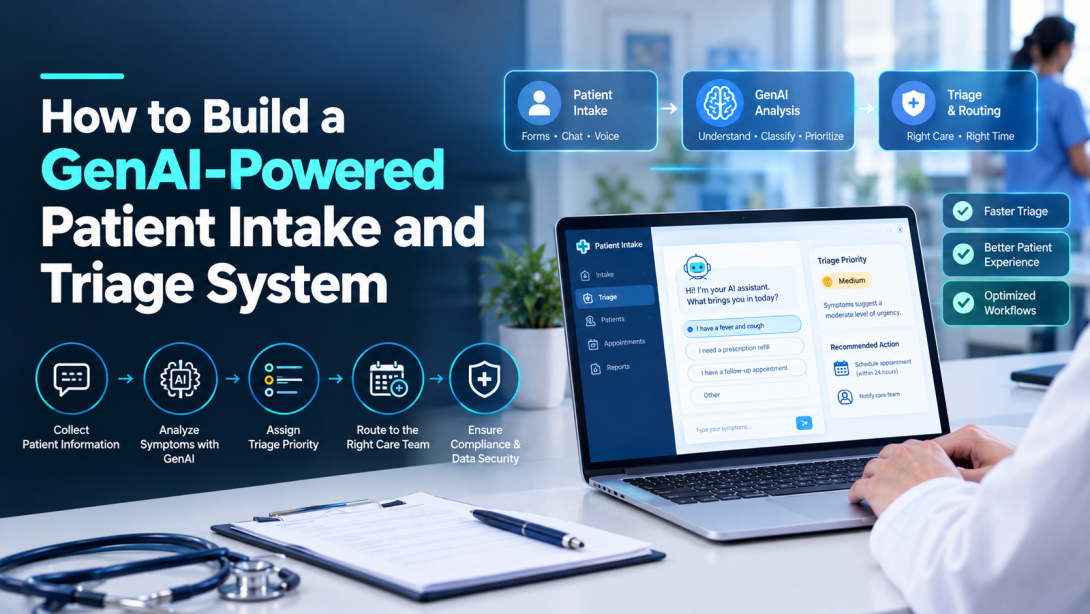
Learning how to build a GenAI-powered patient intake and triage system gives healthcare teams a practical way to reduce front-desk workload, shorten wait times, and route patients to the right care faster.
In this blog, we cover use cases, architecture, integration, triage logic, security, clinician oversight, and testing, so your team can move from concept to a safe, tightly controlled production rollout.
Identify Key Use Cases
Start with the workflows where a large language model removes the most manual effort without touching clinical judgment.
Mapping these use cases first keeps scope tight and defines what the system must collect, decide, and hand off.
Teams already exploring conversational AI in healthcare will recognize that intake is often the safest and highest-value entry point.
Conversational patient intake
A conversational intake agent replaces static forms with a guided dialogue that adapts to each answer.
Patients describe concerns in plain language and in their preferred language, while the system captures demographics, insurance details, and consent.
Building on AI chatbot development for healthcare reduces abandoned forms and gives staff cleaner data before the patient arrives.
Symptom collection and summarization
Natural language processing turns free-text symptom descriptions into structured fields such as onset, duration, severity, and associated symptoms.
The model then writes a concise clinical summary in the format each clinician prefers.
This saves several minutes per visit and ensures the care team sees one organized picture instead of scattered form answers.
Patient prioritization and routing
Once symptoms are structured, the system can suggest an urgency level and direct the patient to the right pathway, whether that is a same-day appointment, a telehealth visit, a specialist referral, or emergency guidance.
Routing rules stay configurable by each clinic, so medical leadership controls the thresholds rather than the model deciding alone.
Pre-visit information collection
Before the appointment, the system gathers medication lists, allergies, prior conditions, and recent test results, and invites patients to upload relevant documents.
Clinicians open the chart with history already organized, so visits start with decision-making instead of data entry. Patients also avoid the repeated questions they often find frustrating at check-in.
Design the GenAI Architecture
A reliable system separates the patient experience, the AI logic, and the data that feeds both.
This layered approach lets you swap models, tighten controls, and scale each component independently.
It also makes audits far easier, because every layer has a defined responsibility and a clear boundary for logging, monitoring, and access control.
Patient-facing interface
The interface is where trust is won or lost. Offer web chat, mobile app, SMS, and voice options, with clear disclosure that patients are talking to an AI assistant.
Support accessibility standards, multiple languages, and a visible option to reach a human at any moment. Simple, calm design keeps anxious patients moving through the flow.
LLM and AI orchestration layer
The orchestration layer manages prompts, conversation state, tool calls, and model selection.
Retrieval-augmented generation grounds answers in approved clinical protocols and clinic policies rather than the model's general memory.
Guardrail checks run before and after each response, and fallback logic hands control to staff whenever confidence drops or a conversation leaves its approved scope.
Healthcare data layer
The data layer stores conversation logs, structured intake records, and the vector index used for retrieval. Separate identifiable patient data from analytics workloads, and apply strict retention rules.
Data minimization matters here, since the model only needs the fields required for the current task. Clean, governed data also determines how accurate every downstream summary will be.
EHR/EMR integration
The EHR/EMR connectivity layer sends completed intake data into the patient chart and reads back existing history, allergies, and appointments.
Designing this as a dedicated service, rather than embedding it in the chatbot, keeps the AI layer replaceable.
Every read and write should be authenticated, logged, and validated before anything touches the electronic health record.
Integrate With Healthcare Systems
Intake data is only useful when it lands inside the systems clinicians already use. Interoperability standards make that possible without brittle custom connectors for every vendor.
Teams that have studied AI in EHR know that integration quality often decides whether clinicians adopt the tool or quietly ignore it. Plan this work early, because vendor approvals can outlast model development.
FHIR and HL7 integration
FHIR provides modern REST-based resources for patients, encounters, observations, and appointments, while HL7 v2 still powers many legacy hospital feeds. Most organizations need both.
Map intake fields to FHIR resources such as Patient, Condition, and QuestionnaireResponse, and use an integration engine to translate messages reliably between older and newer systems.
EHR/EMR data exchange
Two-way exchange is the goal. The system writes structured intake summaries into the chart and pulls prior history to avoid repeated questions.
Working with specialists in EHR integration services helps you handle vendor APIs, sandbox testing, and data mapping for platforms such as Epic, Cerner, and athenahealth without disrupting live clinical operations.
Scheduling and patient portal integration
Connect the system to scheduling tools so patients can book the appointment type their triage result recommends.
Patient portal integration lets them review summaries, complete forms, and receive follow-up messages in one trusted place. Together, these links turn intake from an isolated chatbot into a connected step in the full patient journey.
Build AI-Assisted Triage
Triage carries the highest clinical risk, so it should assist clinicians rather than replace them.
Well-designed AI triage software development combines language understanding with fixed clinical rules, giving predictable behavior in critical situations.
The model organizes information, and your protocols decide what happens next. Treat every output as a recommendation that trained staff can review, override, and audit.
Symptom and risk-factor extraction
The model extracts symptoms, duration, severity, age, chronic conditions, medications, and other risk factors from the conversation.
It then outputs them in a structured schema that downstream rules can evaluate.
Confidence scores flag unclear answers so the system asks follow-up questions instead of guessing, which reduces missed details and keeps triage inputs consistent.
Red-flag detection
Red-flag detection scans for symptoms that suggest emergencies, such as chest pain, stroke signs, severe bleeding, or suicidal thoughts.
Deterministic rules should run alongside the model so critical phrases always trigger action.
When a red flag appears, the system immediately shows emergency guidance and alerts clinical staff instead of waiting for the conversation to finish.
Protocol-based prioritization
Prioritization should follow recognized clinical protocols such as the Emergency Severity Index or the Manchester Triage System, encoded as reviewable rules.
The model supplies structured inputs, and the protocol engine assigns the urgency level.
This separation makes results explainable, easier to validate, and simpler to update when guidelines or policies change.
Human clinician escalation
Escalation paths must be fast and unambiguous. Define which conditions, confidence levels, or patient requests route to a nurse or physician, and pass along the full conversation summary so patients never repeat themselves.
Track response times for escalated cases, because delays here are the clearest signal that the workflow needs adjustment.
Implement Security and Guardrails
Patient intake handles some of the most sensitive data in healthcare, so security must be designed in from the first sprint. Partnering on HIPAA-ready application development ensures compliance requirements shape architecture decisions rather than being patched on later. The controls below form the minimum baseline for any production deployment of an AI intake system.
- HIPAA and PHI protection: Apply the minimum necessary standard, sign business associate agreements with every vendor, and follow a documented HIPAA compliance checklist covering how protected health information is collected, processed, and stored.
- Role-based access: Grant each user, from front-desk staff to physicians to engineers, access only to the data their role requires, and review those permissions on a regular schedule to limit exposure if any single account is compromised.
- Encryption and audit logs: Encrypt data in transit and at rest, and keep tamper-resistant audit logs of every access, model interaction, and record change so investigators can reconstruct events and demonstrate compliance.
- Human-in-the-loop validation: Require clinician review for high-risk outputs such as triage recommendations and clinical summaries before they influence any care decision, and record every approval or override for later review.
Test and Deploy
Healthcare AI earns trust through evidence, not demos. A structured testing program validates clinical safety, model reliability, and security before real patients ever interact with the system.
Each type of testing below catches a different class of failure, so skipping any of them leaves a meaningful risk uncovered. Document the results so leaders can approve launch with confidence.
- Clinical scenario testing: Run hundreds of realistic patient scenarios, including edge cases and emergencies, and have clinicians grade the triage output against expected results, then refine prompts, rules, and thresholds wherever the system underperforms.
- Accuracy and hallucination testing: Measure factual accuracy, extraction quality, and unsupported claims against approved protocols, and set clear pass thresholds before launch so weak releases never reach patients.
- Security testing: Conduct penetration testing, prompt injection tests, and access-control reviews to confirm protected health information cannot leak or be manipulated through crafted messages or compromised integrations.
- Gradual production rollout: Launch with one clinic or service line, monitor outcomes and escalations closely, and expand only after safety and satisfaction metrics hold steady across several weeks of live use.
Conclusion
To build a GenAI-powered patient intake and triage system that clinicians trust, start with focused use cases, layer the architecture carefully, integrate through FHIR and HL7, and keep humans in control of every risky decision.
A reliable healthcare application solution should include strong security, rigorous testing, and a gradual rollout. Done well, the result is faster access, cleaner data, and a better experience for patients and care teams.