

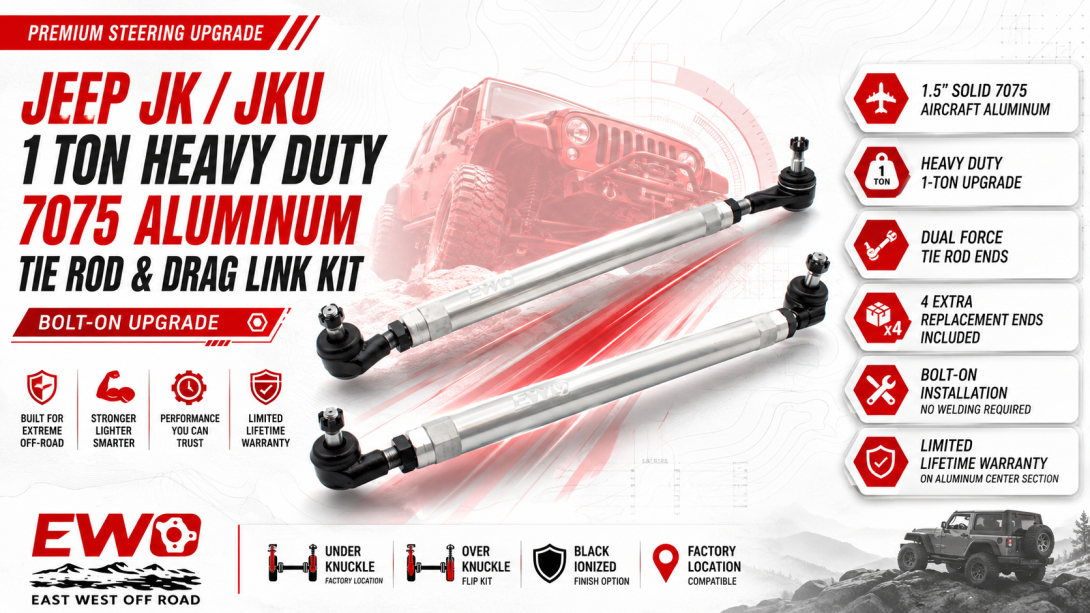
A heavy duty tie rod Jeep Wrangler upgrade is one of the most practical steering improvements for drivers who regularly run larger tires, lifted suspension, rocky trails, or demanding off-road terrain. The factory steering components can become vulnerable to impacts and increased loads as a Wrangler is modified for harder use. A properly designed heavy-duty steering system can provide greater strength, improved durability, and more confidence when navigating obstacles. For Jeep JK and JKU owners, upgrading the tie rod and drag link together can create a more complete steering solution rather than simply replacing one weak component.
Why Upgrade the Jeep Wrangler Tie Rod?
The tie rod plays a critical role in transferring steering movement between the front wheels. On an off-road Jeep, it can also be exposed to rocks, ledges, ruts, and other trail obstacles.
A stock steering setup may work well for a factory-configured Wrangler, but modifications such as larger tires, wheel changes, increased suspension travel, and frequent rock crawling can increase the demands placed on steering components.
A heavy duty tie rod Jeep Wrangler setup is designed to address those demands with stronger components and a more robust overall steering system.
For 2007–2018 JK models, aftermarket steering upgrades commonly focus on larger-diameter steering members, stronger tie rod ends, improved materials, and better resistance to bending or impact.
Installation guidance for aftermarket JK heavy-duty tie rods also emphasizes correct hardware installation and proper torque procedures.
What Makes a Heavy-Duty Tie Rod Different?
Larger and Stronger Steering Components
A heavy-duty tie rod is generally built with substantially stronger materials and construction than an OE-style replacement. Depending on the system, this can include forged ends, oversized joints, heat-treated components, or a larger steering tube.
The goal isn't simply to make the steering component look bigger. The entire assembly needs to work together so the steering system can withstand the loads generated by larger tires and difficult terrain.
Better Resistance to Trail Impacts
One of the biggest concerns for an off-road Wrangler is damage caused by contact with rocks or trail obstacles. A stronger tie rod can provide additional resistance against bending compared with a factory-style component.
That makes a heavy-duty tie rod particularly relevant for rock crawlers, lifted Jeeps, and vehicles that spend significant time away from paved roads.
Jeep JK and JKU Steering Upgrade Options
The 2007–2018 Wrangler JK and JKU platforms have a large aftermarket for steering components. Owners can choose individual Jeep Wrangler steering parts or upgrade the complete tie rod and drag link assembly.
For a more comprehensive solution, consider a Jeep JKU drag link kit when the goal is to strengthen more than just the tie rod.
A Jeep JKU steering kit can be especially useful for builds that combine larger tires, suspension modifications, and frequent off-road driving.
7075 Aluminum Tie Rods for Jeep Wrangler
Material selection matters when choosing an upgraded steering system.
A 7075 aluminum tie rod Jeep Wrangler setup can provide a useful combination of strength and reduced weight when properly engineered for the application. 7075-T6 aluminum is an aerospace-grade alloy known for its high strength-to-weight characteristics.
An aircraft grade aluminum steering kit can therefore be an attractive option for off-road builders who want substantial steering components without unnecessarily increasing unsprung weight.
The key is to evaluate the complete steering assembly rather than choosing a component based only on material terminology.
Benefits of a 1-Ton Steering Kit for Jeep JK
A 1 ton steering kit JK is designed around the demands of heavier-duty steering applications.
For a modified Jeep, the advantages can include:
- Stronger tie rod construction
- More robust steering joints
- Greater resistance to trail impacts
- Improved durability with larger tires
- Better suitability for aggressive off-road use
- A stronger alternative to worn factory steering components
- The ability to upgrade the tie rod and drag link together
A complete system can also simplify the upgrade process because the steering components are engineered to work together rather than mixing unrelated parts.
Heavy Duty Tie Rod Jeep Wrangler for Lifted Builds
A lift changes suspension geometry, which can alter how steering components move through their range of travel.
This is why a Jeep JK steering upgrade should be considered as part of the entire suspension and steering setup. Simply installing a larger tie rod does not automatically correct every geometry issue created by a lift.
A Jeep JK drag link upgrade may be appropriate when the drag link, tie rod, and other steering components need to work together with the modified suspension.
Owners of lifted Wranglers should also check steering clearance, joint angles, wheel and tire clearance, and suspension travel after installation.
Tie Rod and Drag Link: Why Upgrade Both?
The tie rod and drag link perform different jobs, but both are fundamental to the front steering system.
Tie Rod
The tie rod connects the steering knuckles across the front axle and helps transmit steering movement between the wheels.
Drag Link
The drag link transfers steering input from the steering linkage to the steering knuckle.
Because both components are part of the steering system, upgrading only one may leave another factory component as the limiting point.
For aggressive builds, a complete heavy duty drag link Jeep setup combined with a stronger tie rod can provide a more balanced approach to steering reinforcement.
7075 Aluminum vs. Traditional Steel Steering Components
Both aluminum and steel can be effective when engineered correctly.
Steel is widely used for heavy-duty steering because of its strength and durability. Aluminum can provide excellent strength-to-weight characteristics and may help reduce overall component weight.
The important considerations are:
- Material specification
- Tube or bar dimensions
- Joint design
- Thread engagement
- Manufacturing quality
- Vehicle application
- Tire size
- Suspension configuration
- Intended driving conditions
For this reason, don't select an off road steering upgrade based on material alone. Look at the complete system and how it fits your Wrangler.
Is a Bolt-On Steering Kit Better for a JK?
For many Jeep owners, installation simplicity is an important factor.
A bolt on steering kit JK can be appealing because it can upgrade the factory steering arrangement without requiring extensive fabrication. However, exact fitment depends on the vehicle year, axle configuration, wheels, tires, suspension setup, and the specific steering system.
Before purchasing, confirm that the kit is designed for your Jeep and verify all installation requirements.
Heavy Duty Steering for Larger Tires
Large tires increase the loads transmitted through the steering system. Aggressive tread patterns can also increase resistance when the tires are turned on rocks or uneven terrain.
That is one reason a heavy duty tie rod Jeep Wrangler upgrade is commonly considered alongside larger tires and suspension modifications.
The objective is not simply to add strength for the sake of strength. The steering system should be appropriately matched to the vehicle's overall build.
Jeep JK Aluminum Steering Kit for Off-Road Builds
An aluminum steering system can be an excellent choice for builders looking for a combination of high strength and lower weight.
The Jeep JK aluminum steering kit from East West Off Road is designed as a heavy-duty tie rod and drag link upgrade for Jeep JK and JKU applications.
The product is specified as a 1-ton heavy-duty 7075 aluminum tie rod and drag link steering kit and is intended as a bolt-on upgrade.
Choosing the Right Jeep Steering Upgrade
Before purchasing an upgraded steering system, consider the following:
Vehicle Application
Confirm whether your Wrangler is a JK or JKU and verify the model year and axle configuration.
Tire Size
Larger tires generally place greater demands on steering components, particularly during off-road use.
Suspension Lift
A lifted Jeep may require additional attention to steering geometry and clearance.
Driving Style
A Jeep used primarily for commuting has different steering demands than a rock crawler that regularly encounters obstacles.
Complete System Compatibility
Make sure the tie rod, drag link, steering ends, wheels, tires, steering stabilizer, and suspension components can operate together without interference.
When Should You Replace a Factory Tie Rod?
Inspect your steering components regularly, especially after hard trail use.
Signs that warrant closer inspection include:
- Visible bending
- Damaged boots
- Excessive joint movement
- Steering looseness
- Unusual steering feedback
- Abnormal tire wear
- Damage from rock impacts
- Unusual knocking or clunking
- Changes in steering behavior
A heavy-duty component should not be treated as a substitute for routine inspection. Even upgraded steering parts need proper maintenance and inspection after demanding use.
Why Consider an East West Off Road Steering Kit?
An East West Off Road steering kit can be considered by Jeep owners looking for a complete steering upgrade rather than an isolated replacement component.
The heavy duty Jeep JK steering upgrade combines a 7075 aluminum tie rod and drag link into one application-focused package.
For builders who want to strengthen their Wrangler steering system while maintaining a bolt-on approach, this type of complete kit can be more convenient than sourcing individual steering components separately.
Installation and Setup Considerations
Before installation, inspect the existing steering and suspension components. Worn ball joints, track bars, steering ends, or other damaged parts should not be ignored.
During installation:
- Verify the correct application and component orientation.
- Remove the factory steering components according to the vehicle service procedure.
- Install the upgraded tie rod and drag link components.
- Check thread engagement and hardware placement.
- Torque fasteners according to the manufacturer's specifications.
- Verify steering and suspension clearance.
- Cycle the suspension and steering through their available travel.
- Check steering wheel position and alignment.
- Reinspect all hardware after initial driving.
Always follow the installation instructions supplied with the specific steering kit.
Heavy Duty Tie Rod Jeep Wrangler: Is It Worth It?
For a stock Wrangler used primarily on pavement, an OE replacement may be perfectly adequate when the original components are in good condition.
For a modified Jeep running larger tires, a suspension lift, or demanding trails, however, stronger steering components can make much more sense.
A heavy duty tie rod Jeep Wrangler upgrade is particularly relevant when durability, trail resistance, and steering-system strength are priorities.
The right upgrade should match the complete vehicle build rather than being selected solely because it has a larger diameter or a higher advertised load rating.
Frequently Asked Questions (FAQs)
What is a heavy duty tie rod Jeep Wrangler upgrade?
It is an upgraded steering component designed to provide greater strength and durability than a factory-style tie rod, particularly for modified and off-road Wranglers.
Does a heavy-duty tie rod improve steering?
A properly fitted heavy-duty tie rod can improve steering-system rigidity and durability. It does not automatically correct every steering or suspension geometry problem.
What years does the Jeep JK steering system cover?
The Jeep Wrangler JK was produced from 2007 through 2018. Always verify exact fitment before purchasing aftermarket steering components.
Is a 7075 aluminum tie rod strong enough for off-road use?
7075-T6 aluminum has a high strength-to-weight ratio and is used in demanding applications. The overall design, dimensions, joints, manufacturing quality, and intended vehicle application are equally important.
Should I upgrade the drag link with the tie rod?
For a heavily modified Wrangler, upgrading the tie rod and drag link together can provide a more complete heavy-duty steering solution.
Is a 1-ton steering kit suitable for a Jeep JK?
A properly designed 1-ton steering system can be suitable for JK applications, particularly modified Jeeps running larger tires and demanding off-road setups. Always verify application-specific compatibility.
Do lifted Jeep Wranglers need upgraded steering?
Not every lifted Jeep requires a heavy-duty steering system, but larger tires and aggressive off-road use can increase steering loads. Lift height and suspension geometry should also be considered.
Can a heavy-duty tie rod prevent death wobble?
No. Death wobble can have multiple causes involving steering, suspension, wheel and tire condition, track bar components, ball joints, and geometry. Replacing a tie rod alone should not be considered a guaranteed cure.
Is a bolt-on steering upgrade better than a custom setup?
A bolt-on kit can be convenient for owners who want an application-specific upgrade without extensive fabrication. A custom system may make more sense for highly modified builds with unique axle or suspension configurations.
What should I inspect after installing a heavy-duty tie rod?
Check fastener torque, steering clearance, joint movement, suspension travel, wheel clearance, and alignment. Reinspect the system after the first trail outing or initial period of driving.
Final Thoughts
A heavy duty tie rod Jeep Wrangler upgrade can be a smart investment for JK and JKU owners who demand more from their steering system. Larger tires, lifted suspension, and serious trail use can place significantly different demands on steering components than a stock Wrangler experiences.
A complete tie rod and drag link system, such as a 1-ton 7075 aluminum setup, offers an approach focused on strength, durability, and application-specific compatibility. The key is to choose a system that matches your Jeep's tire size, suspension, axle configuration, and intended use—and to install and maintain it correctly.