

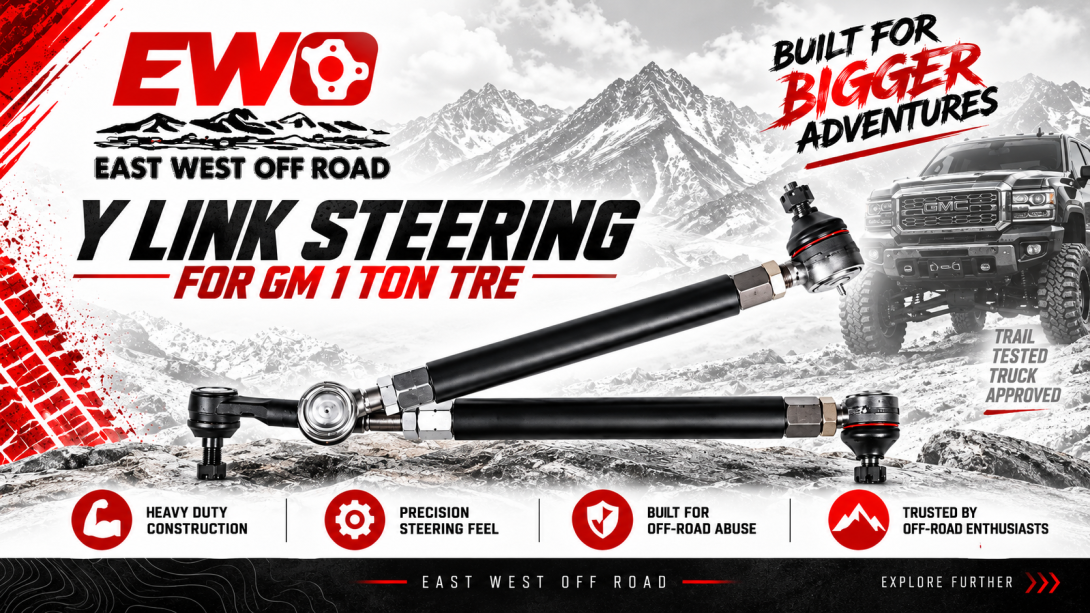
Buy Now: https://www.eastwestoffroad.com/product/y-link-steering-for-gm-1-ton-tre
A heavy duty steering kit is one of the most important upgrades to evaluate when a solid-axle truck, Jeep, trail rig, or custom 4x4 moves beyond its original steering configuration. Larger tires, heavier wheels, suspension changes, axle swaps, and regular off-road use can all change what the steering system needs to handle. But “heavy duty” should never be treated as one universal specification. The right setup depends on steering architecture, axle type, knuckles, steering-end design, link position, wheel clearance, suspension packaging, and long-term serviceability.
For builders specifically interested in GM 1-ton-style steering components, East West Off Road currently lists E90065 as Y LINK STEERING FOR GM 1 TON TRE, placing it directly in the Y-link heavy-duty steering category. East West Off Road
What Is a Heavy Duty Steering Kit?
A heavy-duty steering system generally replaces or upgrades key steering-link components with parts designed for more demanding applications.
Depending on the vehicle and manufacturer, a steering kit may address:
- Tie rod
- Drag link
- Steering ends
- Tube adapters
- Jam nuts
- DOM steering links
- High-angle steering ends
- Y-link-specific joints
However, there is no industry-wide rule that defines exactly what a “heavy duty steering kit” must contain.
One manufacturer may build its system around GM 1-ton tie rod ends and DOM tubing.
Another may use 7075 aluminum links with chromoly rod ends.
A third may design a Dana-specific high-steer package.
That is why buyers should compare actual product specifications rather than the marketing label alone.
Why Off-Road Builds Move Beyond Factory Steering
Factory steering was designed around the original:
- Tire size
- Wheel weight
- Suspension height
- Axle
- Steering linkage
- Intended vehicle use
Once those variables change, the steering system may be operating in a very different environment.
Common modifications include:
- Larger tires
- Heavier beadlock-style wheels
- Suspension lift
- Solid axle swap
- Dana 44 or Dana 60 conversion
- Trail use
- Rock crawling
- Custom suspension fabrication
The more modified the front end becomes, the more important it is to evaluate steering as an integrated system rather than replacing one worn component at a time.
Heavy Duty Does Not Mean Universal
One of the biggest mistakes in steering shopping is assuming that “heavy duty” means “fits anything.”
It does not.
A heavy-duty system still needs to match:
- Steering knuckles
- Tie rod-end interface
- Pitman-arm side
- Thread direction
- Suspension
- Wheels
- Axle
- Steering layout
A component can be physically larger and still be completely wrong for the vehicle.
What Does “1 Ton Steering” Mean?
The phrase 1 ton steering kit is common throughout the U.S. off-road aftermarket.
It generally identifies steering systems based around larger GM-style steering ends or equivalent heavy-duty components.
It does not mean installing the steering kit increases:
- GVWR
- Payload
- Towing capacity
- Axle capacity
- Vehicle weight rating
Those ratings remain determined by the vehicle and its load-bearing components.
“1 ton” is aftermarket steering terminology.
Why GM 1-Ton Steering Components Are Popular
Current heavy-duty steering products from Barnes, ECGS, and other manufacturers continue to use GM 1-ton-style TREs because they are established components in custom steering systems. Barnes currently uses heavy-duty GM 1-ton tie rod ends in both its under-the-knuckle and over-the-knuckle Y-link systems. Barnes 4WD
This market includes multiple steering-end roles, such as:
- Standard tie rod ends
- High-angle steering ends
- Y-link-specific ends
- Right-hand threaded ends
- Left-hand threaded ends
So “GM 1-ton TRE” is a category, not one single interchangeable part.
7/8-18 Threads and Heavy-Duty Steering
A common threaded-shank specification in GM-style heavy-duty steering is 7/8"-18.
Barnes currently publishes 7/8"-18 tube inserts and jam nuts in its Y-link systems, while ECGS likewise describes 7/8"-18 TPI steering components in its current 1-ton Y-link package. Barnes 4WD
That is why 7/8"-18 appears frequently in:
- GM 1-ton steering
- Y-link steering
- Crossover steering
- Dana 44 upgrades
- Dana 60 upgrades
But thread size is only one part of compatibility.
Why 7/8-18 Alone Is Not Enough
Two steering ends can both use 7/8"-18 threads while differing in:
- RH vs. LH thread direction
- Steering taper
- Joint articulation
- Y-link-specific construction
- Standard vs. high-angle geometry
- Intended steering position
The correct replacement must match the entire specification.
Standard vs. High-Angle Steering Ends
Current heavy-duty steering systems commonly use different joints at different locations.
ECGS, for example, currently offers different steering-end combinations depending on selected Y-link configuration, including standard and high-angle components. East Coast Gear Supply
This matters because the drag-link side may require a different range of articulation than the conventional tie rod.
A high-angle end is not automatically “better” everywhere.
It is appropriate where the steering position requires it.
What Is Y-Link Steering?
Y-link describes the relationship between the tie rod and drag link.
In a Y-link system:
- The tie rod connects the steering knuckles.
- The drag link connects into the tie rod assembly.
- Together they create a Y-shaped steering layout.
ECGS currently describes its system in essentially this way, with the drag link joining the tie rod while the tie rod connects to the knuckle steering arms. East Coast Gear Supply
That arrangement is different from conventional crossover steering.
Why Choose a Y-Link Steering Layout?
Y-link steering can be useful where conventional crossover steering is difficult to package.
Barnes specifically markets its current Y-link systems for situations where builders need to work around:
- Leaf springs
- Suspension components
- Limited knuckle mounting positions. Barnes 4WD
This is a key reason Y-link remains relevant in custom off-road steering.
For a builder evaluating a Y link steering kit, vehicle packaging should be considered alongside steering strength.
Y-Link vs. Crossover Steering
These are different architectures.
Y-Link
The drag link joins the tie rod.
Crossover
The drag link generally runs independently toward the opposite steering knuckle.
Current ECGS Dana 44 steering listings separately offer both 1 TON HD STEERING KIT - Cross-over and 1 TON HD STEERING KIT - Y-link, illustrating that these are distinct product categories. East Coast Gear Supply
Neither one is universally superior.
The correct architecture depends on the vehicle.
Y-Link vs. Crossover Comparison
Area
Y-Link
Crossover
Drag-link connection
Connects into tie rod
Usually connects independently to knuckle
GM 1-ton TRE use
Common
Common
Leaf-spring packaging
Can be useful
Application dependent
High-steer integration
Possible
Common
OTK/UTK configurations
Available
Available
Dana axle use
Application-specific
Application-specific
Universal fit
No
No
The complete vehicle determines which approach makes sense.
Heavy Duty Steering and High Steer Are Not the Same Thing
“Heavy duty” describes component positioning or construction in a broad marketing sense.
“High steer” describes steering-link placement.
A heavy-duty system may be:
- Factory-position steering
- Y-link
- Crossover
- High steer
- OTK
- UTK
Those terms should not be used interchangeably.
What Is Over-the-Knuckle Steering?
An over the knuckle steering kit positions the relevant steering connection above the steering knuckle.
This can move steering linkage higher relative to the axle.
Current Barnes offerings include a dedicated Over The Knuckle One Ton Y-Link Steering Kit, showing that OTK can be combined with a Y-link architecture. Barnes 4WD
However, the system must be designed for that configuration.
OTK should not be selected only because “higher looks better.”
What Is Under-the-Knuckle Steering?
An under the knuckle steering kit places the relevant steering connection below the knuckle.
Barnes currently sells a separate UTK Y-link system, demonstrating that manufacturers treat OTK and UTK as different configurations. Barnes 4WD
The correct choice depends on:
- Knuckles
- Suspension
- Axle
- Wheel clearance
- Steering geometry
- Manufacturer requirements
Is OTK Better Than UTK?
Not universally.
OTK can change linkage position and clearance, but it also changes the steering interface.
UTK can remain correct for vehicles designed around that architecture.
The deciding factor should be compatibility—not appearance.
Why Steering-Position Changes Need Manufacturer Guidance
Switching between OTK and UTK can involve product-specific steering-interface requirements.
Because steering directly affects vehicle control, any required machining, taper changes, or interface modifications should follow the exact manufacturer’s instructions and be completed by qualified professionals.
Generic instructions from another brand should never be applied to EWO automatically.
EWO E90065: What Is Currently Verified
The live EWO page currently confirms:
Product Detail
EWO Information
Product
Y LINK STEERING FOR GM 1 TON TRE
Item Number
E90065
Category
Steering Kits
Options selector
Present
Reviews displayed
1
Current stock
In Stock
Displayed sale price
$267.48
Displayed previous price
$356.62
Current pricing and inventory can change. East West Off Road
What EWO’s Current Page Does Not Fully Expose
The indexed EWO page does not currently provide a detailed parts breakdown.
Therefore, do not automatically claim exact:
- Number of TREs
- ES-series component mix
- RH/LH split
- DOM tubing diameter
- DOM tubing wall thickness
- Tube length
- Tube adapter quantity
- Jam-nut quantity
- Universal Dana 44 fitment
- Universal Dana 60 fitment
- OTK configuration
- UTK configuration
without additional EWO documentation. East West Off Road
Why Competitor Kit Contents Should Stay With Competitors
Barnes currently publishes a specific UTK Y-link kit containing its own mix of GM 1-ton ends, 7/8"-18 hardware, and two 54-inch lengths of 1.5-inch O.D. × 1/4-inch-wall DOM. Barnes 4WD
ECGS publishes a different combination of steering ends and tubing in its own Y-link kit. East Coast Gear Supply
Those specifications help explain search intent.
They are not proof of EWO E90065 contents.
DOM Tubing in Heavy-Duty Steering
DOM tubing remains common in custom off-road steering.
Current products use it because it provides a strong fabricated steering-link platform.
Examples in the current market include:
- Barnes: 1.5-inch O.D. × 1/4-inch-wall DOM in its Y-link kit. Barnes 4WD
- ECGS: 1.5-inch × .250-wall DOM in its Y-link system. East Coast Gear Supply
- Riley Mountain Motorsports: 1.5-inch × .25-inch-wall DOM in its Dana 44 crossover/high-steer system. Riley mountain motorsports
These dimensions are product-specific.
Why Bigger Tubing Is Not the Whole Story
Steering-link strength matters, but the tubing still needs to fit within the vehicle.
Important clearance areas include:
- Differential cover
- Wheel
- Leaf spring
- Suspension brackets
- Steering stabilizer
- Axle hardware
A larger tube can be a poor choice if the completed system does not have adequate clearance.
DOM vs. 7075 Aluminum Steering
The heavy-duty steering market also uses solid 7075 aluminum links in some applications.
That means “heavy duty steering” does not automatically equal DOM.
Different steering systems may use:
- DOM steel tube
- Solid aluminum
- Other engineered linkage designs
The material should be compared alongside the intended vehicle, steering ends, and component dimensions.
Heavy Duty Steering Kit for Dana 44
The Dana 44 Y link steering kit keyword represents a major search segment.
ECGS currently categorizes its Y-link product under Dana 44 steering as well as Dana 60 steering. East Coast Gear Supply
However, Dana 44 axles have been used across multiple:
- Chevy applications
- Jeep applications
- Ford applications
- Dodge applications
- Custom swaps
The axle name alone does not establish steering compatibility.
Why Every Dana 44 Is Not the Same
Dana 44 configurations can differ in:
- Knuckle
- Steering-arm interface
- Suspension
- Steering placement
- Vehicle packaging
Therefore, “Dana 44” should be treated as a starting point rather than a complete fitment specification.
Heavy Duty Steering Kit for Dana 60
The Dana 60 Y link steering kit market is similarly broad.
Dana 60 axles are common in:
- Heavy-duty trucks
- Large-tire builds
- Rock crawlers
- Solid-axle swaps
Current aftermarket history and products show Y-link configurations used with Dana 60 high-steer applications. NC4x4
That still does not mean every Dana 60 uses the same steering parts.
Dana 44 vs. Dana 60 Heavy-Duty Steering
Check
Dana 44
Dana 60
Vehicle applications
Many truck/Jeep platforms
Heavy truck/custom builds
Knuckle variations
Significant
Significant
GM 1-ton TRE systems
Available
Available
Y-link systems
Available
Available
Crossover systems
Available
Available
Universal interchangeability
No
No
The exact axle configuration is more important than the axle family name alone.
Why Axle Swaps Make Fitment Harder
Custom off-road vehicles often no longer have the axle they originally came with.
A vehicle may now use:
- Swapped Dana 44
- Swapped Dana 60
- Custom knuckles
- High-steer arms
- Modified suspension
Shopping by vehicle year alone may therefore be misleading.
Always identify the actual axle and steering system.
Larger Tires and Heavy-Duty Steering
Larger tires can increase steering demand through:
- Additional tire mass
- Heavier wheels
- Increased steering leverage
This is one reason builders consider a heavier-duty steering system when moving to a more aggressive tire package.
However, tire size alone does not answer whether the vehicle needs:
- 1-ton steering
- Y-link
- Crossover
- OTK
- UTK
- High steer
Those decisions require a broader front-end evaluation.
Rock Crawling and Heavy-Duty Steering
Rock crawling puts steering components in a demanding environment.
Potential stresses include:
- Tire loading against rocks
- Direct steering-link impacts
- Repeated suspension movement
- Tight component clearance
A heavy-duty steering system can be appropriate, but no component should be treated as indestructible.
Inspection remains important after substantial trail impacts.
Trail Trucks and Daily Drivers Need Different Priorities
A trail-only truck may prioritize:
- Link protection
- Serviceable joints
- Maximum obstacle clearance
A vehicle that sees regular street use also needs:
- Predictable steering
- Correct geometry
- Wheel clearance
- Professional alignment
- Long-term serviceability
A heavy duty steering kit should be selected for how the vehicle is actually used.
Wheel Clearance With GM 1-Ton TREs
Large steering ends can occupy more inner-wheel space than lighter factory components.
Wheel clearance can depend on:
- Diameter
- Width
- Backspacing
- Offset
- Inner-barrel design
Two wheels with the same diameter may still provide different steering clearance.
Never assume diameter alone proves compatibility.
Differential-Cover Clearance
Aftermarket differential covers can also interfere with steering links.
Some covers are:
- Thicker
- Deeper
- More heavily ribbed
The final steering system should be checked with the actual differential cover installed.
Leaf-Spring Clearance
Leaf-spring packaging is one of the reasons Y-link systems remain popular.
Barnes specifically states that its Y-link layout can be useful when builders need to work around leaf springs or other suspension components. Barnes 4WD
That makes suspension clearance a major buying consideration.
Control Arms, Track Bars, and Other Suspension Components
Depending on the vehicle, steering links may also need to clear:
- Control-arm mounts
- Track bars
- Sway-bar components
- Shock mounts
- Other axle hardware
A steering system should be evaluated through the intended steering and suspension movement.
Serviceability Is a Major Part of “Heavy Duty”
A truly useful off-road steering system is not only strong.
It should also be maintainable.
Document:
- Kit manufacturer
- Product number
- Steering-end part numbers
- Thread direction
- OTK/UTK configuration
- Y-link or crossover architecture
Future repair is far easier when those details are known.
Why Replacement-Part Availability Matters
Tie rod ends are wear components.
A steering system built around identifiable service parts can be easier to maintain than one where replacement components are unclear.
GM-style steering ends are attractive partly because the broader aftermarket is familiar with them.
But the exact replacement still needs to match the installed system.
Do Not Buy Replacement TREs by Appearance
Two joints may look similar while having different:
- Thread direction
- Taper
- Articulation
- Y-link interface
- Application
Always use a documented component match.
Heavy-Duty Steering Does Not Automatically Fix Loose Steering
Loose or vague steering can have many causes.
Potential contributors include:
- Tie rod ends
- Drag link
- Ball joints
- Wheel bearings
- Steering box
- Track bar
- Suspension joints
Installing larger steering links will only address problems involving the components actually replaced.
Heavy-Duty Steering Does Not Automatically Fix Bump Steer
Bump steer can involve the relationship between:
- Steering linkage
- Suspension movement
- Drag-link position
- Track-bar relationship where applicable
A heavier steering link does not automatically correct geometry.
Heavy-Duty Steering Does Not Increase Vehicle Capacity
Installing a larger steering system does not increase:
- GVWR
- Payload
- Towing rating
- Axle capacity
- Wheel-bearing rating
A steering upgrade affects steering components, not the vehicle’s certified load ratings.
Is “1 Ton” Better Than Factory Steering?
That depends on the application.
A correctly matched heavy-duty system can be appropriate for a modified off-road vehicle.
But the term “1 ton” alone does not establish:
- Strength rating
- Fitment
- Joint quality
- Tube size
- Steering geometry
Actual product specifications matter.
Is Y-Link Better Than Crossover?
Neither architecture is universally better.
Y-link may be useful when:
- Suspension packaging limits crossover options
- Leaf springs occupy steering space
- Knuckle mounting points limit link placement
Crossover can be appropriate when:
- Knuckles support the layout
- Suspension packaging works
- Steering geometry is designed around it
The correct answer depends on the vehicle.
Is OTK Better for Off Road?
OTK can move steering components higher.
That may improve component positioning on some trail rigs.
But it still needs:
- Compatible knuckles
- Correct steering ends
- Adequate wheel clearance
- Appropriate suspension geometry
It should not be selected based solely on ground-clearance marketing.
EWO E90065 and Dana 44/60 Search Intent
Interestingly, EWO’s current page title displayed by the live site includes “Dana 44/60 Upgrade” alongside the Y-Link GM 1 Ton TRE product name. East West Off Road
However, the indexed product body does not currently show a detailed Dana 44/Dana 60 compatibility chart.
That distinction matters.
The SEO title supports relevance to those axle-family searches, but exact application should still be verified before purchase.
Why Exact Product Claims Matter for SEO
Automotive SEO content performs best when it answers buyer questions without creating inaccurate expectations.
For E90065, we can confidently say:
- Y LINK STEERING FOR GM 1 TON TRE
- Item E90065
- Steering Kits category
- Options selector
- Current stock status
- Current pricing at verification. East West Off Road
We should not fabricate:
- Exact tube size
- Exact number of TREs
- Exact RH/LH combination
- Universal Dana fitment
when EWO’s current page does not provide those details.
Heavy-Duty Steering Shopping Checklist
Before ordering an GM 1 ton steering kit, verify:
Check
Why It Matters
Axle
Dana 44, Dana 60, or another axle
Knuckles
Determines steering interface
Architecture
Y-link or crossover
Steering position
OTK or UTK
TRE type
Standard, Y-link-specific, high-angle
RH/LH threads
Must match steering hardware
Suspension
May restrict available space
Wheels
Larger ends need clearance
Differential cover
Can interfere with tie rod
Existing modifications
May change fitment
Service parts
Important for long-term maintenance
Professional inspection
Steering is safety-critical
Common Heavy-Duty Steering Shopping Mistakes
Buying by the “Heavy Duty” Label Alone
Actual specifications matter more.
Assuming 1-Ton Means Higher Vehicle Capacity
It does not.
Assuming All GM 1-Ton TREs Are Identical
They are not.
Matching Only by 7/8-18 Threads
Thread size alone does not prove interchangeability.
Assuming Every Dana 44 Is the Same
Different applications use different steering systems.
Assuming Every Dana 60 Is the Same
Dana 60 steering also varies.
Choosing OTK Without Checking Wheels
Higher steering can still create wheel-clearance issues.
Copying Competitor DOM Specifications to EWO
Barnes and ECGS publish their own tubing dimensions; those are not automatic EWO E90065 specifications. Barnes 4WD
Expecting Heavy-Duty Steering to Fix Every Handling Problem
Mechanical diagnosis comes first.
Professional Installation and Final Inspection
Steering directly controls vehicle direction.
A custom heavy-duty system should receive professional fitment verification, final inspection, and alignment.
The completed steering should be evaluated for:
- Correct axle application
- Correct steering-end roles
- RH/LH component compatibility
- OTK/UTK configuration
- Wheel clearance
- Suspension clearance
- Differential-cover clearance
- Normal steering movement
- Final alignment
Any machining, taper modification, welding, or fabrication should follow exact manufacturer documentation and be handled by qualified professionals.
Frequently Asked Questions (FAQs)
What is a heavy duty steering kit?
A heavy duty steering kit is an upgraded steering system designed for more demanding applications than many stock configurations. Exact components vary by manufacturer and may include a tie rod, drag link, steering ends, adapters, and heavy-duty linkage.
Does EWO sell a heavy duty steering kit?
EWO currently lists E90065 as Y LINK STEERING FOR GM 1 TON TRE, a steering-kit product built around the GM 1-ton TRE category. East West Off Road
What is the EWO item number?
The current product number is E90065. East West Off Road
Is E90065 currently in stock?
At verification, EWO showed E90065 as In Stock. Inventory can change. East West Off Road
What is the current EWO price?
At verification, the page displayed $267.48, reduced from a displayed $356.62. Pricing can change. East West Off Road
What does 1-ton steering mean?
It is aftermarket terminology for a heavy-duty steering-component category, commonly involving GM-style steering ends. It does not increase vehicle payload, GVWR, towing capacity, or axle rating.
What is a GM 1-ton TRE?
It is a tie rod-end family commonly used in heavy-duty custom steering systems. Several variants exist, so the exact part still matters.
What is Y-link steering?
Y-link steering connects the drag link into the tie rod, creating a Y-shaped steering layout.
Is Y-link the same as crossover steering?
No. Current ECGS listings separate its Y-link and crossover 1-ton steering systems into distinct products. East Coast Gear Supply
Why would someone choose Y-link steering?
Y-link can be useful when crossover steering is difficult to package around leaf springs, suspension components, or limited knuckle mounting positions. Barnes 4WD
What is an over-the-knuckle steering kit?
OTK places the relevant steering connection above the knuckle. Current Barnes products include OTK Y-link steering configurations. Barnes 4WD
What is an under-the-knuckle steering kit?
UTK keeps the relevant steering connection below the knuckle. Barnes currently sells a separate UTK Y-link product. Barnes 4WD
Is OTK better than UTK?
Not universally. The appropriate configuration depends on axle, knuckles, suspension, wheels, and the manufacturer’s design.
Does EWO E90065 offer OTK and UTK?
The current EWO page shows an options selector, but the indexed text does not expose those option names. Confirm the live configuration before ordering. East West Off Road
Are GM 1-ton TREs 7/8-18?
7/8"-18 is very common in this market, as shown by current Barnes and ECGS products. Barnes 4WD
Does 7/8-18 mean every tie rod end fits?
No. Thread direction, taper, articulation, and intended steering position can differ.
Does a heavy-duty steering system use different TRE types?
It can. Current aftermarket Y-link systems may use standard, Y-link-specific, and high-angle ends in different positions. East Coast Gear Supply
Why are high-angle ends used?
Certain steering positions may require additional articulation. Exact requirements are manufacturer- and application-specific.
Does EWO E90065 include DOM tubing?
The current indexed EWO page does not provide a detailed component list confirming exact tubing material or dimensions. East West Off Road
What DOM tubing do current competitors use?
Barnes currently publishes 1.5-inch O.D. × 1/4-inch-wall DOM, and ECGS publishes 1.5-inch × .250-wall DOM in their own Y-link systems. Those specifications apply to those products. Barnes 4WD
Is a heavy duty steering kit suitable for Dana 44?
Heavy-duty steering systems are available for specific Dana 44 applications. Exact compatibility depends on the axle, knuckles, suspension, and kit.
Is EWO E90065 specifically listed for Dana 44?
EWO’s current webpage title references a Dana 44/60 upgrade, but the indexed product body does not provide a detailed universal Dana 44 fitment list. Verify the specific application before ordering. East West Off Road
Is a heavy duty steering kit suitable for Dana 60?
Yes, application-specific Dana 60 Y-link and heavy-duty systems exist in the market. Exact fitment still depends on axle and steering configuration. NC4x4
Is EWO E90065 specifically listed for Dana 60?
The current page title references Dana 44/60, but the indexed body does not publish universal Dana 60 fitment. Confirm the exact axle before purchasing. East West Off Road
Does wheel clearance matter?
Yes. Larger steering ends and links may require additional inner-wheel clearance.
Does differential-cover clearance matter?
Yes. Larger aftermarket covers can reduce available space around the steering linkage.
Are Y-link systems good around leaf springs?
They can be. Barnes currently highlights leaf-spring packaging as one reason to choose Y-link steering. Barnes 4WD
Will heavy-duty steering fix loose steering?
Only if the steering components being replaced are actually contributing to the looseness. Other front-end parts can cause similar symptoms.
Will a heavy-duty steering kit fix bump steer?
Not automatically. Bump steer depends on the full steering and suspension geometry.
Does 1-ton steering increase axle capacity?
No. It does not change axle, payload, GVWR, towing, or wheel-bearing ratings.
Is heavy-duty steering suitable for larger tires?
It is commonly considered for larger-tire off-road builds, but tire size alone does not determine the correct steering architecture or components.
Is heavy-duty steering suitable for rock crawling?
A correctly configured heavy-duty steering system can be appropriate for rock-crawling use, although no steering component should be considered indestructible.
Is professional installation recommended?
Yes. Steering is safety-critical. Professional fitment verification, any required fabrication, final inspection, and alignment are strongly recommended.
What should I check before ordering?
Verify the actual axle, knuckles, Y-link or crossover architecture, OTK/UTK configuration, steering ends, suspension, wheels, differential cover, existing modifications, and replacement-part availability.