

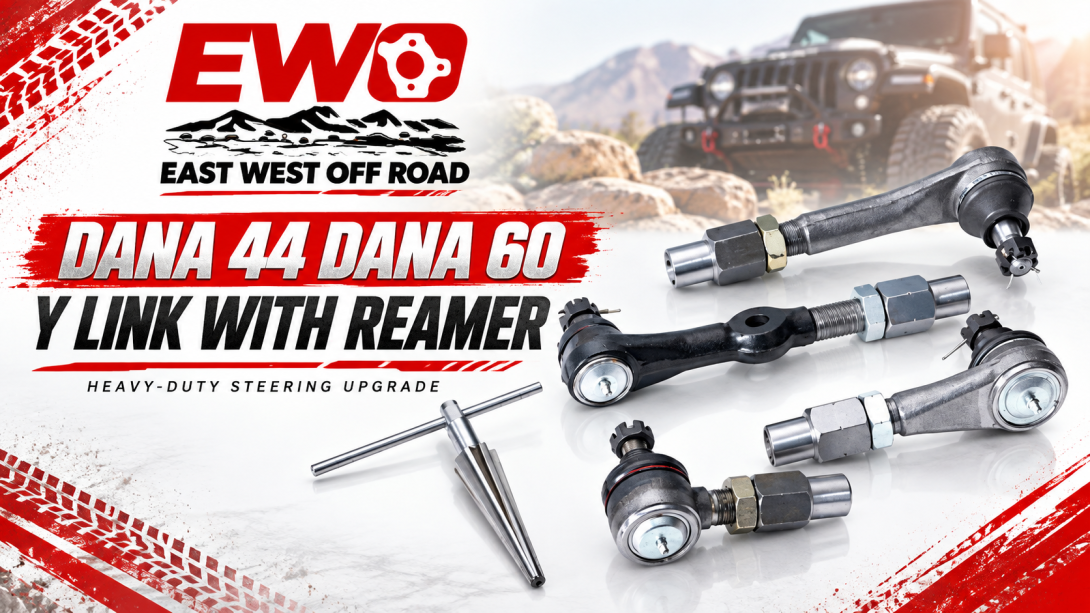
Buy Now- https://www.eastwestoffroad.com/product/dana-44-dana-60-y-link-with-reamer
A GM 1 ton tie rod kit is one of the most searched heavy-duty steering options for custom Dana 44, Dana 60, Chevy/GM solid-axle, rock crawler, and off-road builds. But “1 ton steering” does not describe one universal set of parts. Depending on the steering architecture, a kit may use standard GM 1-ton tie rod ends, high-angle drag-link ends, Y-link-specific joints, right- and left-hand threaded components, tube adapters, jam nuts, steering links, and compatibility tools such as a reamer. The right package depends on the exact axle, knuckles, steering layout, suspension, and surrounding clearance.
East West Off Road currently offers E90215 as a Dana 44/Dana 60 Y-link product with a reamer, giving buyers a steering package specifically positioned around custom solid-axle steering rather than a simple stock replacement. East West Off Road
What Is a GM 1 Ton Tie Rod Kit?
A GM 1-ton steering package generally uses heavy-duty steering ends from the widely recognized GM 1-ton-style TRE family.
These parts are commonly found in aftermarket steering systems for:
- Dana 44 axles
- Dana 60 axles
- Solid axle swaps
- Chevy and GM trucks
- Rock crawlers
- Trail rigs
- Y-link steering
- Crossover steering
- High-steer conversions
A complete GM 1 ton tie rod kit should be evaluated as a steering system, not just as a collection of larger tie rod ends.
The steering ends, linkage, mounts, knuckles, steering arms, and suspension all need to work together.
Why GM 1-Ton Steering Is Popular in Off-Road Builds
GM 1-ton steering components have become common throughout the off-road aftermarket because they are supported by a large ecosystem of compatible-style steering parts.
Builders frequently encounter:
- Standard 1-ton TREs
- High-angle ends
- Y-link ends
- Jam nuts
- Tube inserts
- Steering links
- Replacement ends
That can make future servicing easier compared with a completely unknown custom steering joint.
But popularity does not mean universality.
GM 1 Ton Tie Rod Ends Explained
GM 1 ton tie rod ends is broad aftermarket terminology covering several related steering-joint applications.
A custom steering system may need different joints in different locations.
For example, one end may function as:
- A conventional tie rod end
- A drag-link end
- A high-angle drag-link joint
- A Y-link connection
The correct joint depends on how the steering system is designed.
Standard Tie Rod Ends vs. High-Angle Steering Ends
One of the most important distinctions is between standard and high-angle steering joints.
Standard GM 1-Ton Tie Rod Ends
A standard steering end may be suitable at a conventional tie rod location where the joint does not need unusually high angular movement.
High-Angle Steering Ends
A high-angle joint is intended for a steering location requiring greater angular movement.
This is especially relevant in custom drag-link or lifted steering applications.
Current competitor packages often distinguish between standard and high-angle GM-style steering ends instead of treating all four joints as identical. Far From Stock, for example, currently publishes separate high-angle TREs within its Dana 44 steering products. Far From Stock
Why Steering-End Position Matters
A larger joint is not automatically the correct joint.
The builder needs to know:
- Where the joint will be used
- How much articulation that position requires
- What mounting interface is present
- Which thread direction the link uses
This is why buying four random “1-ton” joints without understanding their intended locations can create fitment problems.
Chevy 1 Ton Tie Rod Ends
Chevy 1 ton tie rod ends is another common phrase used throughout the off-road steering market.
These joints frequently appear in:
- Older Chevy truck steering
- GM solid-axle builds
- Dana 44 conversions
- Dana 60 steering
- Custom Jeep and Toyota axle swaps
The fact that the joint originates from or resembles a GM/Chevy steering family does not mean the final vehicle must be a GM truck.
Custom builders often adapt this steering-end family into other off-road applications.
1 Ton Tie Rod End Kit vs. Complete Steering Kit
A 1 ton tie rod end kit may contain only the steering joints and related small components.
A complete steering kit may add:
- Tie rod
- Drag link
- Tube adapters
- Jam nuts
- Steering arms
- Other axle-specific components
This distinction matters when comparing prices.
A low-cost tie rod end package should not be compared directly with a much larger steering conversion package without considering what each one actually includes.
What Buyers Should Compare in a GM 1-Ton Steering Package
Before buying, compare the package around five major questions:
1. Which axle is it for?
Dana 44 and Dana 60 steering can differ significantly.
2. Which steering layout does it use?
Y-link, crossover, and high-steer are different concepts.
3. Which steering ends are required?
Standard, high-angle, Y-link, RH, and LH components may all differ.
4. What is included?
Some kits include links and adapters; others do not.
5. Does the existing steering interface match?
Custom steering-end conversions may require professionally verified interface compatibility.
What Is Y-Link Steering?
Y-link describes the relationship among the steering links.
Instead of the drag link functioning as a completely separate crossover connection, the steering linkage forms a Y-style relationship.
This type of steering architecture appears frequently in custom solid-axle applications where packaging space is limited.
Why Builders Consider Y-Link Steering
Y-link steering can be relevant where the builder needs to work around:
- Leaf springs
- Suspension links
- Frame components
- Limited steering-knuckle mounting locations
- Other front-end packaging constraints
That does not make Y-link universally better than crossover steering.
The appropriate system depends on the vehicle.
Y-Link Steering vs. Crossover Steering
These terms describe different steering layouts.
Y-Link Steering
The drag-link relationship forms part of a Y-style steering linkage.
Crossover Steering
The drag link generally crosses the vehicle toward an opposite-side steering knuckle or steering arm.
Crossover steering is common in many solid-axle builds, while Y-link can offer different packaging advantages.
High Steer Is a Separate Concept
High steer is often mentioned alongside Y-link and crossover systems.
But it describes something different.
High Steer
Refers broadly to positioning compatible steering connections higher through suitable knuckles and steering arms.
Y-Link
Refers to linkage architecture.
1-Ton Steering
Refers to the steering-component family or category.
A single build can involve more than one of these concepts.
Why This Distinction Matters for SEO Shoppers
A buyer searching “GM 1 ton steering” may actually be looking for:
- A simple replacement TRE
- A Y-link conversion
- A crossover system
- A high-steer conversion
Product pages that clearly explain these differences are more helpful than pages that simply repeat “heavy duty” throughout the copy.
Dana 44 Steering Applications
The Dana 44 is one of the most common axles associated with GM 1-ton steering components.
Current aftermarket Dana 44 products include:
- Y-link systems
- Crossover systems
- High-steer systems
- Standard-height heavy-duty steering
Sky’s Offroad Design currently sells multiple Dana 44 steering packages using GM 1-ton TREs, but its fitment is limited to specific axle and knuckle configurations rather than every Dana 44 ever produced. Skys Offroad Design
Dana 44 Steering Kit With Reamer
A Dana 44 steering kit with reamer should still be selected according to the exact axle configuration.
Dana 44 axles can vary by:
- Manufacturer
- Vehicle application
- Knuckle style
- Steering-arm provisions
- Suspension design
- Brake configuration
“Dana 44” alone is not enough information to guarantee fitment.
Open-Knuckle Dana 44 vs. Other Dana 44 Axles
This is especially important because many aftermarket high-steer systems specify exact knuckle configurations.
Sky’s current Dana 44 kit, for example, limits its application to open-knuckle flat-top live-spindle axles and explicitly excludes other Dana 44 designs. Skys Offroad Design
This demonstrates why universal Dana 44 claims should be avoided.
Chevy Dana 44 Steering
Chevy and GM Dana 44 applications are common in heavy-duty steering searches because these axles have a large aftermarket.
Searches often include:
- GM 1 ton tie rod kit
- Chevy 1 ton tie rod ends
- Dana 44 crossover steering
- Dana 44 high steer
- Dana 44 Y-link steering
Each search may represent a different stage of the build.
Dana 60 Steering Applications
Dana 60 axles are also heavily represented in custom 1-ton steering searches.
They commonly appear under:
- Heavy trucks
- Rock crawlers
- Solid axle swaps
- Competition builds
EWO’s target page explicitly identifies both Dana 44 and Dana 60 in the product name. East West Off Road
Dana 60 Steering Kit With Reamer
A Dana 60 steering kit with reamer should still be matched to the specific Dana 60.
Possible differences include:
- Axle manufacturer
- Generation
- Knuckle architecture
- Steering-arm configuration
- Suspension type
The Dana 60 name alone does not create universal steering compatibility.
Dana 44 vs. Dana 60 Steering
Both axles may use heavy-duty GM-style steering components, but the complete steering packages can differ.
Important differences can involve:
- Steering-arm mounting
- Knuckle design
- Differential housing
- Suspension packaging
- Link position
The axle should therefore be identified before steering components are ordered.
Y Link Steering Kit With Reamer
A Y link steering kit with reamer targets a buyer working on more than a simple TRE replacement.
The phrase combines:
- Y-link steering architecture
- Heavy-duty steering components
- Interface compatibility considerations
EWO E90215 specifically uses Y LINK WITH REAMER in its live product title. East West Off Road
Why a Reamer Appears in Custom Steering Kits
Tie rod ends use a tapered mounting interface.
When a custom steering system changes the steering-end family or mounting location, the existing steering interface may not already match the intended joint.
That is why reamers and taper-compatible components appear frequently in custom GM 1-ton steering discussions.
The presence of a reamer does not mean every axle automatically becomes compatible.
1 Ton Steering Kit With Reamer
A 1 ton steering kit with reamer usually serves a more advanced custom steering project than a basic stock replacement.
Before buying, the vehicle should be evaluated for:
- Axle type
- Steering knuckles
- Steering arms
- Pitman-arm compatibility
- Current linkage layout
- Suspension design
Where machining is involved, steering work should be handled by a qualified professional using the actual component manufacturer's requirements.
Tie Rod End Kit With Reamer
A tie rod end kit with reamer should therefore be evaluated as two separate compatibility questions.
Steering-End Compatibility
Are the TREs correct for the steering architecture?
Mounting-Interface Compatibility
Is the existing mounting interface appropriate for those steering ends?
Both need to be correct.
GM 1 Ton Tie Rod Ends With Reamer
The phrase GM 1 ton tie rod ends with reamer represents strong commercial intent.
The buyer is usually already planning:
- A custom steering conversion
- A Dana axle build
- A Y-link or crossover system
At that stage, exact component compatibility is more important than generic marketing language.
A Reamer Does Not Make the Kit Universal
This is one of the most important points for buyers.
A reamer being included does not mean:
“Use this kit with any Dana 44 or Dana 60.”
The axle, steering arms, knuckles, suspension, and link architecture still need to be compatible.
Why We Do Not Provide Generic Reaming Instructions
Steering joints directly control vehicle direction.
Incorrect machining can compromise the steering-end interface.
For that reason, any steering-knuckle, steering-arm, or pitman-arm modification should follow:
- Manufacturer-specific requirements
- Professional machining practices
- Professional final steering inspection
Generic internet instructions should not replace component-specific professional work.
Right-Hand and Left-Hand Steering Components
Heavy-duty custom steering frequently uses both right-hand and left-hand threaded parts.
This can allow link adjustment without completely removing the joint.
A compatible assembly may include:
- RH steering end
- RH jam nut
- RH tube adapter
and corresponding LH components at the opposite side.
Why Thread Direction Is Important
A right-hand threaded tie rod end will not correctly match a left-hand threaded adapter.
That sounds basic, but custom steering systems can contain multiple ends that look similar.
Documenting thread direction helps avoid confusion during future service.
Standard vs. High-Angle End Replacement
When replacing one steering end in an existing system, do not substitute a standard end simply because it has the same general “GM 1 ton” description.
Confirm whether the original location requires:
- Standard TRE
- High-angle joint
- Y-link-specific joint
The functional position matters.
Replacement Part Numbers Matter
Custom steering becomes much easier to maintain when the builder keeps a record of exact steering-end part numbers.
A good record can include:
- Joint location
- Part number
- RH/LH thread
- Manufacturer
- Original steering kit
This reduces guesswork later.
DOM Tubing in GM 1-Ton Steering Systems
Many first-page competitor steering kits use DOM tubing.
Far From Stock currently publishes specific DOM dimensions for its own Dana 44 systems, and Sky’s uses its own steering-link construction in its Dana 44 packages. Far From Stock
Those specifications are useful for understanding market expectations.
They should not automatically be assigned to EWO E90215.
Why Tube Dimensions Are Product-Specific
Two steering kits can use the same general GM 1-ton TRE family but different:
- Tube outside diameters
- Wall thicknesses
- Threaded inserts
- Link lengths
- Steering layouts
The full package should always be evaluated.
Tube Adapters and Jam Nuts
Custom steering links often use threaded adapters or inserts together with jam nuts.
These components need to match:
- Steering-end thread
- Thread direction
- Link design
The kit manufacturer's components should be treated as one compatibility system.
Wheel Clearance
Heavy-duty steering components may take up more room than stock steering.
Potential interference areas include:
- Wheels
- Tires
- Differential cover
- Leaf springs
- Sway-bar components
- Suspension brackets
Clearance needs to be verified on the actual build.
Why Wheel Size Alone Is Not Enough
Two wheels with the same diameter may have different:
- Width
- Offset
- Backspacing
- Inner barrel profile
That means a generic “fits 17-inch wheels” statement is not enough for custom steering unless the manufacturer specifically publishes it.
Differential Cover Clearance
Heavy-duty aftermarket differential covers can extend farther toward the steering links than stock covers.
That makes clearance especially important on:
- Dana 44
- Dana 60
- High-steer builds
- Y-link systems
- Crossover systems
The complete front-end package should be evaluated together.
Leaf-Spring Clearance
Older GM, Ford, and other Dana axle builds may use leaf springs.
Those springs can limit available space for steering links.
This is one reason some Y-link systems are marketed specifically toward builds where crossover steering is difficult to package.
Suspension Links and Steering Clearance
Linked suspensions create their own packaging challenges.
Steering links should operate without inappropriate contact with:
- Suspension links
- brackets
- frame components
through their intended movement.
Larger Tires and Heavy-Duty Steering
GM 1-ton steering components are commonly used on vehicles running larger tires.
Larger tires can increase:
- Tire mass
- Steering leverage
- Load through steering joints
Heavy wheels can increase those demands further.
Heavy-Duty Steering Does Not Increase Axle Capacity
Installing a larger steering kit does not increase:
- Dana 44 capacity
- Dana 60 capacity
- Axle shaft rating
- Wheel-bearing rating
- GVWR
- Payload
- Towing capacity
Steering upgrades and axle load ratings are separate issues.
GM 1-Ton Steering and Rock Crawlers
Rock crawlers are common users of heavy-duty steering because the front steering links can be exposed to:
- Rocks
- Tire loading
- Trail obstacles
- Repeated suspension movement
Even heavy-duty steering should be inspected after significant impacts.
Trail Truck Applications
A recreational trail truck may also benefit from stronger steering components when the factory configuration no longer matches:
- Tire size
- vehicle use
- suspension setup
The upgrade should still be based on actual need.
Solid Axle Swap Applications
A solid axle swap creates an especially important need for complete steering planning.
The axle, frame, steering box, suspension, and steering linkage may originally come from different vehicle families.
In that environment, GM 1-ton steering components are only one piece of the engineering puzzle.
GM 1-Ton Steering vs. Heim-Joint Steering
Some custom builders also compare conventional TRE-based steering with heim-joint systems.
TRE-Based Steering
Commonly uses automotive-style tapered steering ends.
Heim-Based Steering
Uses spherical rod ends and a different mounting architecture.
Neither should be substituted for the other simply because link sizes appear similar.
The steering system needs to be designed around the selected joint type.
Serviceability as a Buying Factor
One advantage of using a recognizable steering-end family is replacement planning.
A custom part is much easier to service when the owner knows:
- What joint is used
- Which side it belongs on
- Which thread direction it uses
That is valuable for vehicles that may remain in service for many years.
What EWO E90215 Currently Verifies
The live East West Off Road page currently confirms:
Product Detail
Verified EWO Information
Product Name
DANA 44 DANA 60 Y LINK WITH REAMER
Item Number
E90215
Axle terminology
Dana 44 / Dana 60
Steering layout
Y-Link
Reamer
Included in product title
These are the details directly visible on EWO’s current product page. East West Off Road
What EWO E90215 Does Not Currently Publish
The visible EWO product page does not currently expose a detailed parts breakdown.
Therefore, do not automatically claim:
- Exact number of TREs
- Exact TRE part numbers
- Exact RH/LH quantity
- Exact high-angle joint quantity
- Specific DOM tube dimensions
- Specific DOM wall thickness
- Exact tube-adapter quantity
- Exact jam-nut quantity
- Specific steering arms
- Universal Dana 44 fitment
- Universal Dana 60 fitment
unless EWO separately verifies those details.
Why Competitor Kit Contents Should Not Be Copied
Far From Stock currently publishes its own Dana 44 steering packages with specified 7/8"-18 threaded bungs, GM 1-ton TRE combinations, DOM tubing, and high-steer arms. Those details describe Far From Stock’s products. Far From Stock
Sky’s Offroad Design publishes a different component set for its Dana 44 high-steer systems. Skys Offroad Design
Those competitor details help identify search intent, but they are not EWO specifications.
How to Compare GM 1-Ton Steering Kits
A useful product comparison should focus on:
Comparison Point
Why It Matters
Axle application
Dana 44 and Dana 60 vary by configuration
Steering layout
Y-link, crossover, and high steer differ
TRE type
Standard and high-angle joints serve different roles
Thread direction
Replacement and adjustment compatibility
Included components
Determines true kit value
Steering interface
Must match intended joint system
Suspension layout
Can affect clearance
Wheel package
Heavy-duty ends may need more space
Diff cover
Can interfere with steering links
Serviceability
Replacement components matter later
Common Mistake: Buying by the “1 Ton” Label Alone
The phrase does not describe one universal component standard.
Compare actual steering ends and system architecture.
Common Mistake: Assuming Every GM 1-Ton TRE Is the Same
Some joints may differ by:
- Thread direction
- articulation
- offset
- intended location
Identify the correct joint.
Common Mistake: Treating Standard and High-Angle Ends as Interchangeable
They may serve different steering locations.
Replace like-for-like according to the engineered system.
Common Mistake: Assuming Every Dana 44 Uses the Same Steering
Dana 44 axles exist in many different configurations.
Verify the exact axle.
Common Mistake: Assuming Every Dana 60 Uses the Same Steering
Dana 60 steering also varies by axle version and vehicle application.
Common Mistake: Assuming a Reamer Means Universal Fitment
It does not.
A reamer is only one component of a compatible steering conversion.
Common Mistake: Copying Competitor DOM Dimensions
Competitor tubing dimensions apply to their products, not automatically to EWO.
Common Mistake: Ignoring Differential-Cover Clearance
A larger cover can create physical interference with steering links.
Common Mistake: Ignoring Wheel Clearance
Heavy-duty steering ends may need more room inside the wheel.
Common Mistake: Assuming Larger TREs Fix Loose Steering
Loose steering can also involve:
- Ball joints
- wheel bearings
- steering box
- suspension components
- worn linkage elsewhere
Diagnose the system before replacing parts.
Professional Fitment and Final Inspection
Custom steering directly controls vehicle direction.
Professional component verification, fabrication or installation, and final inspection are strongly recommended.
The completed steering system should be checked for:
- Correct steering-end application
- Proper component compatibility
- Safe clearance
- Normal steering movement
- Condition of surrounding components
- Final alignment
Any machining of knuckles, steering arms, pitman arms, or related safety-critical steering interfaces should follow manufacturer-specific requirements and be handled by a qualified professional.
Frequently Asked Questions (FAQs)
What is a GM 1 ton tie rod kit?
It is an aftermarket heavy-duty steering package using GM-style 1-ton steering components, commonly used on custom Dana 44, Dana 60, and solid-axle off-road builds.
Are GM 1-ton steering kits only for GM trucks?
No. GM-style 1-ton steering ends are commonly adapted into custom steering systems on many off-road platforms.
What are GM 1 ton tie rod ends?
They are heavy-duty automotive-style steering joints widely used in custom off-road tie rod, drag-link, Y-link, crossover, and high-steer systems.
What are Chevy 1 ton tie rod ends?
This is another common search term for the GM-style heavy-duty steering-end family.
What is a 1 ton tie rod end kit?
It generally refers to a package containing multiple heavy-duty steering joints and sometimes related jam nuts or adapters.
Is a tie rod end kit the same as a full steering kit?
Not necessarily. A full steering kit may also include tie rod, drag link, steering arms, adapters, or other components.
What is Y-link steering?
Y-link steering describes a linkage arrangement in which the steering links form a Y-style relationship.
What is crossover steering?
Crossover steering typically uses a drag link running toward the opposite-side steering knuckle or steering arm.
Is Y-link steering better than crossover steering?
Not universally. The correct architecture depends on the axle, suspension, steering box, and packaging.
What is high steer?
High steer generally places compatible steering-link connections higher through appropriate steering arms and knuckles.
Is high steer the same as Y-link?
No. High steer describes link position; Y-link describes linkage architecture.
Does EWO sell a Dana 44/Dana 60 Y-link product?
Yes. EWO currently lists DANA 44 DANA 60 Y LINK WITH REAMER, item E90215. East West Off Road
Does the EWO product include a reamer?
The current EWO product title explicitly states “WITH REAMER.” East West Off Road
Is EWO E90215 specifically listed for Dana 44?
Dana 44 appears directly in the current product name.
Is Dana 60 also listed?
Yes. Dana 60 also appears directly in the product name.
Does that mean it fits every Dana 44?
No. Dana 44 configurations vary by vehicle, knuckle, suspension, and steering layout.
Does it fit every Dana 60?
Universal Dana 60 fitment should not be assumed either.
What is a Y link steering kit with reamer?
It combines a Y-link steering application with a reamer included as part of the product package for the intended steering conversion context.
What is a 1 ton steering kit with reamer?
It is a heavy-duty steering package intended for an application where steering-end interface compatibility may need to be addressed.
What is a tie rod end kit with reamer?
It generally describes a TRE-focused steering package supplied with a reamer in the context of the intended steering conversion.
Are GM 1 ton tie rod ends with reamer universal?
No. The axle, knuckle, steering arms, and specific steering ends still need to be compatible.
Why are some steering ends high angle?
High-angle steering ends support applications requiring greater angular movement than some conventional steering-end positions.
Can I replace a high-angle end with a standard TRE?
Do not assume they are interchangeable. Match the joint to the intended steering position.
Why do steering kits use right- and left-hand threads?
Opposing thread directions can be used as part of an adjustable steering-link design.
Does thread direction matter when buying replacement ends?
Yes. Replacement components need to match the existing thread direction.
Why do many steering kits use DOM tubing?
DOM tubing is common in fabricated aftermarket steering links, but exact dimensions vary by manufacturer.
Does EWO E90215 publish exact DOM tube dimensions?
The currently visible product page does not provide detailed tubing specifications.
Can I use Far From Stock’s DOM dimensions for EWO?
No. Those specifications belong to Far From Stock’s own products. Far From Stock
Can I use Sky’s GM 1-ton TRE combination for EWO?
Not automatically. Sky’s component lists apply to its own steering kits. Skys Offroad Design
Does wheel clearance matter?
Yes. Larger steering components can require additional clearance.
Can an aftermarket differential cover interfere with steering links?
Potentially. Larger covers can occupy additional space near the steering linkage.
Do larger tires make heavy-duty steering more relevant?
They can. Larger and heavier wheel-and-tire packages may increase steering demands.
Does a GM 1-ton steering kit increase axle capacity?
No. Steering upgrades do not increase axle, payload, GVWR, or towing ratings.
Will a larger tie rod kit fix bump steer?
Not automatically. Bump steer can involve the complete steering and suspension geometry.
Will it fix loose steering?
Only if the components being replaced are actually responsible for the looseness.
Should custom steering be professionally installed?
Yes. Steering is safety-critical, so professional fitment, installation or fabrication, inspection, and alignment are strongly recommended.