

Buy Now: https://www.eastwestoffroad.com/product/y-link-steering-for-gm-1-ton-tre
GM 1 ton tie rod ends have become one of the most recognizable building blocks in heavy-duty off-road steering. They are commonly used in Y-link, crossover, high-steer, tie rod, and drag-link systems for modified 4x4s running larger tires, solid axles, suspension lifts, and demanding trail setups. Their appeal comes from larger heavy-duty steering-joint architecture, common aftermarket thread standards, broad use across custom steering systems, and the ability to build serviceable steering linkage around readily identifiable rod-end styles.
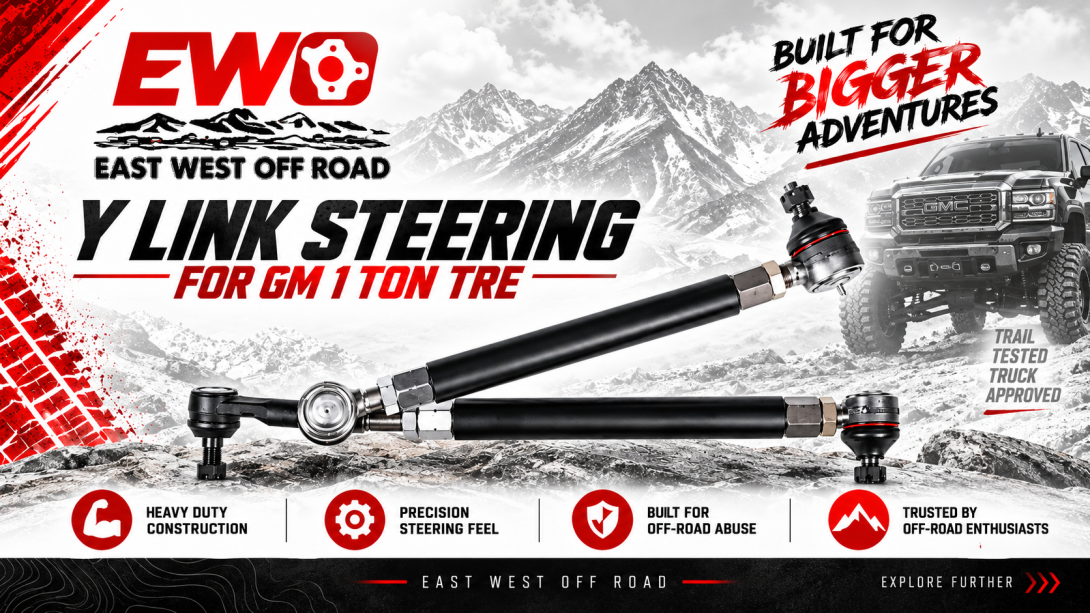
East West Off Road currently offers the E90065 Y Link Steering for GM 1 Ton TRE, providing a heavy-duty Y-link steering option for builders who want to base their steering system around GM 1-ton-style tie rod ends.
What Are GM 1 Ton Tie Rod Ends?
GM 1 ton tie rod ends are heavy-duty tapered steering joints derived from steering applications commonly associated with larger GM truck platforms.
In the off-road aftermarket, however, the term has expanded beyond original GM replacement use.
Today, GM 1-ton-style TREs appear in custom steering systems for:
- Jeeps
- GM trucks
- Ford builds
- Dodge builds
- Toyota solid-axle swaps
- Early Broncos
- Rock crawlers
- Fabricated buggies
- Dana 44 axles
- Dana 60 axles
The term “1 ton” describes the steering-component category. It does not increase the weight rating, axle rating, or payload capacity of the vehicle using them.
What Does TRE Mean?
TRE stands for tie rod end.
A tie rod end is an articulated steering joint that connects steering linkage to components such as:
- Steering knuckles
- Tie rods
- Drag links
- Pitman-arm-side connections
The joint needs to transfer steering force while still allowing the angular movement created by steering and suspension travel.
Why GM 1-Ton TREs Became Popular Off Road
Off-road builders frequently modify vehicles far beyond their original steering configuration.
Common changes include:
- Larger tires
- Heavier wheels
- Beadlocks
- One-ton axle swaps
- Suspension lifts
- Rock-crawling use
- Heavy front bumpers
- Winches
- Low-range gearing
These modifications can increase steering loads substantially.
Builders therefore often look for larger steering joints and stronger linkage rather than relying on smaller light-duty factory components.
Larger Tires Create More Steering Load
Increasing tire diameter changes leverage at the steering knuckle.
A larger and heavier tire can create additional force through:
- Tie rod
- Drag link
- Tie rod ends
- Knuckles
- Pitman arm
- Steering box
Off road, the loads can increase further when a tire is pressed against a rock or another obstacle.
That is one reason GM 1-ton steering hardware is commonly found on serious trail vehicles.
GM 1-Ton TREs vs. Factory Tie Rod Ends
Factory tie rod ends are designed around the original vehicle's:
- Tire size
- Wheel weight
- Steering geometry
- Vehicle weight
- Intended operating conditions
A heavy-duty GM-style steering system is commonly used when those conditions have changed significantly.
Potential benefits can include:
- Larger joint architecture
- Heavy-duty threaded connections
- Common aftermarket availability
- Serviceable steering system design
- Compatibility with custom DOM steering links
The exact strength difference depends on the specific original and aftermarket components.
Why Thread Size Matters
Current GM 1-ton steering components commonly use 7/8"-18 steering-link threads in aftermarket systems.
The thread specification matters because it determines compatibility with:
- Tube inserts
- Weld bungs
- Jam nuts
- Tie rod tubing
- Drag-link tubing
Left-hand and right-hand threaded components are also frequently paired so a steering link can be adjusted without completely removing an end.
However, buyers should always use the specifications supplied for the actual steering system they are purchasing.
Right-Hand vs. Left-Hand Tie Rod Ends
Custom steering links frequently use one right-hand-thread joint and one left-hand-thread joint.
This arrangement can make linkage adjustment easier.
Rotating the steering link can change its effective length while the rod ends remain connected.
The principle is commonly used for:
- Toe adjustment
- Drag-link length adjustment
- Steering-wheel centering
Thread direction needs to match the corresponding bung, insert, and jam nut.
Standard GM 1-Ton Tie Rod Ends
A standard TRE is commonly used where the steering link can connect to the knuckle or related steering point without requiring additional offset.
Applications may include:
- Tie rod ends
- Drag-link ends
- Custom crossover systems
The correct joint still depends on taper, articulation, thread direction, and geometry.
Offset GM 1-Ton Tie Rod Ends
An offset tie rod end positions part of the steering connection differently from a straight or standard joint.
This can help with packaging in certain steering layouts.
Potential clearance issues that may influence offset-joint selection include:
- Wheel
- Knuckle
- Differential cover
- Steering link
- Suspension components
An offset part should be chosen because the steering system requires that geometry—not simply because it appears heavier duty.
High-Angle GM 1-Ton TREs
Some custom steering systems use high-angle steering ends at locations where greater articulation is required.
This can be particularly relevant to:
- Drag links
- Lifted vehicles
- High-steer systems
- Crossover steering
The steering end still needs to remain within its designed articulation throughout suspension and steering travel.
A high-angle joint is not a substitute for correcting fundamentally poor steering geometry.
GM 1 Ton Tie Rod End Kit
A GM 1 ton tie rod end kit may include multiple steering joints intended to work together within a complete steering system.
Depending on the system, this can involve:
- Standard TREs
- Offset TREs
- High-angle TREs
- Left-hand-thread joints
- Right-hand-thread joints
- Jam nuts
- Tube inserts
Kit contents vary significantly between manufacturers.
Buyers should verify the exact included components rather than assuming every “1-ton kit” uses the same joints.
GM 1 Ton TRE Steering Kit
A GM 1 ton TRE steering kit takes the concept beyond individual rod ends.
The steering system may combine GM-style ends with:
- Tie rod
- Drag link
- Y-link adapter or Y-style joint
- DOM tubing
- Tube inserts
- Jam nuts
The correct package depends heavily on the steering layout.
What Is a Y-Link Steering System?
A Y-link steering system connects the drag link into the main tie-rod assembly.
Viewed from above, the steering layout resembles a “Y.”
This differs from a conventional crossover design, where the drag link normally runs independently from the pitman arm to an opposite-side knuckle or steering arm.
A Y link steering kit can be particularly useful where packaging a completely separate crossover drag link is difficult.
Why GM 1-Ton TREs Work Well With Y-Link Steering
Y-link systems require several articulated steering connections.
Heavy-duty GM 1-ton TREs are commonly used because the aftermarket offers different configurations to support:
- Tie rod connections
- Drag-link connections
- Y-link junctions
- OTK layouts
- UTK layouts
That gives builders flexibility when designing a custom front steering system.
Y-Link Steering for Leaf-Spring Vehicles
Leaf springs can make steering packaging difficult because they occupy space close to the axle and steering knuckles.
Potential interference points include:
- Tie rod
- Drag link
- Steering arm
- Differential cover
- Shock
- Track bar
Y-link steering can provide an alternative when conventional crossover steering is difficult to package around these components.
Y-Link vs. Crossover Steering
Neither design is automatically best.
Y-Link
The drag link connects into the tie-rod system.
Potential reasons to choose it include:
- Packaging limitations
- Leaf-spring clearance
- Limited steering-arm mounting points
- Simpler use of factory-style knuckle locations
Crossover Steering
The drag link generally runs independently to the opposite steering knuckle or high-steer arm.
It can provide excellent geometry when correctly designed but may require:
- Suitable steering arm
- Flat-top or aftermarket knuckle
- Additional clearance
- Compatible steering box and pitman-arm arrangement
The complete vehicle determines the appropriate layout.
GM 1-Ton TREs in Crossover Steering
GM 1-ton TREs are also widely used in crossover steering systems.
Common aftermarket configurations combine:
- Heavy DOM tie rod
- Heavy DOM drag link
- Standard TREs
- High-angle TREs
- High-steer arm
- Crossover pitman-arm arrangement
These systems are common on Dana 44 and Dana 60 front axles.
Dana 44 Steering Kit Applications
A Dana 44 steering kit using GM 1-ton-style steering ends can be found in many custom builds.
Potential vehicle platforms include:
- Jeep
- Chevrolet/GMC
- Ford
- Dodge
- International
- Custom 4x4s
However, Dana 44 axles vary significantly.
Fitment can depend on:
- Open vs. closed knuckle
- Flat-top knuckles
- Steering-arm mounting
- Axle generation
- Vehicle manufacturer
- Suspension design
“Dana 44” alone is not enough information to guarantee steering fitment.
Dana 44 Y Link Steering
Dana 44 Y link steering can be useful when a builder has limited room for conventional crossover steering.
Common considerations include:
- Existing knuckle mounting positions
- Leaf springs
- Differential cover
- Wheel clearance
- Pitman-arm location
GM 1-ton tie rod ends can provide the heavy-duty articulated joints needed within that layout.
Dana 60 Steering Kit Applications
A Dana 60 steering kit often supports vehicles using:
- Large tires
- Heavy front axles
- Rock-crawling setups
- One-ton swaps
- Custom trucks
Because Dana 60 builds can place significant loads on steering components, GM 1-ton steering ends are widely used in aftermarket crossover and high-steer systems.
Dana 60 Y Link Steering
Dana 60 Y link steering may be considered where suspension or knuckle packaging makes another steering layout difficult.
Dana 60 configurations vary widely, including:
- Kingpin axles
- Ball-joint axles
- Ford applications
- GM applications
- Dodge applications
Steering-end compatibility should therefore be verified for the exact axle.
Dana 44 vs. Dana 60 Steering Requirements
A Dana 60 is generally a heavier axle platform than a Dana 44, but steering requirements cannot be determined solely from axle name.
Other factors include:
- Tire diameter
- Tire weight
- Wheel offset
- Vehicle weight
- Suspension geometry
- Trail use
- Steering-box configuration
A properly designed Dana 44 steering system can differ substantially from a Dana 60 setup even when both use GM 1-ton TREs.
Over the Knuckle Steering Kit
An over the knuckle steering kit moves the steering-link attachment above the knuckle in a compatible system.
Often abbreviated OTK, this layout can raise the tie rod.
Potential benefits can include:
- Increased steering-link height
- Improved trail clearance
- Different linkage geometry
However, moving the tie rod upward can also create new fitment issues.
OTK Steering Kit Clearance
An OTK steering kit should be checked against:
- Wheel backspacing
- Wheel barrel
- Differential cover
- Leaf springs
- Track bar
- Sway-bar links
- Suspension brackets
The steering system needs clearance throughout the full steering and suspension range.
Under the Knuckle Steering Kit
An under the knuckle steering kit keeps the tie rod below the steering knuckle.
This can provide a more straightforward fit in some vehicles.
Potential advantages include:
- More wheel clearance
- Compatibility with factory-style steering positions
- Easier packaging around some suspension systems
The lower link position can also leave the tie rod more exposed to trail impacts.
UTK Steering Kit
A UTK steering kit should be selected when its lower mounting location provides better overall packaging for the vehicle.
The goal should not simply be maximum steering-link height.
The best position is the one that produces correct geometry and unrestricted movement.
OTK vs. UTK With GM 1-Ton TREs
Both layouts can use heavy-duty steering ends.
Factor
OTK
UTK
Tie rod height
Higher
Lower
Trail exposure
Often reduced
Typically greater
Wheel clearance
May become tighter
Can be easier
Diff-cover clearance
Must be checked
Must be checked
Suspension clearance
Vehicle-specific
Vehicle-specific
Best application
Depends on build
Depends on build
Actual vehicle measurements matter more than a general preference for one layout.
Heavy Duty Off Road Steering Kit
A heavy duty off road steering kit built around GM 1-ton TREs is commonly intended for vehicles that experience more steering load than ordinary street vehicles.
Typical applications include:
- Rock crawlers
- Trail rigs
- Mud trucks
- Overlanding builds
- Solid-axle swaps
- Custom 4x4s
A stronger steering system still needs correct alignment and geometry.
GM 1-Ton TREs for Rock Crawling
Rock crawling can generate severe steering loads at relatively low vehicle speed.
For example, a front tire may become loaded against an obstacle while steering force is applied.
That force travels through the entire steering system.
Large heavy-duty TREs can form part of a steering system built for this environment, but significant trail impacts should always be followed by inspection.
GM 1-Ton TREs for Larger Tires
Larger tires increase steering leverage.
The effect can be compounded by:
- Heavy beadlock wheels
- Low tire pressure
- Sticky off-road tires
- Low-range gearing
- Heavy front-end equipment
This is why many vehicles move to a 1 ton tie rod steering kit after increasing tire size.
1 Ton Tie Rod and Drag Link Kit
A 1 ton tie rod and drag link kit upgrades both primary steering links.
This can be useful when:
- The original tie rod is undersized for the build
- The original drag link is also aging or damaged
- A solid axle has been swapped
- Steering geometry is being redesigned
- Larger tires are installed
A coordinated system can simplify component compatibility and future maintenance.
1 Ton TRE Kit vs. Heim-Joint Steering
Builders often compare GM 1-ton TREs with heim joints.
GM 1-Ton TRE System
Potential benefits include:
- Tapered automotive-style joints
- Dust boots on many configurations
- Broad use in street/trail steering
- Readily identifiable replacement components
Heim Steering
Potential benefits include:
- High articulation
- Flexible custom fabrication
- Multiple mounting arrangements
The right choice depends on the vehicle, operating environment, local requirements, and complete system engineering.
Serviceability Is a Major Advantage
One reason GM 1-ton TRE steering remains popular is that individual steering joints can be treated as service components.
A well-planned steering system makes it easier to identify:
- Right-hand joints
- Left-hand joints
- Standard joints
- Offset joints
- High-angle joints
That matters on a vehicle expected to remain in service for years.
Replacement Tie Rod Ends
Steering joints wear over time.
Inspection areas include:
- Joint play
- Dust-boot condition
- Grease retention
- Tapered-stud condition
- Thread condition
- Impact damage
A damaged or excessively worn steering joint should not be ignored.
Greasable Steering Joints
Many aftermarket GM 1-ton-style TREs are designed to be serviceable.
Where the specific component provides a grease fitting, regular inspection and maintenance should follow the manufacturer's recommendations.
More grease is not automatically better; the manufacturer's service instructions should be followed.
Why Taper Compatibility Matters
Tie rod ends generally use tapered studs.
The steering knuckle or steering arm needs a compatible taper.
A mismatched taper can prevent the joint from seating correctly.
This is one reason steering components should be treated as a complete matched system rather than simply chosen by thread diameter.
Why Articulation Matters
The tie rod end needs to move as:
- Steering angle changes
- Suspension compresses
- Suspension extends
- Axle articulates
If the joint reaches its articulation limit before the suspension or steering reaches its intended travel, it can bind.
That is why high-angle joints are sometimes used in drag-link positions.
Tie Rod End Orientation
Different steering layouts can place tie rod ends at different angles.
OTK, UTK, crossover, high-steer, and Y-link arrangements may all require different joint geometry.
The correct orientation should come from the steering-system manufacturer or qualified builder.
Steering Linkage and Wheel Backspacing
GM 1-ton TREs can be physically larger than many stock steering joints.
That means wheel clearance matters.
Check compatibility with:
- Wheel diameter
- Wheel offset
- Backspacing
- Inner barrel shape
A larger-diameter wheel does not always guarantee sufficient clearance if backspacing places it too close to the steering joint.
Differential Cover Clearance
Large aftermarket differential covers can also interfere with heavy-duty steering linkage.
Clearance should be verified with:
- Wheels centered
- Full left steering
- Full right steering
- Suspension compressed
- Suspension extended
This is particularly relevant when moving between UTK and OTK configurations.
Leaf-Spring Clearance
Leaf springs are another common packaging constraint.
A steering system needs enough room to move without contacting:
- Spring pack
- U-bolts
- Spring plate
- Shock
- Other suspension hardware
Y-link steering is often considered specifically because it can provide another packaging solution for leaf-spring axle builds.
Steering Geometry Still Matters
Larger steering ends do not automatically improve steering geometry.
Correct steering still depends on:
- Tie-rod location
- Drag-link angle
- Pitman-arm position
- Knuckle position
- Track-bar relationship where applicable
- Suspension travel
Heavy-duty components should complement correct geometry rather than attempt to compensate for bad geometry.
GM 1-Ton TREs and Bump Steer
Bump steer is unwanted steering input caused by suspension movement.
It is primarily a geometry problem.
Potential factors include:
- Drag-link angle
- Track-bar angle
- Steering-arm position
- Suspension travel
- Lift height
A GM 1 ton steering kit should therefore not be promoted as an automatic bump-steer cure.
GM 1-Ton TREs and Tie-Rod Roll
Some Y-style steering systems can experience rotational movement in the tie rod because of the way the drag link loads the primary link.
The amount of movement depends on:
- Joint design
- Link geometry
- Component condition
- Y-link arrangement
The steering system should be engineered to control unwanted movement while still allowing necessary articulation.
What Is EWO E90065?
East West Off Road currently lists:
Y LINK STEERING FOR GM 1 TON TRE
Item Number: E90065
The product is positioned within EWO's steering-kit category as a Y-link steering option built around GM 1-ton TRE architecture.
For custom builds, this provides an alternative to sourcing every steering-system component independently.
Does EWO Also Sell Individual GM 1-Ton TREs?
East West Off Road currently lists separate GM 1-ton steering ends in its tie rod end catalog.
For example, its live catalog includes an ES2234R right-hand GM 1-ton tie rod end using a 7/8"-18 RH thread configuration.
It also currently lists other specialized GM 1-ton-style steering ends.
That type of replacement-parts ecosystem can be useful for owners maintaining custom steering systems long term.
Exact compatibility with E90065 should be confirmed from the current product specification rather than assumed from an individual part listing.
Why Y-Link Steering Is Useful With GM 1-Ton TREs
A Y-link steering layout can use the flexibility of multiple GM-style steering-joint configurations while helping solve packaging challenges.
It can be attractive when:
- Crossover steering is difficult to package
- Leaf springs occupy steering space
- Existing knuckle mounting points are limited
- A heavy-duty steering upgrade is desired
Vehicle-specific fitment remains essential.
What to Check Before Buying GM 1-Ton Tie Rod Ends
Check
Why It Matters
Thread size
Must match steering link or insert
Thread direction
RH/LH components must match
Steering taper
Must seat correctly in knuckle or arm
Standard/offset/high-angle
Determines geometry and clearance
OTK or UTK
Changes joint orientation and packaging
Front axle
Dana 44, Dana 60, etc. affect setup
Knuckle design
Determines steering attachment
Wheel backspacing
Larger joints may require clearance
Differential cover
Can interfere with linkage
Suspension design
Leaf springs/links affect routing
Articulation
Prevents binding
Replacement availability
Important for future service
Common Mistake: Ordering by Part Appearance
Two steering joints can look similar while having different:
- Tapers
- threads
- offsets
- articulation
Part identification should be based on specifications rather than appearance alone.
Common Mistake: Ignoring Left- and Right-Hand Threads
The joint must match the steering tube or insert.
A left-hand rod end cannot simply replace a right-hand-thread component.
Common Mistake: Assuming All GM 1-Ton TREs Are the Same
GM 1-ton-style steering ends exist in multiple configurations.
A Y-link joint, offset TRE, high-angle drag-link joint, and standard tie rod end may serve completely different purposes.
Common Mistake: Buying by Axle Name Alone
“Dana 44” or “Dana 60” does not provide enough information by itself.
Actual fitment may depend on:
- Manufacturer
- Year
- Knuckle
- Steering arms
- Suspension
- Wheels
The exact axle configuration should be verified.
Common Mistake: Ignoring Full Steering Travel
A steering system can appear to fit with the wheels pointed straight ahead while interfering at full lock.
Clearance should be verified throughout steering and suspension movement by a qualified installer.
Who Should Consider GM 1-Ton Steering?
This steering category is particularly relevant to:
- Custom solid-axle builds
- Large-tire 4x4s
- Rock crawlers
- Dana 44 projects
- Dana 60 projects
- Leaf-spring builds
- Y-link steering conversions
- Crossover steering conversions
- High-steer systems
A relatively stock light-duty vehicle may not require this level of steering hardware.
Professional Installation and Final Inspection
Tie rod ends directly connect the steering linkage to components that control wheel direction.
A heavy-duty steering conversion should therefore be professionally checked for:
- Correct taper engagement
- Link clearance
- Wheel clearance
- Differential-cover clearance
- Suspension clearance
- Full steering movement
- Joint articulation
- Steering geometry
- Alignment
Custom steering systems involving fabrication, reconfigured knuckles, or modified steering mounting points should be handled or inspected by a qualified automotive steering/fabrication professional.
Frequently Asked Questions (FAQs)
What are GM 1 ton tie rod ends?
They are heavy-duty truck-style steering joints commonly used in custom tie rod, drag link, Y-link, crossover, and high-steer systems.
What does TRE mean?
TRE stands for tie rod end.
Does “1 ton” mean the tie rod end is rated for exactly one ton?
No. In aftermarket steering terminology, “1 ton” refers to a heavy-duty steering-component category rather than a literal vehicle payload rating.
Why are GM 1-ton TREs popular off road?
Their larger steering-joint architecture, aftermarket availability, and compatibility with many custom steering systems make them popular with solid-axle and large-tire builds.
What thread size do GM 1-ton TRE systems commonly use?
Many aftermarket GM 1-ton steering systems use 7/8"-18 threaded steering components. Exact specifications should be verified for the particular joint and kit.
What is the difference between left-hand and right-hand TREs?
The thread direction differs. Using opposing thread directions can allow a steering link to be adjusted by rotating the link.
What is an offset GM 1-ton tie rod end?
It is a steering joint designed with an offset that can help position the linkage differently for clearance or steering geometry.
What is a high-angle GM 1-ton TRE?
It is a steering end designed to allow greater angular movement in applications such as some lifted drag-link or high-steer configurations.
Can GM 1-ton TREs be used in Y-link steering?
Yes. GM 1-ton-style TREs are commonly used in aftermarket Y-link steering systems.
What is the EWO E90065?
E90065 is East West Off Road's current Y LINK STEERING FOR GM 1 TON TRE product.
Can GM 1-ton TREs be used on a Dana 44?
They are widely used in aftermarket Dana 44 steering systems, but exact knuckle, taper, suspension, and vehicle fitment must be verified.
Can GM 1-ton TREs be used on a Dana 60?
Yes, they are common in Dana 60 crossover and high-steer systems, but axle generation and steering configuration matter.
Will one GM 1-ton TRE fit every Dana 44 or Dana 60?
No. Tie rod ends vary by thread, taper, orientation, offset, and articulation requirements.
What is OTK steering?
OTK means Over the Knuckle, where the steering connection is positioned above the knuckle in a compatible system.
What is UTK steering?
UTK means Under the Knuckle, where the steering connection remains below the knuckle.
Is OTK better than UTK?
Not always. OTK may provide additional link height, while UTK can offer easier wheel or component clearance in some applications.
Are GM 1-ton TREs good for rock crawling?
They are widely used in heavy-duty rock-crawling steering systems when properly matched to the vehicle.
Are GM 1-ton tie rod ends good for large tires?
They can be part of an appropriate heavy-duty steering system for large-tire builds, but the entire steering, axle, and suspension system should be evaluated.
Are GM 1-ton TREs better than heim joints?
Neither is universally better. They use different joint architectures and suit different applications.
Can GM 1-ton TREs reduce steering play?
New properly matched joints can eliminate play caused specifically by worn steering ends, but steering looseness may also come from other components.
Will GM 1-ton TREs fix bump steer?
Not automatically. Bump steer is primarily related to steering and suspension geometry.
Does wheel backspacing matter with larger TREs?
Yes. Heavy-duty joints can occupy more space inside the wheel.
Can aftermarket differential covers interfere with GM 1-ton steering?
Yes. Larger differential covers can reduce tie-rod clearance in some steering layouts.
Are GM 1-ton TREs serviceable?
Many aftermarket versions are designed as replaceable steering joints, and some are greasable. Follow the specifications of the exact component.
Does EWO sell individual GM 1-ton tie rod ends?
Yes. EWO currently lists individual GM 1-ton-style steering ends in addition to its steering kits.
Is a Y-link system good for leaf-spring builds?
It can be useful where leaf springs make conventional crossover-steering packaging difficult.
Should I choose standard, offset, or high-angle tie rod ends?
The correct joint depends on its location, steering geometry, knuckle, suspension travel, and clearance requirements.
Should a GM 1-ton steering system be professionally installed?
Professional installation or final inspection is recommended because tie rod ends, tie rods, and drag links directly affect vehicle steering and control.