

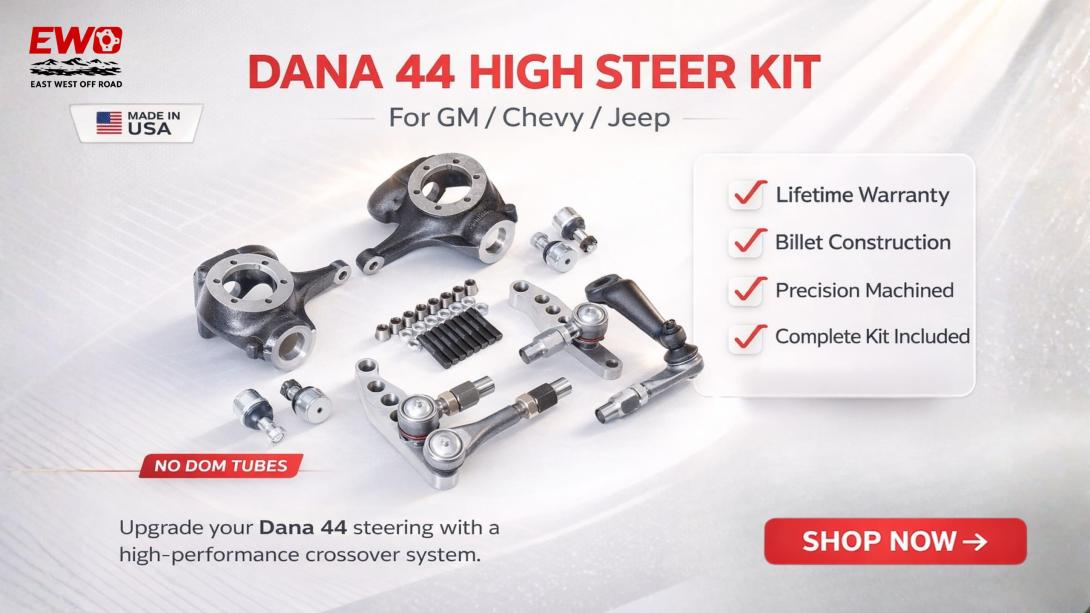
Buy Now: GM / Chevy / Jeep Dana 44 Complete 1-Ton Crossover High Steer Kit
A GM 1 Ton Steering Upgrade is a popular modification for classic Chevy and GMC 4x4 trucks that run larger tires, suspension lifts, and demanding off-road setups. Factory steering components can become a limiting factor when a truck is modified for rock crawling, trail driving, or heavy-duty use. A properly designed 1-ton steering system can provide stronger steering linkage, more robust steering ends, and a better foundation for crossover or high-steer configurations.
For GM K10, K20, K5 Blazer, Suburban, and compatible Dana 44 or Chevy 10-bolt applications, the right combination of steering knuckles, arms, drag link, tie rod, and steering-box components is essential for reliable performance.
Why Consider a GM 1 Ton Steering Upgrade?
Factory steering systems were designed around the original vehicle weight, tire size, suspension height, and steering geometry.
Once a classic GM truck receives larger tires and a suspension lift, the steering system experiences different loads. Rock crawling can also expose steering components to impacts from rocks and other obstacles.
A 1-ton steering upgrade addresses the strength and configuration of the steering system rather than simply replacing one damaged component.
Increased Steering Component Strength
Heavy-duty steering systems typically use larger steering ends and more robust linkage than factory components.
This can provide greater resistance to bending and deformation during demanding off-road use.
The objective is to build a steering system that matches the rest of the vehicle rather than selecting components based only on their advertised size.
Better Suitability for Larger Tires
Larger tires can increase the leverage applied to the steering system.
A properly matched GM 1-ton steering setup can provide a stronger connection between the steering box and front axle, particularly when combined with appropriate high-steer arms and steering knuckles.
Improved Off-Road Clearance
A crossover or high-steer configuration can move steering linkage away from some of the lower areas around the axle.
This can help reduce the likelihood of the tie rod or drag link contacting rocks and trail obstacles.
GM 1 Ton Steering Upgrade for Chevy Trucks
Classic Chevy trucks are some of the most common platforms for GM 1-ton-style steering upgrades.
Popular applications include:
- Chevy K10
- Chevy K20
- Chevy K5 Blazer
- Chevy Suburban
- GMC K10
- GMC K20
- GMC Jimmy
- Custom GM 4x4 builds
The exact steering configuration depends on the front axle, knuckles, steering box, suspension, wheels, and tire size.
A GM 1-ton steering upgrade should therefore be treated as a complete system rather than a universal bolt-on solution.
Dana 44 and GM 1-Ton Steering Components
The Dana 44 is widely used in classic GM and custom off-road builds.
A heavy-duty steering conversion may combine the Dana 44 axle with high-steer knuckles, steering arms, larger steering ends, and crossover linkage.
Dana 44 Flat Top Knuckles
Flat-top knuckles provide the mounting surface required for many high-steer steering arms.
The passenger-side knuckle is particularly important in a traditional crossover configuration because the drag link can travel from the pitman arm across the axle to the passenger-side steering arm.
The correct knuckle must match the specific Dana 44 configuration and outer axle components.
1-Ton High Steer Arms
High-steer arms transfer steering forces into the steering knuckles.
For demanding applications, the arms need to be correctly matched to the knuckle, mounting hardware, steering ends, and intended steering geometry.
The GM/Chevy/Jeep Dana 44 complete 1-ton crossover high-steer kit provides a matched starting point for builders working on compatible Dana 44 applications.
GM Crossover Steering vs. Factory Steering
Crossover steering changes the routing of the drag link.
Instead of relying on a factory-style arrangement, the pitman arm moves the drag link across the front axle to the passenger-side steering knuckle.
The tie rod then connects the steering knuckles.
This arrangement can be particularly useful for lifted GM trucks because it allows the steering linkage to be positioned differently around the axle.
Benefits of Crossover Steering
A properly configured crossover steering system can provide:
- More suitable linkage positioning
- Additional ground clearance
- Stronger steering components
- Better compatibility with high-steer arms
- Improved protection from trail obstacles
- A cleaner steering layout
However, crossover steering does not automatically correct every steering problem. The drag link, track and suspension geometry, pitman arm, steering box, and axle position must all work together.
Square Body GM 1 Ton Steering Upgrade
Square-body Chevy and GMC trucks are popular candidates for heavy-duty steering conversions.
A lifted K10 or K20 can place additional demands on the factory steering system, especially when running larger tires.
K10 Steering Upgrade
A K10 with a Dana 44 front axle can be configured with high-steer knuckles, heavy-duty steering arms, and crossover linkage.
The steering geometry should be evaluated at normal ride height and throughout suspension travel.
K20 Steering Upgrade
K20 builds are often configured for heavier-duty components because of their larger chassis and intended load capacity.
A 1-ton-style steering system can complement a modified K20 running larger tires and a lifted suspension.
K5 Blazer Steering Upgrade
K5 Blazer builds are also popular candidates for crossover steering.
When a K5 receives a lift and larger tires, moving the steering linkage higher can provide useful clearance around the front axle.
GM 1 Ton Tie Rod and Drag Link
The tie rod and drag link perform different functions but need to work together.
The tie rod connects the steering knuckles.
The drag link transfers steering input from the pitman arm to the steering knuckle.
Upgrading both components together creates a more consistent heavy-duty steering system.
GM 1-Ton Steering Ends
GM-style heavy-duty steering ends are commonly used in aftermarket 1-ton steering systems.
Some configurations use steering ends such as ES2026R, ES2027L, ES2234L, and ES2234R depending on the exact linkage arrangement.
The correct steering-end taper, thread direction, and mounting configuration must always be verified before assembly.
Do not select steering ends based solely on the part number without confirming the complete steering configuration.
Steering Box and Pitman Arm Selection
A heavy-duty steering system is only as effective as the steering box and pitman-arm configuration supporting it.
The pitman arm transfers movement from the steering box into the drag link.
3-Inch Drop Pitman Arm
A dropped pitman arm may be appropriate for certain lifted GM applications, but the correct amount of drop depends on the complete steering geometry.
A 3-inch drop pitman arm with a 32-spline sector shaft is one configuration found in the aftermarket, but compatibility must be confirmed with the actual steering box.
The pitman arm should never be selected simply according to suspension lift height.
The steering system should be checked for:
- Drag-link angle
- Steering-box compatibility
- Sector-shaft spline
- Steering travel
- Suspension movement
- Steering clearance
2WD Box Crossover Steering on GM Trucks
Some GM crossover steering conversions use a 2WD steering box configuration.
The reason is that certain steering boxes can provide a more suitable sector-shaft position for crossover steering.
However, not every GM truck requires a 2WD box.
The appropriate steering box depends on the axle, frame, pitman arm, steering linkage, suspension height, and desired steering geometry.
Before purchasing a steering box, verify the complete steering configuration rather than assuming a specific box is required for every crossover conversion.
GM 1 Ton Steering Without DOM Tubing
Some complete steering kits are offered without DOM tubing.
This can be useful for builders who want to fabricate their own drag link and tie rod to suit a custom axle width, suspension configuration, or steering layout.
A kit supplied without DOM tubing means the builder must source suitable tubing and fabricate the linkage appropriately.
The finished links should have adequate thread engagement, correct weld or adapter preparation where applicable, and sufficient clearance throughout suspension travel.
For builders who want the major components without supplied tubing, the EWO GM/Chevy/Jeep Dana 44 1-ton crossover high-steer kit without DOM tubes is designed around this type of custom installation.
GM 1 Ton Steering Upgrade: What Parts Are Needed?
A complete conversion can involve several components.
Steering Knuckles
Compatible flat-top knuckles provide the mounting location for high-steer arms.
High-Steer Arms
The arms connect the steering linkage to the knuckles.
Tie Rod
The tie rod connects the left and right steering knuckles.
Drag Link
The drag link connects the pitman arm to the steering knuckle.
Steering Ends
Heavy-duty steering ends connect the linkage to the steering arms and knuckles.
Pitman Arm
The pitman arm must match the steering box and provide appropriate steering geometry.
Steering Box
The steering box must be compatible with the chassis and intended crossover arrangement.
Tubing
Builders using a kit without DOM tubing must fabricate or source the appropriate linkage material.
Every component should be selected as part of the same steering system.
GM 1 Ton Steering Upgrade for Off-Road Use
Heavy-duty steering becomes particularly valuable when a truck is regularly driven off-road.
Rock crawling can expose the steering linkage to sudden side loads and impacts.
A properly designed system should therefore prioritize strength, clearance, and predictable steering movement.
Rock-Crawling Clearance
The steering linkage should remain protected from obstacles wherever possible.
After installation, inspect clearance between the steering components and:
- Differential housing
- Differential cover
- Leaf springs
- Shocks
- Axle housing
- Wheels
- Tires
- Frame
- Steering stops
Clearance should be checked during actual suspension movement rather than only with the truck sitting at ride height.
GM 1 Ton Steering Upgrade and Bump Steer
Bump steer occurs when suspension movement causes unintended steering movement.
A crossover steering conversion can help create a more suitable steering arrangement on some lifted GM trucks, but the conversion itself does not automatically eliminate bump steer.
The drag link and suspension components need compatible movement through the suspension cycle.
Check Drag Link and Suspension Geometry
After installation, cycle the suspension through:
- Full compression
- Normal ride height
- Full droop
- Left steering lock
- Right steering lock
Watch for changes in steering angle and interference.
If the steering geometry is significantly modified, professional inspection can be worthwhile.
DIY GM 1 Ton Steering Upgrade
A DIY installation can be possible for experienced builders with the appropriate tools and fabrication skills.
However, steering is a safety-critical system.
Builders should have a clear understanding of:
- Steering geometry
- Steering-end tapers
- Thread engagement
- Welding and fabrication
- Suspension travel
- Steering-box compatibility
- Steering stops
- Fastener requirements
If machining, drilling, tapping, or custom welding is required, the work should be performed using appropriate equipment and procedures.
Common GM 1 Ton Steering Upgrade Mistakes
Choosing Components by Size Alone
The biggest steering component is not necessarily the best component for every truck.
Compatibility matters.
Mixing Incompatible Steering Ends
Different steering ends can have different tapers, threads, and dimensions.
Confirm every connection before assembly.
Using the Wrong Pitman Arm
A pitman arm must match the steering box and intended geometry.
Ignoring Wheel Clearance
Large steering arms and linkage can interfere with wheels depending on wheel diameter and backspacing.
Checking Only Ride Height
A steering system that clears at ride height may contact the axle, springs, tires, or frame during suspension travel.
Assuming High Steer Fixes Everything
High steer can improve linkage positioning, but steering geometry still needs to be engineered around the complete suspension system.
How to Choose the Right GM 1 Ton Steering Upgrade
Before purchasing a kit, document the current vehicle configuration.
Check:
- Front axle model
- Driver- and passenger-side knuckle configuration
- Steering box model
- Pitman-arm spline
- Suspension lift
- Tire size
- Wheel diameter
- Wheel backspacing
- Steering-end taper
- Desired crossover or high-steer configuration
This information makes it much easier to determine which steering components will actually work together.
For compatible GM Dana 44 applications, the EWO complete Dana 44 1-ton crossover high-steer solution can simplify sourcing the core components.
Is a GM 1 Ton Steering Upgrade Worth It?
For a modified GM 4x4, a 1-ton steering upgrade can be a worthwhile investment when the factory steering system no longer matches the vehicle's tire size, suspension height, or off-road use.
The greatest benefit comes from treating the upgrade as a complete system.
A strong tie rod paired with unsuitable steering ends or incorrect steering geometry does not create a properly engineered steering system.
Likewise, high-steer arms cannot compensate for an incompatible steering box or inadequate clearance.
The best results come from matching the knuckles, steering arms, steering ends, linkage, pitman arm, steering box, and suspension geometry together.
Frequently Asked Questions (FAQs)
What is a GM 1 Ton Steering Upgrade?
A GM 1 Ton Steering Upgrade replaces or reconfigures factory steering components with heavier-duty steering linkage and steering ends designed for modified Chevy and GMC 4x4 applications.
Is a 1-ton steering setup stronger than stock GM steering?
A properly engineered aftermarket 1-ton-style system can use larger and more robust components than factory steering linkage, providing increased resistance to bending and deformation.
Can I install 1-ton steering on a Dana 44?
Yes, compatible GM 1-ton-style steering components can be used with Dana 44 crossover and high-steer configurations when the knuckles, arms, tapers, steering ends, and linkage are properly matched.
Do I need Dana 44 flat-top knuckles?
For many traditional Dana 44 high-steer conversions, a suitable flat-top passenger-side knuckle is required to mount the high-steer arm.
Is crossover steering good for a lifted K10?
A properly engineered crossover system can provide better linkage positioning and clearance for a lifted K10, but the complete steering and suspension geometry must be checked.
Does a GM 1-ton steering upgrade eliminate bump steer?
No. Bump steer is primarily a geometry issue. A steering upgrade may allow a better configuration, but the drag link and suspension geometry still need to work together correctly.
Do I need a 3-inch drop pitman arm?
Not necessarily. The correct pitman arm depends on the steering box, suspension configuration, drag-link geometry, and clearance requirements.
Can I build a GM 1-ton steering system without DOM tubing?
Yes. Some kits are supplied without DOM tubing, allowing builders to fabricate their own drag link and tie rod. The fabricated components must be properly designed and built.
Can this work with a Chevy 10-bolt axle?
Compatible Chevy 10-bolt applications can use crossover and high-steer steering components, but exact knuckle and outer-component compatibility must be confirmed.
What should I check after installing 1-ton steering?
Check steering travel, suspension travel, wheel and tire clearance, steering stops, drag-link movement, fasteners, steering-wheel position, and front-end alignment.
Final Thoughts
A GM 1 Ton Steering Upgrade can provide a stronger foundation for modified Chevy and GMC 4x4s running larger tires, suspension lifts, and demanding off-road setups. When combined with compatible Dana 44 flat-top knuckles, high-steer arms, heavy-duty steering ends, crossover linkage, and the correct steering-box configuration, it can create a more robust steering system for trail use.
The most important consideration is compatibility. Steering components should be selected as a complete system, with careful attention to tapers, threads, pitman-arm configuration, steering geometry, wheel clearance, suspension travel, and installation hardware.
For builders working with compatible GM Dana 44 applications, a complete crossover high-steer kit can simplify sourcing the core components while leaving the linkage fabrication to suit the individual vehicle.