

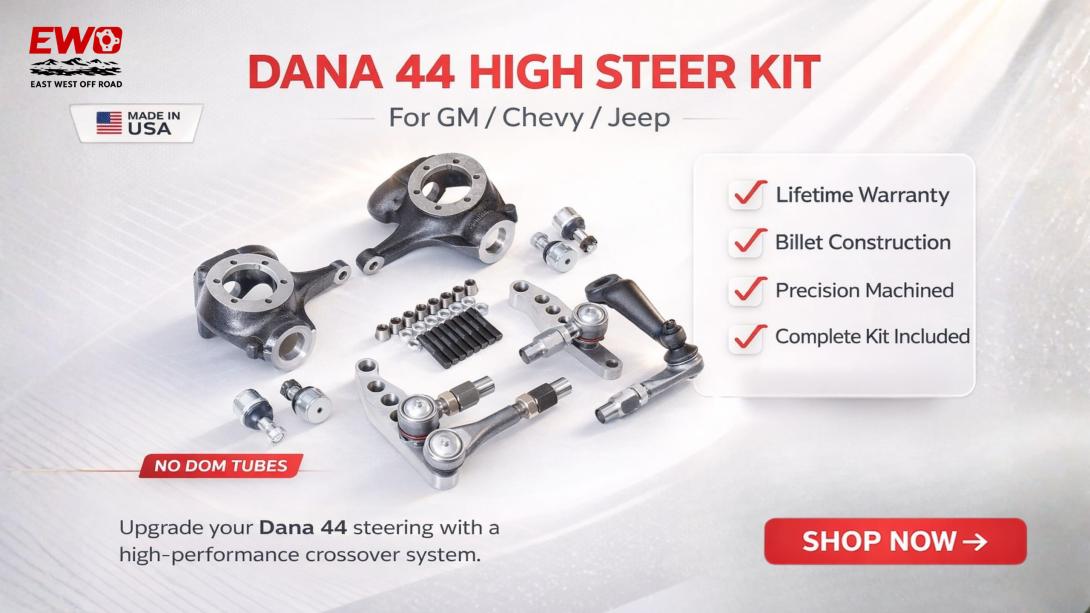
Buy Now: GM / Chevy / Jeep Dana 44 Complete 1-Ton Crossover High Steer Kit
A GM 1 Ton Steering Upgrade is a popular solution for Chevy and GMC trucks running a Dana 44 front axle, especially lifted rigs that see regular off-road use. Factory steering components can become a limiting factor as tire size, suspension travel, and trail demands increase. A properly designed 1-ton crossover steering system can provide stronger steering components while improving drag link and tie rod geometry for demanding applications.
For square-body Chevy trucks, K5 Blazers, GM Dana 44 axle swaps, and custom off-road builds, moving to a high-steer crossover configuration can also help place the steering linkage higher and farther away from rocks and other trail obstacles.
Why Upgrade to GM 1 Ton Steering?
Factory steering systems were designed around the original vehicle configuration. Once you add larger tires, suspension lift, increased articulation, or aggressive off-road driving, the steering system can experience substantially higher loads.
A GM 1 Ton Steering Upgrade focuses on strengthening the linkage and improving the overall steering layout.
Stronger Steering Components
A heavy-duty steering setup typically uses larger tie rod ends, stronger steering arms, and more robust linkage than the original configuration. GM 1-ton steering components are widely used in custom 4x4 builds because they offer a practical foundation for heavy-duty steering conversions.
The goal is not simply to install larger parts. The steering linkage, knuckles, steering arms, pitman arm, and axle geometry need to work together as a complete system.
Better Clearance for Off-Road Use
Factory steering linkage can sit relatively low on an axle, making it vulnerable when crawling over rocks.
A high-steer configuration moves the steering linkage higher on the axle assembly. This can provide additional clearance and reduce the chance of the tie rod or drag link becoming the lowest point of the front axle.
For serious trail rigs, this is one of the major reasons builders choose an Off Road Crossover Steering System instead of simply replacing factory tie rod ends.
Understanding Dana 44 High Steer Geometry
A Dana 44 High Steer Kit typically uses flat-top knuckles and high-steer arms to reposition the steering linkage.
Instead of relying on the original steering arrangement, crossover steering routes the drag link from the pitman arm across to the passenger-side steering arm.
This creates a more direct steering path and can provide better geometry on lifted applications.
Dana 44 Flat Top Knuckles
Flat-top knuckles provide the mounting surface required for high-steer arms. For a GM Dana 44 conversion, the knuckle design and steering arm configuration are critical to achieving the desired steering geometry.
A quality Dana 44 Steering Knuckle Kit should be selected according to the axle configuration, steering arm taper, ball-joint arrangement, and intended steering components.
1 Ton High Steer Arms Dana 44
High-steer arms transfer steering forces from the linkage into the knuckles. Heavy-duty arms should be matched to the correct knuckle and mounting hardware.
The EWO system uses substantial steering components designed around a 1-ton crossover configuration rather than simply adapting a stock steering arrangement.
For builders looking for a complete solution, the GM Jeep Dana 44 1-ton crossover kit combines the major components needed to build a high-steer crossover setup without requiring the purchase of every steering component separately.
GM 1 Ton Steering Upgrade for Chevy Trucks
Classic Chevy and GMC trucks are common candidates for a GM 1 Ton Steering Upgrade. Square-body trucks, K5 Blazers, and other GM 4x4 platforms can benefit from a steering system designed around their modified suspension and axle configuration.
Square Body Crossover Steering Conversion
A Square Body Crossover Steering Conversion can be especially useful when a truck has been lifted and fitted with larger tires.
Rather than forcing the original steering linkage to operate at increasingly poor angles, crossover steering changes the relationship between the steering box, drag link, and knuckles.
Before installing any conversion, verify:
- Front axle type
- Knuckle configuration
- Steering box and sector shaft
- Pitman arm spline and drop
- Tie rod and drag link taper
- Wheel and tire clearance
- Suspension lift height
- Steering arm location
- Track bar or suspension interference
Correct measurements are essential because steering geometry varies between individual builds.
Crossover Steering vs. Factory Steering
The main advantage of crossover steering is the way the drag link connects the steering box to the axle.
In a conventional factory-style configuration, steering movement can become increasingly problematic as suspension height changes. A crossover system can provide a more direct path between the pitman arm and passenger-side steering arm.
Benefits of Crossover Steering
A properly designed crossover system can provide:
- Improved steering linkage positioning
- Better clearance around the axle
- Stronger steering components
- More suitable geometry for lifted applications
- Better compatibility with larger tires
- Reduced exposure of linkage to trail obstacles
- A cleaner heavy-duty steering layout
However, crossover steering is not a substitute for proper suspension geometry. Track-bar angle, drag-link angle, caster, axle position, and steering box condition should all be evaluated together.
What Makes a 1-Ton Steering Upgrade Heavy Duty?
The term "1-ton" is commonly used to describe a heavy-duty steering component size and application, but the complete system still needs to be engineered correctly.
A durable setup depends on more than just large tie rod ends.
Heavy-Duty Tie Rod and Drag Link Ends
The tie rod and drag link ends are critical wear points. GM-style 1-ton components are popular in custom builds because they offer larger connection points and serviceable designs.
Common components used in a Dana 44 crossover system include ES2026R and ES2027L drag link ends along with ES2234L and ES2234R tie rod ends, depending on the exact steering configuration.
Billet Steering Arms
High-quality billet steering arms provide a strong connection between the knuckle and steering linkage.
For demanding off-road applications, the steering arms should be paired with appropriate high-strength studs and correctly installed mounting hardware.
Pitman Arm Selection
The pitman arm determines how the steering box transfers movement into the drag link.
A 3-inch drop pitman arm with a 32-spline configuration may be appropriate for certain GM steering boxes, but compatibility must always be verified before ordering.
The correct drop should be selected based on actual steering and suspension geometry rather than simply choosing the largest available drop.
1 Ton Steering Upgrade Without DOM Tubing
Not every builder wants to fabricate steering linkage from raw DOM tubing.
A complete system can make the conversion easier for builders who want the major steering components together without having to source every individual component.
The EWO package is available as a 1 ton steering without DOM tubing configuration, allowing the builder to focus on the required linkage fabrication while using matched steering components.
For a custom fabrication project, the Dana 44 1-ton crossover high steer kit provides a foundation for GM, Chevy, and Jeep Dana 44 applications.
Choosing the Right Steering Setup for Your Build
Every off-road vehicle is different. A setup that works on a stock-height truck may not provide the correct geometry on a heavily lifted K5 Blazer.
Consider these factors before selecting your steering system.
Tire Size
Larger tires increase the load placed on the steering system. The larger the tire and the more aggressive the trail use, the more important properly sized steering components become.
Suspension Lift
Lift height changes the relationship between the steering box, pitman arm, axle, and steering linkage.
A high-steer system can help optimize the linkage location, but the entire suspension and steering system still needs to be checked through its full range of motion.
Axle Configuration
Dana 44 axles are available in different configurations. Make sure your axle has the correct knuckles and mounting provisions for the steering system you intend to use.
Intended Use
A street-driven truck that occasionally visits a trail has different requirements than a dedicated rock crawler.
For a serious off-road build, durability, clearance, serviceability, and correct geometry should all be considered together.
EWO Dana 44 Crossover Steering Solution
The East West Off Road system is designed around a complete high-steer crossover concept for GM, Chevy, and Jeep Dana 44 applications.
The package can include components such as:
- Driver and passenger Dana 44 flat-top knuckles
- High-steer arms
- Heavy-duty steering hardware
- GM-style drag link ends
- GM-style tie rod ends
- Crossover steering components
- Components designed for a 1-ton steering configuration
This approach can simplify sourcing compared with assembling unrelated steering components from multiple manufacturers.
For builders planning a complete conversion, the East West Offroad Dana 44 crossover steering parts kit is designed for GM/Chevy/Jeep Dana 44 applications.
Installation Considerations
A GM 1 Ton Steering Upgrade should be treated as a complete steering-system modification rather than a simple bolt-on replacement.
Before final assembly, verify steering movement from lock to lock and through the full suspension cycle.
Check for Interference
Inspect clearance between:
- Drag link and differential
- Tie rod and differential cover
- Steering linkage and leaf springs
- Steering arms and wheels
- Linkage and shocks
- Pitman arm and frame
- Steering components and suspension hardware
No steering component should bind during suspension movement or steering articulation.
Verify Steering Geometry
The drag link should operate through a suitable range without creating excessive angle-related problems.
Check the steering at ride height, full compression, full droop, and full steering lock.
Use Correct Hardware
High-steer arms experience significant forces. Use the specified studs, nuts, washers, and torque specifications for the components being installed.
Incorrect hardware or improper installation can compromise an otherwise strong steering system.
GM 1 Ton Steering Upgrade vs. Basic Steering Replacement
A basic steering replacement may make sense for a mostly stock truck that uses factory-size tires and suspension.
A GM 1 Ton Steering Upgrade makes more sense when the vehicle has moved beyond its original operating conditions.
Consider a 1-ton crossover system when your build includes:
- Large off-road tires
- Suspension lift
- Aggressive trail use
- Dana 44 axle conversion
- Square-body Chevy build
- K5 Blazer build
- Custom high-steer setup
- Rock crawling
- Increased steering loads
The objective is to build a steering system that matches the rest of the vehicle rather than allowing the factory linkage to become the weak point.
Frequently Asked Questions (FAQs)
What is a GM 1 Ton Steering Upgrade?
A GM 1 Ton Steering Upgrade replaces lighter factory steering components with heavier-duty steering linkage and commonly uses GM 1-ton-style tie rod and drag link components.
Is 1-ton steering good for a Dana 44?
Yes. GM 1-ton steering components are commonly used with Dana 44 crossover and high-steer conversions when the knuckles, steering arms, tapers, and linkage are correctly matched.
Does crossover steering help a lifted Chevy?
A properly designed crossover steering system can improve steering linkage geometry on lifted Chevy applications and place the linkage in a higher, more protected position.
What is a Dana 44 high-steer conversion?
A Dana 44 high-steer conversion typically uses flat-top knuckles and high-steer arms to move the steering linkage higher on the axle and create a crossover steering arrangement.
Do I need flat-top knuckles for high steer?
For many Dana 44 high-steer configurations, flat-top knuckles provide the mounting surface required for high-steer arms. The exact requirements depend on the axle and steering system.
Can a GM 1-ton steering setup work with a Chevy Dana 44?
Yes, provided the knuckles, steering arms, tie rod ends, drag link ends, tapers, and pitman arm are compatible with the specific axle and steering box configuration.
Is a high-steer kit better for rock crawling?
High-steer crossover systems can be advantageous for rock crawling because they can place steering linkage higher and farther away from obstacles while providing a heavy-duty steering layout.
Does a 1-ton steering upgrade eliminate bump steer?
A steering upgrade alone does not automatically eliminate bump steer. Bump steer is strongly affected by suspension and steering geometry, so the drag link and other suspension components must be correctly positioned.
Can I install a Dana 44 crossover kit without DOM tubing?
Some kits are available without DOM tubing, allowing the builder to fabricate or source the required linkage separately. Always confirm the exact kit contents before installation.
What should I check before buying a GM 1-ton steering kit?
Verify your axle type, knuckle configuration, steering box, pitman arm, steering arm taper, tie rod ends, drag link ends, lift height, tire size, and available clearance before purchasing.
Final Thoughts
A GM 1 Ton Steering Upgrade can be a major improvement for a modified Chevy, GMC, K5 Blazer, or Dana 44-equipped off-road vehicle. The biggest advantage comes from treating the conversion as a complete steering-geometry upgrade rather than simply installing larger tie rod ends.
A properly matched Dana 44 high-steer and crossover system can provide stronger components, better linkage placement, improved obstacle clearance, and a more suitable foundation for demanding off-road use. For a serious build, choosing compatible knuckles, high-steer arms, steering ends, pitman arm, and linkage is the key to creating a dependable steering system.