

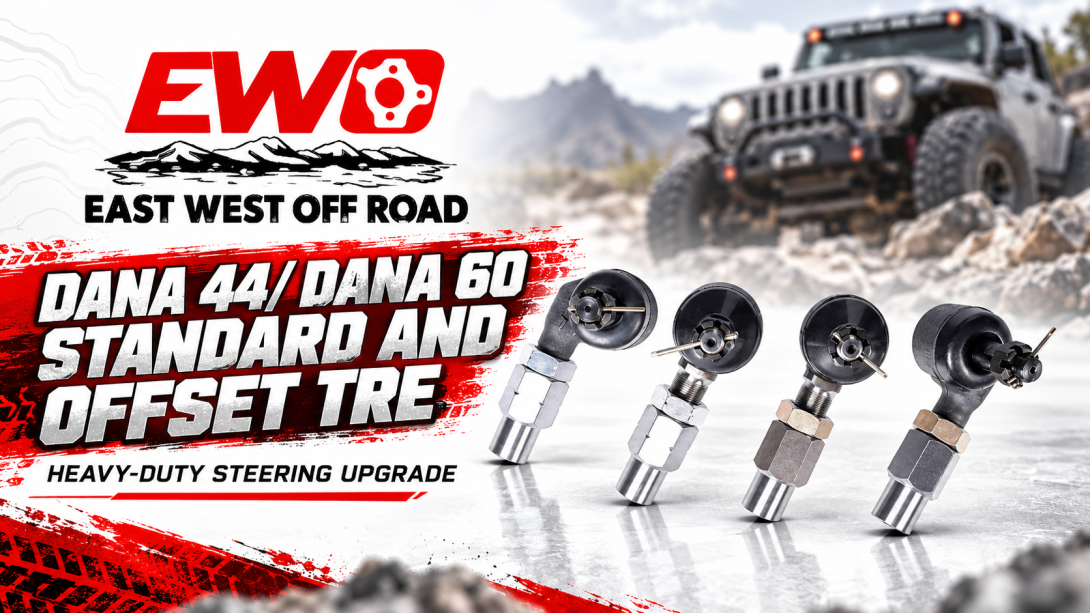
Buy Now: https://www.eastwestoffroad.com/product/dana-44-dana-60-standard-and-offset-tre
GM 1 ton offset tie rod ends are designed for heavy-duty steering applications where a conventional straight tie rod end does not provide the link positioning or component clearance needed by the build. They are widely used in Dana 44, Dana 60, crossover steering, high-steer, rock crawler, and custom solid-axle applications, but choosing the correct offset end involves more than matching the words “GM 1 ton.” Thread direction, thread pitch, taper compatibility, actual offset, steering position, differential-cover clearance, and the rest of the linkage all need to match.
East West Off Road’s E90063 is currently positioned specifically around Dana 44 / Dana 60 standard and offset TRE applications, making it relevant for builders who need a mixed steering-end strategy rather than treating every connection as identical. East West Off Road
What Are GM 1 Ton Offset Tie Rod Ends?
A conventional GM-style 1-ton tie rod end typically keeps its threaded shank relatively centered with the steering joint.
An offset version moves the threaded shank away from that centerline.
That change alters where the steering tube sits relative to the joint and can create additional clearance around nearby components.
Current aftermarket manufacturers most commonly associate offset TREs with clearance around:
- Differential covers
- Steering links
- Suspension components
- Track bars
- Steering arms
- Other axle-mounted hardware
Barnes currently describes its LH and RH GM-style offset ends as moving the tie rod by 1 inch, while Sky’s publishes a 3/4-inch offset on its own design. Skys Offroad Design
The difference matters: “offset GM 1-ton TRE” is a category, not one universal dimension.
Why Offset TRE Search Intent Is Different From Standard TRE Search Intent
Someone searching for a standard GM 1-ton tie rod end may simply be:
- Replacing a worn joint
- Building a conventional tie rod
- Servicing an existing steering system
Someone searching specifically for an offset end usually has an additional fitment problem to solve.
Typical questions include:
- Will the tie rod clear my differential cover?
- Do I need offset ends on both sides?
- Which end is right-hand thread?
- Which end is left-hand thread?
- Does 7/8"-18 automatically mean it fits?
- Is my existing steering system designed for offset ends?
- Do I need standard and offset TREs together?
That makes component identification and clearance planning central to this keyword.
Why Builders Use an Offset Tie Rod End
The main advantage is generally steering-link placement.
A heavy-duty front axle can become crowded after adding:
- Larger differential cover
- Crossover steering
- High-steer components
- Suspension brackets
- Track bar
- Heavier steering links
An appropriately selected offset end can move the tie rod away from one of these obstacles.
Sky’s explicitly markets its current offset GM 1-ton TRE as useful for differential-cover clearance. Skys Offroad Design
That is an important distinction:
Offset TREs are primarily a packaging solution, not simply a stronger-looking version of a standard tie rod end.
Standard and Offset Tie Rod Ends
The correct steering system does not always use the same type of TRE at every connection.
Standard Tie Rod Ends
A standard end may be appropriate when:
- Differential-cover clearance is adequate
- Suspension clearance is adequate
- Current steering-link position is correct
- Existing steering system was designed around a straight end
Offset Tie Rod Ends
An offset end may be appropriate when:
- The tie rod needs additional differential-cover clearance
- The link needs to be repositioned relative to another component
- The existing steering system was specifically designed around an offset joint
This is why EWO’s E90063 product is particularly relevant: its title explicitly combines standard and offset TRE terminology rather than presenting offset ends as a universal replacement for every steering position. East West Off Road
Why a Standard + Offset Steering Combination Can Make Sense
Custom steering rarely has perfectly symmetrical packaging.
One side or connection may have generous clearance.
Another may sit close to:
- Differential cover
- Steering bracket
- Suspension hardware
Using a standard end where clearance is already sufficient and an offset end where positioning requires it can make more sense than forcing the same geometry at every location.
The exact combination should follow the design of the steering system.
Understanding the GM 1-Ton Steering Family
The phrase “GM 1 ton” is widely used in American off-road steering.
It generally refers to a common heavy-duty steering-end family used in:
- Chevy/GM steering
- Dana 44 steering
- Dana 60 steering
- Custom Jeeps
- Solid axle swaps
- Rock crawlers
- Crossover steering
- High-steer conversions
However, several components can exist within that broad family.
They may differ in:
- RH or LH thread
- Standard or offset construction
- Joint articulation
- Taper
- Overall geometry
That means the words GM 1 ton alone are not enough information for a replacement purchase.
7/8-18 Tie Rod Ends
One of the most prominent specifications in current GM 1-ton steering results is 7/8"-18.
It describes the threaded shank:
- 7/8-inch nominal diameter
- 18 threads per inch
East Coast Gear Supply currently lists both LH and RH offset GM-style 1-ton ends with 7/8"-18 TPI. Barnes likewise publishes 7/8"-18 thread shanks on its offset ends. Barnes 4WD
EWO’s individual offset LH listing currently confirms 7/8"-18 threads as well. East West Off Road
Why 7/8-18 Does Not Guarantee Compatibility
This is one of the most important replacement-parts lessons.
Two TREs can both have 7/8"-18 threaded shanks while differing in:
- Thread direction
- Stud taper
- Offset
- Joint articulation
- Overall dimensions
- Intended steering position
So the correct question is not:
“Is it 7/8-18?”
It is:
“Does every relevant specification match my steering system?”
Right-Hand vs. Left-Hand Offset TREs
Heavy-duty adjustable steering links frequently use right- and left-hand threaded components.
Current U.S. marketplace results include distinct:
- RH offset GM-style TREs
- LH offset GM-style TREs
Barnes and ECGS both publish these as separate products. Barnes 4WD
The thread direction needs to correspond with the steering tube’s:
- Tube insert
- Adapter
- Jam nut
Why RH vs. LH Identification Matters During Replacement
An existing heavy-duty steering system may have two ends that look nearly identical from a distance.
But one can be RH threaded while the other is LH threaded.
Ordering from appearance alone can result in the wrong replacement part.
Before ordering, identify:
- Existing part number if available
- Thread direction
- Standard or offset
- Thread specification
- Steering location
This is especially important when servicing an older custom build whose original paperwork may be missing.
Replacement Offset TRE vs. New Steering Build
There are two distinct buyers for GM 1 ton offset tie rod ends.
Replacement Buyer
This buyer already has a functioning heavy-duty steering system and needs to replace a worn or damaged end.
Priority checks include:
- Exact offset geometry
- RH/LH thread
- Thread pitch
- Existing steering-end family
- Joint position
New-Build Buyer
This buyer is planning a steering system from the beginning.
Their priorities are broader:
- Axle identification
- Steering layout
- Knuckles
- Suspension
- Differential cover
- Steering link
- Wheels
- Clearance
The two situations should not be treated as the same purchase.
Why Existing Kit Identification Matters
CavFab’s current replacement listing provides a good example.
Its GM-style offset RH TRE is identified specifically as a replacement for certain CavFab JK 1-ton steering configurations, and CavFab warns buyers that threading varies depending on steering setup. CavFab
That illustrates a general rule for any custom steering system:
Replacement compatibility should come from actual component identification, not visual similarity.
Dana 44 Tie Rod Ends
Dana 44 tie rod ends are a major segment of the heavy-duty off-road steering market.
But “Dana 44” covers many axle configurations.
Dana 44 axles have been used in vehicles from:
- GM
- Ford
- Jeep
- Dodge
- Custom conversions
Differences may include:
- Knuckles
- Steering-arm design
- Suspension
- Brake configuration
- Original steering layout
This means a TRE marketed for one Dana 44 application should not automatically be considered correct for another.
Chevy/GM Dana 44 Applications
Older Chevy and GM Dana 44 applications are heavily represented in the GM 1-ton steering market.
These builds commonly use combinations of:
- Heavy-duty TREs
- Crossover steering
- High-steer arms
- Larger steering links
Offset ends can become particularly useful when a large differential cover or steering position creates clearance concerns.
Jeep Dana 44 Applications
Jeep Dana 44 steering can differ substantially from older GM Dana 44 configurations.
The knuckles, mounting interfaces, and suspension may all differ.
Therefore, a product described as a “Dana 44 offset TRE” should not be treated as universal without application verification.
Dana 60 Tie Rod Ends
Dana 60 tie rod ends are equally important in the heavy-duty steering category.
Dana 60 front axles are commonly used under:
- Heavy trucks
- Rock crawlers
- Competition rigs
- Solid axle swaps
- Large-tire off-road builds
EWO’s E90063 product title explicitly includes Dana 60 as well as Dana 44. East West Off Road
Why Dana 60 Fitment Still Needs Verification
Dana 60 axles vary by:
- Manufacturer
- Year
- Knuckle architecture
- Steering-arm layout
- Suspension
- Vehicle application
Barnes’ current offset end listing, for example, says its product fits most Dana 60 front axles rather than claiming universal compatibility. Barnes 4WD
That wording is a useful reminder that axle identification still matters.
Dana 44 vs. Dana 60 Steering Considerations
Both axle families may use heavy-duty GM-style steering components, but the surrounding layout can differ.
Fitment Area
Why It Matters
Knuckle
Determines steering-end mounting
Stud interface
Must match the intended TRE
Differential cover
Can create tie-rod interference
Steering arms
Affect link location
Suspension
Determines available steering space
Wheels
Heavy-duty components require clearance
A complete fitment check is more reliable than shopping only by axle name.
Differential-Cover Clearance: The Main Offset TRE Use Case
This is one of the strongest themes in current search results.
A large differential cover may extend farther toward the steering link than the original factory cover.
That can create a conflict between:
- Tie rod
- Differential housing/cover
- Other steering hardware
An offset TRE can change the steering tube’s relative position and may create useful clearance in a properly designed system.
Sky’s currently emphasizes differential-cover clearance as a primary reason for its offset TRE design. Skys Offroad Design
Why Differential Cover Brand and Shape Matter
Two aftermarket differential covers can have very different:
- Thickness
- Rib structure
- Depth
- Exterior shape
Therefore, “aftermarket diff cover” is not one standardized clearance scenario.
A steering package that clears one cover may not automatically clear another.
Offset Amount Matters
Offset is not universal.
Current products demonstrate this clearly:
- Barnes publishes a 1-inch offset on its GM-style offset ends.
- Sky’s publishes 3/4 inch on its own design.
- EWO’s current individual offset LH listing publishes 1 inch. Skys Offroad Design
This means the buyer should not treat two “offset 1-ton TREs” as geometrically identical.
Why More Offset Is Not Automatically Better
More offset changes the position of the steering link.
That may help one clearance problem while affecting another area.
The correct amount should correspond to the actual steering system.
The goal is proper clearance and steering operation—not simply the largest available offset.
Offset Tie Rod End Kit vs. Individual Ends
An offset tie rod end kit can be more convenient when the steering build requires multiple matched components.
Buying individual ends may make more sense when servicing an existing setup and only one joint needs replacement.
Individual TRE Purchase
Useful when:
- Exact existing component is known
- Only one joint needs replacement
- Rest of linkage remains serviceable
Kit Purchase
Useful when:
- Building or refreshing multiple steering connections
- Standard and offset ends are required together
- Multiple joints are aging
Kit contents should always be checked rather than assumed.
Why Standard and Offset Components May Belong in the Same Kit
A complete steering system can have different clearance needs at different locations.
One side may require a 1-inch offset to move the link away from a cover.
Another may work perfectly with a standard end.
This makes a standard-plus-offset package logical for some custom steering architectures.
EWO E90063 is specifically titled around this combination. East West Off Road
Heavy Duty Tie Rod Ends
“Heavy duty tie rod ends” is a useful market category, but it is not one universal engineering specification.
Different brands may vary in:
- Joint housing
- Stud
- Boot
- grease fitting
- taper
- offset
- thread system
That makes exact product details more useful than the words “heavy duty” alone.
Offset vs. High-Angle Tie Rod Ends
These terms are sometimes confused.
Offset End
Primarily changes the relationship between the shank and joint body to alter steering-link placement.
High-Angle End
Primarily addresses the joint’s angular movement capability.
One feature does not automatically imply the other.
Choose according to the steering position.
Offset TRE vs. Offset Drag Link End
The words can also become confusing when shopping.
A product may be used in:
- Tie rod position
- Drag-link position
depending on its actual design.
Do not assume every offset steering end performs the same function just because the product appears similar.
Offset TREs in Crossover Steering
Crossover steering generally sends the drag link toward the opposite side of the axle while a separate tie rod connects the knuckles.
This layout commonly uses heavy-duty GM-style steering components.
Offset tie rod ends can be relevant when crossover steering changes where the tie rod sits relative to:
- Differential cover
- Steering arm
- suspension components
Offset TREs in High-Steer Systems
High steer generally raises compatible steering-link mounting locations through appropriate knuckles and steering arms.
That change can improve certain packaging conditions but may create different clearance relationships elsewhere.
Offset TREs can still be useful when the system requires them.
High steer does not automatically eliminate the need to evaluate tie-rod clearance.
Wheel Clearance
Large steering ends may require more room around the inner wheel than factory components.
Important wheel dimensions include:
- Diameter
- Width
- Backspacing
- Offset
- Inner barrel profile
A wheel’s advertised diameter alone does not guarantee steering clearance.
Suspension-Bracket Clearance
Custom suspension brackets can also occupy the space needed by a heavy-duty steering link.
The steering system should be checked in relation to:
- Track-bar bracket
- Control-arm bracket
- Leaf spring
- sway-bar hardware
where applicable.
An offset TRE should not be used to hide severe interference caused by an incorrectly configured steering system.
Track-Bar Clearance
On linked solid-front-axle suspensions, the track bar and steering links operate close to one another.
Their positions need to remain compatible throughout intended movement.
A steering-end offset can alter link placement, but the complete system still needs to be evaluated professionally.
Offset TREs and Larger Tires
Larger wheel-and-tire combinations are one reason owners move toward heavy-duty steering.
Larger tires can increase:
- Steering leverage
- Tire mass
- Loads carried through steering joints
Heavy wheels can increase those demands further.
However, tire size does not determine whether a standard or offset TRE is correct.
Clearance and steering architecture do.
Rock-Crawling Applications
Offset GM 1-ton-style steering ends are common in rock-crawling builds because these vehicles frequently combine:
- Heavy-duty axles
- Large tires
- Crossover/high-steer systems
- Large differential covers
- Tight front-end packaging
The steering system can also experience obstacle contact and significant loading.
Regular inspection remains important even with heavy-duty components.
Trail Trucks
A dual-purpose trail truck needs steering that works both off road and on pavement.
Priorities should include:
- Correct component fitment
- Reliable joint identification
- Adequate clearance
- Proper professional alignment
An offset steering end should solve a specific packaging requirement without compromising the complete steering system.
Solid Axle Swap Builds
Solid axle swaps are especially complex because they may combine:
- One vehicle’s frame
- Another vehicle’s axle
- Custom suspension
- Different steering box
- Aftermarket knuckles
- Fabricated steering links
GM 1-ton steering components are common in these builds, but no single offset TRE is universally correct for every swap.
Replacement Serviceability
One major advantage of using an established steering component family is easier future servicing.
Builders should keep records of:
- TRE part number
- RH/LH thread
- Standard or offset type
- Steering position
- Manufacturer
This can save significant time when an end eventually wears out.
Why Part Numbers Matter
Descriptions such as:
“offset 1-ton end”
are not always enough.
Current brands use different product identifiers and different geometric specifications.
A specific part number provides a much stronger reference during replacement.
Do Not Replace an Offset End With a Standard End by Appearance
A standard end may thread into the same style of tube adapter while positioning the tie rod differently.
That can alter:
- Differential-cover clearance
- Link position
- Surrounding component clearance
A replacement should correspond to the steering system’s intended configuration.
Do Not Replace a Standard End With an Offset End Without Verification
The reverse is also true.
Adding offset where it was not designed can reposition the steering link unnecessarily.
The existing steering architecture should determine the component.
What EWO E90063 Currently Confirms
The current live EWO product page confirms:
Product Detail
Verified EWO Information
Product
DANA 44/ DANA 60 STANDARD AND OFFSET TRE
Item
E90063
Axle terminology
Dana 44 / Dana 60
TRE terminology
Standard and Offset
Availability at verification
In Stock
The live listing currently displays pricing as well, but pricing and inventory can change, so buyers should check the current page at checkout. East West Off Road
What EWO’s Individual Offset Listing Currently Confirms
EWO’s current left-hand offset listing publishes:
- GM 1-ton terminology
- Left-hand configuration
- 1-inch offset
- 7/8"-18 threads
- Dana 44 steering tag
- Dana 60 steering tag
for that specific EWO component. East West Off Road
These details are useful for understanding EWO’s offset TRE family.
What Should Not Be Invented for E90063
The indexed E90063 page does not currently provide a complete component-by-component parts breakdown.
Therefore, do not automatically advertise:
- Exact number of standard ends
- Exact number of offset ends
- Exact LH/RH combination
- Exact ES-series combination
- Tube adapters
- Jam-nut quantities
- DOM tubing dimensions
- Universal Dana 44 fitment
- Universal Dana 60 fitment
unless EWO provides additional confirmation.
Why Barnes Specifications Should Stay With Barnes
Barnes publishes 1-inch offset, 7/8"-18 thread shanks, and its own taper specifications for its current OS2234L/OS2234R products. Barnes 4WD
Those specifications describe Barnes products.
Even where an EWO product shares some dimensions, each claim should still come from EWO’s own documentation.
Why Sky’s Specifications Should Stay With Sky’s
Sky’s currently publishes a 3/4-inch offset and 7/8"-18 thread shank on its own product. Skys Offroad Design
That differs from EWO’s published 1-inch offset on its current individual offset end. East West Off Road
This is exactly why specifications should never be transferred across brands.
Why ECGS Specifications Should Stay With ECGS
East Coast Gear Supply currently publishes 7/8"-18 RH and LH offset 1-ton steering products with its own taper and optional hardware information. East Coast Gear Supply
Those details help define current U.S. shopping intent.
They do not automatically define EWO E90063.
GM 1-Ton Offset TRE Buyer Checklist
Before ordering, verify:
Buyer Check
Why It Matters
Existing part
Helps identify direct replacement
Standard or offset
Changes steering-link position
RH or LH
Must match link thread direction
Thread specification
Needed for tube-adapter compatibility
Offset amount
Different brands use different geometry
Steering-end interface
Must match the intended steering system
Dana 44/Dana 60 configuration
Axles differ by application
Differential cover
Primary clearance concern
Suspension
Brackets/track bar may affect space
Wheel setup
Heavy-duty components need clearance
Steering layout
Crossover/high steer changes link position
Professional inspection
Steering is safety-critical
Common Mistake: Buying Only by the Phrase “GM 1 Ton”
The GM 1-ton family contains multiple steering-end configurations.
Verify the exact end.
Common Mistake: Ignoring RH vs. LH
The wrong thread direction will not correctly match the steering link.
Confirm it before ordering.
Common Mistake: Assuming Every Offset TRE Has the Same Offset
Current products demonstrate different dimensions.
EWO and Barnes publish 1-inch offsets on specific products, while Sky’s currently publishes 3/4 inch on its own. East West Off Road
Common Mistake: Assuming 7/8-18 Means Direct Replacement
It does not.
Other dimensions and application details still matter.
Common Mistake: Ignoring Differential Cover Geometry
A large aftermarket cover is one of the main reasons offset steering components are considered.
Verify actual physical clearance.
Common Mistake: Assuming Offset TREs Are Automatically Stronger
Offset is a geometry characteristic.
Strength depends on the product’s actual design and construction.
Common Mistake: Using Offset Ends Everywhere
A mixed standard/offset steering system may be the intended design.
Use each component in its correct location.
Common Mistake: Treating Dana 44 as Universal Fitment
Dana 44 axles vary widely.
Identify the vehicle, knuckles, and steering system.
Common Mistake: Treating Dana 60 as Universal Fitment
Dana 60 front axles also vary by manufacturer, year, and steering architecture.
Common Mistake: Copying a Competitor’s Taper or Offset
A competitor’s specifications belong to that specific product.
Use EWO-published information for EWO products.
Common Mistake: Assuming Offset TREs Fix Steering Problems
Offset TREs are primarily a component-placement solution.
They do not automatically fix:
- Loose steering
- Bump steer
- Worn ball joints
- Wheel-bearing problems
- Steering-box wear
- Alignment problems
Diagnose the underlying issue.
Professional Fitment and Final Inspection
Tie rod ends are safety-critical because they form part of the physical connection between steering input and the front wheels.
Professional fitment, installation, final inspection, and alignment are strongly recommended for custom heavy-duty steering.
The finished steering system should be checked for:
- Correct standard/offset end locations
- Correct RH/LH components
- Compatible steering interfaces
- Differential-cover clearance
- Suspension clearance
- Wheel clearance
- Normal link movement
- Secure steering joints
- Appropriate final alignment
Any modification of steering knuckles, steering arms, pitman arms, or related interfaces should follow the actual component manufacturer’s requirements and be performed by a qualified professional.
Frequently Asked Questions (FAQs)
What are GM 1 ton offset tie rod ends?
They are heavy-duty GM-style 1-ton steering ends with the threaded shank offset from the joint centerline to reposition the steering link in compatible applications.
Why use an offset tie rod end?
The most common reason is additional clearance around a differential cover or other front-axle components.
Are GM 1-ton offset TREs stronger than standard TREs?
Offset itself describes geometry, not a universal strength increase.
What is the difference between standard and offset tie rod ends?
A standard end keeps its shank relatively centered with the joint body, while an offset end moves the shank away from that centerline.
Does EWO offer standard and offset TREs together?
EWO currently lists E90063 as DANA 44/ DANA 60 STANDARD AND OFFSET TRE. East West Off Road
What is EWO E90063?
It is the current EWO item number for the Dana 44/Dana 60 Standard and Offset TRE product. East West Off Road
Is E90063 currently in stock?
At the time of verification, EWO showed it as in stock. Availability can change. East West Off Road
What thread size do GM 1-ton offset TREs commonly use?
7/8"-18 is widely represented in the current aftermarket. EWO’s individual offset LH listing also specifies 7/8"-18. East West Off Road
What does 7/8-18 mean?
It means a nominal 7/8-inch threaded shank with 18 threads per inch.
Does 7/8-18 mean every tie rod end is interchangeable?
No. Thread direction, taper, offset, joint geometry, and application can still differ.
Does EWO list a 1-inch offset TRE?
Yes. EWO’s current individual LH offset GM 1-ton TRE listing specifies a 1-inch offset. East West Off Road
Are all offset GM 1-ton TREs 1-inch offset?
No. Sky’s currently publishes 3/4 inch on its own offset design. Skys Offroad Design
Does Barnes use a 1-inch offset?
Barnes currently specifies 1 inch on its OS2234L and OS2234R products. Barnes 4WD
Why do offset dimensions vary?
Each manufacturer designs its steering product around its own component geometry and intended applications.
Are there RH and LH offset TREs?
Yes. Current aftermarket listings include separate right- and left-hand-thread options.
Why does thread direction matter?
The steering end has to match the thread direction of its adapter, jam nut, and steering link.
Can I replace a left-hand TRE with a right-hand TRE?
Not unless the steering link itself is configured for that thread direction.
Can I replace a standard TRE with an offset TRE?
Only when the steering system is designed for the resulting link position and clearance.
Can I replace an offset TRE with a standard TRE?
Do not assume so. That can move the steering link and eliminate clearance the offset end was intended to provide.
Are GM 1-ton offset TREs used on Dana 44 axles?
Yes, they are commonly used in custom Dana 44 steering, but exact application needs verification.
Are they used on Dana 60 axles?
Yes. They are also common in custom Dana 60 steering systems.
Does EWO E90063 mention Dana 44 and Dana 60?
Yes. Both appear directly in its current product title. East West Off Road
Does that mean it fits every Dana 44?
No. Dana 44 configurations vary by knuckle, suspension, vehicle, and steering system.
Does it fit every Dana 60?
Universal Dana 60 compatibility should not be assumed either.
Are offset TREs useful with aftermarket differential covers?
They can be when the steering design requires additional tie-rod clearance around a larger cover.
Do offset TREs guarantee differential-cover clearance?
No. Complete steering and suspension clearance must still be verified.
Are offset ends used in crossover steering?
Yes. They are commonly seen in heavy-duty crossover steering applications.
Can offset ends be used with high steer?
They can be used in systems specifically designed around them.
Is offset the same as high angle?
No. Offset describes component positioning; high angle describes joint articulation.
Does wheel clearance matter with 1-ton TREs?
Yes. Heavy-duty steering ends may require more space around the inner wheel.
Can suspension brackets interfere with steering?
Yes. Track-bar and other suspension brackets can create steering-link clearance concerns.
Do larger tires make heavy-duty steering more relevant?
They can, because larger and heavier wheel-and-tire combinations may increase steering loads.
Does a heavy-duty TRE increase Dana 44 or Dana 60 axle capacity?
No. It does not increase axle, GVWR, payload, towing, or wheel-bearing ratings.
Can offset tie rod ends fix bump steer?
Not automatically. Bump steer can involve the complete steering and suspension relationship.
Will offset TREs fix loose steering?
Only if worn TREs are actually causing the problem. Other front-end components can produce similar symptoms.
Should custom steering components be professionally installed?
Yes. Steering is safety-critical, so professional component verification, fitment, installation, final inspection, and alignment are strongly recommended.