

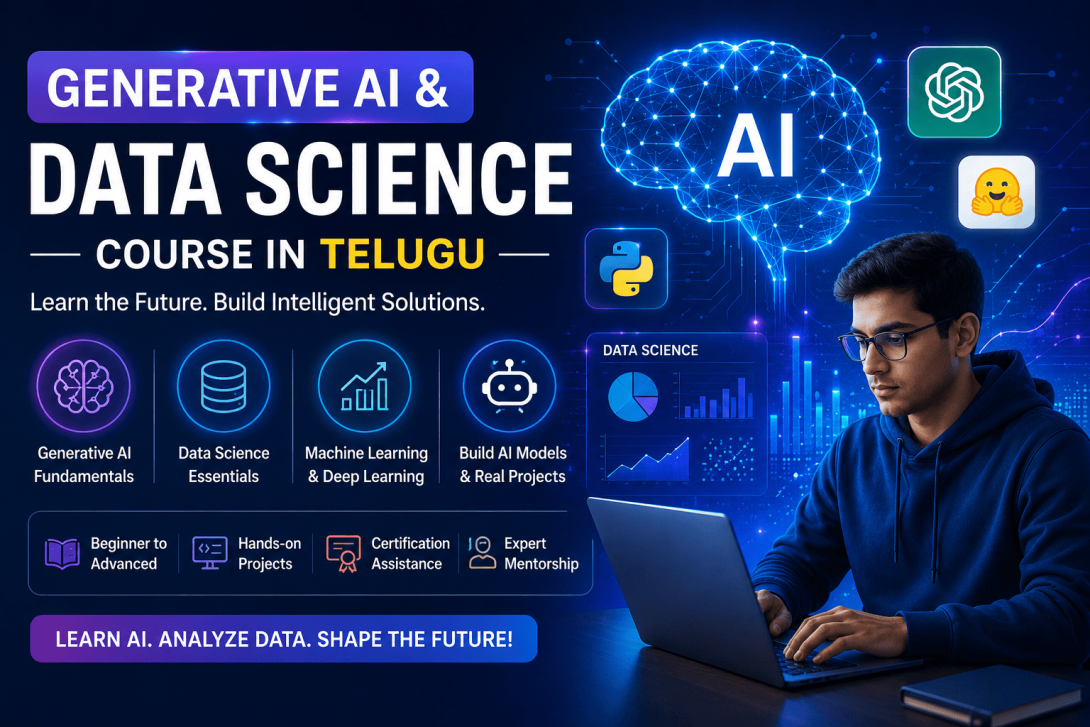
Artificial Intelligence and Data Science have become important technologies across industries such as healthcare, finance, retail, education, manufacturing, and software development. For beginners, however, learning these fields can seem complicated because they involve programming, statistics, machine learning, and rapidly evolving AI technologies. Following a structured learning roadmap can make the journey more organized and practical. A Generative AI & Data Science Course in Telugu can provide beginners with an accessible way to learn these concepts step by step.
Start with Python Programming
The first stage of the learning journey should focus on Python programming. Python is widely used for data analysis, machine learning, automation, and AI development.
Beginners should learn variables, data types, operators, conditional statements, loops, functions, lists, dictionaries, file handling, and basic object-oriented programming. Strong programming fundamentals make it easier to understand advanced Data Science concepts later.
Learn Mathematics and Statistics
The next step is developing a practical understanding of mathematics and statistics. Data Science uses statistical techniques to understand patterns and relationships within datasets.
Important concepts include mean, median, mode, probability, variance, standard deviation, distributions, correlation, and basic hypothesis testing. Beginners do not need to master every advanced mathematical formula immediately. Understanding how these concepts are used in real-world data problems is more important initially.
Understand Data Handling
Real-world data is rarely clean. Therefore, learners should develop skills in data collection, cleaning, preprocessing, and transformation.
Python libraries such as NumPy and Pandas can help learners work with structured datasets. They can practice identifying missing values, removing duplicates, changing data formats, and preparing datasets for analysis.
Explore Data Analysis and Visualization
Once learners know how to prepare data, they can move toward Exploratory Data Analysis (EDA). EDA helps identify trends, relationships, unusual values, and useful patterns.
Data visualization makes these findings easier to understand. Learners can create charts and graphs to communicate insights effectively. This stage is particularly useful for anyone interested in Data Analyst or Business Intelligence roles.
Learn Machine Learning
The next stage is Machine Learning, where learners understand how computers can identify patterns from data and make predictions.
Important topics include:
- Supervised Learning
- Unsupervised Learning
- Regression
- Classification
- Clustering
- Model Evaluation
- Feature Engineering
Learners should combine theoretical knowledge with small projects to understand how machine learning models are developed and evaluated.
Explore Deep Learning and AI
After developing machine learning fundamentals, students can explore Deep Learning and broader Artificial Intelligence concepts. Neural networks, computer vision, and Natural Language Processing can introduce learners to more advanced AI applications.
Practical exercises can help students understand how AI systems process text, images, and other types of information.
Enter Generative AI
The next major stage is Generative AI, which focuses on systems capable of creating new content. Learners can explore Large Language Models, prompt engineering, embeddings, Retrieval-Augmented Generation, AI agents, and LLM-based applications.
Understanding how to design effective prompts and integrate AI models into applications can provide valuable modern skills.
Build Real-World Projects
Projects are essential throughout the learning roadmap. Beginners can start with simple projects and gradually increase complexity.
Examples include sales prediction, customer segmentation, sentiment analysis, recommendation systems, document analysis, and AI chatbot applications. Projects help learners connect different concepts and demonstrate practical abilities.
Develop a Professional Portfolio
After completing projects, learners should organize their work into a portfolio. Each project should explain the problem, tools used, approach, results, and key learnings.
A strong portfolio can help demonstrate practical skills during job applications and interviews.
Conclusion
A structured learning roadmap can make Generative AI and Data Science easier to approach. Starting with Python, progressing through statistics and data analysis, learning machine learning, and then moving toward Generative AI provides a logical path for beginners. A Generative AI & Data Science Course in Telugu can support this journey by combining foundational concepts with practical learning. Consistent practice, project development, and continuous skill improvement can help learners prepare for the evolving technology industry.