

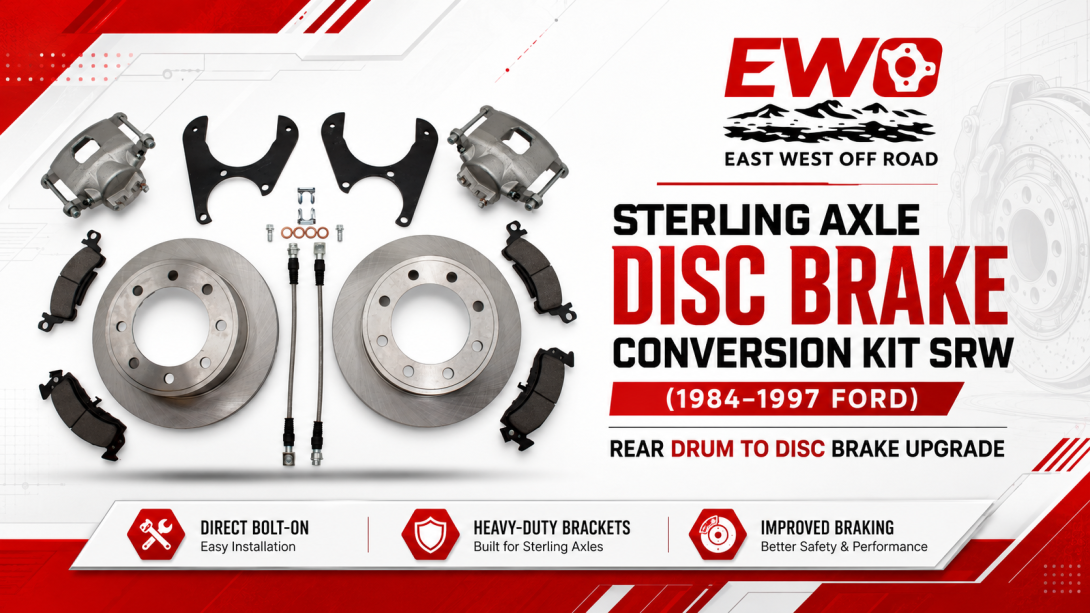
A ford sterling disc brake conversion is a practical upgrade for owners of compatible older Ford Sterling Single Rear Wheel axles who want to replace large factory rear drums with a rotor-and-caliper braking system. Whether the axle is under a classic Ford truck, tow rig, off-road build, or custom 4x4, converting to rear discs can simplify brake inspection and servicing while providing the architecture of a modern disc brake system. The most important part of the upgrade is matching the kit to the correct Sterling axle, SRW configuration, wheel package, calipers, hydraulic system, and parking-brake requirements.
The East West Off Road E2055 Sterling Axle Disc Brake Conversion Kit is designed around 1984–1997 Ford Sterling SRW applications and gives buyers optional parking-brake-caliper and steel-braided-brake-hose configurations.
What Is a Ford Sterling Disc Brake Conversion?
A Ford Sterling rear disc conversion replaces the major drum-brake components with a disc system built around rotors and hydraulic calipers.
A typical conversion system can include:
- Rear brake rotors
- Heavy-duty caliper mounting brackets
- Hydraulic brake calipers
- Brake pads
- Flexible brake hoses
- Hydraulic fittings
- Mounting hardware
Depending on the configuration, buyers may also choose a caliper with mechanical parking-brake capability.
A properly matched Ford Sterling disc brake conversion should be treated as a complete brake-system upgrade rather than simply a way to remove the original drums.
Why Sterling Axles Are Popular in Heavy-Duty Ford Builds
The Sterling rear axle family has a strong reputation in Ford heavy-duty truck and 4x4 applications.
Builders commonly encounter Sterling axles in:
- Heavy-duty Ford pickups
- 3/4-ton truck builds
- 1-ton truck builds
- Tow rigs
- Diesel projects
- Off-road trucks
- Custom axle swaps
The Sterling 10.25 full-floating axle in particular has become a popular platform because of its heavy-duty construction and broad aftermarket support.
That makes rear disc conversion parts highly relevant for owners restoring or modifying older Ford trucks.
Sterling 10.25 Disc Brake Conversion
The phrase Sterling 10.25 disc brake conversion is one of the most common searches associated with this upgrade.
A Sterling 10.25 rear disc system replaces the original drum hardware with compatible rotors, brackets, calipers, hoses, pads, and related brake components.
However, not every Sterling axle is identical.
Before purchasing any kit, owners should verify:
- Axle generation
- SRW or DRW configuration
- Full-float or other axle type
- Lug pattern
- Hub configuration
- Wheel clearance
Correct axle identification is one of the most important parts of choosing a brake conversion.
What Does SRW Mean?
SRW means Single Rear Wheel.
An SRW truck uses one rear wheel on each side of the axle.
This is different from a DRW, or Dual Rear Wheel, truck that uses two wheels on each side.
The distinction matters because the hub position, wheel mounting, brake-bracket offset, and rotor location can differ.
A kit designed for an SRW Sterling axle should not automatically be assumed to fit a dually axle.
SRW vs. DRW Ford Sterling Axles
Current Sterling conversion products in the aftermarket clearly separate SRW and DRW applications.
That distinction exists for good reason.
SRW Sterling Axle
Single Rear Wheel setups are common on conventional heavy-duty pickups and many off-road axle swaps.
DRW Sterling Axle
Dual Rear Wheel setups use different wheel and hub geometry and may require a completely different brake conversion arrangement.
The EWO E2055 product is specifically positioned for compatible 1984–1997 Ford Sterling SRW axles.
Why Verify the Actual Axle Instead of the Truck VIN Alone?
Older heavy-duty trucks often have decades of modification history.
Previous owners may have installed:
- Replacement axle assemblies
- Different hubs
- Gear-ratio changes
- One-ton axle swaps
- Different wheel configurations
- Custom suspension systems
A truck's model year therefore does not always prove which axle is currently installed.
For a conversion involving safety-critical brake components, verify the physical axle before buying parts.
Benefits of Converting Sterling Rear Drums to Disc Brakes
The main appeal of a rear disc conversion is not simply appearance.
The upgrade can change several practical aspects of brake servicing and operation.
Easier Brake Inspection
A disc system provides direct visual access to major components such as:
- Rotor surfaces
- Brake calipers
- Flexible hoses
- Visible portions of the brake pads
This can make routine brake inspection more straightforward.
That is particularly useful on off-road trucks and work vehicles that receive frequent maintenance.
Easier Brake Pad Service
Traditional heavy-duty drum brakes contain shoes, springs, retainers, adjusters, and other components inside the drum.
Disc brake pads are typically easier to access once the caliper is serviced correctly.
For long-term ownership, simpler pad inspection and replacement can be a significant advantage.
Heat Management
Every braking system converts vehicle motion into heat.
Disc systems expose a large portion of the rotor to surrounding airflow, giving them different heat-management characteristics from enclosed drums.
Actual performance still depends on:
- Rotor size
- Caliper size
- Brake pads
- Vehicle weight
- Tire size
- Driving conditions
A conversion should therefore be evaluated as a complete system rather than marketed as a guaranteed cure for brake fade.
Potential Unsprung-Weight Reduction
Large heavy-duty drum assemblies can be extremely heavy.
Some Sterling disc conversion systems may reduce the amount of unsprung weight at the rear axle compared with the original drum setup.
The actual reduction varies with the exact original and replacement components.
Simpler Long-Term Serviceability
One major reason owners convert older trucks is parts accessibility.
A disc system based on commonly available rotor, pad, and caliper formats may simplify future maintenance compared with servicing aging heavy-duty drum assemblies.
Replacement-part availability should therefore be considered when comparing conversion kits.
EWO E2055 Ford Sterling Brake Conversion
East West Off Road currently identifies its product as:
Sterling Axle Disc Brake Conversion Kit SRW (1984–1997 Ford) | Rear Drum to Disc Brake Upgrade
The item number is:
E2055
The product is specifically positioned toward Ford Sterling SRW rear axle applications.
Relevant product themes include:
- Sterling axle
- Ford Sterling axle
- Disc brake conversion
- Rear disc brake kit
- Drum-to-disc conversion
- Ford truck brakes
- SRW axle
- Towing upgrades
- Off-road brake kit
- Ford axle parts
- Brake performance upgrade
That makes it directly aligned with owners researching a complete older Ford Sterling rear brake upgrade.
Sterling Axle Disc Brake Conversion Kit SRW
A Sterling Axle Disc Brake Conversion Kit SRW is designed around the specific mounting and brake geometry of a Single Rear Wheel axle.
Using axle-specific components can simplify several compatibility decisions involving:
- Caliper location
- Rotor position
- Bracket offset
- Hose routing
- Wheel clearance
This is particularly useful for owners who would otherwise need to source and match every component individually.
Brake Caliper Mounting Brackets
The mounting bracket is one of the most important components in a rear disc conversion.
Its job is to position the brake caliper correctly relative to the rotor.
Bracket geometry affects:
- Caliper height
- Caliper offset
- Rotor alignment
- Brake-pad contact area
- Component clearance
A heavy-duty bracket needs to remain stable under braking loads.
This is why Sterling-specific bracket design is a major feature in competing conversion kits.
Rotor Compatibility
The brake rotor must work with the:
- Axle hub
- Wheel studs
- Caliper
- Brake pads
- Mounting bracket
- Wheel
Rotor diameter alone does not establish compatibility.
Rotor thickness and offset are also important because the caliper must sit correctly around the rotor.
Using a matched kit reduces the chances of combining parts with incompatible dimensions.
Rear Brake Caliper Options
A Sterling disc conversion can use different types of rear brake calipers depending on the system.
The biggest functional difference for many truck owners is whether the caliper includes a mechanical parking brake.
Standard Hydraulic Rear Calipers
A conventional hydraulic caliper performs normal service braking using brake-fluid pressure.
This can work well in a conversion where the vehicle already has another appropriately engineered parking-brake solution.
It generally offers a simpler caliper design.
Integrated Parking Brake Calipers
A parking-brake caliper combines:
- Hydraulic service braking
- Mechanical parking-brake operation
This can be important because removing the factory rear drums often removes the original drum-based parking-brake mechanism at the same time.
The current EWO product lets buyers select a parking-brake-caliper upgrade.
Why Parking Brake Planning Should Happen Before the Conversion
The parking brake can easily become an afterthought.
That creates a problem because a truck's existing mechanical parking-brake hardware may be built into the drum system being removed.
Before selecting the conversion, determine whether the finished vehicle will use:
- Integrated parking-brake calipers
- Another mechanical parking-brake solution
- Vehicle-specific alternative hardware
The mechanical brake system should be planned along with the hydraulic brakes.
Ford Sterling Rear Drum to Disc Brake Upgrade
A rear drum to disc brake upgrade changes more than the friction components.
The entire rear brake layout changes from an expanding-shoe design to a rotor-and-caliper system.
That means buyers should evaluate:
- Hydraulic compatibility
- Parking-brake strategy
- Rotor/caliper matching
- Wheel clearance
- Brake balance
- Replacement-part availability
A conversion is most successful when all of these considerations are addressed together.
Ford Sterling Disc Brakes for 3/4-Ton Trucks
Sterling axles are frequently associated with heavy-duty Ford 3/4-ton applications.
These trucks may be used for:
- Towing
- Work
- Off-road driving
- Snowplow duty
- Overlanding
- Classic-truck restoration
The brake system should be selected around the actual loaded vehicle rather than simply the axle by itself.
Ford Sterling Disc Brakes for 1-Ton Builds
One-ton builds can place even greater demands on braking components.
Additional vehicle weight, larger tires, utility equipment, towing loads, or off-road modifications can all change brake-system requirements.
For this reason, caliper size and rotor configuration should be considered alongside:
- Front brakes
- Master cylinder
- Booster
- Brake bias
- Tire traction
- Vehicle weight
The rear conversion needs to operate as part of the complete truck.
Sterling Disc Brake Conversion for Tow Rigs
Towing places additional energy into the braking system during deceleration.
A properly engineered Sterling rear disc conversion can be part of a heavy-duty tow build, but rear axle brakes are only one piece of the overall system.
A tow setup should also consider:
- Front brake condition
- Brake fluid
- Tires
- Vehicle gross weight
- Trailer braking
- Brake controller requirements
- Cooling and repeated-braking demands
A rear disc conversion should never be treated as a substitute for properly functioning trailer brakes where those are required.
Sterling Disc Brake Conversion for Off-Road Trucks
Ford Sterling axles are also found under custom trail rigs and 4x4 axle-swap builds.
Off-road brakes may experience:
- Mud
- Water
- Sand
- Dust
- Rocks
- Trail debris
The exposed nature of a disc system can make inspection after off-road use easier.
Owners can visually check the rotor, caliper, hose, and visible pad area for contamination or damage.
Disc Brake Conversion for Rock Crawlers
Rock crawlers often run:
- Heavy axles
- Large tires
- Low gearing
- Suspension modifications
- Added armor
Those modifications increase overall vehicle weight and can alter braking demands.
A Sterling rear axle conversion should therefore be considered as part of a complete build, not an isolated upgrade.
Disc Brake Conversion for Classic Ford Trucks
Older Ford pickups are increasingly being restored with modern drivability improvements.
Common restomod upgrades include:
- Modern tires
- Updated steering
- Improved suspension
- Better brake systems
- Engine swaps
- Overdrive transmissions
A rear disc conversion can fit naturally into this type of project when the Sterling axle and brake components are correctly matched.
Steel Braided Brake Hose Upgrade
East West Off Road currently offers a selectable steel braided brake hose upgrade with E2055.
Flexible brake hoses are needed because the axle and calipers move relative to the chassis.
The correct hose should provide adequate flexibility without:
- Stretching
- Kinking
- Abrading
- Contacting rotating parts
A braided exterior can provide additional protection, but hose specification and routing remain more important than appearance.
Rubber Brake Hoses vs. Braided Brake Hoses
Both can be appropriate when designed for automotive brake systems.
Quality Rubber Brake Hoses
These are widely used in production vehicles and provide the flexibility required for suspension movement.
Braided Brake Hoses
A braided outer layer may provide additional abrasion resistance and can be attractive for custom and off-road applications.
Either option must use the correct fittings and length.
Wheel Clearance After a Sterling Disc Conversion
Wheel clearance deserves attention before ordering parts.
The rear caliper occupies space inside the wheel.
Factors affecting clearance include:
- Wheel diameter
- Wheel backspacing
- Rotor diameter
- Caliper body size
- Parking-brake lever position
Current competitor Sterling SRW kits may specify minimum wheel configurations, showing why wheel fitment should be verified rather than assumed.
Standard Lug Pattern vs. Later Sterling Variations
Sterling axles were produced in different generations and configurations.
Some older SRW Sterling 10.25 applications are commonly associated with the traditional 8-lug pattern used on heavy-duty Ford trucks of the era.
Later Sterling axle families can differ.
This is another reason a conversion marketed for 1984–1997 applications should not automatically be assumed to fit every later Sterling axle.
Full-Float Axle Considerations
Many heavy-duty Sterling 10.25 applications use a full-floating axle design.
In a full-float axle, the hub and axle-shaft arrangement differs from lighter semi-float designs.
That difference affects the brake conversion architecture.
A kit designed for a particular full-float SRW axle should only be used with the intended configuration.
Brake Balance After Converting Rear Drums to Discs
Front and rear brakes need to work together.
Brake balance is affected by:
- Front caliper piston area
- Rear caliper piston area
- Rotor diameter
- Master cylinder
- Proportioning system
- Vehicle weight distribution
- Tire grip
Changing the rear brake architecture can change how rear braking responds.
Final brake behavior should therefore be evaluated by a qualified brake professional.
Proportioning Valve Considerations
The proportioning system influences rear hydraulic pressure.
Some custom four-wheel-disc builds use an adjustable proportioning valve.
However, this should not be treated as a way to compensate for incorrectly matched components.
Proper caliper, rotor, master-cylinder, and front/rear system selection should come first.
Master Cylinder Compatibility
The master cylinder provides hydraulic fluid volume to the brakes.
Different caliper piston areas can change the amount of fluid required for operation.
That means a rear disc conversion may affect:
- Pedal travel
- Hydraulic response
- Brake balance
Whether a master-cylinder change is appropriate depends on the actual truck and complete brake system.
Brake Booster Compatibility
Power-brake vehicles use a booster to assist pedal force.
The booster, master cylinder, pedal ratio, and caliper system work together.
A rear disc conversion alone does not determine whether the existing booster is suitable.
The system should be evaluated as a whole.
Brake Pedal Feel
A properly operating brake system should provide consistent pedal behavior.
If the pedal feels unusually soft, long, or inconsistent after major brake work, the cause needs to be identified.
Possible issues can include:
- Air in the hydraulic system
- Leaks
- Hose problems
- Caliper clearance
- Component mismatch
Abnormal pedal behavior should not be accepted simply because the truck was converted to discs.
Rear Disc Brake Bleeding
Any time the hydraulic system is opened, trapped air can affect braking.
Air is compressible, unlike brake fluid, and can create poor pedal feel.
Brake bleeding is therefore a critical part of completing hydraulic work.
Because brakes directly affect vehicle safety, service should follow the component manufacturer's approved procedure or be handled by a qualified technician.
Disc Brake Pad Choices
Brake-pad compound influences:
- Friction
- Heat tolerance
- Noise
- Wear
- Dust
A heavy work truck may have different ideal pad requirements from a lightly driven classic pickup.
Always use a pad that is physically compatible with the selected caliper and appropriate for the vehicle's intended use.
Rotor Wear and Maintenance
Rotors should be inspected for:
- Surface condition
- Heat damage
- Uneven wear
- Thickness
- Physical damage
Routine inspection becomes especially important on trucks used for towing or heavy off-road work.
Caliper Maintenance
Rear calipers should be checked for:
- Hydraulic leaks
- Damaged boots
- Sticking slides
- Uneven pad wear
- Corrosion
- Parking-brake lever condition where equipped
Disc brakes may simplify inspection, but they are not maintenance-free.
Parking Brake Cable Compatibility
When a parking-brake caliper is selected, the mechanical cable system also needs to work with it.
Cable length, routing, lever movement, and adjustment can vary by vehicle.
A parking-brake caliper does not automatically guarantee compatibility with every original Ford cable system.
The complete mechanical parking-brake arrangement needs to be verified.
Why a Complete Sterling Kit Can Be Better Than Piecing Parts Together
Building a conversion from individual components requires independently matching:
- Brackets
- Rotors
- Calipers
- Pads
- Hoses
- Hydraulic fittings
A complete axle-specific kit reduces many of those decisions.
That can make it easier to plan a reliable system and source replacement components later.
Key Questions Before Buying a Ford Sterling Disc Conversion
Question
Why It Matters
Is the axle really a Sterling?
Confirms the basic platform
Is it SRW or DRW?
Determines hub and brake geometry
Is it within the intended year range?
Helps confirm axle generation
Is it full-float?
Affects kit architecture
What caliper is being used?
Affects hydraulics and pads
Is a parking brake required?
Determines caliper/mechanical setup
Will the wheels clear the caliper?
Prevents wheel interference
What hoses are included?
Determines hydraulic compatibility
Are replacement pads/calipers readily available?
Important for future service
Has the full brake system been evaluated?
Ensures proper overall operation
Why Choose the EWO Ford Sterling Conversion Kit?
The EWO E2055 product is built around a specific buyer: the owner of a compatible 1984–1997 Ford Sterling SRW axle who wants to replace the rear drums with a complete disc-brake architecture.
Current product positioning includes:
- Ford Sterling axle application
- 1984–1997 year range
- SRW focus
- Rear drum-to-disc conversion
- Optional parking-brake calipers
- Optional steel-braided brake hose
- Towing-upgrade positioning
- Off-road brake-kit positioning
- Ford axle-parts positioning
For the correct axle, this provides a purpose-focused alternative to sourcing unrelated brake components one by one.
Professional Installation and Final Inspection
Brake components directly affect vehicle stopping and control.
A conversion involves caliper mounting, rotors, hydraulic lines, parking-brake components, wheel clearance, and overall brake balance.
For that reason, professional installation or final inspection by a qualified automotive brake technician is recommended before the truck returns to road, trail, towing, or work use.
Frequently Asked Questions (FAQs)
What is a Ford Sterling disc brake conversion?
It replaces the rear drum-brake system on a compatible Ford Sterling axle with disc rotors and hydraulic calipers.
What Ford Sterling axle does the EWO E2055 kit fit?
The current EWO product is listed for compatible 1984–1997 Ford Sterling Single Rear Wheel applications.
What does SRW mean on a Ford Sterling axle?
SRW means Single Rear Wheel—one rear wheel on each side of the axle rather than a dual-rear-wheel arrangement.
Will an SRW conversion kit fit a DRW Sterling axle?
Not automatically. SRW and DRW axles can use different hub and brake geometry, so the kit must match the actual axle.
Is this a Sterling 10.25 disc brake conversion?
The 1984–1997 Ford Sterling SRW application is commonly associated with the Sterling 10.25 axle family, but the actual axle should always be verified before ordering.
Why convert Sterling drum brakes to discs?
Common reasons include easier inspection, simpler brake servicing, potentially reduced unsprung weight, and the different heat-management characteristics of disc brakes.
Are disc brakes always stronger than the original Sterling drums?
Not automatically. Overall brake performance depends on the specific rotors, calipers, pads, hydraulics, vehicle weight, tires, and brake balance.
Does a rear disc conversion eliminate brake fade?
No brake system is immune to heat-related performance changes. A properly designed disc setup can provide favorable heat-management characteristics, but component sizing and operating conditions still matter.
Does the EWO kit offer parking-brake calipers?
Yes. The current product listing provides a parking-brake-caliper upgrade option.
Why would I need parking-brake calipers?
The original parking brake may be integrated into the drum assembly being removed. A compatible parking-brake caliper can provide a mechanical parking-brake solution.
Does the kit offer steel-braided brake hoses?
The current EWO listing provides a steel-braided brake-hose upgrade option.
Are braided brake hoses better than rubber hoses?
Both can work properly when designed for the application. Correct fitting, length, routing, and condition matter more than appearance.
Can I use the conversion on an F-250 or F-350?
Compatibility depends on the actual Sterling axle under the truck, not simply the vehicle badge. Verify axle type, year range, and SRW configuration.
Can a Sterling axle from another truck use the kit?
Potentially, if the axle itself matches the intended application. The receiving vehicle's hydraulic system, wheels, and parking brake also need to be considered.
Is a Sterling disc brake conversion good for towing?
A properly engineered conversion can be part of a tow-oriented build. The complete truck and trailer braking systems still need to be correctly maintained and matched to the load.
Is the conversion good for off-road trucks?
It can be appropriate for compatible 4x4 builds. Disc brakes also provide easy visual access for inspection after mud or water exposure.
Will the conversion reduce rear axle weight?
Some Sterling disc conversions can reduce unsprung weight compared with large factory drum assemblies. The exact difference depends on the components used.
Will my factory wheels clear the disc brakes?
Not necessarily. Wheel diameter, backspacing, rotor size, and caliper dimensions determine clearance.
Do I need a different master cylinder?
Possibly, but not automatically. Master-cylinder suitability depends on the complete front and rear hydraulic brake system.
Do I need an adjustable proportioning valve?
Some custom systems use one, but the need depends on the complete vehicle and brake configuration.
What happens to the factory parking brake?
The original drum-based system may no longer function after the drum assembly is removed. The finished conversion therefore needs an appropriate mechanical parking-brake solution.
Are replacement pads and calipers important when choosing a kit?
Yes. Using readily serviceable components can simplify long-term maintenance and parts replacement.
Is this conversion suitable for a classic Ford restomod?
It can be appropriate when the vehicle uses the compatible Sterling SRW axle and the overall hydraulic brake system is correctly matched.
Should the brake system be inspected after conversion?
Yes. Rotor/caliper alignment, hydraulic integrity, parking-brake operation, wheel clearance, and overall braking behavior should all be verified.
Should a Sterling disc brake conversion be professionally installed?
Professional installation or final inspection is recommended because brakes are safety-critical components and the conversion changes both mechanical and hydraulic parts of the vehicle.