

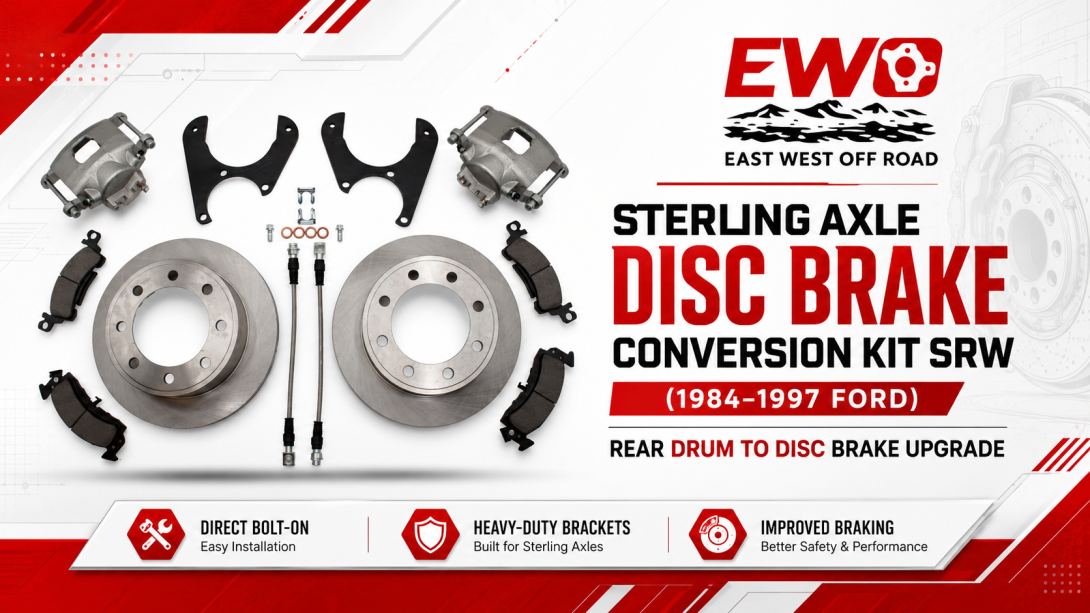
A ford sterling disc brake conversion is a practical upgrade for owners of compatible older Ford Sterling Single Rear Wheel axles who want to replace the factory rear drum setup with a modern rotor-and-caliper braking system. For classic F-250 and F-350 builds, tow rigs, off-road trucks, restorations, and custom axle swaps, converting the rear brakes can simplify inspection and maintenance while updating the axle with more service-friendly components.
The East West Off Road Sterling Axle Disc Brake Conversion Kit SRW is designed for 1984–1997 Ford Sterling SRW applications and provides selectable parking-brake-caliper and steel-braided-hose options. The key to a successful conversion is identifying the exact axle first and making sure the new rear brakes work correctly with the truck's wheels, hydraulic system, parking brake, and overall brake balance.
What Is a Ford Sterling Disc Brake Conversion?
A Sterling rear disc conversion removes the primary drum-brake hardware and replaces it with components that support a disc brake system.
A traditional rear drum arrangement typically uses:
- Brake drums
- Brake shoes
- Wheel cylinders
- Return springs
- Adjusters
- Drum-specific retaining hardware
A disc conversion instead uses a system centered around:
- Brake rotors
- Hydraulic calipers
- Disc brake pads
- Caliper brackets
- Brake hoses
- Mounting hardware
Depending on the selected kit, parking-brake hardware may also be incorporated.
The exact contents vary between manufacturers, so buyers should verify what is included rather than assuming every drum to disc brake conversion kit is identical.
Why Convert a Sterling Axle From Drum Brakes to Disc Brakes?
Ford's Sterling axles are well known in heavy-duty truck and off-road applications, but many older versions were equipped with large rear drum brakes.
Owners commonly convert them to discs for several reasons.
Easier Brake Inspection
Disc pads and rotors are generally easier to inspect visually than shoes and hardware hidden inside a drum.
Simpler Routine Service
Servicing pads and calipers can be more straightforward than dealing with multiple drum springs, retainers, shoes, and adjusters.
Modern Brake Architecture
A rotor-and-caliper system gives an older truck a more contemporary rear-brake layout.
Off-Road Serviceability
Mud, water, and debris are common on trail-driven trucks. A more open disc-brake arrangement can be easier to inspect and clean after off-road use.
Useful for Restomods and Axle Swaps
A rear disc conversion can make sense when a Sterling axle is already being rebuilt or installed into a custom vehicle.
Which Ford Sterling Axles Are Commonly Converted?
Older Ford Sterling full-float axles are common in heavy-duty pickup applications.
You may encounter references to:
- Sterling 10.25
- Sterling 10.5
- SRW axles
- DRW axles
- 8-lug configurations
- Multiple axle generations
These terms should not be treated as interchangeable.
A conversion designed for one generation or hub arrangement may not fit another.
Current competitor kits commonly separate SRW and DRW applications, which reinforces the importance of verifying the actual axle rather than shopping by “Sterling axle” alone.
What Does SRW Mean?
SRW stands for Single Rear Wheel.
An SRW truck uses one rear wheel on each side of the axle.
A DRW, or Dual Rear Wheel truck, uses two wheels on each side.
That difference can affect:
- Hub geometry
- Rotor placement
- Caliper-bracket offset
- Wheel fitment
- Brake component clearance
The EWO kit discussed here is specifically positioned as an SRW disc brake conversion.
Do not assume it fits a DRW or dually axle.
Ford Sterling 10.25 Disc Brake Conversion
The Sterling 10.25 is one of the most common axles associated with older Ford rear disc conversions.
A ford 10.25 disc brake kit replaces the original rear drum architecture with a rotor-and-caliper system appropriate for the specific axle.
Before purchasing, verify:
- Actual Sterling axle type
- Model year or axle generation
- SRW configuration
- Lug pattern
- Hub arrangement
- Wheel diameter
- Backspacing
- Brake hose requirements
- Parking-brake requirements
Current Sterling 10.25 competitor kits specifically distinguish 1985–1992 from 1993–1997 versions in their installation details, showing why the exact axle generation matters even within the same axle family.
Does This Kit Fit a Ford Sterling 10.5?
A ford 10.5 sterling brake conversion is related to the same broad axle family, but you should not assume a kit for an older Sterling SRW axle automatically fits every later 10.5 configuration.
Possible differences include:
- Hub geometry
- Factory brake setup
- Lug pattern
- Bracket mounting
- Rotor offset
- Axle housing details
The EWO product should be selected according to its listed 1984–1997 Ford Sterling SRW application.
If you have a later Sterling 10.5 or an axle swap, confirm compatibility before ordering.
Why Axle Identification Comes First
A 30-year-old Ford truck may not still have the axle it left the factory with.
Previous owners may have installed:
- A different Sterling axle
- A later-model axle
- A DRW axle
- Custom hubs
- Different wheel studs
- Modified brake components
- An axle from another truck
That makes physical axle verification essential.
Before ordering a ford sterling disc brake conversion, identify the actual rear axle rather than relying only on the truck's model year.
What Does a Drum-to-Disc Conversion Actually Change?
The core difference is the way braking force is applied.
Drum Brake Operation
In a drum system, brake shoes expand outward against the inner surface of the drum.
Disc Brake Operation
In a disc system, caliper pistons push brake pads against both sides of a rotating rotor.
The conversion changes:
- Friction components
- Hydraulic hardware
- Component mounting
- Brake servicing
- Parking-brake arrangement
- Inspection access
That is why a conversion should be approached as a complete brake-system change rather than simply swapping one friction surface for another.
Benefits of Sterling Rear Axle Disc Brakes
A correctly installed sterling rear axle disc brakes setup can offer several practical benefits.
More Accessible Components
Pads, calipers, and rotors can generally be inspected without removing a large brake drum.
Easier Pad Replacement
Disc pads usually involve fewer internal springs and adjuster pieces than a traditional drum assembly.
Better Exposure to Cooling Air
Brake rotors are exposed to airflow, helping them release heat created during repeated braking.
Easier Trail Inspection
Off-road users can inspect the brakes more quickly after water, mud, sand, or rock exposure.
Cleaner Restomod Packaging
A disc conversion can complement a broader modernized drivetrain and chassis build.
Does a Disc Conversion Automatically Improve Stopping Distance?
No.
This is an important distinction.
A truck braking performance upgrade depends on the entire braking system, including:
- Front brakes
- Rear brakes
- Tires
- Master cylinder
- Brake booster
- Brake fluid
- Hydraulic line condition
- Brake bias
- Pad compound
- Vehicle weight
- Road surface
A rear conversion may change serviceability, heat behavior, component configuration, and braking characteristics, but no single kit should be assumed to guarantee shorter stopping distance under every condition.
Why Rear Brake Balance Matters
The rear axle should contribute the correct amount of braking relative to the front.
If rear braking force is too high, the rear tires may lock prematurely.
If it is too low, the front brakes may carry too much of the braking load.
A conversion changes calipers, rotors, and potentially hydraulic volume.
That means overall brake balance deserves attention after installation.
Depending on the vehicle, this may involve reviewing:
- Proportioning
- Master-cylinder compatibility
- Caliper piston area
- Rotor size
- Front brake configuration
- Tire traction
A qualified brake professional can help evaluate a heavily modified system.
Parking Brake Calipers: Why the Option Matters
Parking-brake compatibility is one of the most important decisions in a rear disc conversion.
The current EWO product page offers a selectable parking-brake caliper upgrade.
A standard hydraulic caliper does not automatically provide mechanical parking-brake functionality.
Why Keep a Parking Brake?
A parking brake can be important for:
- Parking on grades
- Manual-transmission trucks
- Service and repair work
- Vehicle inspections
- Emergency backup
- Tow rigs
- Work trucks
Before choosing your kit configuration, determine whether mechanical parking-brake functionality is required for your vehicle.
Parking Brake Cable Compatibility
Even when a parking-brake-capable caliper is used, the truck's existing cable system may not connect directly.
A custom setup may require:
- Cable adapters
- Different cable lengths
- Modified routing
- Custom brackets
- Additional adjustment
Competitor Sterling kits commonly list optional emergency-brake calipers and cables separately, demonstrating why this should be planned before installation.
Steel-Braided Brake Hoses
The EWO kit also offers an optional steel-braided brake-hose upgrade.
Brake hoses connect the rigid hydraulic lines to moving brake components.
A braided hose can be attractive for a custom or off-road build, but correct fitment and routing remain essential.
Check:
- Hose length
- Fitting compatibility
- Clearance
- Abrasion points
- Suspension droop
- Suspension compression
- Wheel movement
Why Hose Routing Is a Safety Issue
A flexible brake hose should never be stretched, twisted, pinched, or rubbed.
Improper routing can cause contact with:
- Wheels
- Tires
- Suspension brackets
- Axle housing
- Sharp metal edges
- Exhaust components
After installing a rear axle brake conversion kit, inspect hose routing throughout expected suspension movement.
Rear Disc Brake Conversion for Off-Road Trucks
A rear disc brake conversion truck project is especially common on older trail rigs and custom axle builds.
Off-road brakes may be exposed to:
- Mud
- Water
- Dust
- Rocks
- Sand
- Repeated downhill braking
A disc brake system provides easier access for inspection and cleaning after demanding trail use.
That does not eliminate maintenance.
Trail-driven brakes should still be checked frequently for:
- Pad wear
- Rotor damage
- Hose abrasion
- Loose hardware
- Fluid leakage
- Parking-brake operation
Disc Conversion for Tow Rigs
Heavy Ford trucks equipped with Sterling axles are commonly used for towing.
A heavy duty brake conversion kit may therefore be part of a broader tow-rig brake overhaul.
However, towing adds significant variables.
Inspect:
- Front brake capacity
- Rear brake condition
- Trailer brakes
- Brake controller
- Tires
- Brake fluid
- Hydraulic system
- Vehicle and trailer weight
Do not treat the rear disc conversion as a substitute for properly functioning trailer brakes or front brakes.
Disc Brakes and Brake Fade
Repeated braking generates heat.
Disc brakes have an exposed rotor that can transfer heat to surrounding air.
This can be advantageous in repeated braking situations.
However, fade resistance depends on:
- Pad material
- Rotor size
- Brake fluid
- Vehicle weight
- Speed
- Front/rear braking distribution
- Cooling conditions
A high performance brake kit truck setup should therefore be evaluated as a system.
Master Cylinder Compatibility
One common question after a rear disc swap is whether a new master cylinder is required.
There is no universal answer.
The correct master-cylinder setup depends on:
- Caliper piston volume
- Front brake configuration
- Master-cylinder bore
- Brake pedal ratio
- Booster
- Hydraulic system design
If brake pedal travel or feel changes significantly after conversion, the cause should be diagnosed before driving normally.
Brake Booster Considerations
A rear disc conversion does not automatically require a different brake booster.
But the existing booster must still function correctly.
A failing booster can cause:
- High pedal effort
- Poor assist
- Inconsistent braking feel
If the truck already has brake-assist issues, repair those before evaluating the final behavior of the disc conversion.
Ford Truck Brake Upgrade Planning
A complete ford truck brake upgrade should consider much more than the rear axle.
Possible components include:
- Front pads
- Front rotors
- Front calipers
- Rear disc conversion
- Brake hoses
- Hard brake lines
- Master cylinder
- Booster
- Proportioning
- Brake fluid
- Tires
Balanced braking is more important than simply installing large individual components.
Wheel Clearance Is Critical
Rear disc calipers require different wheel clearance than drums.
Before finalizing an SRW disc brake conversion, verify:
- Wheel diameter
- Wheel barrel shape
- Offset
- Backspacing
- Caliper position
- Rotor dimensions
Current competitor kits may publish specific wheel-clearance claims, such as compatibility with certain factory wheel sizes. Those specifications apply to those products and should not automatically be transferred to the EWO kit.
Lug Pattern and Hub Configuration
Sterling axles from different generations can use different wheel and hub arrangements.
Check the actual:
- Lug pattern
- Hub design
- Rotor mounting arrangement
- Wheel type
Some competitor kits specifically target older 8×6.5 Sterling configurations and exclude later metric-pattern versions.
Use the EWO fitment information for the EWO product rather than assuming competitor compatibility applies.
What Should You Inspect During the Conversion?
Removing the factory drums gives you an excellent opportunity to inspect the axle.
Check:
- Wheel bearings
- Wheel seals
- Hub surfaces
- Studs
- Brake hard lines
- Hose mounting
- Axle leaks
- Fasteners
- Differential condition
A leaking axle seal should be repaired before new pads and rotors are installed.
Why Oil and Grease Contamination Matter
Brake friction surfaces must remain clean.
Contamination from:
- Gear oil
- Bearing grease
- Brake fluid
- Anti-seize
- Dirty solvents
can reduce friction and damage brake pads.
If the old drum assembly shows signs of axle-seal leakage, repair the leak first.
Ford Sterling Brake Conversion Installation Planning
Before starting the conversion:
- Confirm the axle.
- Verify SRW fitment.
- Review kit contents.
- Confirm parking-brake requirements.
- Verify wheel clearance.
- Inspect brake hard lines.
- Inspect the master cylinder and booster.
- Gather the correct brake fluid.
- Review the manufacturer's instructions.
- Arrange professional installation if needed.
Brake components are safety-critical hardware.
Do not begin the project without understanding the complete installation.
Caliper Bracket Positioning
The caliper bracket determines where the caliper sits relative to the rotor.
Incorrect positioning can cause:
- Rotor contact
- Uneven pad engagement
- Caliper misalignment
- Hardware interference
Use the brackets and hardware exactly as specified for the kit.
Do not copy spacer arrangements from a different manufacturer's conversion.
Differences Between Early and Later Sterling Axles
The Sterling 10.25 family includes variations within its production years.
Current competitor installation guidance, for example, distinguishes between earlier and later SRW axles and uses different bracket-spacing procedures.
That is another reason to verify your axle generation before installation.
Even when two axles share the Sterling 10.25 name, their installation details may differ.
Rotor and Caliper Alignment
Once mounted, the rotor should sit correctly within the caliper.
Verify:
- Rotor centering
- Pad alignment
- Bracket position
- Rotor runout where applicable
- Hardware clearance
If components do not align naturally, stop and determine why.
Do not force the caliper or bracket into position.
Caliper Bleeder Orientation
Hydraulic brakes must be completely bled after installation.
The caliper bleeder needs to be positioned so trapped air can escape from the system.
An incorrectly oriented caliper may trap air and cause a soft pedal.
Always follow the installation instructions for the exact calipers supplied.
Bleeding the Brake System
Whenever hydraulic brake lines are opened, air can enter the system.
Air causes a soft or spongy brake pedal because it compresses under pressure.
Before driving:
- Bleed the system fully
- Check fluid level
- Inspect all connections
- Confirm no leaks
- Verify pedal firmness
- Recheck hose routing
If the pedal does not feel correct, do not drive the vehicle until the problem is identified.
Bedding New Pads and Rotors
New brake components often require a bedding process.
Bedding helps establish consistent contact between pads and rotors.
The exact procedure depends on the friction material and rotor manufacturer.
Follow the instructions for the actual parts supplied with your conversion.
Drum-to-Disc Conversion and Weight Reduction
Some Sterling conversion manufacturers advertise large reductions in unsprung weight compared with factory drum systems.
Those claims are product-specific.
The amount of weight saved depends on the exact:
- Drum assembly
- Hub
- Rotor
- Caliper
- Brackets
- Hardware
Do not apply a competitor's advertised weight reduction automatically to the EWO kit.
How a Disc Conversion Changes Maintenance
A disc conversion changes the types of parts you inspect and service.
After conversion, routine rear-brake maintenance typically focuses on:
- Brake pad thickness
- Rotor condition
- Calipers
- Caliper hardware
- Brake hoses
- Hydraulic fittings
- Parking-brake mechanism
For many truck owners, that simpler visual access is one of the biggest reasons to make the change.
Is a Sterling Disc Conversion Good for a Restoration?
It depends on the goal.
Factory Restoration
If originality is the priority, rebuilding the original rear drums may be preferable.
Restomod
If the truck is being modernized with updated suspension, drivetrain, wheels, or other components, rear discs may fit the overall project better.
Functional Work Truck
For a truck that works regularly, serviceability and replacement-part access may be more important than factory originality.
Rebuild the Drums or Convert to Discs?
Both approaches have valid use cases.
Keep or Rebuild Drums If:
- Factory originality matters
- The existing system works correctly
- Replacement parts are readily available
- The truck remains mostly stock
Consider Disc Conversion If:
- The drum system needs extensive rebuilding
- You want easier inspection
- The truck is already being modified
- The Sterling axle is part of an axle swap
- You prefer disc brake servicing
- You need a modernized rear brake setup
What to Compare When Shopping for a Conversion Kit
When comparing products, check:
Fitment
Does it fit your actual axle and SRW configuration?
Included Components
Does the kit include rotors, calipers, pads, hoses, brackets, and hardware?
Parking Brake
Is a parking-brake solution included or optional?
Brake Hoses
Are standard or braided hoses available?
Wheel Requirements
Will your current wheels clear the calipers?
Replacement Parts
Can pads, rotors, calipers, and hoses be sourced later?
Installation
Does the kit bolt on, weld on, or require machining?
Competitor products vary significantly in these areas. Some are bolt-on SRW packages, while other Sterling conversions are explicitly weld-on systems.
Why Replacement-Part Availability Matters
A brake conversion may stay on the truck for many years.
Wear components will eventually need service.
Before buying, consider future access to:
- Brake pads
- Rotors
- Calipers
- Brake hoses
- Parking-brake components
A kit using easily serviceable components can make long-term ownership simpler.
Who Should Consider the EWO Sterling SRW Kit?
The EWO kit may be worth considering if your build involves:
- A compatible 1984–1997 Ford Sterling SRW axle
- A classic Ford truck
- An F-Series restomod
- An off-road build
- A tow or work truck
- A custom axle swap
- A rear brake modernization project
You can review the current sterling axle disc brake conversion kit configuration directly before ordering.
What Makes the EWO Product Relevant?
The current EWO E2055 listing centers on:
- 1984–1997 Ford Sterling SRW application
- Rear drum-to-disc conversion
- Selectable parking-brake calipers
- Selectable steel-braided brake hoses
That directly addresses several of the key considerations buyers research before making a Sterling conversion.
Before-You-Buy Checklist
Before purchasing your rear axle brake conversion kit, confirm:
- Actual Sterling axle
- SRW rather than DRW configuration
- Axle generation
- Lug pattern
- Hub arrangement
- Wheel clearance
- Parking-brake needs
- Brake hose selection
- Hydraulic system condition
- Master-cylinder condition
- Brake booster condition
- Front brake condition
- Installation requirements
This is especially important on older modified trucks where factory specifications may no longer reflect what is actually installed.
Safety After Installation
Before road testing:
- Check every brake fitting for leaks
- Confirm a firm pedal
- Verify brake fluid level
- Test the parking brake
- Inspect wheel clearance
- Recheck hardware
- Confirm hose routing
- Verify both rear brakes operate properly
Initial testing should be performed carefully in a controlled environment.
Final Thoughts
A ford sterling disc brake conversion can be a smart way to modernize a compatible older Ford Sterling SRW axle and replace complex rear drum hardware with a more accessible rotor-and-caliper system.
The upgrade can make particular sense for:
- Restomods
- Tow rigs
- Trail trucks
- Axle swaps
- Older work trucks
- Custom 4x4 builds
But correct fitment comes first.
Confirm the axle, SRW configuration, wheel setup, parking-brake requirements, brake hoses, and hydraulic system before placing your order.
The East West Off Road Sterling Axle Disc Brake Conversion Kit SRW provides a dedicated option for the listed 1984–1997 Ford application, along with selectable parking-brake and braided-hose upgrades.
Plan the complete brake system rather than the rear axle alone, and have safety-critical installation work inspected professionally whenever necessary.
Frequently Asked Questions (FAQs)
What is a Ford Sterling disc brake conversion?
It replaces compatible rear drum brake components on a Ford Sterling axle with a disc brake setup using rotors, calipers, pads, brackets, hoses, and related hardware.
What Sterling axle does the EWO kit fit?
The current EWO E2055 listing identifies the kit for 1984–1997 Ford Sterling SRW applications.
What does SRW mean?
SRW means Single Rear Wheel, with one wheel on each side of the rear axle.
Does the SRW kit fit a dually?
Do not assume so. DRW axles may use different hub, wheel, rotor, and brake-bracket geometry.
Is the Sterling 10.25 a common candidate for disc conversion?
Yes. The older Sterling 10.25 full-float SRW axle is a common application for aftermarket rear disc conversions.
Does the EWO kit fit every Sterling 10.25?
Verify the exact axle and current product fitment before purchasing. Different generations and previous modifications can affect compatibility.
Does it fit a Ford Sterling 10.5?
Do not assume 10.25 and 10.5 compatibility. Confirm the exact application with the manufacturer.
What years are commonly associated with older Sterling SRW drum axles?
Aftermarket kits commonly target approximately the mid-1980s through 1997 Sterling SRW applications. The EWO listing specifically states 1984–1997.
Why convert drum brakes to discs?
Common reasons include easier inspection, simpler pad servicing, modernizing an older truck, and building a custom axle or off-road vehicle.
Does a disc conversion guarantee better stopping distance?
No. Stopping performance depends on the entire brake system, tires, vehicle weight, hydraulic balance, and road conditions.
Does EWO offer parking-brake calipers?
Yes. The current product page lists parking-brake calipers as a selectable upgrade.
Does the kit offer braided brake hoses?
Yes. Steel-braided brake hoses are currently available as an option on the EWO listing.
Do I need a parking brake?
For many street-driven vehicles, a functional parking brake is important for safety, inspection, and normal use. Requirements can vary by jurisdiction.
Can the stock parking-brake cable be reused?
Compatibility depends on the caliper, cable arrangement, and truck. Custom cables or adapters may be required.
Do I need a new master cylinder?
Not automatically. Compatibility depends on the complete hydraulic setup and caliper requirements.
Do I need a proportioning valve?
Some conversions may require brake-balance adjustments. Have the completed system evaluated if needed.
Will factory wheels clear the calipers?
That depends on the specific wheel and conversion components. Verify wheel-barrel and caliper clearance before driving.
Do the brakes need to be bled after the conversion?
Yes. Opening the hydraulic system requires proper bleeding before the vehicle is driven.
Can I install a Ford Sterling disc conversion myself?
Experienced mechanics may be able to perform the conversion, but brake systems are safety-critical. Professional installation is recommended if you are uncertain about any part of the work.
What should I inspect while the axle is apart?
Inspect wheel bearings, seals, hubs, studs, brake lines, hoses, leaks, and related axle hardware.
Is a Sterling disc conversion good for off-road use?
It can be attractive for off-road builds because disc components are accessible for inspection and cleaning after trail use.
Is the conversion suitable for towing?
It can be part of a tow-rig brake upgrade, but the complete brake system—including front brakes and trailer brakes—must be properly maintained and matched to the load.
Should I rebuild the drums or convert to discs?
Rebuild drums when originality or stock configuration matters. Consider discs when easier servicing, modernization, or custom-build requirements are priorities.
Where can I buy the EWO Ford Sterling disc brake conversion kit?
The EWO Sterling Axle Disc Brake Conversion Kit SRW for the listed 1984–1997 Ford application is available through the Buy Now link at the top of this guide.