
The global Food and Beverage Packaging Market is witnessing steady growth as food manufacturers, beverage producers, retailers, and consumers increasingly require packaging that provides product protection, convenience, safety, and longer shelf life. Packaging plays an important role throughout the food supply chain by protecting products during transportation, storage, and retail distribution.
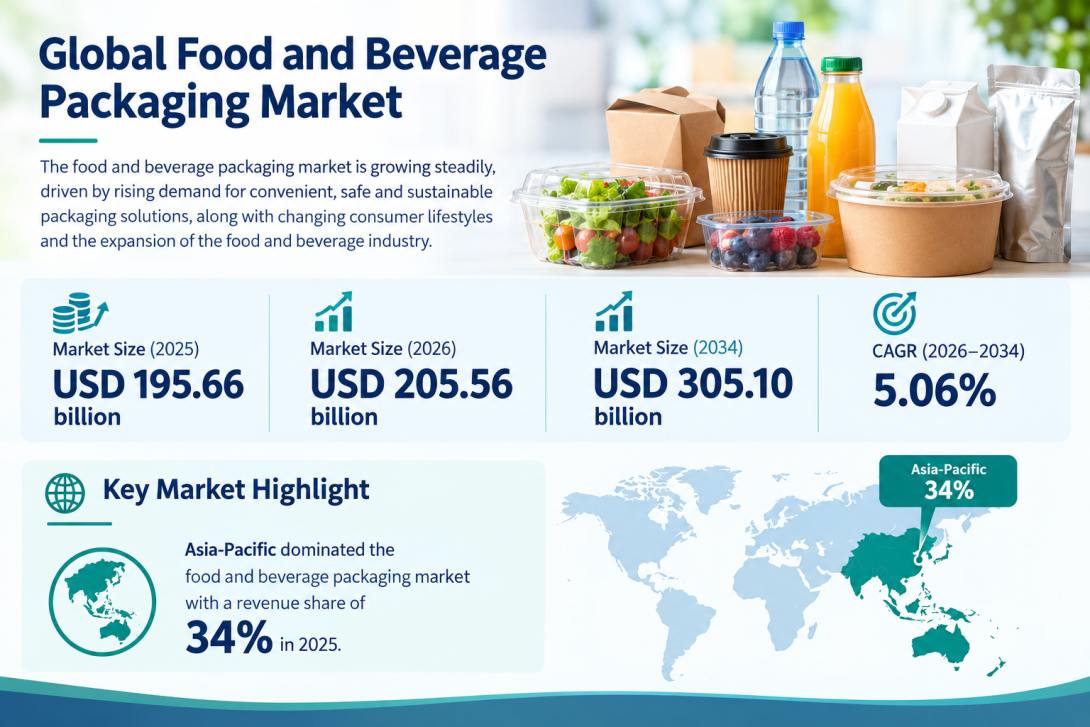
According to Fortune Business Insights, the global Food and Beverage Packaging Market size was valued at USD 195.66 billion in 2025. The market is projected to grow from USD 205.56 billion in 2026 to USD 305.10 billion by 2034, exhibiting a CAGR of 5.06% during the forecast period. Asia Pacific dominated the global market with a revenue share of 34% in 2025.
Rising Demand for Packaged Food and Beverages
The growing consumption of packaged food and beverages is one of the major factors supporting market expansion. Changing lifestyles, urbanization, busy work schedules, and increasing demand for convenient food products are encouraging consumers to purchase ready-to-eat meals, processed foods, packaged snacks, and beverages.
Packaging allows manufacturers to protect food products from contamination while supporting transportation and storage. The continued expansion of supermarkets, convenience stores, food delivery services, and online grocery platforms is also creating demand for efficient packaging solutions.
Growing Focus on Product Safety and Shelf Life
Food safety remains an important consideration for manufacturers and consumers. Packaging solutions help protect products from moisture, oxygen, light, microorganisms, and physical damage, depending on the type of packaging used.
Technological developments in packaging materials and formats are enabling manufacturers to improve product preservation and extend shelf life. Modified-atmosphere packaging, barrier packaging, aseptic packaging, and other technologies are being adopted for products requiring specialized protection.
For detailed market insights : https://www.fortunebusinessinsights.com/food-and-beverage-packaging-market-108086
Packaging Material Analysis
The Food and Beverage Packaging Market includes packaging manufactured from plastic, paper and paperboard, glass, metal, and other materials.
Plastic remains widely used because of its lightweight characteristics, versatility, durability, and suitability for multiple packaging formats. Paper and paperboard are increasingly being considered for applications where recyclability and renewable material content are important considerations.
Glass continues to be used for beverages, sauces, and other products where product visibility and barrier properties are required. Metal packaging is widely used for canned food and beverages because of its strength, durability, and protective characteristics.
Packaging Type Analysis
Based on packaging type, the market includes rigid packaging and flexible packaging.
Rigid packaging is used across a wide range of food and beverage applications, including bottles, cans, jars, containers, and trays. Its structural strength provides protection during transportation and storage.
Flexible packaging includes pouches, films, wraps, and bags. Its lightweight design and ability to use less material in certain applications have increased its adoption across snacks, processed foods, frozen products, and beverages.
Application Analysis
The market serves various applications, including food products, beverages, dairy products, bakery and confectionery, meat and seafood, fruits and vegetables, and other food and beverage categories.
Beverage packaging represents an important application area, with bottles, cans, cartons, and other formats used for water, soft drinks, juices, alcoholic beverages, and other products. Meanwhile, packaged food manufacturers are increasingly adopting convenient formats designed for transportation, storage, and consumption.
The expansion of processed and ready-to-eat food categories is expected to create additional opportunities for packaging manufacturers.
Sustainability and Packaging Innovation
Environmental concerns are influencing the development of food and beverage packaging. Manufacturers are increasingly exploring recyclable, reusable, lightweight, and alternative-material packaging solutions.
The industry is also focusing on reducing packaging waste and improving material efficiency. Innovations in bio-based materials, recyclable structures, lightweight packaging, and improved collection and recycling systems are expected to influence product development during the forecast period.
Regional Analysis
Asia Pacific dominated the Food and Beverage Packaging Market in 2025, accounting for a 34% revenue share. The region's strong position is supported by a large consumer base, rapid urbanization, expanding food and beverage industries, and increasing consumption of packaged products.
Countries across Asia Pacific are witnessing growth in organized retail, food delivery, e-commerce, and processed food consumption. These trends are contributing to increased demand for packaging across multiple food and beverage categories.
North America represents another important market, supported by established food processing industries, widespread packaged food consumption, and demand for convenient packaging formats. Europe is also focusing on packaging innovation, recycling, and sustainable material solutions.
Meanwhile, markets in Latin America and the Middle East & Africa are expected to benefit from growing urban populations, changing consumption patterns, and expanding food and beverage production capabilities.
Competitive Landscape
The competitive landscape of the Food and Beverage Packaging Market includes manufacturers offering flexible packaging, rigid containers, paper-based solutions, glass packaging, metal packaging, and other specialized formats.
Companies are focusing on product development, material innovation, sustainability, manufacturing capacity expansion, and strategic partnerships. The increasing importance of recyclable and lightweight packaging is also encouraging market participants to invest in new materials and production technologies.
Recent Industry Developments
Recent industry developments have focused on sustainable packaging, lightweight designs, recyclable materials, and improved product protection. Manufacturers are working to balance packaging performance with environmental considerations while meeting the requirements of food and beverage producers.
The development of new flexible structures, paper-based packaging formats, recyclable plastics, and advanced barrier materials is expected to support innovation across the industry.
Get Free Sample PDF: https://www.fortunebusinessinsights.com/enquiry/request-sample-pdf/food-and-beverage-packaging-market-108086
Future Outlook
The Food and Beverage Packaging Market is expected to maintain steady growth through 2034 as packaged food consumption, beverage demand, e-commerce, food delivery, and convenience-oriented lifestyles continue to expand.
The market is projected to increase from USD 205.56 billion in 2026 to USD 305.10 billion by 2034, registering a CAGR of 5.06% during the forecast period. Asia Pacific is expected to remain an important market due to its large consumer base and expanding food and beverage industries, while sustainability, packaging efficiency, and material innovation will continue to shape the industry's future development.
Related Reports
What Everyone Should Know About Japan’s Market - Food and Beverage Packaging Market - Insights