
The global Fiber Reinforced Polymer (FRP) Composites Market Share is witnessing significant growth as industries increasingly adopt lightweight, durable, and high-performance materials. FRP composites are manufactured by combining polymer resins with reinforcing fibers, such as glass, carbon, and aramid. These materials offer excellent strength-to-weight ratios, corrosion resistance, and design flexibility, making them suitable for transportation, construction, aerospace, electronics, and other industrial applications.
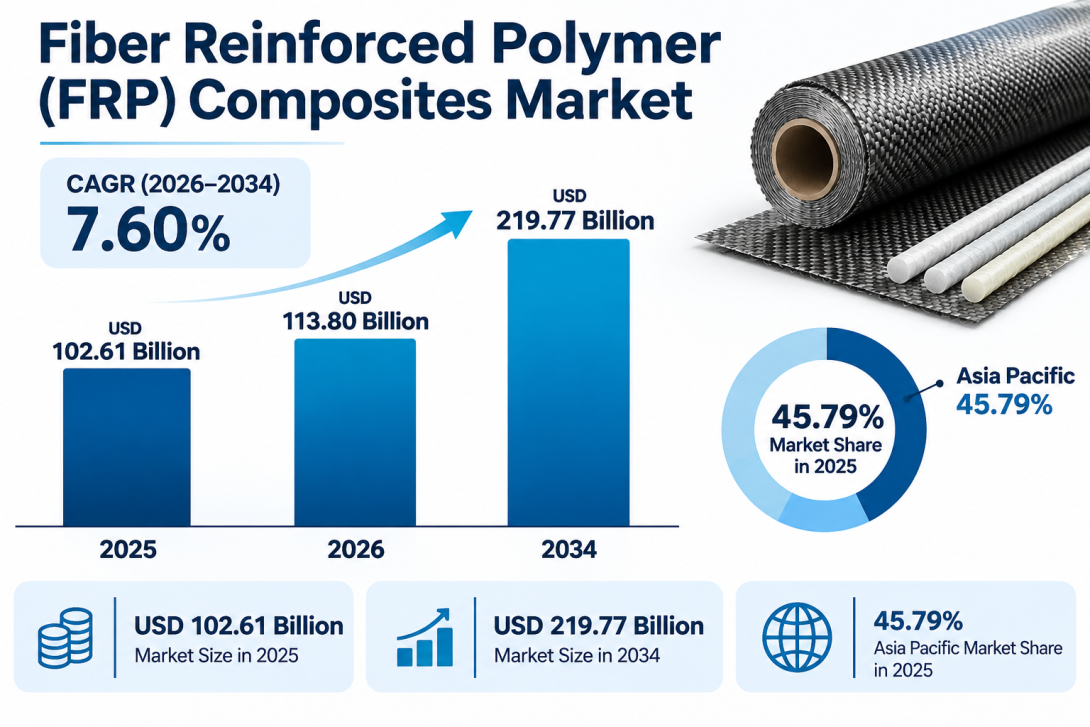
According to Fortune Business Insights, the global Fiber Reinforced Polymer (FRP) composites market size was valued at USD 102.61 billion in 2025. The market is projected to grow from USD 113.80 billion in 2026 to USD 219.77 billion by 2034, registering a CAGR of 7.60% during the forecast period (2026–2034). Asia Pacific dominated the global market with a share of 45.79% in 2025. Increasing infrastructure development, rising electric vehicle production, and growing demand for lightweight industrial materials are supporting market expansion.
Increasing Demand for Lightweight and High-Performance Materials
The growing need for lightweight materials across various industries is a major factor driving the Fiber Reinforced Polymer Composites Market. Manufacturers are increasingly replacing traditional materials, including steel and aluminum, with FRP composites to improve product performance and reduce overall weight.
These materials provide high mechanical strength, durability, and resistance to environmental conditions. Their ability to withstand corrosion also makes them suitable for applications where conventional materials may require frequent maintenance or replacement.
Rising Adoption of FRP Composites in the Transportation Industry
The transportation industry represents an important application area for fiber reinforced polymer composites. Automotive manufacturers are increasingly using these materials in vehicle body panels, structural components, interior parts, and underbody applications.
The transition toward electric vehicles is further supporting market demand. Lightweight composite materials help reduce vehicle weight, improve energy efficiency, and extend driving range. Additionally, growing requirements for fuel-efficient vehicles and reduced emissions are encouraging automotive companies to invest in advanced composite technologies.
For detailed market insights : https://www.fortunebusinessinsights.com/fiber-reinforced-polymer-composites-frp-market-102905
Material Type Analysis
Based on type, the market is segmented into glass fiber-reinforced polymer, carbon fiber-reinforced polymer, and others.
Glass Fiber-Reinforced Polymer (GFRP): GFRP holds a dominant position in the market because of its affordability, corrosion resistance, strength, and flexibility. These materials are widely used in construction, automotive, transportation, and industrial applications. The segment is expected to account for a market share of 76.69% in 2026.
Carbon Fiber-Reinforced Polymer (CFRP): CFRP composites are known for their exceptional strength, stiffness, and lightweight characteristics. They are widely utilized in aerospace, automotive, sports equipment, and specialized construction applications. Increasing demand for high-performance materials is supporting segment growth.
Others: Other fiber-reinforced polymers include composites manufactured using different reinforcing fibers. These materials serve specialized industrial applications requiring specific mechanical and performance characteristics.
Application Analysis
Based on application, the market is categorized into transportation, construction, electronics, sports and leisure, and others.
Transportation: Transportation is a leading application segment, projected to account for 39.87% of the global market in 2026. FRP composites are used in automotive components, aircraft structures, marine equipment, and other transportation applications because of their lightweight construction and durability.
Construction: The construction industry is increasingly adopting FRP materials for structural reinforcement, concrete strengthening, building components, and infrastructure projects. Their corrosion resistance and extended service life make them suitable for bridges, buildings, and industrial structures.
Electronics: FRP composites are used in electronic components, including printed circuit boards and specialized equipment, due to their insulation and structural properties.
Sports & Leisure: These materials are utilized in products such as bicycles, tennis rackets, hockey sticks, and recreational equipment. Their lightweight characteristics help improve product performance.
Others: Additional applications include aerospace, marine, industrial equipment, and specialized manufacturing.
Regional Analysis
The global Fiber Reinforced Polymer Composites Market is divided into Asia Pacific, North America, Europe, Latin America, and the Middle East & Africa.
Asia Pacific: Asia Pacific dominated the global market with a share of 45.79% in 2025, reaching a valuation of USD 46.99 billion. Rapid industrialization, infrastructure development, expanding automotive production, and increasing construction activities are supporting regional growth.
North America: The regional market was valued at USD 26.20 billion in 2025. Strong demand from the aerospace, automotive, and construction industries, combined with technological advancements in composite manufacturing, is contributing to market expansion.
Europe: Europe recorded a market valuation of USD 23.47 billion in 2025. The presence of established automotive and aerospace industries and increasing emphasis on emission reduction are encouraging the adoption of lightweight composite materials.
Latin America: Growing construction and infrastructure investments are creating opportunities for FRP composite manufacturers. Demand for durable and corrosion-resistant materials is supporting regional development.
Middle East & Africa: Expanding infrastructure projects, industrial development, and construction activities are contributing to market growth. FRP composites are increasingly considered for applications requiring durability under challenging environmental conditions.
Competitive Landscape
Companies operating in the Fiber Reinforced Polymer Composites Market are focusing on technological innovation, research and development, production expansion, and strategic partnerships. Market participants are also developing advanced composite materials to improve manufacturing efficiency, durability, and sustainability.
Key companies operating in the market include:
- SGL Carbon
- Avient Corporation
- Hexcel Corporation
- Arvind Composites
- Owens Corning
- Mitsubishi Chemical Carbon Fiber and Composites Inc.
- Park Aerospace Corp.
- NIPPON STEEL Chemical & Material Co., Ltd.
- TORAY Industries, Inc.
- TEIJIN Limited
Recent Industry Developments
The FRP composites industry is witnessing advancements in sustainable materials, automated manufacturing, and recyclable composite technologies.
In July 2026, Teijin Limited developed a thermosetting long carbon fiber-reinforced plastic featuring heat-activated self-healing properties and chemical recyclability. This development aims to improve component durability and support material circularity.
In June 2026, Syensqo partnered with Bucci Composites to license Double Diaphragm Forming technology for high-volume automotive composite manufacturing. The collaboration aims to improve production efficiency and support the manufacturing of structural composite components.
Get Free Sample PDF: https://www.fortunebusinessinsights.com/enquiry/request-sample-pdf/fiber-reinforced-polymer-composites-frp-market-102905
Future Outlook
The Fiber Reinforced Polymer Composites Market is expected to experience steady growth through 2034, driven by increasing demand from transportation, construction, aerospace, and electronics industries. The growing adoption of electric vehicles and the need for energy-efficient materials will create additional opportunities for manufacturers.
Furthermore, advancements in recyclable fibers, sustainable resins, and automated production technologies are expected to improve the long-term potential of the industry. As companies continue prioritizing lightweight construction, durability, and operational efficiency, FRP composites are likely to gain wider acceptance across industrial applications. With a projected CAGR of 7.60% during 2026–2034, the market is positioned for continued expansion.
Related Report
Curious About Japan’s Market? Explore the Latest - Fiber Reinforced Polymer Composites Market Share - Insights