
The global Fake Image Detection Market is experiencing rapid growth as businesses, governments, and digital platforms seek reliable ways to identify manipulated and artificially generated images. The increasing use of artificial intelligence (AI) tools has made image creation and editing easier, but it has also increased concerns about misinformation, digital fraud, identity theft, and the misuse of visual content. Consequently, image authentication technologies are becoming increasingly important across multiple industries.
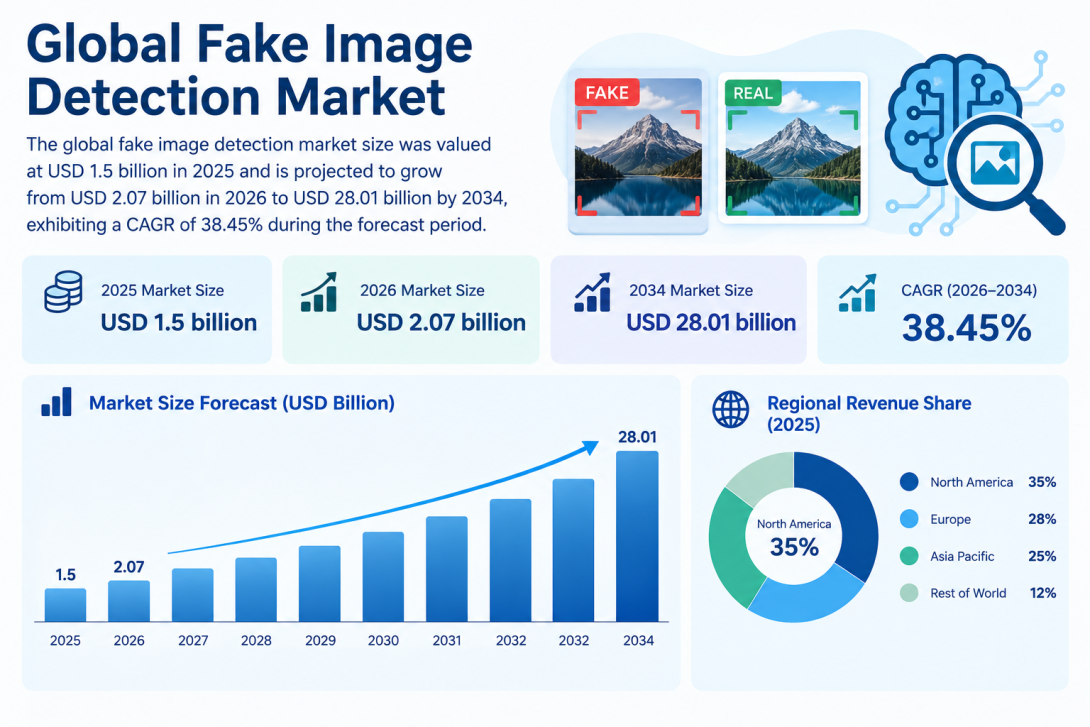
According to Fortune Business Insights, the global Fake Image Detection Market was valued at USD 1.5 billion in 2025. The market is projected to grow from USD 2.07 billion in 2026 to USD 28.01 billion by 2034, exhibiting a compound annual growth rate (CAGR) of 38.45% during the forecast period. North America dominated the market with a revenue share of 35% in 2025. Growing demand for digital verification, AI-powered security solutions, and content authentication is expected to support market expansion.
Rising Concerns About Digital Misinformation and Image Manipulation
The increasing circulation of manipulated images across social media, news platforms, and online communities is a major factor driving the Fake Image Detection Market. Edited photographs and AI-generated visuals can misrepresent events, damage reputations, and influence public opinion. Organizations increasingly require automated tools to determine whether an image has been altered or generated artificially.
Image detection solutions analyze visual patterns, metadata, inconsistencies, and other digital characteristics to identify potentially manipulated content. As image-based misinformation becomes more sophisticated, demand for advanced verification technologies is expected to increase.
Growing Adoption of Artificial Intelligence and Machine Learning
Artificial intelligence and machine learning are transforming image verification by enabling systems to analyze large volumes of digital content. These technologies can identify suspicious patterns, detect visual inconsistencies, and support the automated classification of authentic and manipulated images.
Machine learning models can be trained on different types of altered and synthetic images to improve detection capabilities. However, their performance depends on training data, image quality, and the manipulation techniques being examined. Continuous model development will remain important as image-generation technologies evolve.
For detailed market insights : https://www.fortunebusinessinsights.com/fake-image-detection-market-110220
Solution Type Analysis
The Fake Image Detection Market includes photoshopped image detection, deepfake image detection, real-time verification, AI-generated image detection, and other solutions such as content authentication and mobile applications.
Photoshopped image detection focuses on identifying edited photographs, altered objects, and inconsistencies within digital images. These solutions are useful for journalism, advertising, digital investigations, and content verification.
Deepfake image detection addresses synthetic or manipulated visuals designed to appear authentic. Increasing concerns about identity misuse, misleading content, and fraudulent digital representations are supporting demand for these solutions.
Real-time verification helps organizations assess images during content uploads, online transactions, and digital identity checks. AI-generated image detection focuses on identifying synthetic images created using generative AI systems. Other solutions provide specialized authentication and mobile-based verification capabilities.
Technology Analysis
Machine learning and AI represent important technologies within the Fake Image Detection Market. These approaches use trained algorithms to identify patterns associated with manipulated or artificially generated images. Their ability to process substantial volumes of content makes them useful for large digital platforms and enterprise applications.
Image processing and analysis technologies examine image structure, pixel characteristics, compression patterns, and other visual features. Combining these methods with AI can improve verification workflows and help investigators assess suspicious content. The growing complexity of synthetic media is expected to encourage further investment in detection technology.
Deployment Analysis
Based on deployment, the market is divided into cloud and on-premise solutions.
Cloud-based platforms offer scalability, remote accessibility, and flexible processing capacity. They can help organizations verify large volumes of images without maintaining extensive local infrastructure.
On-premise solutions provide organizations with greater control over their systems and data environments. They may be preferred by government agencies, financial institutions, and other organizations with strict security or data-handling requirements. Deployment decisions generally depend on operational needs, regulatory obligations, cost, and integration requirements.
Industry Analysis
The banking, financial services, and insurance (BFSI) sector uses image verification to support identity checks, fraud prevention, and the validation of digital documents. Government and defense organizations rely on image authentication for investigations, intelligence analysis, and digital evidence assessment.
Information technology and telecommunications companies require tools to manage digital content and protect online platforms. Media and entertainment organizations use detection technologies to verify images and maintain editorial credibility. Retail and e-commerce businesses can also benefit from image authentication when reviewing product listings, identifying suspicious visual content, and addressing fraudulent activity.
Regional Analysis
North America led the Fake Image Detection Market with a 35% revenue share in 2025. Strong adoption of AI technologies, advanced cybersecurity infrastructure, and increasing concerns about misinformation and digital fraud support regional demand.
Europe benefits from growing attention to digital trust, privacy, and online content governance. Media organizations, enterprises, and public institutions are potential adopters of image verification technologies.
Asia Pacific offers growth opportunities due to rapid digitalization, expanding internet usage, and increasing AI adoption. Demand from technology companies, e-commerce platforms, and government organizations may support regional expansion.
South America presents emerging opportunities as businesses strengthen digital security and online fraud prevention measures.
The Middle East & Africa may experience increased adoption as governments and enterprises invest in digital transformation, cybersecurity, and digital identity verification.
Competitive Landscape
The market includes technology providers developing solutions for image authentication, deepfake detection, digital forensics, and AI-driven content analysis. Competition is shaped by detection accuracy, processing speed, integration capabilities, scalability, and the ability to adapt to emerging image-generation methods.
Companies operating in this market include Canon, OpenAI, Microsoft Corporation, DuckDuckGoose AI, Reality Defender, Sensity AI, Primeau Forensics LTD., DeepWare AI, iProov, and Amped. Industry participants are focusing on improving detection methods and supporting the verification of increasingly realistic synthetic content.
Recent Industry Developments
Industry development is increasingly centered on automated image verification, AI-based forensic analysis, and the integration of authenticity checks into digital workflows. Cloud-based tools and application programming interfaces can help businesses incorporate image screening into existing platforms.
Another important development is the growing focus on content provenance, watermarking, and complementary authentication methods. Detection tools can produce false positives or miss sophisticated manipulations, making multiple verification methods and human review important in sensitive applications.
Get Free Sample PDF: https://www.fortunebusinessinsights.com/enquiry/request-sample-pdf/fake-image-detection-market-110220
Future Outlook
The Fake Image Detection Market is expected to experience substantial growth through 2034 as organizations place greater emphasis on digital trust, fraud prevention, and visual content authentication. According to Fortune Business Insights, the market is projected to reach USD 28.01 billion by 2034, growing at a CAGR of 38.45% during 2026–2034.
Future market opportunities will depend on advances in AI, improved detection accuracy, scalable deployment options, and integration with cybersecurity systems. As synthetic images become more realistic, organizations will increasingly need effective methods to evaluate visual authenticity. Continued innovation and responsible implementation are likely to make fake image detection an important component of the broader digital security ecosystem.
Related Reports
Uncover Japan’s Market Trends - Explore the Latest - Fake Image Detection Market - Insights