

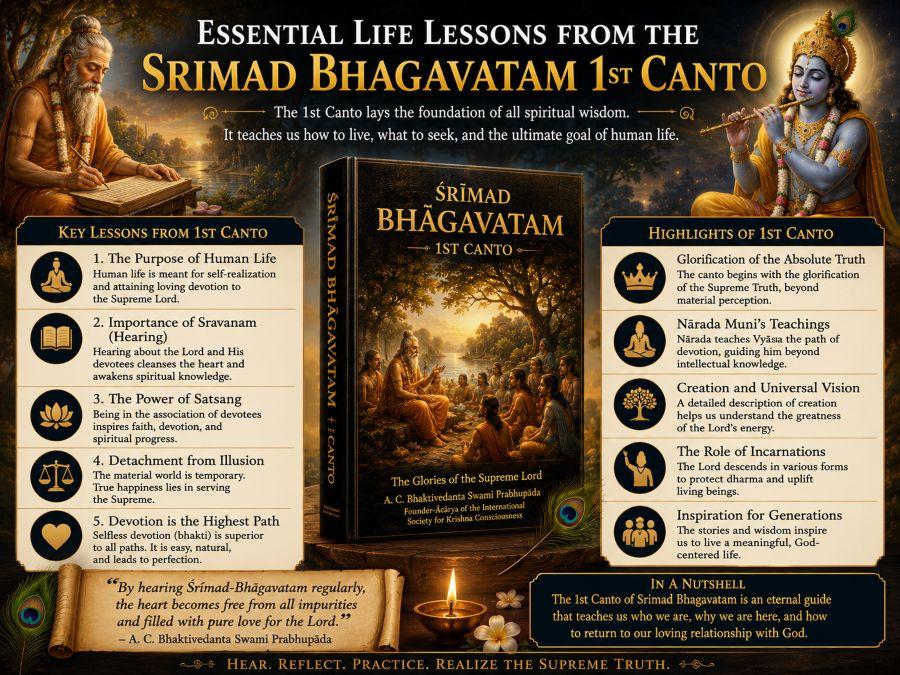
The Book That Begins Where All Others End
Most books begin with answers. The Srimad Bhagavatam begins with a question — and that single difference tells you everything about the kind of text you are dealing with.
Five thousand years ago, a gathering of sages settled into the forest of Naimisharanya for a thousand-year sacrifice dedicated to the welfare of all living beings. They had access to every scripture, every philosophical tradition, every form of Vedic knowledge available to humanity. And yet, when the learned Suta Gosvami arrived among them, their first words were not a request for ritual knowledge or cosmological data. They asked, with the directness of people who have exhausted easier questions: "What is the ultimate good for all people in all circumstances? Please tell us that one thing which, when heard and practiced, satisfies the soul completely."
That question — its urgency, its honesty, its refusal to settle for partial answers — is the doorway into the Srimad Bhagavatam 1st Canto. And the answer that unfolds across its nineteen chapters does not disappoint. It does not give you a list of rules. It does not offer a theology to memorize. It offers something far more radical: a complete reorientation of how a human being understands their own existence.
This article is a careful reading of the life lessons embedded in that First Canto — not as ancient curiosities but as living principles that apply to a Tuesday afternoon in the twenty-first century just as forcefully as they did to a forest gathering five millennia ago.
Lesson One: Ask the Right Question Before You Seek Any Answer
The very architecture of the First Canto teaches its first lesson before a single philosophical argument is made. The assembled sages at Naimisharanya were not ordinary people. They were scholars, practitioners, realized souls. They had studied. They had performed austerities. They had accumulated what any reasonable person would call wisdom.
And yet they chose to begin again — to sit down, to become students, to ask rather than declare.
This posture of genuine inquiry is rarer than it appears. Most people in positions of knowledge are defending what they already believe. The sages of Naimisharanya modeled something different: the willingness to hold knowledge lightly enough to receive something deeper.
The practical lesson here is not abstract. In daily life, the quality of your existence is largely determined not by how many answers you carry but by how honestly you can interrogate your assumptions. The person who believes they already understand why their relationships are failing, why their work feels hollow, why their inner life is dry — that person is closed to the very information that could change everything. The sages teach us to sit with the discomfort of not-knowing long enough to formulate the question that actually matters.
What is the one thing? Not the fifty things. Not the comprehensive program. The one thing, when properly received, that satisfies completely. That question alone is worth a week of honest reflection.
Lesson Two: The Purpose of Scripture Is the Welfare of All Beings
Suta Gosvami's opening glorification of the Bhagavatam in the First Canto contains a declaration that is easy to read past but should stop every thoughtful reader cold. He describes the Srimad Bhagavatam as the ripened fruit of the tree of Vedic literature, and he states explicitly that it was composed not for scholars, not for the already-devoted, but for the mumukshu — those earnestly seeking liberation — and beyond even them, for all suffering souls without discrimination.
This is a remarkable statement. The text announces its own purpose as universal welfare. Not the welfare of one community, one tradition, one caste, one era. All people. In all conditions. At all times.
The life lesson embedded here is one of orientation. Whatever work you do in this world — whether you write, teach, lead, build, cook, or simply raise children — the Bhagavatam is asking you to examine whose welfare it serves. Work that genuinely extends beyond personal interest and tribal loyalty has a quality and a durability that narrow work never achieves. This is not idealism. It is observed reality. The creations that last, the lives that leave genuine marks, are invariably those oriented toward something larger than the creator's own advancement.
The sages modeled this by choosing to spend a thousand years in collective inquiry for the benefit of future generations who would never know their names. The Bhagavatam records this choice as its own origin story. Purpose, it suggests, precedes and shapes everything that follows.
Lesson Three: Spiritual Knowledge Must Be Transmitted Through Living Relationship
One of the most structurally significant lessons of the First Canto is embedded not in any particular verse but in the entire format of the text's transmission. Suta Gosvami did not hand the sages a manuscript. He spoke to them. They asked; he answered. Questions arose; he clarified. The teaching moved between human beings who were present to each other.
This matters because the Bhagavatam is specifically concerned with the degraded conditions of the current age — an era the text calls Kali-yuga, characterized by shortened lifespan, diminished memory, restless minds, and the loss of institutional wisdom. In this age, the text insists, the highest knowledge cannot be transmitted through texts alone. It requires the parampara — a living chain of teacher and student, in which the knowledge passes not just as information but as realization.
This principle has immediate practical application. We live in an age of unprecedented information access and unprecedented wisdom poverty. The gap between what people know and how they live has never been wider. We can read every book on healthy relationships and still destroy ours. We can study every productivity framework and still waste decades. Information without transmission — without the kind of relational context that converts knowledge into understanding — remains inert.
The First Canto teaches that the seeking of a genuine teacher, a person who embodies rather than merely recites, is not a luxury for spiritual enthusiasts. It is a fundamental requirement for the knowledge that actually transforms a life.
Lesson Four: The Material World Offers No Permanent Refuge
Among the opening teachings that Suta Gosvami delivers, one carries a directness that can feel uncomfortable to contemporary ears: the material world, however beautiful and however compelling, offers no lasting shelter. Everything within it — wealth, fame, relationships, health, beauty, power — exists within the domain of time, and time without exception consumes them all.
The Bhagavatam does not deliver this teaching as a counsel of despair. It delivers it as a counsel of accuracy. The suffering that arises from misplaced investment — from pouring the entirety of one's hope and security into things that are constitutionally impermanent — is not a punishment. It is a natural consequence of a misidentification. The soul is eternal. Attaching eternal hope to temporal things creates a tension that no amount of achievement can resolve.
This lesson does not require you to abandon your career, your relationships, or your engagement with the world. The Bhagavatam is not advocating for monasticism as the only valid path. It is advocating for a specific kind of clarity about what you are doing and why. Enjoy the world. Engage with it fully. Love your people. Build your work. But do not mistake any of it for the final shelter. Hold it with the open hand rather than the clenched fist, and what you hold will bring genuine joy rather than the anxious grasping that poisons so many otherwise beautiful lives.
Lesson Five: The Hearing of Sacred Narrative Is Itself a Spiritual Practice
The First Canto introduces what may be the Bhagavatam's most distinctive and most frequently misunderstood contribution to spiritual practice: sravana, or sacred hearing.
In most Western religious frameworks, spiritual practice is understood primarily as something one does — prayer, meditation, ritual observance, ethical conduct. The Bhagavatam proposes something different as the supreme practice for this age: the act of deeply, devotionally, attentively hearing the glories of the Supreme Person. Not studying them analytically. Not debating them philosophically. Hearing them — with the full presence of body, mind, and heart — from a realized source.
The rationale is precise. The mind in the current age is uniquely susceptible to distraction and uniquely resistant to sustained internal practice. Most people cannot maintain concentrated meditation for extended periods. Most cannot perform elaborate rituals with the consistency required for result. But hearing — the simple act of receiving sound with open attention — is available to every human being regardless of their external circumstances, their level of education, or their stage of spiritual development.
The First Canto demonstrates this principle through its own narrative. The sages at Naimisharanya do not meditate their way to realization. They ask, they listen, and the very hearing transforms them. The transmission happens through sound received in a condition of sincere receptivity.
For the modern reader, this teaching opens a practical door. The practice of listening — to sacred texts, to qualified teachers, to music that genuinely opens the heart — is not a lesser practice. According to the Bhagavatam, it is the primary practice. The quality of your inner life may have less to do with the austerities you perform and more to do with what you choose to fill your ears with day after day.
Lesson Six: Great Souls Are Defined by What They Carry Others Toward
The First Canto introduces several figures whose lives serve as living lessons rather than mere biographical data. Chief among them in this opening section is Sukadeva Gosvami himself — the sage who will eventually narrate the entire Bhagavatam to the dying King Parikshit.
Sukadeva is described in the First Canto as a brahma-nishtha — one fully absorbed in the transcendent, self-satisfied, requiring nothing from the world. He had no social obligation to speak the Bhagavatam. He was not looking for students. He had, by every conventional measure, already arrived. And yet when the situation demanded — when a dying king needed what only this knowledge could provide — Sukadeva descended from his solitary absorption and sat for seven days, speaking with total generosity.
The lesson is not about what Sukadeva possessed. It is about what he chose to do with it. Realized knowledge that stays locked in private experience does not fulfill the Bhagavatam's understanding of its own purpose. The highest attainment, according to this text, naturally flows outward — not because the one who has attained it needs to share, but because the nature of genuine spiritual consciousness is compassion, and compassion cannot remain passive in the face of suffering.
In practical terms: what you know that could genuinely help others is not yours to hoard. The reluctance to share knowledge — from insecurity, from the hoarding instinct, from the fear of being wrong — is the precise opposite of the quality that the First Canto holds up as the mark of the great soul.
Lesson Seven: Time Is the Supreme Teacher and the Supreme Reminder
If there is one thread that runs through every chapter of the First Canto without interruption, it is the presence of time as a active philosophical force. The Sanskrit term kala — time — appears in the First Canto not as a neutral backdrop but as an agent. Time moves. Time teaches. And time, the Bhagavatam insists, is one of the faces of the Supreme Person.
This is a teaching that the modern world has largely suppressed. We live in a culture of extension — of anti-aging, of legacy-building, of productivity optimization — all of which share a common anxiety about time's movement. The First Canto does not offer to stop time or to make peace with it through distraction. It offers something more honest: the invitation to let time's movement teach you what actually matters.
The story of King Parikshit, introduced in the First Canto, makes this visceral. A man who has everything — power, virtue, family, legacy — receives notice that he has seven days to live. His response becomes the entire Bhagavatam. The deadline does not destroy him. It clarifies him. It strips away everything that was postponing his essential life and forces an encounter with the questions he had always planned to ask later.
The practical teaching is uncomfortable but valuable: do not wait for the seven-day notice. The clarity that Parikshit achieved under mortal pressure is available to you right now, if you are willing to hold the fact of your own finitude steadily enough to let it reorganize your priorities. What would you do differently today if you knew the number of your remaining days? Whatever that answer contains — begin there.
Lesson Eight: Devotion Without Motivation Is the Highest Human Achievement
Perhaps the most philosophically sophisticated lesson of the First Canto is introduced in Suta Gosvami's description of the ideal spiritual practice for the current age. He describes ahaituki and apratihata devotion — unmotivated and unobstructed. These two qualities together define the highest form of human spiritual engagement.
Unmotivated: not practiced for any result. Not for liberation. Not for material benefit. Not even for the experience of divine bliss. Practiced purely, the way a mother loves a child — not because of what the child provides but simply because the love is the love.
Unobstructed: not dependent on favorable circumstances. Not requiring a monastery, a temple, a community, a health condition, a level of learning, a social position. Available in poverty, in illness, in grief, in confusion, in the marketplace as fully as in the meditation chamber.
The combination of these two qualities — love that needs no reward and practice that needs no perfect condition — describes something the First Canto calls para dharma, the supreme occupation of the human being. It is the kind of orientation that transforms every ordinary moment into a spiritual act, because the quality of consciousness brought to any action determines its ultimate nature more than the action itself.
This is the First Canto's answer to the question the sages brought to Naimisharanya. The ultimate good for all people in all circumstances is this: to hear, remember, and speak the glories of the Supreme Person — without agenda, without condition, without waiting for the right moment. The right moment is always this one.
Lesson Nine: The World Needs People Who Ask What Everyone Avoids
There is a passage in the First Canto that is easy to read past but rewards careful attention. When the sages ask their central question, the text notes that they are asking on behalf of all living beings — not just the humans present, not just the spiritually inclined, but all. The scope of the question is universal even though the setting is intimate.
This is a teaching about the responsibility of the thoughtful person. In every era, there are questions that the general population is too busy, too distracted, or too frightened to ask. Who are we? Why are we suffering? Is there a purpose to this, and if so, what is the wisest way to live in its service? These questions do not disappear because people avoid them. They press against the surface of daily life in the form of depression, addiction, meaninglessness, and the particular despair of people who have achieved everything they were told to want and found it insufficient.
The sages at Naimisharanya took on the work of asking these questions explicitly, publicly, and with total seriousness — not for their own benefit but for the benefit of the living beings who would never ask. The First Canto honors that choice by framing it as the origin of the entire Bhagavatam. The text would not exist if these souls had not sat down and asked what most people perpetually defer.
The lesson for any thoughtful person in any field is direct: do not let the avoidance of the crowd determine the depth of your inquiry. The questions that feel too large, too uncomfortable, too metaphysically ambitious — those are often precisely the questions most worth asking. And the act of asking them, genuinely and without the pressure to have immediate answers, is itself a form of service to the world.
Lesson Ten: Liberation Is Not the Goal — Love Is
The First Canto closes its essential philosophical argument with a statement that has stunned and moved readers across centuries. After describing all the benefits of devotional practice — peace of mind, freedom from material suffering, liberation from the cycle of birth and death — Suta Gosvami makes a distinction that overturns the entire framework of conventional religious aspiration.
He says: those who practice devotion to the Supreme Person with genuine love do not even desire liberation. Liberation — mukti, the freedom from material existence that is the stated goal of virtually every other spiritual path in the Vedic tradition — is considered by such souls to be a secondary concern. Not something to be rejected, but something that becomes irrelevant when the higher thing is found.
The higher thing is love. Relationship. The specific, personal, inexhaustible connection between the individual soul and the Supreme Person that the Bhagavatam describes across its twelve cantos with increasing intimacy and depth.
This is the First Canto's final reorientation of the human project. We spend our lives seeking freedom — freedom from suffering, from limitation, from the feeling of being trapped. The Bhagavatam does not dismiss that seeking. But it offers a correction: the deepest freedom is not the freedom from relationship but the freedom found within the most complete relationship possible. The soul that has found genuine love for the Supreme does not need to be liberated from anything, because love of that quality is itself the fullest possible experience of freedom.
Conclusion: The First Step of the Longest and Most Rewarding Journey
The First Canto of the Srimad Bhagavatam is nineteen chapters that function as both an overture and a complete composition in themselves. They contain within them the entire logic of the text that follows — every theme that will be explored across twelve cantos and eighteen thousand verses is present in seed form in these opening pages.
But more than a literary achievement, the First Canto is an invitation. It is addressed to you specifically — to the version of you that sits quietly sometimes and wonders whether there is something more than what the world currently offers. It does not promise easy answers or quick results. It promises something considerably more valuable: the gradual but unmistakable movement of a human life from confusion toward clarity, from isolation toward connection, from the restless surface of existence toward its still and luminous depth.
The ten lessons examined in this article are not instructions. They are observations — things the First Canto noticed about human nature, human suffering, and human possibility that remain as accurate today as they were five thousand years ago in a forest beside a river. They do not require you to accept any particular theology before engaging with them. They require only what the sages at Naimisharanya brought to their inquiry: honesty, patience, and the willingness to ask the question that actually matters.
What is the one thing that, when properly received, satisfies completely?
The First Canto of the Srimad Bhagavatam believes it has the answer. The remarkable thing — the thing that has kept this text alive and alive and alive across five millennia of human change — is that so many people, having read it carefully, have found themselves agreeing.