

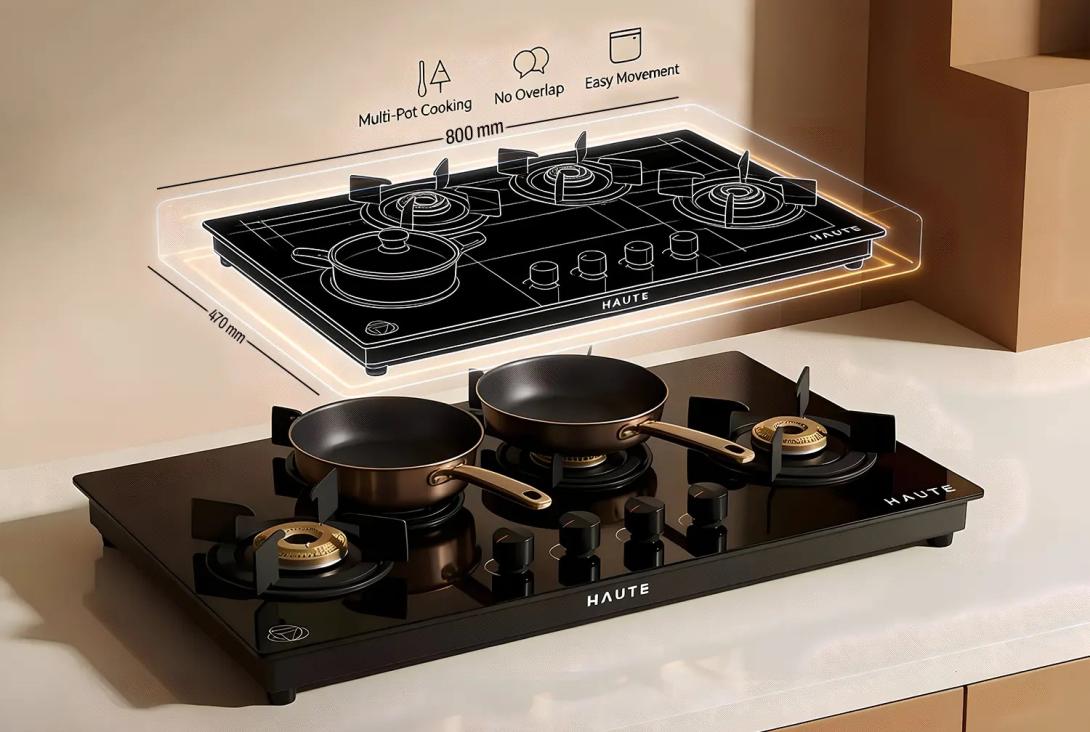
Ever visited a cooktop showroom? You may have wondered why all the stoves look identical, didn't you? The features are more or less the same. So, when you take a glance at them all at once, you hardly figure out any differences. That makes selecting one of the best 4 burner gas stoves a difficult decision. If you are about to buy a 4-burner stove for your household, this post explains what actually deserves your attention.
Burner Material: The First Thing to Check When Buying 4 Burner Gas Stoves
The best 4 burner gas stoves are the ones that come with a quality burner material. Truth be told, most people glance at the burner and assume metal is metal. However, the story is somewhat different.
Here are the differences between aluminum and brass-
Aluminium
Brass
Aluminium burners are lighter and more affordable.
However, a large share of budget stoves use them without highlighting it anywhere on the packaging.
However, the downside is:
Aluminium reacts to repeated heating and cooling cycles, and within a couple of years the flame often starts sitting unevenly across the ring, cooking food inconsistently.
Brass distributes heat more evenly, resists corrosion from daily spills, and holds its shape under years of use. A triple ring flame design in brass burners tends to stay reliable long after cheaper alternatives have started wearing thin.
Here's what you should check while shopping-
- Ask what the burner is made of
- Look for brass for consistent cooking
- The heavier, the better (note that brass has more mass than aluminium)
Thickness of the Glass Top
This one gets overlooked constantly, and it shouldn't.
Standard glass tops run at 5mm to 6mm. That's fine until a heavy vessel gets set down harder than intended, or a wet ladle slips out of your hand mid-stir. Thinner glass under sudden thermal and physical stress is where cracks tend to start, usually right at the edge near a burner.
An 8mm toughened glass surface handles that kind of daily impact differently. It's built to survive thermal shock along with the odd dropped pressure cooker or ladle without leaving so much as a scratch. If a brand backs its glass with a genuinely long warranty, ten years for example, this is a sign the thickness was chosen for good.
One quick note: A cracked glass top can compromise the structural base the burners are on, and replacing it is rarely cheap.
Valve Cycles – An Essential Feature before Taking this Decision
Here's something that comes up far less than it should during buying conversations. Every valve has a cycle rating. That means the number of times it can be switched on and off before performance starts degrading.
A stove that looks identical to a competitor on the outside can have completely different internal valve quality. Precision-engineered valves designed for reliable everyday performance keep the flame control smooth for years, whereas lower-grade valves tend to stiffen or stick well before the stove itself shows any other sign of ageing. Here's your answer if you ask what this looks like in daily use-
- Smooth valve turning with light pressure (even after months of use)
- No sticking when adjusting between low flame and high flame
- Consistent flame response instead of a delayed or jumpy ignition
You will notice the difference the very first week if a stove has an ergonomic valve design, especially when your hands are wet or you're holding a pan in the other hand.
Burner's Layout & Spacing
4 burner gas stoves sound spacious until you actually try placing a pressure cooker, a kadai, and two smaller pans on the surface together. Poor spacing means handles can clash or vessels may overlap. This turns what should be efficient cooking into a frustration.
A good burner layout allows large cookware to sit comfortably side by side, which is really the entire point of choosing four burners over two or three in the first place. This detail rarely shows up in a product photo. Thus, it's worth checking actual dimensions rather than assuming.
Ignition as well as Knob Quality
Manual lighters can be an additional tool. However, they are not reliable, especially when you are too busy in the kitchen. This is the reasons the metal knobs with built-in ignition comes as a savior solution. This lets you light the burner with one hand. Knobs rated for tens of thousands of cycles keep their smooth turning action far longer than thinner plastic or lightweight metal versions.
Design of the Drip Tray & Warranty
A removable drip tray made from food-grade stainless steel catches spills and makes cleanup considerably faster than a fixed tray that needs wiping in place while still warm. Stainless steel also resists rust better than painted or coated metal. That may tend to chip after repeated washing and eventually corrodes at the edges.
Next comes the warranty. It says more about a stove than almost any other spec on the sheet. A short warranty period means the manufacturer is not confident in the materials used.
On the other hand, a glass top backed by a 10-year warranty combined with a comprehensive product warranty covering the wider stove suggests the components were built to actually last.
Dimensions & Fit
Before finalising one of the best 4 burner gas stoves, measure your counter space against the stove's actual length and width. A model too large for the platform overhangs awkwardly and looks out of place. One that's too light for its footprint can feel unstable under a heavy vessel, especially when two burners are being used at once.
The Last Take
Selecting among 4 burner gas stoves really comes down to a handful of details that rarely get a second look in the showroom: burner material, glass thickness, valve durability, pan support quality, burner spacing, and warranty backing. None of these show up clearly in a glance at a product photo, but together they decide whether the stove performs reliably for a decade or starts giving trouble within a year or two.
A little attention to these specifics before buying saves considerable frustration later, and it's the real difference between a stove that looks good on day one and one that keeps performing years down the line.