
The global Enterprise Networking Market is experiencing steady growth as businesses increasingly depend on reliable, secure, and high-performance network infrastructure. Enterprise networking solutions connect employees, offices, data centers, cloud platforms, and connected devices, enabling organizations to manage information and support daily operations. The growing adoption of cloud computing, remote work, artificial intelligence (AI), and digital transformation is increasing the need for advanced networking technologies.
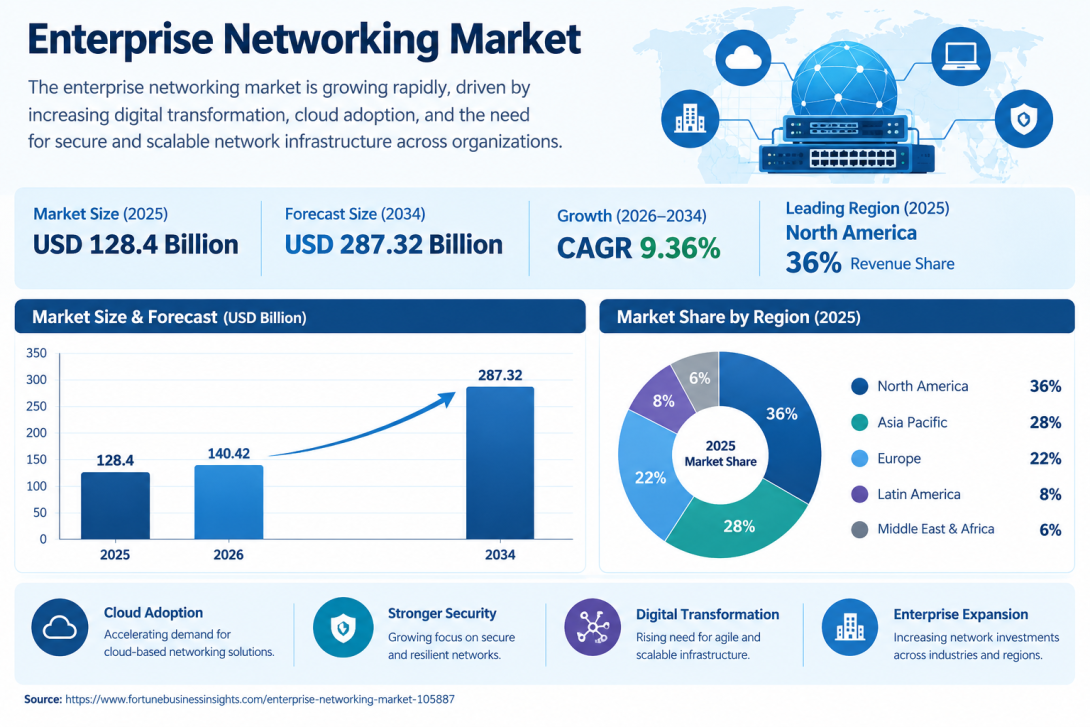
According to Fortune Business Insights, the global Enterprise Networking Market size was valued at USD 128.4 billion in 2025. The market is projected to grow from USD 140.42 billion in 2026 to USD 287.32 billion by 2034, exhibiting a compound annual growth rate (CAGR) of 9.36% during the forecast period. North America dominated the market with a revenue share of 36% in 2025, supported by advanced digital infrastructure and strong enterprise technology investments.
Growing Digital Transformation Driving Market Growth
Digital transformation is one of the major factors supporting the growth of the Enterprise Networking Market. Organizations across banking, healthcare, manufacturing, retail, education, and telecommunications are upgrading their IT infrastructure to improve operational efficiency and business connectivity.
Modern enterprises require networks that can handle increasing data traffic, support business applications, and connect distributed teams. Traditional networking systems may struggle to meet these requirements as organizations expand their digital operations. Consequently, businesses are investing in modern routers, switches, wireless access points, network management software, and security solutions.
The growing use of cloud-based applications and connected devices is further increasing the importance of scalable enterprise networking infrastructure.
Rising Adoption of Cloud-Based Networking Solutions
Cloud computing is changing how enterprises design, deploy, and manage their networks. Cloud-based networking allows organizations to manage connectivity through centralized platforms while reducing dependence on extensive on-site infrastructure.
These solutions provide flexibility, simplified administration, and the ability to scale network resources according to business requirements. They are particularly useful for companies operating across multiple locations or supporting remote employees.
Managed networking services are also gaining attention among businesses seeking specialized technical support. By outsourcing selected network operations, organizations can focus on core activities while improving network monitoring, maintenance, and performance management.
For detailed market insights : https://www.fortunebusinessinsights.com/enterprise-networking-market-105887
Increasing Focus on Network Security and Automation
Cybersecurity has become a critical consideration for enterprises as digital operations expand. Business networks connect sensitive information, cloud applications, employee devices, and essential operational systems, making them potential targets for cyberattacks.
Organizations are incorporating network security technologies, access controls, encryption, and continuous monitoring into their infrastructure. Zero-trust security approaches and secure access service edge (SASE) architectures are also influencing enterprise networking strategies.
Network automation and AI-powered monitoring are helping IT teams identify performance issues, analyze network traffic, and detect unusual activity. These capabilities can reduce manual workloads and support faster responses to network disruptions.
Enterprise Networking Market Segmentation Analysis
By Component
The Enterprise Networking Market is segmented into products and services.
Products: This segment includes routers, switches, wireless access points, networking appliances, and related software. Products remain essential for establishing reliable connectivity across offices, data centers, and enterprise facilities. Demand is supported by network upgrades, increasing data traffic, and the need for improved performance and security.
Services: Services include consulting, network integration, maintenance, technical support, and managed networking. As network environments become more complex, businesses increasingly require professional expertise to implement, monitor, and optimize their infrastructure.
By Deployment Mode
Cloud-Based Deployment: Cloud-based networking enables centralized management, flexible scaling, and easier administration across distributed business environments. It supports organizations adopting hybrid work arrangements, cloud applications, and software-defined networking.
On-Premises Deployment: On-premises networking remains relevant for enterprises that require direct infrastructure control, customized configurations, and predictable performance. Organizations in regulated industries may continue to use on-premises or hybrid environments to address security, compliance, and operational requirements.
By Organization Size
Large Enterprises: Large organizations typically operate complex networks across multiple offices, data centers, and geographic locations. Their requirements include high availability, advanced security, automation, and integration with cloud platforms.
Small and Medium-Sized Enterprises: SMEs increasingly adopt scalable networking solutions to improve connectivity without requiring extensive internal IT resources. Cloud-managed platforms and managed services can help smaller businesses simplify administration and control infrastructure costs.
By End User
Aerospace and defense organizations require secure and resilient networking infrastructure for mission-critical communication and information exchange. Educational institutions use enterprise networks to support digital learning, campus connectivity, and research collaboration.
Media and communication companies depend on high-bandwidth networks for content production, distribution, and real-time collaboration. Other end users, including healthcare providers, financial institutions, retailers, and manufacturers, use enterprise networking to support digital services and daily operations.
Regional Analysis of the Enterprise Networking Market
North America
North America accounted for 36% of the global Enterprise Networking Market revenue in 2025, making it the leading regional market. The region benefits from advanced IT infrastructure, high enterprise technology adoption, and continuous investments in cloud computing and cybersecurity.
Businesses are modernizing their networks to support distributed workforces, data-intensive applications, and digital business models. Demand for software-defined networking, cloud-managed solutions, and automated network management is contributing to regional development.
Europe
Europe represents an important market due to enterprise digitalization, cloud adoption, and increasing emphasis on data protection. Organizations across manufacturing, financial services, education, and public administration require secure and reliable connectivity. Network modernization and managed services are expected to support continued market development.
Asia Pacific
Asia Pacific offers growth opportunities as businesses expand their digital infrastructure and adopt cloud-based technologies. Increasing investments in data centers, enterprise software, connected devices, and digital services are creating demand for advanced networking systems. Expanding business activity and technology adoption across countries such as China, India, and Japan are also supporting regional demand.
South America
South America is gradually adopting modern enterprise networking technologies as organizations invest in digital transformation and improved business connectivity. Cloud services, network security, and infrastructure upgrades are important areas of development. However, budget limitations and differences in digital infrastructure maturity may influence adoption rates.
Middle East & Africa
The Middle East and Africa market is supported by investments in digital infrastructure, smart city initiatives, telecommunications, and enterprise technology modernization. Businesses are increasingly seeking reliable networking solutions to improve operational efficiency and support digital services. Infrastructure availability, technical expertise, and implementation costs will influence the pace of regional growth.
Competitive Landscape
The Enterprise Networking Market is competitive, with technology providers focusing on network performance, security, scalability, automation, and cloud integration. Companies seek to differentiate their offerings through product innovation, software capabilities, managed services, and enterprise support.
Key industry participants include Cisco Systems, Huawei Technologies, Hewlett Packard Enterprise, Dell Technologies, Nokia, and Arista Networks. Competition also reflects growing interest in software-defined networking, AI-enabled network management, and integrated security solutions.
Companies that provide flexible infrastructure and effective management tools may be better positioned to meet the changing requirements of enterprises across industries.
Recent Industry Developments
Enterprise networking is evolving toward software-driven management, automated operations, and stronger integration between networking and cybersecurity. Businesses are increasingly exploring AI-powered network monitoring to identify faults, improve traffic management, and reduce operational disruptions.
Cloud-managed infrastructure and hybrid networking are also receiving greater attention as organizations connect on-premises systems with public and private cloud environments. In addition, advanced wireless technologies and high-performance data center networks are becoming important for enterprises handling growing volumes of information.
Get Free Sample PDF: https://www.fortunebusinessinsights.com/enquiry/request-sample-pdf/enterprise-networking-market-105887
Future Outlook
The global Enterprise Networking Market is expected to experience sustained growth through 2034 as businesses continue modernizing their digital infrastructure. According to Fortune Business Insights, the market is projected to reach USD 287.32 billion by 2034, expanding at a CAGR of 9.36% during 2026–2034.
Increasing cloud adoption, cybersecurity requirements, remote connectivity, and AI-driven network management will remain important factors shaping the market. Opportunities are also emerging in managed networking services, software-defined infrastructure, and automated network operations.
However, enterprises must address implementation costs, integration challenges, cybersecurity risks, and the shortage of specialized technical skills. Providers that combine reliable performance, strong security, and flexible deployment options may benefit from the growing demand for modern enterprise connectivity.
Overall, enterprise networking will remain an essential part of business technology infrastructure, supporting digital transformation, operational continuity, and secure information exchange across industries.
Related Reports
Explore Japan’s Market Opportunities - Latest - Enterprise Networking Market - Insights