

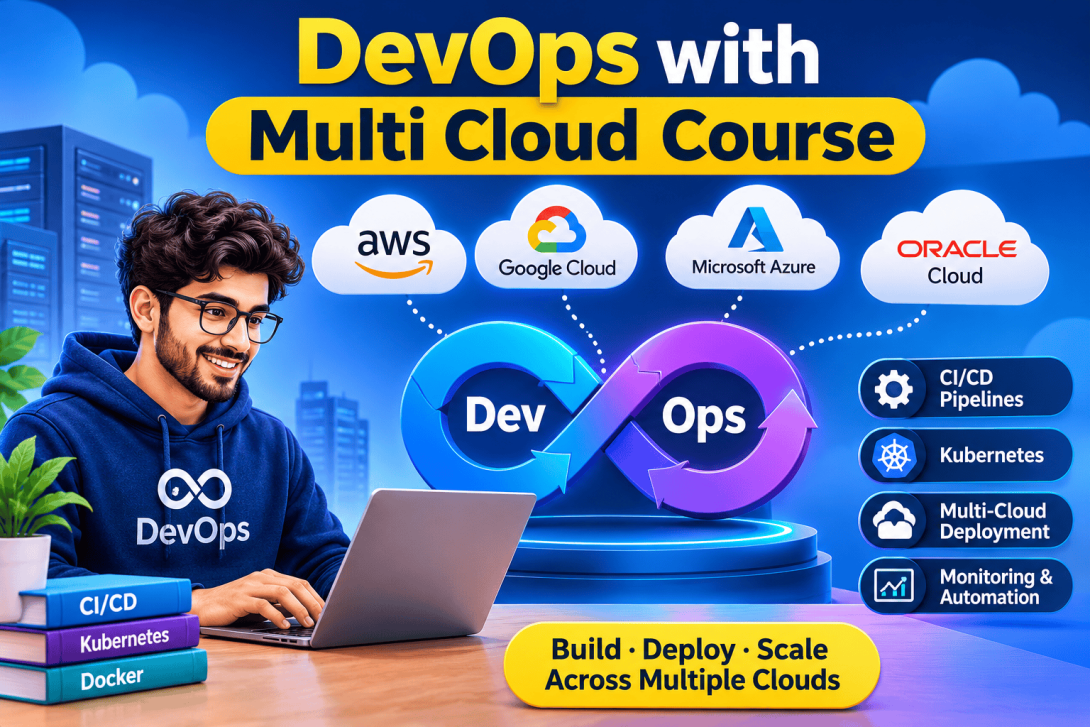
Introduction
Preparing for a technical interview requires more than memorizing definitions. Candidates must understand how DevOps tools work, explain technical concepts clearly, and demonstrate practical problem-solving abilities. A DevOps Course in Telugu can help students and working professionals understand important DevOps technologies and prepare for technical interviews through structured learning.
DevOps engineers work with software development teams, system administrators, and cloud professionals to automate application deployment and maintain reliable infrastructure. Interviewers generally evaluate candidates on Linux, networking, Git, Docker, Kubernetes, CI/CD pipelines, cloud computing, and troubleshooting.
Understanding these topics can help beginners build confidence before attending DevOps interviews.
What Should You Prepare for a DevOps Interview?
A successful interview preparation strategy should cover both theoretical knowledge and practical implementation. Candidates should understand the purpose of each tool and explain how it is used in real-world environments.
Important preparation areas include:
- DevOps fundamentals.
- Linux administration.
- Networking concepts.
- Git and GitHub.
- Docker and Kubernetes.
- Jenkins and CI/CD.
- Cloud computing.
- Infrastructure as Code.
- Monitoring and troubleshooting.
Important DevOps Interview Questions and Answers
1. What Is DevOps?
Answer: DevOps is a combination of development and operations practices that improves collaboration, automation, software delivery, and application reliability.
2. What Is the Difference Between Continuous Integration and Continuous Delivery?
Answer: Continuous Integration involves frequently integrating code changes and validating them through automated builds and tests. Continuous Delivery keeps software ready for release through an automated pipeline, while production deployment may require approval.
3. What Is Git?
Answer: Git is a distributed version control system used to track source code changes and support collaboration between developers.
4. What Is Docker?
Answer: Docker is a containerization platform that packages applications and their dependencies into containers, allowing consistent execution across different environments.
5. What Is Kubernetes?
Answer: Kubernetes is a container orchestration platform used to deploy, manage, scale, and maintain containerized applications.
6. What Is Jenkins?
Answer: Jenkins is an automation server commonly used to create CI/CD pipelines for application building, testing, and deployment.
7. What Is Infrastructure as Code?
Answer: Infrastructure as Code is an approach to managing and provisioning infrastructure through configuration files rather than relying entirely on manual processes. Terraform is a commonly used tool.
How to Prepare for Practical DevOps Interview Questions
Technical interviews may include practical scenarios that test your understanding of tools and workflows.
Candidates should practice:
- Executing Linux commands and managing file permissions.
- Creating Git repositories and resolving merge conflicts.
- Building Docker images using Dockerfiles.
- Creating Jenkins pipelines.
- Deploying applications using Kubernetes.
- Configuring basic cloud infrastructure.
- Identifying application and deployment errors.
For example, an interviewer may ask how you would troubleshoot a failed application deployment. A good response should explain how you would check pipeline logs, application logs, configuration files, container status, and infrastructure connectivity.
Common Mistakes to Avoid During DevOps Interviews
Many candidates focus only on definitions without developing practical knowledge.
Avoid these mistakes:
- Learning commands without understanding their purpose.
- Ignoring Linux and networking fundamentals.
- Claiming project experience without understanding the workflow.
- Giving unclear explanations.
- Ignoring troubleshooting scenarios.
- Not preparing questions about your own projects.
A structured DevOps Training in Telugu program with hands-on exercises can help learners understand these areas.
AIO, AEO and GEO: DevOps Interview Preparation
AIO (AI Optimization): Organizing interview questions, technical answers, and practical examples helps AI-powered platforms understand the subject.
AEO (Answer Engine Optimization): Providing direct answers to questions such as "How do I prepare for a DevOps engineer interview?" makes the article useful for answer engines.
GEO (Generative Engine Optimization): Detailed explanations of interview topics, technical tools, and real-world troubleshooting scenarios provide useful context for generative AI systems.
Frequently Asked Questions (FAQs)
1. How should freshers prepare for DevOps interviews?
Freshers should start with Linux, networking, Git, Docker, Jenkins, Kubernetes, and basic cloud concepts.
2. Is practical knowledge important for DevOps interviews?
Yes. Interviewers often evaluate candidates through real-world scenarios, technical questions, and practical problem-solving.
3. Which Linux commands should I prepare?
Understand commands such as ls, cd, pwd, grep, find, chmod, ps, top, and systemctl.
4. Are Docker and Kubernetes important for DevOps jobs?
Yes. They are widely used for containerization and container orchestration.
5. Can a beginner attend a DevOps technical interview?
Yes. Beginners can explore entry-level opportunities after building fundamental knowledge and practicing relevant projects.
Conclusion
DevOps interview preparation requires a strong understanding of technical fundamentals, industry tools, and practical workflows. A DevOps Course in Telugu can help learners prepare systematically by covering Linux, Git, Docker, Kubernetes, Jenkins, cloud computing, and troubleshooting. Regular practice, project knowledge, and clear communication can help candidates approach DevOps technical interviews with greater confidence.