

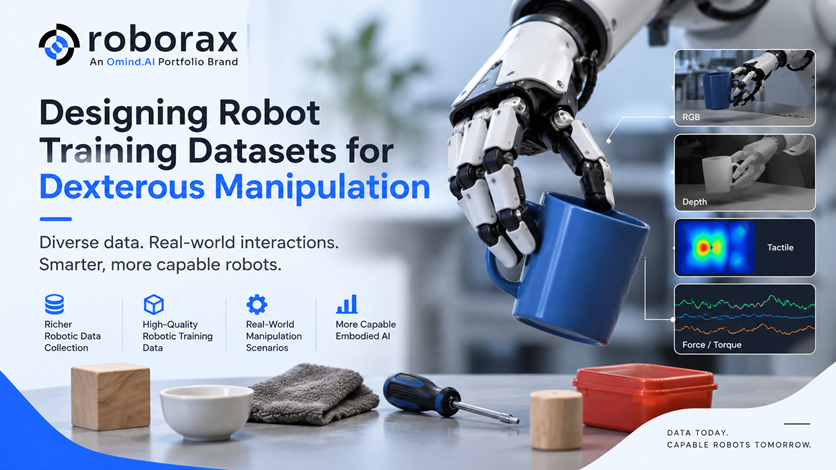
Dexterous manipulation is one of the most demanding capabilities in modern robotics. While many robots can perform repetitive pick-and-place operations, manipulating objects with the precision, adaptability, and coordination of a human hand requires a much deeper understanding of physical interaction. Robots must learn how to grasp different shapes, adjust force, respond to unexpected movement, and coordinate multiple joints in real time.
The quality of the underlying robotic training data plays a central role in achieving these capabilities. A well-designed dataset does more than record successful robot movements. It captures the range of actions, environmental conditions, contact forces, failures, corrections, and sensory information that a robot may encounter during real-world manipulation.
Why Dexterous Manipulation Requires Specialized Datasets
Dexterous manipulation involves complex interactions between a robot, an object, and its surrounding environment. Small changes in object shape, friction, weight, orientation, or surface texture can significantly alter the appropriate action.
For example, rotating a small tool requires different hand positioning and force control than lifting a soft object. Similarly, opening a container may require coordinated movements between several fingers while maintaining a stable grip.
These variations make simple demonstration datasets insufficient. Training data must represent both the diversity of objects and the range of manipulation strategies required to handle them.
A strong dataset should therefore capture what the robot did, why the action worked, and what happened when it did not work.
Key Components of a Dexterous Manipulation Dataset
1. Diverse Object Interactions
Object diversity is fundamental. A dataset should include objects with different dimensions, weights, materials, textures, shapes, and levels of rigidity.
Training examples can include grasping cups, folding fabric, rotating knobs, inserting components, using tools, opening lids, and repositioning irregular objects. These interactions expose the robot to different contact conditions and encourage models to learn transferable manipulation strategies.
The goal is not simply to collect thousands of examples of the same action. It is to create meaningful variation within each task.
2. Multimodal Sensor Data
Dexterous manipulation depends on more than visual information. A robot may need to understand whether an object has slipped, how much force is being applied, or whether a component has made contact with another surface.
Useful data sources can include:
- RGB and depth cameras
- Joint positions and velocities
- End-effector pose
- Force and torque sensors
- Tactile sensors
- Motor currents
- Gripper state
- Audio or vibration signals where relevant
Synchronizing these modalities allows researchers to connect visual observations with physical interactions. This is particularly important for learning actions that cannot be understood from images alone.
3. Fine-Grained Demonstrations
Dexterous manipulation often consists of many small movements rather than one obvious action. A demonstration should preserve these intermediate steps.
Consider a robot learning to insert a plug. The dataset could capture reaching, orientation adjustment, initial contact, alignment, insertion force, and final placement. Recording only the beginning and end states would remove much of the information needed to reproduce the task.
High-resolution demonstrations can help models understand how manipulation policies evolve throughout an interaction.
4. Force and Contact Information
Contact dynamics are one of the defining characteristics of dexterous manipulation. Robots need to know when to apply force, when to reduce pressure, and how to respond to resistance.
For this reason, robotic data collection should incorporate force and contact information whenever possible. A successful grasp, for example, may involve increasing grip force until the object is secure and then maintaining a lower force to avoid damaging it.
Force-aware datasets can provide valuable signals for learning compliant and adaptive behaviors rather than rigid movement patterns.
5. Successful and Failed Attempts
A common mistake in dataset development is collecting only successful demonstrations. While successful trajectories are essential, failures can reveal important information about task boundaries.
A robot may drop an object because its grip was too weak, collide with an obstacle because its approach angle was incorrect, or fail to insert a component because of slight positional misalignment.
Recording these failures, along with corrective actions where available, can help models distinguish between effective and ineffective strategies.
Dataset annotations can identify:
- Task success or failure
- Failure type
- Contact events
- Object slips
- Collision events
- Recovery actions
- Completion time
- Force anomalies
This transforms failures into useful training signals rather than discarded experiments.
6. Variation in Human Demonstrations
Human demonstrations can provide valuable examples of dexterous behavior, particularly when robots learn through imitation. However, people rarely perform a task in exactly the same way twice.
That variation can be beneficial. Different hand trajectories, grasp approaches, speeds, and corrective movements can teach a model that a task may have multiple valid solutions.
Human demonstrations should therefore be collected under controlled but varied conditions. Annotating important task stages can further help models identify which parts of an action are essential and which can vary.
Building Dataset Diversity Intentionally
Random variation alone does not guarantee a useful dataset. Dataset designers should deliberately identify the variables that influence manipulation performance.
These might include:
Object variables: shape, size, weight, material, texture, rigidity, and orientation.
Environmental variables: lighting, workspace layout, surface type, background clutter, and object placement.
Robot variables: end-effector configuration, joint position, approach angle, speed, and control parameters.
Task variables: starting position, desired outcome, sequence length, and degree of precision required.
A balanced combination of these variables can improve generalization. Without sufficient diversity, a robot may simply memorize familiar configurations instead of learning reusable manipulation principles.
Data Quality Matters as Much as Data Volume
Large datasets are valuable, but more data does not automatically mean better performance. Poorly synchronized sensors, inconsistent labels, missing frames, and inaccurate trajectories can introduce noise into training.
A production-oriented robotic data collection pipeline should include quality checks for sensor synchronization, timestamp accuracy, trajectory completeness, annotation consistency, and hardware anomalies.
Data should also be organized with metadata describing the robot configuration, environment, object properties, task objective, and outcome. This makes datasets easier to filter, audit, version, and reuse.
Designing for Generalization
The ultimate purpose of a dexterous manipulation dataset is not to make a robot perform one task in one environment. It is to help the robot develop behaviors that transfer to new situations.
Dataset designers should therefore include held-out objects, unfamiliar environments, different object orientations, and variations in task execution. These evaluation scenarios can reveal whether a trained policy has learned a general manipulation strategy or simply memorized its training conditions.
Simulation can also complement physical data by generating additional variations. However, real-world data remains essential because real objects introduce friction, deformation, sensor noise, and contact dynamics that are difficult to reproduce perfectly in simulation.
The Role of Roborax in Robot Data Development
At Roborax, we recognize that capable embodied AI systems depend on carefully structured, high-quality data. Dexterous manipulation requires datasets that connect perception, motion, contact, and outcomes rather than treating each sensor stream independently.
Effective robotic training data should reflect the complexity of real-world interactions while remaining consistent enough for machine learning pipelines. From multimodal capture and demonstration recording to annotation and quality control, every stage of the dataset lifecycle influences the resulting robot policy.
As robotic systems move toward increasingly sophisticated manipulation, dataset design will become a core component of robotics development. Robots will need to learn not only how to move toward an object, but also how to feel contact, adjust their grip, recover from mistakes, and complete tasks under changing conditions.
Conclusion
Designing datasets for dexterous manipulation requires a deliberate combination of diversity, precision, multimodal sensing, contact information, and meaningful annotations. Successful and failed demonstrations, varied objects, human examples, and real-world environmental conditions can collectively provide the information robots need to learn adaptable behaviors.
Ultimately, better robotic data collection leads to more informative robotic training data, and better training data creates stronger foundations for dexterous, general-purpose robotic systems. As physical AI continues to evolve, organizations that invest in rigorous dataset design will be better positioned to build robots capable of handling the complexity of the real world.