

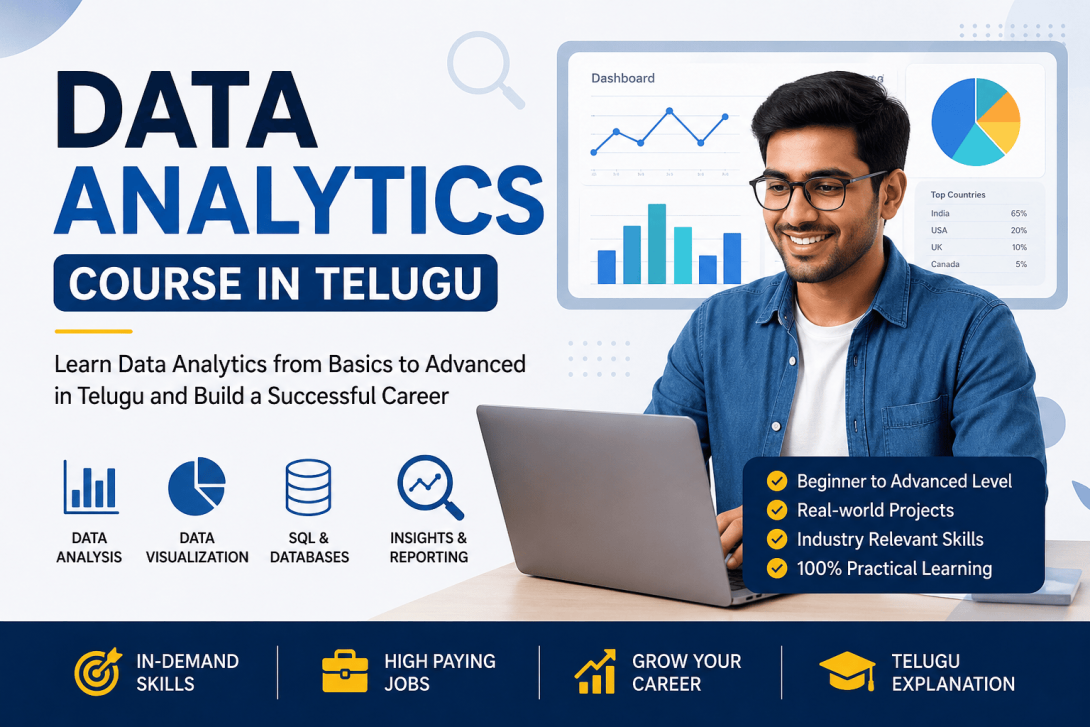
Data has become an essential part of modern business decision-making. Organizations collect information from customers, websites, transactions, applications, and internal operations. However, raw information becomes valuable only when professionals can analyze it and convert it into meaningful insights. This growing requirement has created opportunities for people interested in data-driven careers. For Telugu-speaking learners, a Data Analytics Course in Telugu can provide a comfortable starting point for developing these skills.
What Is a Data-Driven Career?
A data-driven career involves using information, analytical methods, and technology to solve business problems and support better decisions. Professionals in this field may work with sales data, customer information, financial records, marketing performance, or operational metrics.
Roles such as Data Analyst, Business Analyst, BI Analyst, Reporting Analyst, and Data Visualization Specialist can involve different levels of data analysis.
Why Learn Data Analytics?
Businesses increasingly depend on measurable information rather than assumptions. Data analysts help organizations identify trends, understand performance, discover problems, and find opportunities.
Learning Data Analytics can therefore provide skills that are useful across industries such as banking, healthcare, retail, e-commerce, technology, logistics, and education.
Learning Data Analytics in Telugu
For beginners, understanding technical terminology can sometimes be challenging. A Data Analytics Course in Telugu can simplify difficult concepts by explaining them in a familiar language.
Learners can first understand the fundamentals and then become comfortable with industry terminology and tools. This can create a smoother transition from beginner-level knowledge to professional skills.
Important Skills to Develop
A successful learning path should include multiple technologies and concepts. Excel can help beginners learn data organization, formulas, pivot tables, and basic reporting.
SQL is essential for retrieving and analyzing information stored in databases. Learners should understand queries, filtering, grouping, joins, and aggregate functions.
Power BI can be used to transform data into interactive dashboards. Learners can also explore Power Query for data transformation and DAX for advanced calculations.
Python can further strengthen analytical capabilities, particularly for learners interested in automation and advanced data processing.
Importance of Projects
Practical projects help learners understand how analytics works in real business situations. A learner can create projects based on sales analysis, customer behavior, financial reporting, inventory management, or marketing performance.
Projects can also become part of a data analytics portfolio, helping candidates demonstrate their practical skills during interviews.
Career Growth Through Data Analytics
Data analytics skills can open opportunities in multiple business functions. As experience increases, professionals may take on more complex analytical responsibilities, specialize in business intelligence, or move toward advanced data-related roles.
Continuous learning is important because analytics tools and business requirements continue to evolve.
Conclusion
A Data Analytics Course in Telugu can help learners build a structured foundation for a data-driven career. By developing skills in Excel, SQL, Power BI, Python, data visualization, statistics, and analytical thinking, learners can prepare themselves for practical opportunities. Combining technical knowledge with real-world projects and effective communication can create a strong foundation for long-term career growth.