

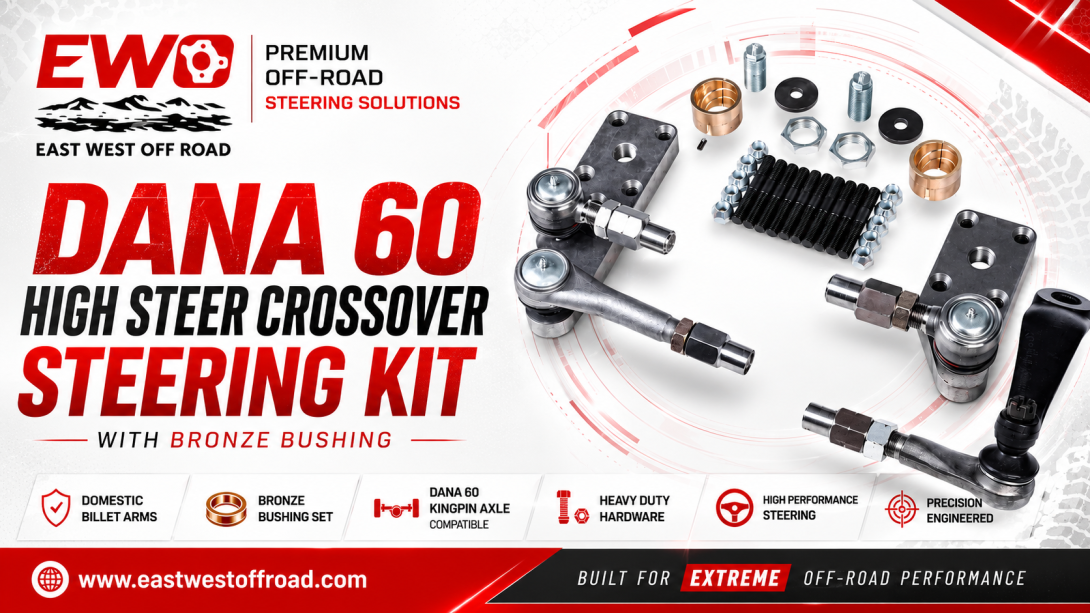
Buy Now: Dana 60 High Steer Crossover Steering Kit with Bronze Kingpin Bushings
A Dana 60 Steering Kit is a popular upgrade for heavy-duty 4x4 builds using a Dana 60 front axle. When a truck is equipped with large tires, suspension lift, increased articulation, or used for serious off-road driving, upgrading the steering system can provide stronger linkage and better component clearance. A properly matched Dana 60 steering kit can combine high-steer arms, crossover steering, heavy-duty steering ends, kingpin bushings, and the hardware needed to build a dependable steering system.
For builders working with a kingpin Dana 60, choosing components as a complete system is especially important. Knuckle configuration, steering-arm pattern, steering-end taper, pitman arm, linkage dimensions, and suspension geometry all need to work together.
What Is a Dana 60 Steering Kit?
A Dana 60 steering kit is a collection of steering components designed to upgrade or replace the steering linkage on a Dana 60 front axle.
Depending on the configuration, a kit may include:
- High-steer arms
- Tie rod ends
- Drag link ends
- Tie rod components
- Drag link components
- Kingpin bushings
- Mounting hardware
- Spacers
- Jam nuts
- Weld-in tube inserts
Some kits include DOM tubing, while others are supplied without tubing for builders who prefer to fabricate their own linkage.
The right configuration depends on the specific Dana 60 axle, knuckles, steering box, suspension, and intended use.
Why Upgrade a Dana 60 Steering System?
The Dana 60 is commonly selected for heavy-duty off-road builds, but the steering system still needs to be matched to the vehicle.
Large tires can increase steering loads, while rock crawling exposes steering components to impacts and side loads.
A properly designed steering upgrade can provide several advantages.
Stronger Steering Linkage
Heavy-duty steering ends and larger linkage can provide increased resistance to bending and deformation compared with stock-style components.
This is particularly useful for vehicles running large tires or spending significant time on difficult trails.
Increased Steering Clearance
High-steer configurations move steering linkage higher on the axle.
This can reduce the chance of the tie rod or drag link contacting rocks, ledges, and other obstacles.
Better Compatibility With Modified Suspension
A lifted vehicle may require a different steering-linkage position to achieve suitable geometry.
A properly designed Dana 60 high-steer configuration can provide additional flexibility when setting up the steering system around the modified suspension.
Dana 60 High Steer Kit vs. Standard Steering
A standard steering arrangement generally keeps the linkage closer to its original mounting locations.
A Dana 60 high steer kit uses high-steer arms to move the steering linkage higher on the knuckle.
This can be beneficial for off-road vehicles because the linkage is less exposed to obstacles below the axle.
High steer can also provide additional options for managing steering geometry on lifted builds.
However, installing high-steer arms alone does not automatically solve bump steer. The drag link, track bar, axle position, steering box, pitman arm, and suspension geometry must all be considered.
Dana 60 Crossover Steering Kit
Crossover steering changes the routing of the drag link.
Instead of using a factory-style steering arrangement, the drag link travels from the steering-box pitman arm across the front axle to the passenger-side steering arm.
The tie rod then connects the steering knuckles.
A Dana 60 crossover steering kit is therefore different from simply installing a stronger tie rod.
It changes the steering architecture while allowing the use of high-steer arms and heavy-duty steering components.
For lifted trucks and custom solid-axle builds, crossover steering can provide a cleaner linkage arrangement when properly engineered.
Dana 60 Kingpin Steering Kit
Kingpin Dana 60 axles use kingpin-style steering knuckles rather than ball-joint-style knuckles.
That distinction is important when choosing a Dana 60 kingpin steering kit.
The steering kit must be compatible with the kingpin knuckles and their mounting arrangement.
Builders should verify:
- Kingpin axle type
- Knuckle manufacturer
- Steering-arm mounting pattern
- Four-hole or five-hole configuration
- Steering-end taper
- Stud dimensions
- Kingpin bushing condition
- Steering-box configuration
A kit designed for a kingpin Dana 60 should not automatically be assumed to fit every Dana 60 configuration.
Dana 60 Billet High-Steer Arms
High-steer arms provide the connection between the steering knuckles and steering linkage.
For demanding off-road builds, billet high-steer arms can offer a robust mounting platform for the tie rod and drag link.
The EWO Dana 60 configuration uses 1.25-inch-thick billet high-steer arms manufactured from domestic billet material.
The thickness of the arm is only one consideration, however. The knuckle mounting pattern, stud configuration, steering-end taper, and overall steering geometry are equally important.
5-Hole Dana 60 Steering Arms
Some aftermarket Dana 60 knuckles use a five-hole mounting pattern.
A 5-hole Dana 60 steering arm provides compatibility with knuckles designed around that pattern.
The EWO configuration is designed around a five-hole pattern for Reid and similar compatible knuckles and can also work with four-hole knuckles using the appropriate mounting holes.
Always verify the exact steering arm and knuckle combination before assembly.
Using an incompatible mounting pattern can compromise the steering system.
Reid Compatible Dana 60 Steering Kit
Reid Racing-style steering knuckles are frequently used in heavy-duty Dana 60 builds.
A Reid compatible Dana 60 steering kit can simplify component selection when the high-steer arms and knuckles are designed to work together.
Before ordering, confirm the exact knuckle model and mounting pattern.
The steering arm must sit securely against the knuckle, and all mounting hardware must be installed according to the manufacturer's specifications.
Dana 60 Bronze Kingpin Bushings
Kingpin bushings are an important part of a kingpin axle's steering assembly.
Worn bushings can contribute to unwanted movement and should be addressed during an axle rebuild or steering-system upgrade.
A Dana 60 bronze kingpin bushing setup can provide a serviceable foundation for a kingpin steering rebuild when the components are correctly matched.
The EWO kit discussed here includes bronze kingpin bushings along with the high-steer and crossover steering components.
This allows builders to address the steering linkage and compatible kingpin bushing components as part of the same upgrade.
GM 1-Ton Steering Kit for Dana 60
GM 1-ton steering components are commonly used in heavy-duty Dana 60 crossover configurations.
These components are popular in the aftermarket because they are available in heavy-duty configurations and can be paired with suitable high-steer arms and steering linkage.
Depending on the configuration, the steering system can use:
- ES2026R
- ES2027L
- ES2234L
- ES2234R
- Tapered nuts
- Spacers
- Jam nuts
- Appropriate mounting hardware
The correct components depend on the specific steering-arm and knuckle configuration.
Do not select steering ends based only on thread size or appearance. Verify taper, dimensions, thread direction, and intended application.
Dana 60 Drag Link Kit
The drag link transfers steering movement from the pitman arm to the steering knuckle.
A heavy-duty Dana 60 drag link kit should be selected around the steering box, pitman arm, high-steer arm, and axle position.
The drag link length is particularly important on custom builds.
A steering system should be checked at normal ride height and through full suspension travel to make sure the drag link does not bind or contact other components.
Dana 60 Tie Rod Kit
The tie rod connects the steering knuckles and transfers steering movement from one side of the axle to the other.
A Dana 60 tie rod kit can be configured with heavy-duty steering ends and high-steer arms to provide increased strength and better linkage placement.
For large-tire applications, the tie rod should be designed around:
- Tire size
- Wheel backspacing
- Steering-arm location
- Knuckle type
- Axle width
- Suspension travel
- Steering stops
A stronger tie rod cannot compensate for worn knuckles, kingpins, loose bearings, poor steering geometry, or damaged suspension components.
Dana 60 Steering Kit Without DOM Tubes
Some builders prefer to fabricate their own drag link and tie rod.
For those applications, a Dana 60 steering kit without DOM tubes can provide the steering ends, arms, bushings, hardware, weld-in inserts, and jam nuts while allowing the builder to supply the appropriate tubing.
The EWO configuration discussed here does not include DOM tubing.
It includes 7/8-18 weld-in tube inserts and matching jam nuts for the linkage fabrication process.
When fabricating steering linkage, use appropriate material and professional welding and fabrication practices because the drag link and tie rod are safety-critical components.
7/8-18 Weld Bungs and Jam Nuts
Weld-in tube inserts provide the threaded interface between the steering linkage and steering ends.
The 7/8-18 weld bungs and jam nuts used in a Dana 60 steering configuration allow the builder to fabricate linkage to the required dimensions.
Proper thread engagement is essential.
The finished tubing should also have suitable diameter, wall thickness, weld quality, and end preparation for the intended application.
Do not select tubing solely because it matches the thread size of the steering end.
Dana 60 Springless High Steer Applications
The term springless Dana 60 high steer is sometimes used when discussing specific kingpin and aftermarket knuckle configurations.
Because Dana 60 axles exist in multiple configurations, builders should identify the exact axle and steering knuckle before selecting components.
A springless or kingpin-related setup should be evaluated according to its actual knuckle, kingpin, steering-arm, and axle configuration rather than relying on a generic Dana 60 description.
Dana 60 Steering Geometry
Steering geometry is one of the most important parts of a Dana 60 steering upgrade.
A lift or axle modification changes the relationship between the:
- Steering box
- Pitman arm
- Drag link
- Tie rod
- Track bar
- Axle
- Knuckles
- Suspension
The drag link and track bar should operate through compatible arcs.
If the axle has been moved forward, the steering system may require additional geometry planning.
The pitman arm should also be selected based on the steering box and desired steering geometry rather than simply choosing a drop based on lift height.
Wheel and Tire Clearance
Large steering components can create clearance issues even when the axle and steering kit are otherwise compatible.
Before final installation, check the relationship between the steering components and:
- Wheels
- Tires
- Differential cover
- Leaf springs
- Shocks
- Axle housing
- Steering stops
- Frame
Wheel diameter and backspacing can significantly affect available clearance.
Turn the steering from lock to lock and inspect the system before driving.
Dana 60 Steering Kit Installation
Steering components are safety-critical, so installation should be approached carefully.
Confirm Knuckle Compatibility
Verify that the high-steer arms match the exact steering knuckles.
Check the mounting-hole pattern, studs, taper, and required hardware.
Install Steering Ends Correctly
Confirm that the steering ends match the intended arm and knuckle tapers.
Use the specified nuts and hardware and follow the manufacturer's torque requirements.
Check Linkage Movement
Move the steering from full left to full right.
Then cycle the suspension through compression and droop.
Look for binding, interference, excessive joint angles, or contact with the axle and suspension.
Verify Steering Stops
Proper steering stops help prevent excessive steering angles and unwanted component contact.
Check the stops after the new steering components are installed.
Check Alignment
After installing new steering linkage, verify toe and steering-wheel position.
A professional alignment inspection is recommended after significant steering or suspension modifications.
Dana 60 Steering Kit for Rock Crawling
Rock crawling places unusual demands on a steering system.
Large tires can encounter rocks and ledges that apply substantial side loads to the steering linkage.
A high-steer configuration can move the linkage higher and reduce its exposure to trail obstacles.
However, the steering system should still be inspected regularly.
After difficult trail use, check the steering arms, studs, steering ends, welds, jam nuts, kingpin components, and linkage for signs of damage or looseness.
Choosing the Right Dana 60 Steering Kit
The best Dana 60 steering kit depends on the axle and vehicle rather than simply the advertised strength rating.
Before ordering, verify:
- Dana 60 axle configuration
- Kingpin or other knuckle type
- Knuckle manufacturer
- Four-hole or five-hole arm pattern
- Reid compatibility
- High-steer arm thickness
- Steering-end taper
- Tie rod ends
- Drag link ends
- Kingpin bushings
- Pitman arm
- Steering-box configuration
- Wheel backspacing
- Tire size
- Suspension lift
- Axle position
- DOM tubing requirements
A complete system should be designed around the actual vehicle.
Why Choose a Complete Dana 60 Steering Kit?
Sourcing every steering component individually can make compatibility more difficult to manage.
A matched Dana 60 steering kit can simplify the process by bringing the major steering components together.
The Dana 60 kingpin crossover steering kit with bronze bushings combines high-steer arms, bronze kingpin bushings, heavy-duty steering ends, mounting hardware, spacers, jam nuts, and weld-in tube inserts for a compatible kingpin Dana 60 application.
For builders supplying their own DOM tubing, this type of configuration can provide the core components needed to fabricate the final linkage.
Is a Dana 60 Steering Kit Worth It?
For a heavily modified Dana 60-equipped 4x4, upgrading the steering system can be a worthwhile investment.
A properly matched steering kit can provide stronger steering components, better linkage placement, improved clearance, and a more purpose-built configuration for large tires and demanding off-road use.
The most important consideration is not simply choosing the largest steering components available.
The complete system needs to work together.
Kingpin condition, steering-arm mounting, steering-end taper, pitman arm, steering-box configuration, suspension geometry, wheel clearance, and linkage fabrication all affect the final result.
Frequently Asked Questions (FAQs)
What is a Dana 60 Steering Kit?
A Dana 60 steering kit is a collection of compatible steering components designed to upgrade the steering linkage on a Dana 60 front axle.
What is included in a Dana 60 high-steer kit?
Depending on the configuration, a kit can include high-steer arms, steering ends, kingpin bushings, mounting hardware, spacers, jam nuts, and weld-in tube inserts. Some versions may also include DOM tubing.
What is the benefit of Dana 60 crossover steering?
Crossover steering routes the drag link from the pitman arm across the axle to the passenger-side steering arm. It can provide a more suitable steering layout for many lifted and modified vehicles.
Are Dana 60 high-steer arms worth it?
They can be useful for off-road vehicles because they move the steering linkage higher and can improve clearance from rocks and other obstacles.
What are 5-hole Dana 60 steering arms?
They are high-steer arms designed around a five-hole knuckle mounting pattern. Compatibility with the specific knuckle must be confirmed.
Can I use a Dana 60 steering kit with Reid knuckles?
Some Dana 60 steering kits are designed for Reid and similar compatible knuckles. Verify the exact mounting pattern before installation.
Does a Dana 60 steering kit include DOM tubing?
Not always. The EWO configuration discussed here does not include DOM tubing but includes weld-in tube inserts and matching jam nuts.
What are ES2026R and ES2027L?
They are heavy-duty GM-style steering ends commonly used in crossover and drag-link configurations when their taper, thread, and dimensions match the application.
What are ES2234L and ES2234R?
They are GM-style heavy-duty tie-rod ends commonly used in larger steering configurations when compatible with the steering arms and knuckles.
Do bronze kingpin bushings matter?
Yes. Kingpin bushings support steering movement in compatible kingpin axle assemblies. Worn bushings should be addressed during an axle or steering rebuild.
Can a Dana 60 steering kit fix bump steer?
A steering kit does not automatically fix bump steer. Correct steering geometry depends on the relationship between the drag link, track bar, axle movement, pitman arm, and suspension.
Is a Dana 60 steering kit good for rock crawling?
A properly configured high-steer crossover system can be well suited to rock crawling because it can raise steering linkage and improve obstacle clearance. Proper installation and regular inspection remain essential.
Final Thoughts
A Dana 60 Steering Kit can be an important upgrade for a heavy-duty 4x4 running a kingpin Dana 60, large tires, suspension lift, or demanding off-road setup.
The right combination of high-steer arms, crossover steering, heavy-duty GM 1-ton steering ends, bronze kingpin bushings, and properly fabricated linkage can create a stronger and more practical steering system.
For builders using a compatible kingpin Dana 60, the EWO configuration with 1.25-inch-thick billet high-steer arms, bronze kingpin bushings, heavy-duty steering ends, and 7/8-18 weld-in inserts provides a solid starting point for a custom steering build.
Before installation, verify every component against the actual axle and vehicle configuration. Proper steering geometry, steering-end taper, knuckle compatibility, wheel clearance, suspension travel, hardware torque, and final inspection are essential for dependable operation on both the street and trail.