

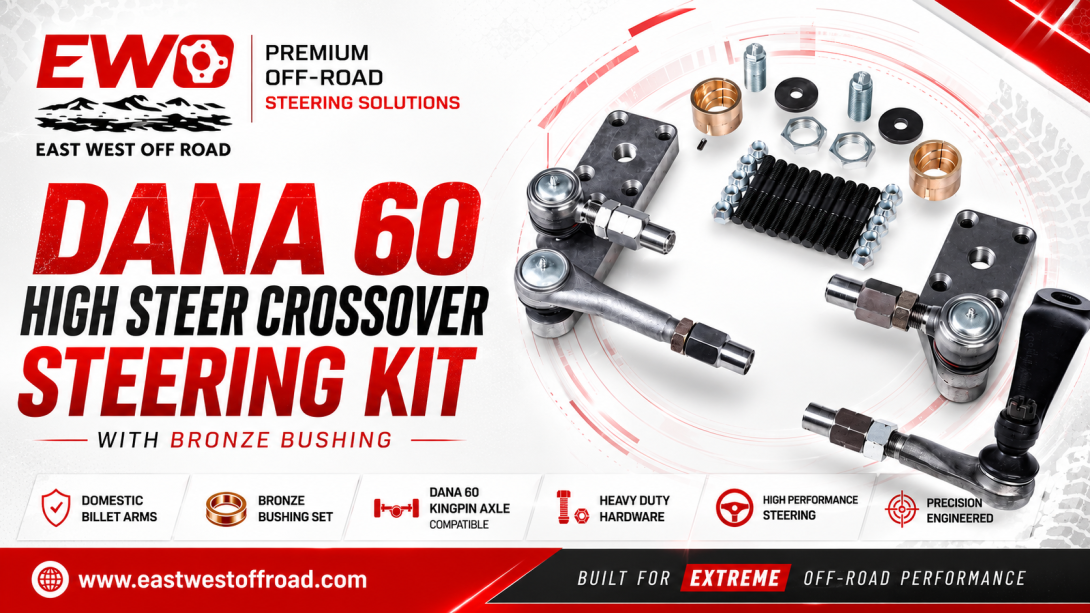
Buy Now: Dana 60 High Steer Crossover Steering Kit with Bronze Kingpin Bushings
A Dana 60 Kingpin High Steer setup is a popular steering upgrade for heavy-duty 4x4 builds using a GM-style kingpin Dana 60 front axle. By combining high-steer arms, crossover steering, heavy-duty steering ends, and compatible kingpin components, builders can move the steering linkage higher on the axle while creating a stronger steering layout for large tires and demanding off-road use.
For rock crawlers, lifted trucks, and custom solid-axle builds, the right Dana 60 kingpin high-steer configuration can improve steering clearance, provide better linkage positioning, and offer a solid foundation for a heavy-duty crossover steering system.
What Is Dana 60 Kingpin High Steer?
Dana 60 Kingpin High Steer refers to a steering configuration designed around a kingpin-style Dana 60 front axle, where the steering linkage is positioned higher using high-steer arms mounted to compatible steering knuckles.
Unlike a conventional factory steering arrangement, high steer relocates the steering linkage closer to the top of the steering knuckle.
When combined with crossover steering, the drag link travels from the steering box and pitman arm across the front axle to the passenger-side steering arm.
The result is a steering layout designed specifically for heavily modified solid-axle vehicles.
Why Use High Steer on a Dana 60 Kingpin Axle?
A Dana 60 is already a popular heavy-duty axle platform, but the factory steering arrangement may not provide the clearance or geometry desired for a modified off-road vehicle.
Larger tires, suspension lifts, increased articulation, and difficult terrain can place additional loads on the steering linkage.
A properly designed high-steer system addresses several of these concerns.
Improved Steering Clearance
Moving the tie rod and drag link higher can reduce exposure to rocks, ledges, and other trail obstacles.
This can be especially valuable on rock-crawling vehicles where the steering linkage frequently passes close to obstacles.
Better Linkage Position
High-steer arms allow the steering linkage to be positioned higher on the knuckles.
For lifted vehicles, this can provide more flexibility when designing the steering system around suspension travel, axle position, and steering-box location.
Heavy-Duty Steering Capability
Dana 60 high-steer systems are commonly paired with larger steering ends and robust linkage.
This makes them suitable for builds running larger tires and experiencing substantially higher steering loads than a stock vehicle.
Dana 60 Kingpin Crossover Steering
High steer and crossover steering describe two related but different aspects of the conversion.
High steer refers to the location of the steering linkage on the knuckle.
Crossover steering refers to the drag-link routing from the pitman arm across the front axle to the passenger-side steering knuckle.
Combining the two creates a high-steer crossover configuration.
The steering box moves the pitman arm, the pitman arm moves the drag link, and the drag link transfers steering input to the passenger-side high-steer arm. The tie rod then connects the steering knuckles.
This configuration can provide a cleaner steering layout for many lifted Dana 60 builds.
Dana 60 High Steer Arms
High-steer arms are one of the most important components in a Dana 60 kingpin high-steer conversion.
The arm provides the mounting point for the drag link or tie rod and transfers steering forces into the steering knuckle.
For a heavy-duty build, builders should pay attention to:
- Arm material
- Thickness
- Mounting pattern
- Stud configuration
- Steering-end taper
- Knuckle compatibility
- Clearance
- Steering geometry
The EWO Dana 60 kit uses 1.25-inch-thick billet high-steer arms manufactured from domestic billet material for a heavy-duty steering application.
5-Hole Dana 60 Steering Arms
Some aftermarket Dana 60 steering knuckles use a five-hole steering-arm pattern.
A 5-hole Dana 60 steering arm can provide additional mounting flexibility when paired with compatible aftermarket knuckles.
The EWO configuration uses a five-hole pattern designed for Reid and similar compatible knuckles while also allowing use with four-hole knuckles where the appropriate four mounting holes are used.
Before installation, always verify the exact knuckle and arm pattern.
Do not assume that every Dana 60 kingpin knuckle uses the same steering-arm mounting arrangement.
Reid Compatible Dana 60 High Steer Arms
Reid Racing-style knuckles are commonly considered when building high-strength Dana 60 steering systems.
Compatible high-steer arms can provide a straightforward way to connect the steering linkage to these aftermarket knuckles.
However, the knuckle, steering arm, studs, and steering ends should be treated as one system.
Check the mounting pattern, stud size, taper, and required hardware before assembly.
Dana 60 Kingpin Bronze Bushing High Steer Kit
Kingpin axle condition is another important consideration when upgrading the steering system.
The kingpin components control steering movement at the axle ends, making their condition important for steering feel and durability.
A Dana 60 bronze bushing high steer kit combines the steering upgrade with bronze kingpin bushings intended for compatible kingpin axle applications.
The EWO kit includes bronze kingpin bushings along with the high-steer steering components and associated hardware.
Replacing or upgrading worn kingpin components can be particularly useful when rebuilding an older Dana 60 before installing a new steering system.
GM 1-Ton Steering Components for Dana 60
GM 1-ton steering components are commonly used in heavy-duty Dana 60 crossover steering configurations.
These components are popular because they provide larger steering ends and are available in configurations suitable for high-steer and crossover applications.
Depending on the setup, a Dana 60 steering system can use:
- ES2026R drag link end
- ES2027L drag link end
- ES2234L tie rod end
- ES2234R tie rod end
- Matching tapered nuts
- Appropriate spacers
- High-steer arm hardware
The exact steering-end arrangement should always match the steering arm, knuckle taper, and linkage design.
ES2026R Drag Link End for Dana 60
The ES2026R is a commonly referenced GM-style heavy-duty drag-link end for crossover steering applications.
In a Dana 60 high-steer system, the correct drag-link end must match the steering arm taper and linkage configuration.
The steering end is only one part of the system, so builders should verify thread direction, taper, engagement, and clearance before final assembly.
ES2027L Drag Link End
The ES2027L provides the complementary left-hand-thread configuration used in certain heavy-duty steering assemblies.
Left- and right-hand-threaded steering ends can allow adjustment of the linkage without removing the complete assembly.
The thread direction and component placement should follow the specific steering system design.
Never substitute a steering end solely because the dimensions appear similar.
ES2234L and ES2234R Tie Rod Ends
The ES2234L and ES2234R are commonly associated with heavy-duty GM-style tie-rod configurations.
Using compatible steering ends allows builders to create a strong tie rod and drag link system around the Dana 60 high-steer arms.
Correct taper engagement is critical.
The steering end should seat properly in the steering arm or knuckle, with the correct nut, cotter pin arrangement where applicable, and manufacturer-specified torque.
Dana 60 Tie Rod Kit for Large-Tire Builds
A Dana 60 tie rod kit is responsible for transferring steering movement between the two front steering knuckles.
For vehicles running large tires, the tie rod needs to withstand substantial steering loads and resist bending during off-road use.
A high-steer tie rod configuration can also place the linkage higher and farther away from common trail obstacles.
However, increasing tie-rod strength does not compensate for worn ball joints, damaged knuckles, loose steering components, poor alignment, or incorrect steering geometry.
The entire front-end system needs to work together.
Dana 60 Kingpin High Steer Without DOM Tubes
Not every builder needs a complete steering kit that includes DOM tubing.
A Dana 60 high steer without DOM tubes configuration can be useful for builders who already have suitable tubing or prefer to fabricate their own drag link and tie rod.
The EWO configuration discussed here includes weld-in tube inserts and matching jam nuts but does not include DOM tubing.
This allows builders to source or fabricate the linkage according to their specific vehicle dimensions.
When fabricating steering linkage, use appropriate material, thread engagement, welding practices, and fabrication procedures for a safety-critical component.
7/8-18 Weld Bungs and Jam Nuts
The linkage configuration can use 7/8-18 weld-in tube inserts and matching jam nuts.
These components provide the threaded connection between the steering linkage tubing and the steering ends.
Correct thread engagement is essential when fabricating the final drag link or tie rod.
The builder should also verify the required tubing diameter and wall thickness for the intended application instead of selecting tubing solely based on appearance.
Springless Dana 60 High Steer
Some Dana 60 high-steer discussions involve springless or kingpin-related axle configurations.
The important distinction is that a kingpin Dana 60 uses kingpin steering knuckles rather than ball-joint-style steering knuckles.
A springless Dana 60 high steer setup should therefore be evaluated according to the exact kingpin and knuckle configuration being used.
Always confirm the axle type before ordering steering components.
Dana 60 High Steer vs. Standard Steering
A standard steering arrangement places the linkage closer to the factory steering locations.
A high-steer setup moves the linkage upward.
For a modified off-road vehicle, high steer can provide:
- Increased steering clearance
- Higher linkage placement
- Better protection from trail obstacles
- More flexibility for lifted suspension
- Compatibility with heavy-duty steering components
The actual benefit depends on how the complete system is engineered.
High steer does not automatically eliminate bump steer or solve every steering problem.
Dana 60 High Steer Geometry
Steering geometry should be considered before purchasing or installing high-steer components.
A lifted truck changes the relationship between:
- Steering box
- Pitman arm
- Drag link
- Tie rod
- Front axle
- Track bar
- Suspension
- Steering knuckles
The drag link and suspension should move through compatible arcs.
If the axle has been moved significantly from its original position, the high-steer arrangement may require additional geometry planning.
The pitman arm should also be selected based on the actual steering-box spline and desired linkage geometry rather than lift height alone.
Installation and Clearance Checks
Because steering is safety-critical, installation requires careful inspection.
Before driving the vehicle, check the complete steering system through its full operating range.
Check Steering Lock
Turn the steering from full left to full right.
Look for interference between:
- Tie rod
- Drag link
- Differential cover
- Axle housing
- Leaf springs
- Shocks
- Wheels
- Tires
- Steering stops
- Frame
Cycle the Suspension
Do not perform clearance checks only at ride height.
Cycle the suspension through compression and droop while turning the steering.
This can reveal contact points that are invisible when the vehicle is sitting at normal ride height.
Verify Fasteners and Torque
Use the hardware specified for the steering arms and knuckles.
Follow the manufacturer's torque specifications and inspect the mounting surfaces before final tightening.
Check Alignment
After steering linkage installation, verify toe and steering-wheel position.
A professional alignment inspection is recommended when significant steering or suspension components have been changed.
Dana 60 High Steer for Rock Crawling
Rock crawling is one of the applications where high-steer Dana 60 systems are particularly popular.
The steering linkage is exposed to rocks and obstacles, especially when the vehicle is fitted with large tires and significant suspension articulation.
Moving the linkage higher can reduce exposure to direct impacts.
However, high steer does not make the steering system immune to damage.
Drivers should still use appropriate steering stops, inspect components after hard trail use, and avoid relying on steering linkage to push against obstacles.
Choosing a Dana 60 Kingpin High Steer Kit
When comparing Dana 60 kingpin high-steer kits, look beyond the product name.
Check:
- Kingpin axle compatibility
- Knuckle type
- Steering-arm mounting pattern
- Four-hole or five-hole configuration
- Reid compatibility
- Arm thickness
- Steering-end taper
- Tie-rod ends
- Drag-link ends
- Bronze kingpin bushings
- Linkage tubing requirements
- Weld-in bungs
- Jam nuts
- Pitman arm compatibility
- Wheel clearance
- Suspension geometry
A complete system should be selected around the actual axle and vehicle configuration.
Why Choose a Dana 60 Kingpin Crossover Steering Kit?
A matched kit can simplify the process of building a Dana 60 steering system.
Instead of sourcing every steering component independently, a complete package can provide compatible major components together.
The Dana 60 kingpin crossover high-steer kit with bronze bushings is designed around kingpin Dana 60 applications and combines high-steer arms, bronze kingpin bushings, heavy-duty steering ends, and related installation hardware.
For builders who already have their own linkage tubing, the no-DOM configuration can also be a practical approach.
Is Dana 60 Kingpin High Steer Worth It?
For a heavily modified 4x4 running a kingpin Dana 60, high steer can be a worthwhile upgrade when the steering system is designed correctly.
The combination of high-steer arms, crossover linkage, heavy-duty steering ends, and properly maintained kingpin components can provide a stronger and more practical steering layout.
The biggest advantage is not simply installing larger parts. It is creating a steering system where the axle, knuckles, steering box, pitman arm, linkage, suspension, and wheels all work together.
Frequently Asked Questions (FAQs)
What is Dana 60 Kingpin High Steer?
Dana 60 Kingpin High Steer is a steering configuration that uses compatible high-steer arms on a kingpin Dana 60 to position the steering linkage higher on the axle.
What is the difference between high steer and crossover steering?
High steer describes the elevated position of the steering linkage. Crossover steering describes the drag link traveling across the front axle from the pitman arm to the passenger-side steering knuckle.
Do Dana 60 kingpin axles need high-steer arms?
Not every Dana 60 requires high-steer arms. The need depends on the vehicle's lift, steering geometry, tire size, axle configuration, and intended use.
What are 5-hole Dana 60 steering arms?
They are high-steer arms designed around a five-hole knuckle mounting pattern. Compatibility must be verified with the specific steering knuckle.
Are Reid knuckles compatible with Dana 60 high-steer arms?
Some high-steer arms are specifically designed for Reid and similar compatible knuckle patterns. Always verify the exact arm and knuckle configuration before installation.
What are ES2026R and ES2027L used for?
They are heavy-duty steering ends commonly used in GM-style drag-link configurations. Their exact application depends on the steering system design and required taper and thread configuration.
What are ES2234L and ES2234R?
They are GM-style heavy-duty tie-rod ends commonly used in larger steering configurations when the taper and dimensions are compatible.
Does this Dana 60 kit include DOM tubing?
The configuration discussed here does not include DOM tubing. It includes weld-in tube inserts and matching jam nuts for builders supplying or fabricating their own linkage.
Are bronze kingpin bushings important?
Kingpin bushings support steering movement in compatible kingpin axle assemblies. If the existing bushings are worn, addressing them as part of an axle rebuild can help restore proper steering component support.
Can high steer eliminate bump steer?
No. High steer can help create better steering geometry, but bump steer depends on the relationship between the drag link, track bar, axle movement, suspension, and steering box.
Is Dana 60 high steer good for rock crawling?
It can be an excellent configuration for serious off-road builds because elevated steering linkage can provide additional clearance from trail obstacles. Proper geometry and component installation remain essential.
Final Thoughts
A Dana 60 Kingpin High Steer conversion is a strong option for builders looking to improve the steering layout of a heavy-duty kingpin axle.
By combining compatible high-steer arms, crossover steering, heavy-duty GM 1-ton steering ends, bronze kingpin bushings, and correctly fabricated linkage, a Dana 60 can be configured for demanding off-road use while providing better steering clearance and a more purpose-built layout.
The key is compatibility. Confirm the kingpin axle, steering knuckles, arm mounting pattern, steering-end taper, linkage dimensions, pitman arm, wheel clearance, and suspension geometry before installation.
For builders looking for a matched starting point, the EWO Dana 60 kingpin crossover high-steer kit with bronze bushings provides the core components needed to build a heavy-duty steering system around a compatible Dana 60 kingpin axle.