

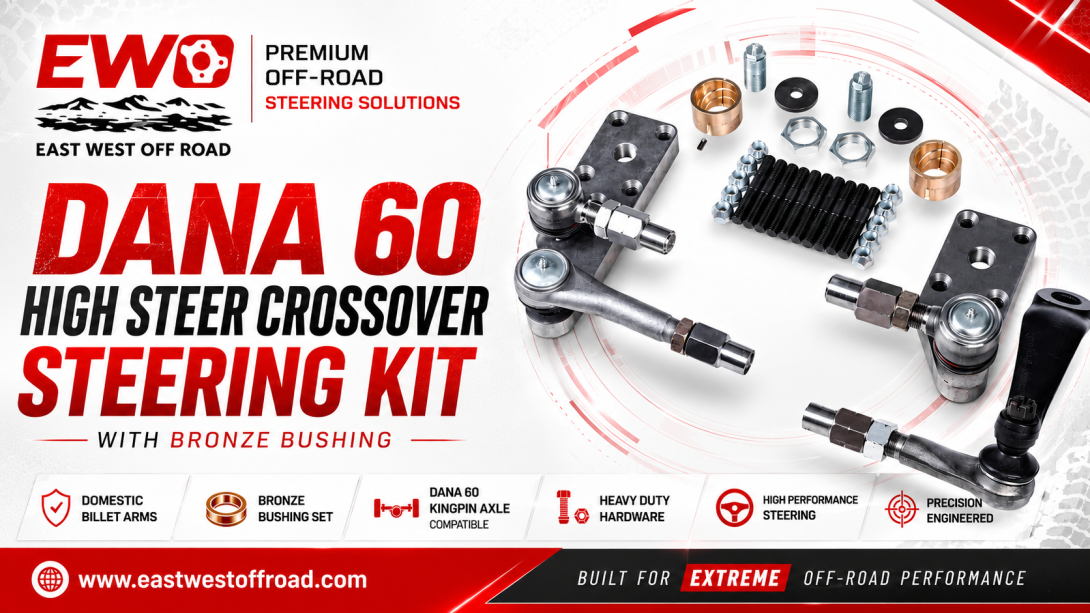
Dana 60 High Steer Arms 5 Stud components are a key upgrade for builders who want a stronger, higher-mounted steering configuration on a kingpin Dana 60 front axle. Designed for demanding applications such as lifted trucks, rock crawlers, solid-axle swaps, and custom 4x4s, 5-stud high-steer arms provide the mounting foundation for heavy-duty crossover steering while helping relocate steering linkage higher around the axle. When combined with billet construction, DOM tubing, GM 1-ton steering ends, and high-strength hardware, they become an essential part of a complete Dana 60 steering upgrade.
For serious off-road builds, choosing the correct steering arms is about more than simply adding another mounting point. Arm thickness, stud pattern, knuckle compatibility, steering-end location, linkage geometry, and hardware strength all affect how the finished system performs.
What Are Dana 60 High Steer Arms 5 Stud?
Dana 60 High Steer Arms 5 Stud are heavy-duty steering arms designed to mount on top of compatible kingpin Dana 60 steering knuckles.
Their primary purpose is to provide elevated mounting locations for steering linkage.
Moving the steering attachment points higher can help accomplish two major goals:
- Create additional clearance around vulnerable steering components
- Provide more flexibility when setting up steering geometry on lifted or modified vehicles
The 5-stud configuration provides an additional mounting point compared with traditional four-stud layouts on compatible steering knuckles.
For vehicles exposed to substantial steering loads, this makes the mounting pattern an important consideration when designing the complete system.
What Does “5 Stud” Mean on a Dana 60 High Steer Arm?
The term 5 stud refers to the number of mounting locations used to secure a compatible high-steer arm to the steering knuckle.
A 5 hole pattern Dana 60 steering arms configuration uses five mounting points around the high-steer arm.
The steering arm itself becomes the connection between the steering linkage and the knuckle.
When the driver turns the steering wheel, steering force travels through the steering box, drag link, steering arm, knuckle, and tie rod system.
Because of those forces, the mounting interface is a critical part of the steering system.
Why Use a 5-Stud High Steer Arm?
The purpose of adding another mounting position is to create a more substantial arm-to-knuckle connection on compatible components.
This becomes particularly relevant on vehicles using:
- Large off-road tires
- Heavy wheels
- Low tire pressures
- Aggressive rock-crawling setups
- Heavy-duty Dana 60 axles
- Crossover steering
- High-steer tie rods
- Custom suspension systems
A steering arm should never be evaluated only by the number of mounting holes, however.
Material, thickness, machining, studs, conical hardware, knuckle condition, linkage position, and proper installation are equally important.
4-Stud vs. 5-Stud Dana 60 High Steer Arms
One of the common questions builders encounter is whether they need a four-stud or five-stud steering arm.
4-Stud High Steer Arms
Traditional kingpin Dana 60 high-steer setups commonly use four primary mounting locations.
These configurations have been used successfully on many off-road builds when paired with compatible knuckles and appropriate hardware.
5-Stud High Steer Arms
A five-stud arm provides an additional mounting location when the steering knuckle supports the pattern.
This can provide a more substantial mounting interface for demanding steering applications.
However, the fifth hole should not be viewed as a substitute for correct material, machining, studs, hardware, or installation.
The entire steering-arm attachment system needs to work together.
Kingpin Dana 60 Compatibility
High-steer arms are especially associated with kingpin Dana 60 axles because of the upper steering-knuckle design.
A Kingpin Dana 60 Steering Upgrade uses this area of the knuckle to create an elevated steering-arm mounting point.
This is different from a ball-joint Dana 60.
Kingpin and ball-joint Dana 60 axles use different knuckle designs, so components intended for a kingpin axle should not automatically be assumed to fit a ball-joint version.
Before purchasing high-steer arms, identify the axle type and exact steering knuckles installed on the vehicle.
Stock Dana 60 Knuckles vs. 5-Hole Aftermarket Knuckles
The steering knuckle plays a major role in determining high-steer-arm compatibility.
Some aftermarket Dana 60 knuckles are manufactured specifically with a five-hole high-steer mounting pattern.
Other knuckles may use different mounting arrangements.
Builders should verify:
- Knuckle manufacturer
- Number of steering-arm mounting holes
- Hole location
- Stud specification
- Conical hardware requirements
- Tie-rod-end taper
- Steering-arm orientation
Do not choose steering arms based only on the axle being called a Dana 60.
Dana 60 axles were manufactured in numerous configurations, and aftermarket knuckles add even more possibilities.
Why Arm Thickness Matters
A high-steer arm serves as a structural connection between the steering linkage and steering knuckle.
For this reason, arm thickness matters.
The East West Offroad steering configuration is built around 1.25 inch thick Dana 60 billet arms.
A substantial billet arm provides a solid foundation for heavy-duty crossover and high-steer applications.
Thickness alone, however, does not determine quality.
Builders should consider:
- Material
- Machining quality
- Mounting pattern
- Hole spacing
- Steering-end position
- Stud quality
- Knuckle compatibility
- Overall steering geometry
The goal is a complete system in which all components are appropriately matched.
Why Billet High Steer Arms Are Used
Billet steering arms are machined to provide accurate mounting surfaces and steering-link locations.
Precision is important because small dimensional differences can affect:
- Tie-rod position
- Drag-link position
- Steering geometry
- Wheel clearance
- Knuckle clearance
- Linkage alignment
A properly machined arm also provides consistent mounting surfaces for high-strength studs and related hardware.
For heavy off-road applications, this combination of substantial material and accurate machining is an important consideration.
How High Steer Increases Steering-Link Clearance
One of the biggest reasons to install a Dana 60 High Steer Kit is steering-link placement.
Factory or low-mounted steering linkage can sit relatively close to rocks and other trail obstacles.
High-steer arms relocate compatible linkage mounting points upward.
Depending on the finished configuration, this can help move steering components farther away from:
- Rocks
- Ledges
- Deep ruts
- Trail debris
- Uneven terrain
This is particularly valuable on rock crawlers where the axle and steering system routinely pass close to obstacles.
High Steer and Dana 60 Crossover Steering
High-steer arms are frequently combined with Dana 60 Crossover Steering.
The two terms describe different parts of the conversion.
High steer refers to raising the steering-link mounting position.
Crossover steering refers to routing the drag link across the vehicle toward the opposite steering knuckle.
Combining the two gives builders greater flexibility when designing steering around a modified suspension.
This combination is commonly found on:
- Lifted Chevy trucks
- Modified Ford 4x4s
- Dodge Dana 60 builds
- Custom Jeeps
- Rock crawlers
- Solid-axle conversions
- Full-size trail rigs
Chevy Dana 60 Crossover Steering With 5-Stud Arms
Chevy Dana 60 Crossover Steering is a particularly common application for high-steer arms.
Older solid-axle Chevy and GMC trucks are frequently modified with suspension lifts, larger tires, heavy-duty axles, and off-road suspension components.
As lift height increases, the original steering configuration may no longer be ideal for the modified suspension geometry.
Adding crossover steering and compatible high-steer arms gives builders another way to configure the drag link and tie rod around the finished truck.
Exact fitment still depends on the vehicle year, axle, steering knuckles, steering box, pitman arm, suspension, and wheel/tire combination.
High Steer Arms and Steering Geometry
Moving steering components higher changes more than ground clearance.
It also changes their relationship to other parts of the suspension.
Important geometry considerations include:
- Drag-link angle
- Tie-rod position
- Pitman-arm height
- Steering-box location
- Suspension travel
- Axle articulation
- Wheel clearance
- Tire clearance
For some vehicles, high steer helps create a more appropriate steering-link position after a substantial suspension lift.
However, a high-steer arm alone does not automatically correct every steering-geometry problem.
The entire suspension and steering system must be considered together.
DOM Tubing for a Complete High Steer System
Steering arms need equally capable linkage.
A heavy-duty configuration commonly uses Dana 60 crossover steering with DOM tubing.
DOM stands for Drawn Over Mandrel.
It is widely used in fabricated steering components because of its consistent dimensions and suitability for heavy-duty applications.
The East West Offroad configuration incorporates 1.50 OD 250 wall DOM tubing for the steering links.
That means:
- 1.50-inch outside diameter
- .250-inch wall thickness
The tubing provides the foundation for custom tie-rod and drag-link fabrication.
Why Custom Steering-Link Length Matters
No two modified Dana 60 builds are necessarily identical.
Final linkage dimensions can vary based on:
- Axle width
- Steering-arm position
- Steering-box location
- Pitman arm
- Vehicle width
- Suspension lift
- Wheelbase
- Knuckle design
- Tie-rod location
That is why heavy-duty DOM tubing is commonly incorporated into custom crossover and high-steer systems.
The steering links can be configured around the actual dimensions of the vehicle.
Dana 60 Drag Link Kit Components
The drag link transfers steering-box input to the steering knuckle.
In a high-steer crossover system, its geometry is particularly important.
A heavy-duty Dana 60 Drag Link Kit needs steering ends, tubing, weld bungs, and mounting locations that work together.
The East West Offroad configuration uses:
ES2026R ES2027L drag link ends
These components become part of the crossover drag-link system when paired with properly fabricated DOM tubing.
GM 1 Ton Tie Rod Ends
The tie rod connects the two steering knuckles and allows them to steer together.
The system uses:
ES2234L ES2234R tie rod ends
These are commonly associated with heavy-duty GM 1 Ton Tie Rod Ends applications.
GM 1-ton-style steering components are widely used in custom off-road steering systems because they provide a substantial steering-joint solution for correctly designed applications.
Pairing them with heavy-wall DOM tubing creates a strong foundation for the tie-rod assembly.
7/8-18 Weld Bungs and Jam Nuts
Heavy-duty steering ends need correctly matched threaded connections.
The configuration uses 7/8-18 weld bungs and jam nuts.
The weld bungs are installed into the DOM tubing to provide threaded mounting points for the steering ends.
Jam nuts secure the steering-link adjustment once the final length and alignment have been established.
Because welding quality directly affects the steering linkage, critical fabrication should be performed by an experienced professional.
High-Strength Studs for High Steer Arms
The connection between the high-steer arm and knuckle experiences substantial steering load.
For that reason, arm mounting hardware should receive the same attention as the arm itself.
The package uses Dana 60 high strength studs 180000 PSI as part of the heavy-duty mounting system.
High-strength studs work with the steering arm, knuckle, and related mounting hardware to form the structural attachment.
Using premium steering arms while ignoring mounting hardware would leave an important part of the system unaddressed.
Why Conical Hardware Matters
Many Dana 60 high-steer systems use tapered or conical hardware at the steering-arm mounting interface.
This style of hardware helps create a properly located and secure connection between compatible components.
The exact hardware requirements depend on the steering arms and knuckles being used.
Builders should always follow the specifications provided for their specific steering-arm and knuckle combination rather than substituting unrelated hardware.
Complete High Steer Kit vs. Buying Arms Alone
High-steer arms can be purchased as individual components, but the arms represent only one part of a complete steering conversion.
A complete Dana 60 kingpin steering kit can simplify the build by bringing together the primary components needed for the steering system.
A complete package can include components such as:
Component
Function
1.25-inch billet high-steer arms
Provides elevated steering mounting locations
5-hole steering-arm configuration
Creates a heavy-duty mounting interface on compatible knuckles
1.50 OD .250-wall DOM tubing
Provides material for heavy-duty steering links
ES2026R / ES2027L ends
Used for the crossover drag-link system
ES2234L / ES2234R ends
Heavy-duty GM-style tie rod ends
7/8-18 weld bungs
Provides threaded linkage connections
7/8-18 jam nuts
Secures final linkage adjustment
High-strength steering-arm studs
Mounts the steering arms to compatible knuckles
Supporting Dana 60 Kingpin Parts
Completes the steering conversion
This approach reduces the number of separate compatibility decisions required when building the steering system.
5-Stud Arms for a 1 Ton Steering Upgrade Kit
A 1 Ton Steering Upgrade Kit typically focuses on replacing lighter-duty steering components with more substantial parts.
Five-stud high-steer arms can complement this type of build by providing a heavy-duty steering-link mounting platform.
Combined with:
- GM 1-ton tie rod ends
- Heavy-wall DOM tubing
- Heavy-duty drag link ends
- High-strength studs
- Properly matched knuckles
the steering arms become part of a complete heavy-duty system rather than a standalone modification.
Dana 60 High Steer Arms for Rock Crawlers
Rock crawling is one of the applications where high-steer placement can be especially valuable.
Low steering linkage can be vulnerable when the front axle approaches rocks and ledges.
High-steer arms allow compatible linkage mounting points to sit higher around the axle.
At the same time, large tires and low tire pressures can place substantial loads through the steering system.
An Off Road Crossover Steering setup therefore needs both good component placement and adequate component strength.
Dana 60 High Steer Arms for Solid Axle Swaps
Solid axle swaps often require a steering system to be designed around the new axle rather than reusing the original vehicle geometry.
A Dana 60 high-steer setup gives fabricators flexibility when establishing:
- Tie-rod height
- Drag-link position
- Pitman-arm relationship
- Steering-box placement
- Suspension clearance
Steering design should ideally be considered during the axle and suspension planning process rather than after the rest of the conversion has been completed.
Wheel and Tire Clearance With High Steer Arms
Moving steering components higher can improve ground clearance, but it can also change the relationship between steering arms, wheels, and tires.
Builders should verify:
- Wheel diameter
- Wheel backspacing
- Steering-arm height
- Tie-rod-end location
- Tire sidewall clearance
- Full steering-lock clearance
Aftermarket wheels and custom axle configurations can change available space considerably.
Clearance should be physically verified on the vehicle.
What to Check Before Ordering 5-Stud Dana 60 High Steer Arms
Before purchasing steering arms, confirm several important details.
Confirm You Have a Kingpin Dana 60
Do not assume every Dana 60 front axle uses the same steering knuckles.
Identify whether the axle is kingpin or ball joint.
Verify the Knuckle Mounting Pattern
Check whether your steering knuckles support the intended five-hole pattern.
Verify Tie Rod End Compatibility
Steering arms may be machined for specific tie-rod-end tapers or mounting arrangements.
Confirm compatibility with the steering ends being used.
Check Wheel Clearance
High-steer arms and rod ends may occupy space closer to the wheel than the original steering components.
Check Linkage Geometry
Determine where the drag link and tie rod need to operate relative to the suspension and steering box.
Inspect Existing Dana 60 Kingpin Parts
Knuckles, studs, bushings, bearings, and related components should be in serviceable condition before installing upgraded steering hardware.
Installation and Setup Matter
High-strength steering components still require proper installation.
Critical items include:
- Correct knuckle preparation
- Proper steering-arm seating
- Correct mounting hardware
- Proper fastener torque
- Correct steering-end engagement
- Adequate jam-nut engagement
- Professional-quality welding
- Full steering clearance
- Suspension-travel clearance
- Final alignment
Steering directly affects vehicle control, so critical fabrication and installation should be handled or inspected by an experienced automotive professional.
Why Choose the East West Offroad Dana 60 Kit?
The East West Offroad Dana 60 kit brings the high-steer arms together with the other major components required for a serious crossover/high-steer conversion.
Instead of buying arms first and later determining which tubing, steering ends, bungs, jam nuts, and studs are needed, builders can start with a coordinated steering package.
The EWO kingpin high steer kit is aimed at applications where steering geometry, component strength, and high-steer placement all matter.
For lifted trucks, rock crawlers, custom 4x4s, and Dana 60 solid-axle projects, that complete-system approach can simplify the build.
Frequently Asked Questions (FAQs)
What are Dana 60 High Steer Arms 5 Stud?
Dana 60 High Steer Arms 5 Stud are steering arms designed to mount on top of compatible kingpin Dana 60 knuckles using a five-position mounting pattern. They provide elevated mounting points for crossover and high-steer linkage.
What is the benefit of a 5-stud steering arm?
A five-stud configuration adds another mounting location on compatible knuckles, creating a substantial arm-to-knuckle mounting interface for demanding steering applications.
Are 5-stud arms better than 4-stud arms?
The correct choice depends on the steering knuckles and the complete steering system. Five-stud arms provide an additional mounting location when used with compatible knuckles, but arm material, studs, hardware, machining, and installation remain equally important.
Do 5-stud high-steer arms fit stock Dana 60 knuckles?
Fitment depends on the exact knuckle and arm design. Some five-stud high-steer systems are intended for aftermarket five-hole knuckles, while compatibility with other knuckle configurations varies. Always verify the actual mounting pattern before ordering.
Are these arms for kingpin Dana 60 axles?
High-steer arms of this type are designed around kingpin Dana 60 steering-knuckle configurations. They should not automatically be assumed compatible with ball-joint Dana 60 axles.
How thick are the Dana 60 billet high-steer arms?
The East West Offroad configuration uses 1.25-inch-thick Dana 60 billet arms as part of its crossover/high-steer system.
What does high steer do?
High steer relocates compatible steering-link mounting points higher on the axle. This can provide additional steering-link clearance and greater flexibility when designing steering geometry for lifted vehicles.
Is high steer the same as crossover steering?
No. High steer describes the elevated linkage mounting location, while crossover steering describes the drag-link configuration across the vehicle. The two are frequently combined.
What size DOM tubing is used with the steering kit?
The steering configuration uses 1.50-inch OD .250-wall DOM tubing for heavy-duty drag-link and tie-rod fabrication.
Which tie rod ends are used?
The system uses ES2234L and ES2234R tie rod ends, commonly associated with heavy-duty GM 1-ton steering applications.
Which drag link ends are used?
The crossover configuration uses ES2026R and ES2027L drag link ends.
What size weld bungs are used?
The system incorporates 7/8-18 weld bungs and matching jam nuts for the steering linkage.
Are 5-stud high-steer arms good for rock crawling?
A properly engineered high-steer setup can be well suited to rock crawling because it relocates compatible steering linkage higher around the axle while providing a heavy-duty steering-arm platform.
Can I use Dana 60 high-steer arms on a Chevy truck?
They may be suitable for Chevy trucks running compatible kingpin Dana 60 axles and steering knuckles. Exact compatibility depends on the axle, knuckles, steering box, suspension, wheels, tires, and crossover configuration.
Do I need a complete high-steer kit or just the arms?
That depends on the existing steering system. If the vehicle already has compatible linkage and hardware, arms may be only one required component. For a complete conversion, a coordinated kit can simplify the selection of steering arms, DOM tubing, rod ends, bungs, jam nuts, and mounting hardware.
Should high-steer arms be professionally installed?
Professional installation or inspection is recommended because steering-arm mounting, steering geometry, fabrication, welding, clearance, and alignment directly affect vehicle control.