

A Dana 44 Steering Knuckle Kit is an important upgrade to consider when building a custom steering system for a Chevy K10, K20, K5 Blazer, classic GMC truck, or compatible Jeep-based solid-axle project. Whether you're replacing damaged knuckles, converting to crossover steering, or installing high-steer arms, selecting the right steering knuckles is essential for proper fitment, steering geometry, and long-term serviceability.
The Dana 44 axle has been used in numerous trucks and off-road vehicles, but not every Dana 44 has the same steering-knuckle design. Differences in spindle mounting patterns, ball joints, steering-arm locations, and wheel-end components can affect which replacement knuckles will fit.
For off-road builders planning a heavy-duty steering upgrade, flat-top knuckles are particularly valuable because they provide mounting locations for compatible high-steer arms.
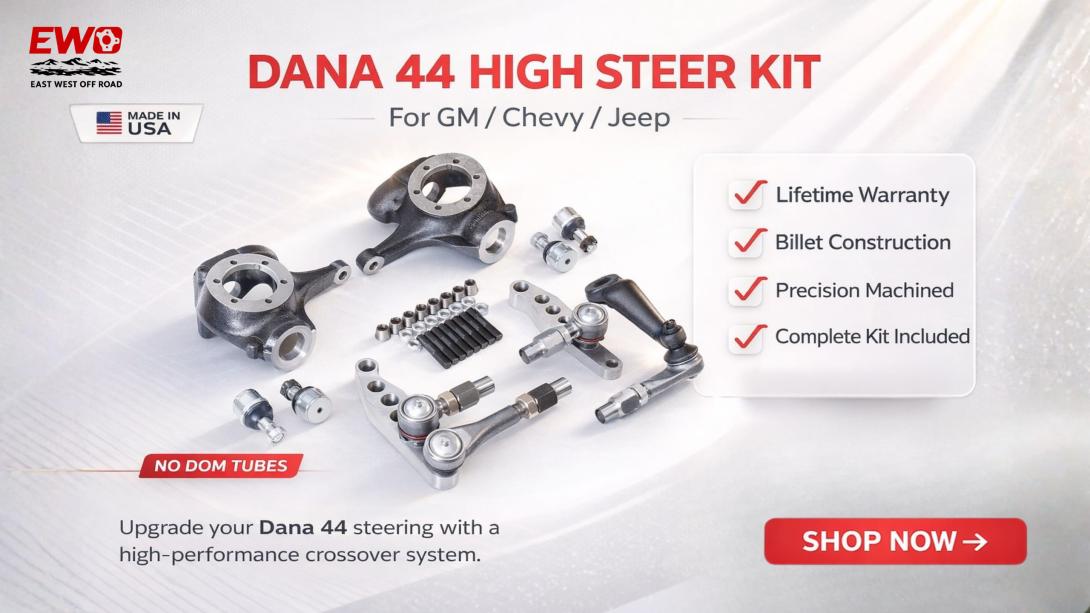
East West Offroad offers its GM / Chevy / Jeep Dana 44 Complete 1-Ton Crossover High Steer Kit with Knuckles – No DOM Tubes (E90089) for compatible custom steering conversions.
However, before choosing a kit, it's important to understand how steering knuckles work, how flat-top designs differ from standard factory components, and what additional parts may be required for a complete high-steer conversion.
This guide covers knuckle compatibility, high-steer mounting options, GM 1-ton steering components, and the essential checks to make before purchasing.
What Is a Dana 44 Steering Knuckle Kit?
A Dana 44 steering knuckle kit is an aftermarket component package designed to replace or upgrade the steering knuckles on a compatible Dana 44 front axle.
Steering knuckles connect the axle's wheel-end components to the steering system and allow the front wheels to pivot when the driver turns the steering wheel.
They also provide mounting interfaces for components such as:
- Upper and lower ball joints
- Wheel spindles
- Brake components
- Steering arms
- Tie rod ends
- Drag link connections
- Steering-stop components
Depending on the manufacturer, a knuckle kit may include individual replacement knuckles, a driver/passenger pair, or additional high-steer hardware.
Some comprehensive conversion packages also include steering arms, steering ends, threaded hardware, and other components.
Why Steering Knuckles Matter in Off-Road Builds
Steering knuckles experience forces from steering input, vehicle weight, wheel movement, braking, and impacts transmitted through the front axle.
On modified vehicles, the original knuckles may not provide the mounting locations required for a new steering arrangement.
For example, a crossover high-steer conversion may require an elevated passenger-side steering connection that the original knuckle cannot accommodate.
Replacing the knuckles with compatible flat-top designs can provide the necessary mounting interface.
However, stronger-looking knuckles or additional mounting holes do not automatically improve steering performance.
The complete steering system must be properly designed and assembled.
Understanding Dana 44 Steering Knuckle Types
Before shopping for replacement knuckles, it's important to identify the type already installed on your axle.
Dana 44 steering knuckles are available in different configurations depending on the original vehicle and manufacturer.
Standard Dana 44 Steering Knuckles
Standard steering knuckles generally provide factory-designed mounting locations for steering and wheel-end components.
They may use cast-in steering arms or other mounting arrangements.
These knuckles can work correctly with the original steering system but may lack the mounting surfaces required for certain aftermarket high-steer arms.
Dana 44 Flat Top Knuckles
Dana 44 Flat Top Knuckles feature upper mounting areas that can support compatible aftermarket steering arms when properly machined and prepared.
This makes them particularly useful in custom crossover and high-steer conversions.
Some factory flat-top knuckles require additional machining before steering arms can be installed.
Certain aftermarket designs are supplied with machined surfaces and prepared mounting holes.
Aftermarket Heavy-Duty Knuckles
Aftermarket steering knuckles may incorporate additional material, revised mounting patterns, or other manufacturer-specific design features.
For example, some aftermarket Dana 44 knuckles use four-stud high-steer mounting patterns instead of traditional three-stud arrangements.
Others feature integrated steering stops or revised shapes for additional clearance.
These features vary by manufacturer and should not be assumed to apply to every knuckle kit.
Steering Knuckle Comparison
Knuckle Type
Main Characteristics
Common Application
Factory standard knuckle
Original steering connections
Stock-style replacement
Factory flat-top knuckle
Upper flat mounting area, potentially requiring machining
Custom high-steer preparation
Machined flat-top knuckle
Prepared steering-arm mounting interface
High-steer conversion
Heavy-duty aftermarket knuckle
Manufacturer-specific reinforced or revised design
Modified off-road applications
Knuckle and high-steer-arm package
Matching major steering-mounting components
Crossover/high-steer projects
Selecting the correct type depends on the axle and intended steering configuration.
Dana 44 Flat Top Knuckles: Why Are They Important?
Flat-top knuckles are among the most frequently discussed components in Dana 44 high-steer conversions.
Their upper mounting surfaces allow compatible high-steer arms to be attached above the original lower steering connections.
Elevated Steering-Linkage Mounting
A high-steer arrangement can position selected steering connections higher on the axle.
Depending on the vehicle, this may provide additional clearance beneath portions of the steering linkage.
That can be useful when modifying a truck for rocky trails or accommodating suspension changes.
However, raised steering connections may also introduce interference with leaf springs, wheels, or chassis components.
Support for Crossover Steering
A conventional crossover steering system uses a drag link routed toward the opposite side of the front axle.
For many classic GM applications, a suitable passenger-side flat-top knuckle provides a location for the crossover steering arm.
Full High-Steer Conversion
A full high-steer arrangement may use elevated steering arms on both knuckles.
This can allow the tie rod and drag link to connect through raised mounting locations.
The exact arrangement depends on the steering arms, knuckle design, and complete vehicle geometry.
For builders comparing a Dana 44 Steering Knuckle Kit, understanding the intended high-steer layout is important before selecting the hardware.
Driver-Side vs. Passenger-Side Dana 44 Steering Knuckles
One of the most common purchasing mistakes is assuming that driver-side and passenger-side knuckles are identical.
Although both support the wheel-end assembly, their steering-arm mounting requirements may differ.
Driver-Side Dana 44 Knuckle
The driver-side knuckle provides a steering connection on many original-equipment configurations.
Certain older Chevy Dana 44 applications use a driver-side upper steering-arm mounting arrangement.
However, this does not guarantee compatibility with a particular aftermarket high-steer arm.
Mounting patterns and hardware specifications must be verified.
Passenger-Side Dana 44 Knuckle
The passenger-side knuckle is especially important in conventional crossover steering conversions.
Because the drag link generally routes toward the passenger side, the knuckle must support the intended steering-arm connection.
Some original Dana 44 passenger-side knuckles may have a suitable flat casting but lack finished mounting holes.
Other versions may require replacement.
Do You Need Both Knuckles?
The answer depends on the steering design.
A crossover-only conversion may need an appropriate passenger-side steering connection.
A full high-steer conversion may require compatible mounting arrangements on both sides.
If your existing knuckles are worn, damaged, or incompatible with the intended system, a matching pair may be worth evaluating.
Do not purchase a pair solely because the product is marketed as heavy-duty. Confirm what your actual build requires.
Three-Stud vs. Four-Stud High-Steer Knuckle Mounting
High-steer-arm mounting patterns vary across knuckle designs.
Two common arrangements are three-stud and four-stud mounting.
Three-Stud High-Steer Mounting
Some traditional Dana 44 flat-top knuckles use three steering-arm mounting studs.
A compatible arm is secured using matching studs, washers, and nuts.
Correct mounting-surface preparation and hardware specifications are essential.
Four-Stud High-Steer Mounting
Certain aftermarket Dana 44 knuckles feature a fourth mounting location.
An additional mounting point can influence the attachment design and load distribution when used with a compatible steering arm.
However, a four-stud system is not automatically compatible with every three-stud or four-stud arm.
What to Verify Before Ordering
Mounting Feature
Required Check
Stud quantity
Three-stud or four-stud pattern
Stud diameter
Match arm and knuckle specification
Mounting-hole pattern
Confirm exact dimensions
Steering-arm surface
Properly prepared and compatible
Washers and nuts
Correct manufacturer-specified hardware
Steering-arm taper
Match intended steering end
Arm orientation
Compatible with steering layout
The manufacturer's instructions should determine the correct attachment hardware and installation requirements.
Dana 44 Ball Joints: What Should You Check During Knuckle Replacement?
The ball joints allow the steering knuckle to pivot relative to the axle.
They are important for both steering movement and wheel-end support.
When replacing Dana 44 knuckles, the upper and lower ball joints must be checked for compatibility and condition.
Upper Ball Joints
Upper ball-joint specifications can vary depending on the axle and knuckle configuration.
The correct joint must match the intended mounting interface.
Lower Ball Joints
Lower ball joints also play an important role in supporting the knuckle and allowing steering movement.
A worn or incompatible lower joint can compromise the finished assembly.
Should Ball Joints Be Replaced With the Knuckles?
That depends on their condition, compatibility, and manufacturer requirements.
A knuckle replacement provides an opportunity to inspect the existing joints.
However, replacing the knuckles does not automatically mean every related component must be replaced.
Buyers researching Dana 44 upper lower ball joints should verify the exact axle application and whether the chosen kit includes the required joints.
Spindle, Hub, and Brake Compatibility: An Often-Overlooked Fitment Issue
A steering knuckle may appear to fit the axle but still be incompatible with the existing wheel-end components.
This is one of the most important reasons to verify more than the Dana 44 axle name.
Spindle Mounting Pattern
Dana 44 axles have been used with different spindle mounting configurations.
The replacement knuckle must have the correct mounting interface for the intended spindle.
Wheel Hubs and Bearings
The spindle, wheel bearings, and hub assembly must work together with the selected knuckle.
A replacement knuckle intended for a different axle version may require different wheel-end components.
Brake Caliper Brackets
Brake caliper mounting arrangements can also vary.
The original brake brackets should not automatically be assumed compatible with an aftermarket knuckle.
Outer Axle Shafts
Changes to wheel-end components may also affect the compatibility of outer axle shafts and associated joints.
For mixed-component axle projects, the complete wheel-end assembly must be evaluated.
Knuckle Fitment Checklist
Component
What to Confirm
Upper ball joint
Correct mounting interface
Lower ball joint
Correct specification
Spindle
Compatible mounting pattern
Wheel hub
Compatible wheel-end assembly
Brake caliper bracket
Correct attachment
Outer axle shaft
Correct axle and spindle arrangement
Steering arm
Matching high-steer mounting pattern
Tie rod end
Compatible taper and orientation
A complete knuckle fitment evaluation should include every relevant connection—not just the steering arm.
Dana 44 Steering Knuckle Kit for Chevy K10, K20 and K5 Blazer
Classic Chevy trucks are common platforms for Dana 44 steering upgrades.
However, the same model may have different axle configurations across production years or after previous modifications.
Chevy K10 Steering Knuckle Upgrade
Some Chevy K10 trucks use Dana 44 front axles suitable for certain crossover and high-steer conversions.
Before choosing components, verify the actual axle, knuckle configuration, steering box, and wheel-end parts.
Chevy K20 Steering Knuckle Upgrade
Certain K20 configurations also use Dana 44 front axles.
However, other K20 trucks may have different axles.
The actual installed axle must be identified before ordering a Dana 44 kit.
Chevy K5 Blazer
Classic K5 Blazer builds are popular candidates for steering modifications.
A knuckle-based conversion may be appropriate when the vehicle has compatible axle components and a steering layout suited to the intended upgrade.
GMC Trucks and Suburbans
Some GMC K-series and Suburban applications share relevant solid-axle configurations with Chevy models.
However, exact fitment depends on the installed axle and wheel-end components.
What About Jeep Dana 44 Axles?
Older full-size Jeep Dana 44 axles may share certain compatible steering-knuckle and spindle interfaces with Chevy applications.
That does not mean every Jeep Dana 44 is interchangeable.
Modern Jeep Dana 44 axle designs can differ substantially from traditional GM-style configurations.
Dana 44 vs. GM Corporate 10-Bolt Steering Knuckles
Buyers frequently compare Dana 44 and Chevy Corporate 10-bolt steering components.
Some aftermarket knuckles are marketed for compatible applications involving both axle families.
However, the axles are not identical.
Differences may include wheel-end components, steering-arm mounting interfaces, and axle-specific hardware.
Before purchasing, identify:
- The exact axle housing
- Existing knuckle type
- Spindle and brake components
- Ball-joint requirements
- Steering-end mounting configuration
- Any previous axle modifications
If the vehicle has undergone an axle swap, do not rely on its original model-year specifications.
Chevy Dana 44 Crossover Steering Kit: How Knuckles Affect the Conversion
A Chevy Dana 44 Crossover Steering Kit changes the way steering input reaches the front axle.
Many classic GM solid-axle trucks originally used a factory push-pull steering arrangement.
A conventional crossover conversion generally uses a longer drag link routed toward a passenger-side steering connection.
Why the Passenger-Side Knuckle Matters
The new drag link requires an appropriate attachment point.
A compatible flat-top knuckle with a high-steer arm can provide the necessary connection.
Steering Box Requirements
Some classic GM push-pull steering conversions require a compatible 2WD-style steering box.
The exact steering gear must be selected according to the vehicle and desired linkage arrangement.
Pitman Arm Compatibility
The pitman arm connects the steering box to the drag link.
Specifications such as drop, spline count, and connection taper must match the intended application.
A 3 inch drop pitman arm 32 splines configuration appears in some aftermarket steering discussions, but it is not universally appropriate for every Chevy crossover conversion.
High Steer vs. Crossover Steering
High steer refers to elevated steering-arm mounting.
Crossover steering refers to the drag link's route toward the opposite side of the axle.
A system can use both, but the correct combination depends on the steering geometry.
Builders researching a Chevy Dana 44 Crossover Steering Kit should verify these requirements before purchasing.
East West Offroad Dana 44 Complete 1-Ton High-Steer Kit With Knuckles
East West Offroad offers the following product:
GM / Chevy / Jeep Dana 44 Complete 1-Ton Crossover High Steer Kit with Knuckles – No DOM Tubes
Product Number: E90089
The package is relevant to builders planning a compatible knuckle-based crossover high-steer configuration.
What Makes E90089 Different?
The product name establishes two important details.
First, steering knuckles are included in the package.
Second, DOM steering tubes are excluded.
This makes E90089 different from packages that include preselected tubing or sell only individual knuckles and steering arms.
E90089 Purchasing Checklist
Before ordering, verify the exact contents of the selected configuration.
Component Category
What to Verify
Dana 44 knuckles
Quantity, side, and axle compatibility
High-steer arms
Design and mounting pattern
Steering-arm studs
Quantity and specifications
Conical washers and nuts
Correct attachment hardware
Tie rod ends
Exact part numbers and tapers
Drag link ends
Correct articulation and mounting
Ball joints
Package inclusion and compatibility
Threaded tube adapters
Matching tube and thread specifications
Pitman arm
Whether included or required separately
DOM steering tubes
Not included
This is a purchasing checklist rather than an independently confirmed inventory of every component in E90089.
Confirm the current product contents and available options with East West Offroad.
Why Choose a Kit Without DOM Tubes?
Not every custom axle build uses the same linkage lengths.
The required tie rod and drag link dimensions depend on the axle width, steering-arm locations, steering-box position, and suspension configuration.
A package without DOM tubing allows the fabricator to source appropriately specified tubing for the vehicle.
This may be useful for experienced builders working with custom axle swaps or nonstandard suspension setups.
How to Select the Right High-Steer Arms for Dana 44 Knuckles
High-steer arms must match the selected knuckles and intended steering linkage.
Some aftermarket systems feature 1.25 inch thick billet steering arms, but arm thickness alone should not determine the purchasing decision.
Material Specifications
Steering-arm material influences structural properties.
Compare the actual manufacturer's material information rather than relying only on general descriptions such as heavy-duty or billet.
Mounting Pattern
The arm must match the knuckle's stud pattern and prepared mounting surface.
Steering-End Compatibility
The steering-end taper and intended mounting direction must be appropriate for the arm.
Steering Geometry
The position of the connection affects the drag link or tie rod path.
The selected arms must work with the complete steering arrangement.
Clearance
High-steer arms may occupy space near leaf springs, wheels, suspension brackets, or other components.
Clearance must be evaluated throughout the required operating range.
GM 1-Ton Steering Components and Dana 44 Knuckle Compatibility
Many aftermarket Dana 44 high-steer conversions use GM 1-ton-style steering ends.
These components are available in different configurations with identifiable part numbers.
Drag Link Ends
Common GM-style drag link end references include ES2026R and ES2027L.
Their suitability depends on thread dimensions, stud taper, articulation, and intended connection location.
Tie Rod Ends
ES2234L and ES2234R are commonly associated with certain aftermarket GM-style tie rod arrangements.
However, similar part numbers or thread specifications do not guarantee full compatibility.
Why the Taper Matters
A steering-end mounting stud uses a tapered connection.
The corresponding steering arm or knuckle must have the correct mounting interface.
An incorrectly matched taper can prevent proper seating and secure attachment.
What Does a 1-Ton Steering Upgrade Mean?
In aftermarket steering terminology, 1 ton generally refers to the steering-end component family.
It does not increase a vehicle's certified axle rating, towing capacity, or payload.
Dana 44 Steering Knuckle Replacement: Pre-Installation Checklist
Before replacing knuckles, organize the project around the specific axle and steering design.
1. Verify the Axle
Identify the actual Dana 44 configuration and confirm whether it has been modified.
2. Inspect the Existing Knuckles
Evaluate the existing steering connections, mounting surfaces, and component condition.
3. Confirm Ball-Joint Compatibility
The selected knuckles must use suitable upper and lower ball joints.
4. Check Spindle and Brake Interfaces
Confirm that the wheel-end components will work with the replacement knuckles.
5. Select Compatible High-Steer Arms
Match the mounting pattern, studs, steering-end taper, and arm geometry.
6. Confirm Steering Box and Pitman Arm Requirements
A crossover conversion may require changes beyond the axle.
7. Plan the Steering Linkage
If the kit does not include DOM tubing, have a qualified fabricator determine the appropriate material and final linkage design.
8. Evaluate Steering Stops
The finished assembly must allow appropriate steering travel without joint binding or interference.
9. Arrange Professional Inspection and Alignment
Steering-knuckle replacement involves safety-critical components.
A qualified professional should verify the installation, steering movement, component security, and alignment before the vehicle returns to service.
Common Mistakes When Buying a Dana 44 Steering Knuckle Kit
Assuming Every Dana 44 Knuckle Is Interchangeable
Different Dana 44 axles can use different knuckles, spindles, and braking components.
The exact application matters.
Choosing Knuckles Based Only on Appearance
A flat-looking upper casting does not guarantee that the knuckle is prepared for high-steer mounting.
Mixing Three-Stud and Four-Stud Hardware
The arm, knuckle, studs, and washers must be compatible.
Do not assume mounting hardware from different products can be combined.
Ignoring Spindle and Brake Fitment
A compatible steering-arm mounting surface does not automatically mean the wheel-end components will fit.
Selecting the Wrong Tie Rod End
Thread size alone does not establish the correct mounting taper or articulation.
Confusing a Knuckle Kit With a Complete Steering Conversion
A pair of knuckles may not include everything required for crossover steering.
Additional arms, steering ends, tubing, or steering-box components may be necessary.
Assuming High Steer Eliminates Bump Steer
Bump steer depends on steering and suspension geometry.
Elevated steering arms alone do not guarantee its elimination.
Overlooking Fabrication Requirements
A no-DOM-tubing package may require custom linkage fabrication.
Professional installation and inspection are important.
Dana 44 Steering Knuckle Kit vs. Complete High-Steer Kit
Before buying, compare the intended package scope.
Feature
Knuckle-Only Kit
Knuckle & Arm Kit
Complete Crossover High-Steer Package
Steering knuckles
Included
Included
Included when specified
High-steer arms
Usually separate
Included
Depends on product inventory
Steering ends
Usually separate
Usually separate
Verify current inventory
Mounting hardware
Varies
Varies
Verify current inventory
Ball joints
Varies
Varies
Verify current inventory
DOM tubing
Usually separate
Usually separate
Product-dependent
Steering-box requirements
Separate evaluation
Separate evaluation
Separate evaluation
Fabrication
Application-dependent
Application-dependent
Application-dependent
A complete package can simplify sourcing major components, but buyers must still verify the exact contents.
For builders evaluating an EWO complete high steer kit without DOM, E90089 offers a knuckle-based option while leaving the steering tubing to be sourced separately.
Is a Dana 44 Steering Knuckle Upgrade Worth It?
A steering-knuckle upgrade may be worthwhile when the existing knuckles are damaged, incompatible with the proposed steering arms, or unsuitable for the intended crossover high-steer conversion.
However, replacing knuckles should be based on the vehicle's actual requirements.
For example, a compatible factory flat-top knuckle may already provide a suitable starting point for professional high-steer preparation.
Another build may require a new aftermarket knuckle because the existing mounting surface or wheel-end configuration is unsuitable.
The best purchasing decision considers the complete system rather than knuckle appearance or advertised strength alone.
Final Thoughts: Choose the Right Dana 44 Steering Knuckles for Your Build
A Dana 44 steering knuckle kit is an important part of many crossover and high-steer conversions.
The knuckles determine how steering arms, ball joints, wheel-end components, and steering linkage connect to the front axle.
Choosing compatible components can help avoid unnecessary machining, incorrect mounting hardware, and expensive installation delays.
Whether you're building a Chevy K10, K20, K5 Blazer, or compatible custom Jeep axle, start by identifying the actual axle and wheel-end configuration.
Then compare flat-top knuckles, high-steer arms, steering ends, spindle compatibility, and the complete steering layout.
For builders planning a GM 1-ton crossover high-steer conversion without supplied DOM tubing, East West Offroad's E90089 product provides a knuckle-based package to evaluate.
Review the current specifications, confirm all required components, and have the steering system professionally installed and inspected.
Frequently Asked Questions (FAQs)
1. What is a Dana 44 Steering Knuckle Kit?
A Dana 44 Steering Knuckle Kit is an aftermarket component package containing replacement or upgraded steering knuckles for compatible Dana 44 front axles. Some packages also include high-steer arms and other steering components.
2. What do steering knuckles do on a Dana 44 axle?
Steering knuckles connect the wheel-end assembly to the axle and allow the front wheels to pivot. They also provide mounting interfaces for ball joints, spindles, steering arms, and steering-linkage components.
3. What are Dana 44 flat top knuckles?
Flat-top knuckles have upper mounting areas that can support compatible high-steer arms when properly prepared. They are commonly used in crossover and high-steer conversions.
4. Are all Dana 44 steering knuckles interchangeable?
No. Dana 44 axles use different knuckle and wheel-end configurations depending on the vehicle and axle generation.
5. What is the difference between driver-side and passenger-side Dana 44 knuckles?
The knuckles may have different steering-arm mounting requirements. In many conventional crossover conversions, the passenger-side knuckle must provide a suitable connection for the drag link.
6. Do I need both knuckles for high steer?
A full high-steer system may require compatible mounting arrangements on both sides. A crossover-only conversion may use a different configuration. The exact requirements depend on the steering layout.
7. What is the difference between three-stud and four-stud high-steer knuckles?
They use different steering-arm mounting patterns. Some aftermarket knuckles provide a fourth stud position, but compatible arms and hardware must be used.
8. Do Dana 44 steering knuckles include ball joints?
It depends on the product. Some packages include ball joints, while others do not. Always verify the current component list.
9. Can Dana 44 knuckles fit a Chevy K10?
Certain Chevy K10 Dana 44 configurations can use compatible replacement or high-steer knuckles. The installed axle and wheel-end components must be verified first.
10. Will Dana 44 knuckles fit a Chevy K20?
Some K20 trucks use compatible Dana 44 front axles. Other axle configurations require different components. Confirm the actual axle before purchasing.
11. Can I use Dana 44 knuckles on a K5 Blazer?
Certain K5 Blazer Dana 44 applications can use appropriate aftermarket knuckles. Fitment depends on the axle and wheel-end configuration.
12. Are Chevy and Jeep Dana 44 steering knuckles interchangeable?
Some older Chevy and full-size Jeep Dana 44 configurations share compatible mounting interfaces. However, interchangeability depends on the exact components and should never be assumed across all models.
13. Can Dana 44 high-steer knuckles fit a GM Corporate 10-bolt axle?
Some aftermarket knuckles are designed for compatible Dana 44 and GM Corporate 10-bolt applications. Exact compatibility and any required changes must be confirmed.
14. What are 1.25-inch billet high-steer arms?
These are aftermarket steering arms manufactured from billet material with a nominal thickness of 1.25 inches. Their suitability depends on material, mounting pattern, design, and intended application.
15. What is a GM 1-ton steering upgrade?
It generally refers to using GM-style heavy-duty steering ends and related components in a compatible steering system. It does not increase the vehicle's certified load rating.
16. Do I need a different steering box for crossover steering?
Certain classic GM push-pull steering conversions require a compatible 2WD-style steering box. The correct configuration depends on the vehicle.
17. Does the EWO E90089 kit include steering knuckles?
Yes. The E90089 product is officially listed as a complete crossover high-steer kit with knuckles. Confirm the exact quantities and specifications before ordering.
18. Does E90089 include DOM tubing?
No. E90089 is the no-DOM-tubes version. Suitable tubing must be obtained separately for the intended steering assembly.
19. Does upgrading steering knuckles improve ground clearance?
Compatible high-steer knuckles and arms may allow certain steering connections to be positioned higher. The actual clearance benefit depends on the complete vehicle configuration.
20. Can replacing Dana 44 knuckles eliminate bump steer?
Not automatically. Bump steer depends on steering and suspension geometry, and replacement knuckles alone do not guarantee correction.
21. Can I install Dana 44 steering knuckles myself?
Steering-knuckle replacement involves safety-critical components, suspension interfaces, and wheel-end assembly requirements. Professional installation and inspection are strongly recommended.
22. Where can I buy a Dana 44 Steering Knuckle Kit?
East West Offroad offers the GM / Chevy / Jeep Dana 44 Complete 1-Ton Crossover High Steer Kit with Knuckles – No DOM Tubes, item E90089, through its official website. Verify current specifications, package contents, and vehicle compatibility before ordering.