

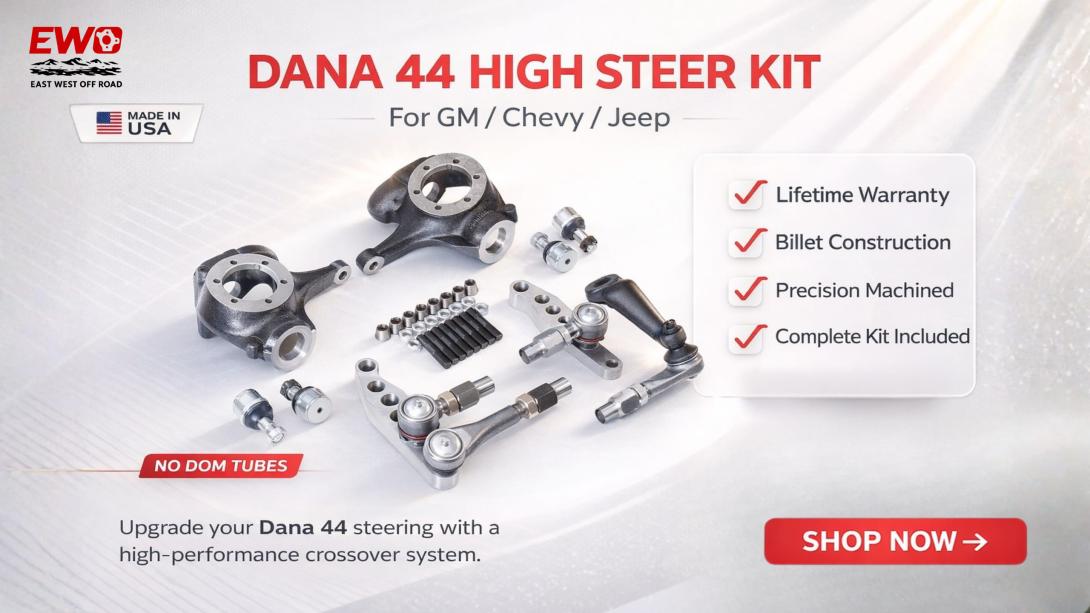
A Dana 44 High Steer Kit is one of the most important steering upgrades to consider when building a lifted Chevy, GM, Jeep, Square Body, rock crawler, or custom solid-axle 4x4. By combining compatible flat-top knuckles, elevated steering arms, heavy-duty GM-style steering ends, crossover drag-link routing, and custom steering linkage, a properly planned system can provide a steering layout better suited to modified suspension and serious off-road use.
The East West Off Road GM / Chevy / Jeep Dana 44 Complete 1-Ton Crossover High Steer Kit with Knuckles – No DOM Tubes is particularly interesting for fabrication-oriented builders because the main high-steer components are packaged together while the final steering tubes are left to the installer to source according to the vehicle's actual dimensions.
What Is a Dana 44 High Steer Kit?
A high-steer system moves steering-link attachment points higher on the front axle.
This is generally accomplished using:
- Compatible flat-top steering knuckles
- High-steer arms
- Heavy-duty steering ends
- Custom tie rod
- Crossover drag link
- Correct steering-box and pitman-arm configuration
The goal is not simply to raise steering components as high as possible.
A successful conversion must also maintain:
- Correct joint articulation
- Suspension clearance
- Wheel clearance
- Steering-box compatibility
- Proper toe
- Safe drag-link geometry
High steer should therefore be treated as a complete steering-system project.
High Steer vs. Crossover Steering
These terms are frequently used together, but they describe two different aspects of the system.
High Steer
High steer refers to the vertical location of the steering linkage.
A steering arm mounted to the top of a compatible flat-top knuckle creates a higher attachment point.
Crossover Steering
Crossover steering refers to the drag-link routing.
Instead of using a short factory-style steering arrangement on one side, the drag link runs across the vehicle toward the opposite-side steering arm.
Many lifted classic GM builds use high steer and crossover steering together.
Why Builders Convert to Crossover Steering
Suspension lifts change the relationship between:
- Frame
- Steering box
- Front axle
- Pitman arm
- Steering knuckles
Once those locations change, the original steering arrangement may no longer be ideal for the finished vehicle.
Crossover steering allows the drag-link layout to be planned around the modified suspension.
This is one reason it is popular on:
- Chevy K5 Blazers
- Chevy K10 trucks
- Chevy K20 trucks
- GMC K-series trucks
- Square Body Suburbans
- Dana 44 axle swaps
- Rock crawlers
- Custom trail rigs
Chevy Dana 44 Crossover Steering Kit
A Chevy Dana 44 Crossover Steering Kit provides a foundation for moving away from the original steering arrangement toward a crossover setup using high-steer-compatible components.
For a Chevy Dana 44 build, the installer should verify the actual axle rather than relying only on the truck's year.
Older vehicles frequently have:
- Replacement axles
- Knuckle swaps
- Brake conversions
- Different hubs
- Previous steering modifications
The axle under the truck today may not be the axle installed at the factory.
Why Dana 44 Flat Top Knuckles Matter
Dana 44 Flat Top Knuckles provide the mounting platform required for traditional high-steer arms.
A flat-top knuckle has sufficient material above the upper ball-joint area for the steering arm mounting surface.
The steering arm then provides the elevated attachment point for the steering linkage.
Without a compatible knuckle, there is no proper foundation for a conventional Dana 44 high-steer arm.
Factory Flat Top Knuckles vs. Aftermarket Knuckles
Some factory Dana 44 knuckles can be used as the basis for high steer.
However, a factory casting may require professional:
- Milling
- Drilling
- Tapping
- Surface preparation
- Inspection
Purpose-built aftermarket knuckles can reduce the need to locate and modify old donor castings.
For many builders, that is a major advantage.
Dana 44 Driver Passenger Flat Top Knuckles
A Dana 44 driver passenger flat top knuckles configuration gives a builder more flexibility than using only one high-steer mounting surface.
With compatible arms on both sides, a full high-steer layout can potentially support:
- Elevated tie rod
- Crossover drag link
- Driver-side steering arm
- Passenger-side steering arm
The actual layout should be designed around the suspension and axle rather than copied blindly from another truck.
Dana 44 Steering Knuckle Kit
When comparing a Dana 44 Steering Knuckle Kit, verify more than the word “Dana 44.”
Important fitment points include:
- Ball-joint design
- Spindle compatibility
- Brake hardware
- Hub configuration
- Steering-arm pattern
- Steering-end taper
Dana 44 axles were used under many different vehicles.
Not every Dana 44 outer assembly is identical.
Bottom Down Taper Knuckle Dana 44
A builder may encounter the search phrase bottom down taper knuckle Dana 44 while comparing steering-knuckle configurations.
Taper direction determines how the steering-end stud enters the knuckle or steering arm.
That can influence:
- Tie rod height
- Wheel clearance
- Spring clearance
- Joint orientation
Always verify the taper orientation of the actual component.
Do not modify a steering taper simply because another Dana 44 setup uses a different orientation.
High Steer Arms Are Structural Steering Components
The high-steer arm transfers steering force from the tie rod or drag link into the steering knuckle.
That means the arm should be evaluated for:
- Material
- Thickness
- Machining
- Stud pattern
- Steering-end taper
- Knuckle compatibility
The steering arm is not simply a spacer or cosmetic accessory.
It is a major structural part of the steering system.
1.25 Inch Thick Billet Steering Arms
Many heavy-duty Dana 44 systems use substantial billet steering arms, and 1.25 inch thick billet steering arms are a common specification encountered in this market.
Arm thickness can provide substantial material around the mounting and steering-end locations.
However, thickness alone does not determine quality.
Also evaluate:
- Material
- Taper accuracy
- Mounting pattern
- Fasteners
- Machining quality
- Steering geometry
1 Ton High Steer Arms Dana 44
The phrase 1 Ton High Steer Arms Dana 44 usually refers to arms configured for the heavy-duty GM-style steering-end family commonly used in custom crossover systems.
The term “1-ton” does not mean the steering arm changes the vehicle's:
- Payload capacity
- GVWR
- Towing rating
- Axle rating
It describes the steering component family.
Chevy 3/4 Ton Tie Rod Arms
Builders may also see the phrase Chevy 3/4 ton tie rod arms.
This typically relates to the steering-end taper or GM steering-end family being used with a particular arm.
Do not choose steering arms based only on “3/4-ton” or “1-ton” wording.
Verify the exact:
- Steering-end part number
- Taper
- Thread
- Mounting arrangement
What Is a GM 1 Ton Steering Upgrade?
A GM 1 Ton Steering Upgrade replaces lighter or factory-style steering linkage with a heavier aftermarket steering-end and linkage arrangement.
A typical 1-ton steering conversion may involve:
- Heavy-duty tie rod ends
- Heavy-duty drag link ends
- Larger threaded connections
- Custom steering tubes
- High-steer arms
The system should still be designed around the actual vehicle.
ES2026R and ES2027L Drag Link Ends
Builders researching this style of conversion often encounter ES2026R ES2027L drag link ends.
These are common GM-style steering-end part numbers used in aftermarket crossover steering systems.
When selecting them, verify:
- Thread direction
- Thread size
- Taper
- Articulation
- Pitman-arm compatibility
- Steering-arm compatibility
Do not assume they fit every Dana 44 setup without verification.
ES2234L and ES2234R Tie Rod Ends
Similarly, ES2234L ES2234R tie rod ends are widely referenced in heavy-duty steering builds.
The left- and right-hand designations matter because a custom steering link may use opposite thread directions for adjustment.
Before fabrication, confirm:
- End part numbers
- Tube-adapter threads
- Jam nuts
- Steering taper
- Required thread engagement
Why Opposite Thread Directions Are Used
A custom tie rod or drag link may use a right-hand thread at one end and a left-hand thread at the other.
This allows the tube to be rotated to adjust its effective length.
That can simplify:
- Toe adjustment
- Drag-link adjustment
- Steering-wheel centering
Remember that “left-hand thread” does not automatically mean the component belongs on the driver's side.
Why the No-DOM Design Matters
One of the defining features of the E90089 product is that DOM steering tubes are not included.
An EWO complete high steer kit without DOM can make sense for builders who want control over the final tie rod and drag link dimensions.
This can be useful when:
- Axle width is not stock
- Steering-box location has changed
- Suspension geometry is custom
- Vehicle uses an axle swap
- Builder already has suitable tubing
- Fabrication shop prefers its own material
- Custom link dimensions are required
What Does “Complete” Mean Without DOM Tubes?
A no-DOM steering kit can still provide the core steering components while deliberately leaving the steering tubes out.
“Complete” should therefore not be interpreted as “nothing else is required.”
The finished vehicle may still need:
- Properly selected DOM tubing
- Professional tube fabrication
- Steering-box changes
- Pitman-arm changes
- Additional clearance work
- Alignment
The exact requirements vary by build.
Dana 44 DIY Steering Kit
A Dana 44 DIY Steering Kit is attractive to experienced builders because it allows the final linkage to be sized around the actual truck.
This is particularly valuable when working with:
- Custom axle widths
- Axle swaps
- Nonstandard suspension
- Custom steering-box placement
- Modified wheelbase
- Rock-crawler chassis
A fabrication-oriented kit provides flexibility, but it also requires more careful planning.
Why Custom Link Length Matters
The final tie rod and drag link lengths depend on real vehicle dimensions.
Factors include:
- Knuckle-to-knuckle distance
- Steering-arm location
- Pitman-arm position
- Steering-box location
- Adjustment range
- Thread engagement
Do not copy steering-link lengths from another vehicle unless the geometry is genuinely identical.
1 Ton Steering Without DOM Tubing
For experienced builders, 1 ton steering without DOM tubing can be preferable to a package with predetermined tube lengths.
It allows the installer to source tubing appropriate for the vehicle and fabricate the linkage around the actual hard points.
The tradeoff is that the builder becomes responsible for:
- Correct tube selection
- Accurate measurement
- Tube-adapter compatibility
- Professional welding
- Final inspection
Because steering is safety-critical, fabrication should be performed by someone qualified for structural steering work.
Off Road Crossover Steering System
An Off Road Crossover Steering System should be designed for more than static garage clearance.
Off-road steering operates while:
- Suspension articulates
- Tires contact obstacles
- Axle moves relative to the frame
- Steering reaches full lock
- Components experience impact loads
The steering needs enough clearance and articulation throughout the complete operating range.
HD Crossover Steering Kit for Rock Crawling
An hd crossover steering kit is particularly relevant for rock crawling.
A front tire can be:
- Fully turned
- Wedged against a rock
- Supporting substantial vehicle weight
- At full suspension articulation
The steering links may also contact trail obstacles.
A heavy-duty system should therefore be evaluated for:
- Linkage clearance
- Joint articulation
- Arm security
- Knuckle compatibility
- Steering-box condition
High Steer and Trail Clearance
One of the attractions of high steer is the ability to reposition steering linkage higher relative to trail obstacles.
A low tie rod may contact:
- Rocks
- Ledges
- Roots
- Deep ruts
Moving the linkage higher can improve clearance in some configurations.
However, it also creates new clearance concerns above the axle.
Leaf Spring Clearance
Classic GM solid-axle trucks commonly use front leaf springs.
High-steer linkage may move closer to those springs.
Check:
- Tie rod to leaf spring
- Drag link to leaf spring
- High-steer arm to spring
at:
- Ride height
- Full compression
- Full droop
- Cross-axle articulation
A steering setup that clears while parked may interfere on the trail.
Oil Pan and Crossmember Clearance
Moving steering higher can reduce available room to:
- Oil pan
- Engine crossmember
- Frame
- Shock mounts
This is why “higher” is not automatically “better.”
The steering system needs enough room above and below throughout suspension travel.
Differential Cover Clearance
Large aftermarket differential covers can interfere with heavy-duty steering linkage.
Check the tie rod at:
- Straight ahead
- Full left
- Full right
- Suspension compression
Aftermarket parts from different manufacturers can fit individually but still interfere when installed together.
Wheel Clearance
Heavy-duty steering ends and billet arms may sit close to the inside of the wheel.
Verify:
- Wheel diameter
- Backspacing
- Inner barrel shape
- Tire sidewall
- Steering-end stud
Wheel diameter by itself does not confirm adequate clearance.
Square Body Crossover Steering Conversion
A Square Body Crossover Steering Conversion commonly involves more than high-steer arms.
A complete project may require:
- Crossover-compatible steering box
- Pitman arm
- Drag link
- High-steer arms
- Flat-top knuckles
- Custom tie rod
- Alignment
The steering-box configuration is particularly important on older GM trucks.
2WD Box Crossover Steering Kit
Classic straight-axle GM crossover conversions often use a 2WD box crossover steering kit arrangement.
The steering box must move the pitman arm in the direction required by the crossover drag link.
Before purchasing a steering box, verify:
- Vehicle year
- Mounting pattern
- Sector shaft
- Input shaft
- Hydraulic fittings
- Pitman-arm compatibility
A random 2WD steering box should not be selected without checking these details.
Pitman Arm Selection
The pitman arm connects the steering box to the drag link.
It influences:
- Drag-link height
- Drag-link angle
- Frame clearance
- Joint articulation
The correct pitman arm depends on the steering box and finished steering geometry.
3 Inch Drop Pitman Arm 32 Splines
Some builders specifically search for a 3 inch drop pitman arm 32 splines setup.
That specification should not automatically be assumed correct for every Dana 44 high-steer conversion.
Verify:
- Sector-shaft spline
- Indexing
- Arm drop
- Drag-link position
- Suspension geometry
More pitman-arm drop is not automatically better.
Dana 44 Upper Lower Ball Joints
Installing new steering knuckles gives access to the ball joints.
That makes the high-steer conversion a logical time to inspect Dana 44 upper lower ball joints.
Worn joints can contribute to:
- Steering play
- Alignment changes
- Uneven tire wear
- Knuckle movement
Installing premium steering components around worn ball joints can undermine the entire upgrade.
Inspect the Wheel Bearings and Spindles
A high-steer conversion should also include inspection of:
- Wheel bearings
- Spindles
- Hubs
- Axle U-joints
- Brake hardware
Steering problems can come from multiple areas.
Do not assume new high-steer components will correct unrelated front-axle wear.
Inspect the Steering Box and Frame
Classic trucks can develop wear or movement around the steering-box mounting area.
Check:
- Steering-box bolts
- Frame cracks
- Mounting holes
- Steering shaft
- Sector-shaft play
A stronger drag link will not correct a loose or damaged steering-box mount.
GM Jeep Dana 44 1-Ton Crossover Kit
A GM Jeep Dana 44 1-ton crossover kit should be chosen by axle configuration rather than the vehicle badge alone.
A Jeep may have a Chevy Dana 44 swap.
A Chevy may have a replacement axle from a different year.
A custom Toyota or trail rig may also use GM Dana 44 outer components.
Identify what is physically under the vehicle before ordering.
Dana 44 vs. Chevy 10 Bolt Steering
The Chevy Dana 44 and GM Corporate 10 Bolt are commonly discussed together in crossover steering conversions.
However, do not assume every component is universally interchangeable.
Check:
- Knuckles
- Ball joints
- Spindles
- Brakes
- Hubs
- Steering tapers
The actual outer assembly determines compatibility.
Does High Steer Eliminate Bump Steer?
No.
High steer may help create better steering geometry, but it does not automatically eliminate bump steer.
Bump steer occurs when suspension movement causes unwanted steering input.
It depends on the relationship between:
- Drag-link movement
- Suspension movement
- Steering-arm location
- Pitman-arm location
Poor geometry can still create bump steer with premium components.
Does High Steer Fix Loose Steering?
Only if the looseness comes from parts being replaced.
Other possible sources include:
- Steering box
- Steering shaft
- Ball joints
- Wheel bearings
- Frame movement
- Suspension bushings
- Loose steering arms
Diagnose the complete vehicle.
Steering Stops Matter
The steering system should have proper mechanical stops.
Do not allow:
- Tie rod ends
- Drag link ends
- Steering box
- Tires
to become the accidental steering stops.
Correct stops help prevent joint binding and excessive knuckle travel.
Full Steering and Suspension Check
Before regular road or trail use, inspect the system at:
- Full left lock
- Full right lock
- Full compression
- Full droop
- Driver-side articulation
- Passenger-side articulation
Check every steering component for:
- Contact
- Binding
- Insufficient articulation
- Thread interference
Alignment After a Dana 44 High-Steer Conversion
Any major steering conversion should be followed by professional inspection and alignment.
Important areas include:
Toe
The tie rod controls toe.
Steering-Wheel Center
Drag-link adjustment influences steering-wheel center.
Caster
Caster affects stability and return-to-center.
Clearance
Recheck full-lock and suspension clearance after the final adjustment.
Common Dana 44 High-Steer Mistakes
Ordering by Vehicle Year Alone
Older off-road vehicles frequently have axle swaps.
Identify the actual axle.
Assuming Every Dana 44 Is the Same
Knuckles, brakes, spindles, and steering interfaces vary.
Treating “1-Ton” as a Vehicle Rating
It describes the steering-end family, not a GVWR increase.
Choosing the Largest Pitman-Arm Drop
The correct geometry matters more than maximum drop.
Assuming High Steer Automatically Fixes Bump Steer
It does not.
Ignoring Full Suspension Travel
Static clearance is not enough.
Fabricating Steering Without Proper Experience
Tie rods and drag links are safety-critical structural components.
Why Choose a No-DOM Dana 44 Kit?
A no-DOM high-steer kit makes the most sense when the builder wants control over the final steering links.
It is especially useful for:
- Custom axle swaps
- Nonstandard widths
- Custom suspension
- Experienced fabrication shops
- Builders with tubing already available
A fixed-length steering package may be more convenient for a standard application, but it can be less useful when the vehicle has been heavily modified.
Why Consider East West Offroad Steering Parts?
East West Offroad steering parts cover several levels of Dana 44 crossover and high-steer builds.
For the E90089 configuration, the defining concept is a GM / Chevy / Jeep Dana 44 complete 1-ton crossover high-steer package with knuckles while leaving DOM steering tubes out of the package.
That makes it especially relevant to builders who want:
- A knuckle-based high-steer foundation
- Heavy-duty crossover steering
- 1-ton steering architecture
- Flexibility in tie rod and drag link length
- Custom fabrication control
Before ordering, compare the current package contents with the exact needs of your vehicle.
Who Should Consider a Dana 44 High Steer Kit?
A high-steer crossover conversion is especially relevant for:
- Lifted Chevy K5 Blazers
- K10 trail trucks
- K20 builds
- Square Body Suburbans
- GMC Jimmy projects
- Dana 44 axle swaps
- Compatible Jeep builds
- Rock crawlers
- Custom off-road rigs
A near-stock vehicle with healthy factory steering may not need the same level of modification.
Pre-Purchase Checklist
Before ordering, verify:
- Actual axle type
- Knuckle configuration
- Driver/passenger steering-arm requirements
- Ball joints
- Spindles
- Brakes
- Wheel hubs
- Steering-box type
- Sector-shaft compatibility
- Pitman-arm requirement
- Tie rod end taper
- Drag link end taper
- Thread requirements
- Wheel backspacing
- Leaf-spring clearance
- Differential-cover clearance
- Oil-pan clearance
- Fabrication capability
- Final alignment plan
This checklist is especially important for vehicles that have been modified by previous owners.
Final Thoughts
A Dana 44 High Steer Kit can provide the foundation for a serious crossover steering upgrade on a lifted GM, Chevy, Jeep, or custom Dana 44 vehicle.
But high steer is not simply about mounting a tie rod higher.
A successful system requires compatible:
- Flat-top knuckles
- Billet steering arms
- Steering ends
- Steering box
- Pitman arm
- Custom linkage
- Suspension geometry
For builders who want more control over the finished tie rod and drag link dimensions, the East West Off Road E90089 no-DOM configuration offers a useful approach: start with the major crossover/high-steer hardware and fabricate the steering links to match the actual vehicle.
That flexibility is particularly valuable for axle swaps, Square Body builds, rock crawlers, and custom suspension projects where standard predetermined linkage lengths may not be appropriate.
Identify the axle first, verify every interface, plan the steering geometry around the finished suspension, use qualified fabrication for structural steering components, and complete the project with professional inspection and alignment.
Frequently Asked Questions (FAQs)
What is a Dana 44 High Steer Kit?
A Dana 44 High Steer Kit uses compatible flat-top knuckles and steering arms to relocate steering-link attachment points higher on the front axle.
What is crossover steering?
Crossover steering routes the drag link across the vehicle toward the opposite-side steering connection instead of using the original steering arrangement.
Is crossover steering the same as high steer?
No. Crossover describes drag-link routing, while high steer describes the vertical location of the steering linkage. Many builds combine both.
Why do I need Dana 44 flat-top knuckles?
Traditional high-steer arms require a suitable upper mounting surface. Flat-top knuckles provide that foundation.
Do all Dana 44 axles use the same knuckles?
No. Dana 44 outer components vary by vehicle, year, spindle, brake, and knuckle configuration.
What does “1-ton steering” mean?
It refers to a common heavy-duty GM-style steering-end family. It does not increase vehicle GVWR, payload, axle capacity, or towing rating.
Does EWO E90089 include DOM tubing?
No. The product is specifically identified as the no-DOM-tubes version.
Why buy a steering kit without DOM tubing?
It allows custom tie rod and drag link lengths to be fabricated around the actual axle width, steering-box location, and suspension geometry.
Is a no-DOM kit better for axle swaps?
It can be particularly useful for custom axle swaps because the builder is not forced to use predetermined steering-link lengths.
Does high steer improve ground clearance?
It can move steering linkage higher and reduce exposure to trail obstacles in properly configured systems.
Will high steer eliminate bump steer?
Not automatically. Bump steer depends on the complete relationship between steering and suspension movement.
Can a high-steer kit fix loose steering?
Only if the looseness comes from components being replaced. Steering-box wear, ball joints, bearings, frame movement, and other parts can also create play.
What are ES2026R and ES2027L?
They are GM-style steering-end part numbers commonly referenced in heavy-duty crossover drag-link systems. Verify compatibility with the exact kit and vehicle.
What are ES2234L and ES2234R?
They are steering-end part numbers commonly used in heavy-duty aftermarket tie rod systems. Thread direction, taper, and application must be verified.
What are Chevy 3/4-ton tie rod arms?
The phrase usually refers to steering arms configured around a particular GM steering-end family. Verify the exact taper rather than relying only on vehicle-weight terminology.
Are 1.25-inch billet steering arms good for high steer?
Substantial billet arms are common in high-steer applications, but thickness alone does not determine compatibility or quality.
Do I need a 2WD steering box for crossover steering?
Many classic straight-axle GM crossover conversions use a compatible 2WD-style steering box. The exact requirement must be verified for the vehicle.
Do I need a dropped pitman arm?
It depends on the steering box, suspension height, steering-arm location, and drag-link geometry.
Will a 3-inch drop pitman arm fit every build?
No. Drop, spline configuration, indexing, and steering geometry must match the specific vehicle.
Should I replace the ball joints during the conversion?
The knuckle conversion provides a good opportunity to inspect the upper and lower ball joints. Replace them if worn or if required by the project.
Can I fabricate my own tie rod and drag link?
Custom links can be fabricated, but steering is safety-critical. Qualified fabrication and professional inspection are strongly recommended.
Can this type of kit work on a Chevy K10?
Compatible K10 Dana 44 and related GM front-axle builds are common crossover/high-steer applications. Confirm the actual axle and outer components.
Can it work on a K5 Blazer or K20?
Yes, compatible Dana 44-based builds are common candidates, but vehicle model alone does not guarantee fitment.
Can a Jeep use GM Dana 44 high-steer components?
Some Jeep builds use Chevy/GM Dana 44 axles or compatible outer components. Verify the actual axle rather than assuming compatibility from the Jeep badge.
What should I check before ordering?
Confirm axle type, knuckles, spindles, brakes, ball joints, steering box, pitman arm, steering-end taper, wheels, suspension clearance, and fabrication requirements.
Do I need an alignment after installing high steer?
Yes. Toe, caster, steering-wheel position, steering stops, joint articulation, and all steering clearances should be checked after installation.
Where can I buy the EWO Dana 44 high-steer kit without DOM tubing?
Use the Buy Now link at the top of this article to view the GM / Chevy / Jeep Dana 44 Complete 1-Ton Crossover High Steer Kit with Knuckles – No DOM Tubes from East West Off Road.