

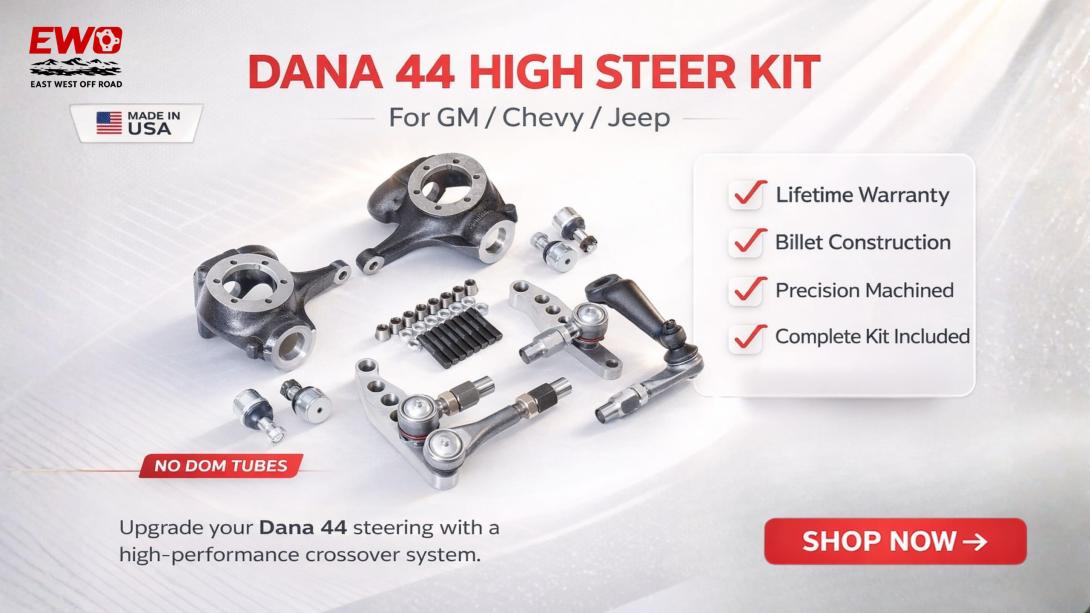
Dana 44 Flat Top Knuckles are an important part of many high-steer and crossover steering conversions on Chevy, GM, Jeep, and custom solid-axle 4x4s. Their flat upper surface provides a mounting platform for compatible high-steer arms, allowing the steering linkage to be repositioned higher on the axle. For builders working on a Square Body Chevy, K10, K20, K5 Blazer, or custom Dana 44 swap, choosing the correct knuckles involves much more than simply confirming that the axle is a Dana 44. Ball-joint configuration, spindle, brakes, steering-arm mounting, steering taper, and axle application all need to be considered.
Understanding Dana 44 Flat Top Knuckles
A steering knuckle connects the front axle assembly to the wheel-end components while providing the mechanical connection for steering movement.
A conventional Dana 44 knuckle may not provide the upper mounting surface needed for a high-steer arm.
A flat-top design changes that by providing a machined or manufactured surface where a high-steer arm can be installed.
This allows the steering linkage to be moved upward and can create a more suitable configuration for certain lifted vehicles.
Flat-top knuckles are therefore commonly associated with:
- High-steer conversions
- Crossover steering
- Lifted 4x4s
- Rock crawlers
- Larger-tire vehicles
- Custom Dana 44 axle swaps
- Heavy-duty steering upgrades
The important point is that a flat-top knuckle is a foundation component, not a complete steering solution by itself.
Why Flat Top Knuckles Matter on a Lifted Dana 44
Suspension modifications change the relationship between the axle and steering system.
As the front axle moves farther from the frame, steering-linkage angles can become more pronounced.
A high-steer configuration can reposition the steering linkage and may provide a better starting point for correcting steering geometry.
Improved Ground Clearance
One of the biggest advantages of moving steering linkage higher is increased protection from trail obstacles.
A low-mounted tie rod can become a vulnerable point when a vehicle travels over rocks, ruts, and ledges.
Raising the linkage can reduce the chance of direct contact with some obstacles.
Better Linkage Position
A properly designed high-steer system can place the drag link and tie rod closer to a useful operating position for a lifted suspension.
However, this depends on the complete steering geometry.
Flat-top knuckles do not automatically eliminate bump steer or steering wander.
Support for Heavy-Duty Steering
Flat-top knuckles also allow the use of substantial high-steer arms.
This makes them a popular starting point for 1-ton-style steering upgrades on modified Chevy and GM trucks.
How to Identify a Dana 44 Flat Top Knuckle
Identifying the knuckle before purchasing replacement components can prevent expensive fitment mistakes.
The most obvious characteristic is the flat mounting area on the top of the knuckle.
However, visual identification alone is not enough.
A proper identification process should include:
- Identifying the front axle.
- Checking the knuckle casting and configuration.
- Confirming driver or passenger side.
- Checking ball-joint dimensions and configuration.
- Identifying the spindle and hub arrangement.
- Checking brake components.
- Confirming the steering-arm mounting pattern.
- Verifying steering-end taper.
Dana 44 axles appeared in many different applications, so two knuckles can look similar while having important differences.
Dana 44 Driver and Passenger Flat Top Knuckles
Side-specific fitment is especially important for crossover steering.
Passenger-Side Flat Top Knuckle
The passenger-side knuckle is commonly used as the attachment point for the crossover drag link.
In a traditional GM crossover arrangement, the drag link travels from the pitman arm across the front axle to the passenger-side steering arm.
Because of this routing, the passenger-side flat-top knuckle is often one of the most important components in the conversion.
Driver-Side Flat Top Knuckle
The driver-side knuckle connects the opposite side of the steering system through the tie rod.
Its configuration still needs to match the axle and steering system.
Do not assume that any Dana 44 driver-side knuckle can be paired with any passenger-side flat-top knuckle.
The complete axle-end configuration should be verified before ordering.
Factory Dana 44 Knuckles vs. New Flat Top Knuckles
Builders generally have two approaches when looking for flat-top knuckles.
Modifying Factory Knuckles
Some factory Dana 44 knuckles can be prepared for high-steer applications.
Depending on the specific knuckle, machining may involve preparing the upper surface and creating the mounting holes for the steering arm.
This is precision machining rather than a simple drilling operation.
The surface needs to be properly positioned, and mounting holes need to be accurately located and tapped.
A poorly machined steering knuckle can create mounting and safety problems.
Purpose-Built Aftermarket Knuckles
Aftermarket flat-top knuckles offer another route.
They can be attractive when a builder does not have a suitable factory knuckle available or wants to avoid finding and machining vintage axle components.
For builders who want the major components together, the GM/Chevy/Jeep Dana 44 complete high-steer kit with knuckles provides a complete starting point for a compatible 1-ton crossover configuration.
High-Steer Arms and Knuckle Compatibility
Installing flat-top knuckles creates the mounting foundation, but the steering arm still has to match.
High-steer arms transfer steering force into the knuckle.
A heavy-duty application may use 1.25 inch thick billet steering arms, although the exact arm specification should be based on the intended knuckle and steering configuration.
Important compatibility factors include:
- Mounting-hole pattern
- Stud size
- Arm thickness
- Steering-end taper
- Arm geometry
- Linkage location
- Wheel clearance
A thicker steering arm is not automatically better if its geometry or mounting configuration does not match the rest of the system.
Dana 44 Steering Knuckle Kit Considerations
A complete Dana 44 Steering Knuckle Kit can simplify the conversion process.
When comparing kits, look beyond the number of parts included.
Check whether the package addresses your actual axle configuration.
Axle Compatibility
Confirm the kit is intended for the exact Dana 44 application.
Ball-Joint Compatibility
Verify upper and lower ball-joint specifications.
Steering Compatibility
Confirm the steering arms and steering ends work with the intended crossover configuration.
Wheel Compatibility
Check the physical space available inside the wheel.
Brake Compatibility
Verify spindle, hub, rotor, and caliper compatibility before changing knuckles.
Dana 44 Upper Lower Ball Joints
The upper and lower ball joints are critical to knuckle fitment.
A replacement knuckle must work with the axle's ball-joint configuration.
This becomes especially important when combining:
- Vintage axle housings
- Replacement knuckles
- Aftermarket steering arms
- Different spindle assemblies
- Modified brake systems
Before purchasing Dana 44 upper lower ball joints, confirm the actual axle and knuckle specifications rather than relying on the vehicle model alone.
Spindle and Brake Compatibility
The steering knuckle is also connected to the wheel-end assembly.
Changing knuckles can affect compatibility with:
- Spindles
- Hubs
- Rotors
- Brake calipers
- Axle shafts
- Wheel bearings
A high-steer conversion should therefore be treated as an axle-end project rather than an isolated steering modification.
This is particularly important on older Chevy and GM trucks that may have received replacement axles or brake upgrades during their lifetime.
Steering Taper on Flat Top Knuckles
Steering taper determines how the steering end seats in the knuckle or high-steer arm.
A bottom down taper knuckle Dana 44 configuration can require a specific steering-end orientation.
The steering-end taper must match the intended mounting location.
Do not select a steering end solely because its thread diameter appears correct.
Verify:
- Taper direction
- Taper dimensions
- Thread size
- Thread direction
- Stud dimensions
- Steering-arm configuration
If a factory knuckle needs machining or modification, use accurate measurements and qualified machining rather than attempting to compensate for an incompatible steering end.
GM 1-Ton Steering With Dana 44 Flat Tops
Flat-top knuckles are commonly used as part of a GM 1 Ton Steering Upgrade.
The complete system can include:
- Flat-top knuckles
- High-steer arms
- Drag link
- Tie rod
- Heavy-duty steering ends
- Pitman arm
- Steering box
- Mounting hardware
The steering components should be selected as a system.
For example, changing the steering arm position may affect drag-link length and pitman-arm requirements.
Chevy 3/4 Ton Tie Rod Arms
Some classic GM Dana 44 applications are associated with Chevy 3/4-ton steering components.
However, vehicle weight class alone does not determine whether a particular tie-rod arm will fit.
The actual knuckle and steering configuration should be verified.
This is especially important when working with used or mixed-generation Dana 44 parts.
ES2026R and ES2027L Drag Link Ends
GM-style steering configurations can use steering ends such as ES2026R and ES2027L in appropriate applications.
These part numbers should be verified against the intended steering system.
Before ordering, check:
- Thread direction
- Taper
- Stud dimensions
- Linkage diameter
- Steering-arm location
- Required articulation
A steering-end part number should never be treated as universal across every Dana 44 configuration.
ES2234L and ES2234R Tie Rod Ends
Likewise, ES2234L and ES2234R are associated with certain GM heavy-duty tie-rod applications.
The correct tie-rod end depends on the steering arm, knuckle, taper, thread configuration, and linkage design.
When building a custom steering system, confirm the complete specification instead of matching only the thread.
Flat Top Knuckles for Square Body Chevy Trucks
Classic Square Body trucks are popular candidates for Dana 44 high-steer conversions.
K10
A lifted K10 running larger tires can benefit from a steering system designed around the modified axle position.
Check the relationship between the steering box, pitman arm, drag link, high-steer arm, and suspension.
K20
K20 builds often use larger tires and heavier-duty components.
A properly configured high-steer system can provide a stronger steering foundation while improving linkage clearance.
K5 Blazer
A K5 Blazer used for serious trail driving can place substantial loads on steering components.
Flat-top knuckles combined with appropriate high-steer arms can provide the foundation for a crossover steering configuration.
3 Inch Drop Pitman Arm 32 Splines
The pitman arm transfers movement from the steering box to the drag link.
Some GM crossover configurations use a 3 inch drop pitman arm 32 splines setup.
That does not mean every lifted Dana 44 requires one.
The correct pitman arm depends on:
- Steering-box sector shaft
- Spline configuration
- Drag-link position
- Suspension height
- Steering travel
- Overall geometry
Selecting a pitman arm based solely on lift height can produce poor steering geometry.
2WD Box Crossover Steering Considerations
Certain GM solid-axle crossover configurations use a compatible 2WD steering box.
A 2WD box crossover steering kit setup can change the position of the steering-box sector shaft and may be appropriate for specific GM builds.
This is an application-specific decision.
Before changing the steering box, confirm frame mounting, sector-shaft configuration, pitman-arm compatibility, steering ratio, and drag-link geometry.
Dana 44 DIY Steering Conversion
A Dana 44 DIY Steering Kit can be useful for experienced builders who are fabricating their own linkage.
Custom fabrication provides flexibility when:
- Axle position has changed
- Suspension height is unusual
- Steering-box location has changed
- Wheelbase has been modified
- Custom high-steer arms are being used
The builder can determine the final drag-link and tie-rod dimensions instead of relying on a universal pre-cut length.
1 Ton Steering Without DOM Tubing
A 1 ton steering without DOM tubing configuration can be particularly useful for custom projects.
Without finished linkage tubes, the builder can fabricate links around the actual vehicle dimensions.
This is useful for custom Square Body trucks and axle swaps where the correct link length cannot be determined until the steering components are positioned.
Because steering is safety-critical, tubing selection, thread engagement, fabrication, welding, and final inspection should be handled appropriately.
EWO Complete High Steer Kit Without DOM
An EWO complete high steer kit without DOM tubing gives builders a way to source the major components while maintaining flexibility over final linkage dimensions.
This can be useful for custom GM, Chevy, and Jeep Dana 44 builds.
The EWO Dana 44 1-ton crossover high-steer kit is supplied without DOM tubing, allowing the builder to determine and fabricate the appropriate drag-link and tie-rod lengths for the specific vehicle.
How to Install Dana 44 Flat Top Knuckles
Installation begins with confirming the complete axle-end configuration.
Remove the Existing Knuckle
Disassemble the wheel-end components according to the axle manufacturer's service procedures.
Inspect the ball joints, spindle, hub, brakes, and axle shaft while the components are accessible.
Install the Replacement Knuckle
Install the compatible knuckle using the correct ball joints and manufacturer-specified hardware.
Do not reuse questionable hardware or damaged components.
Install the High-Steer Arm
Mount the steering arm using the specified studs, nuts, washers, and other hardware.
Follow the steering-arm manufacturer's torque specifications.
Connect the Steering Linkage
Install the drag link and tie rod with compatible steering ends.
Verify taper seating and thread engagement.
Check Steering and Suspension Travel
Turn the steering from lock to lock while cycling the suspension through full compression and droop.
Inspect for contact with:
- Differential housing
- Leaf springs
- Shocks
- Frame
- Wheels
- Tires
- Steering stops
- Sway bar
- Axle housing
Common Flat Top Knuckle Buying Mistakes
Buying by “Dana 44” Alone
The Dana 44 name covers many configurations.
Always verify the actual axle application.
Ignoring Side-Specific Fitment
Driver-side and passenger-side knuckles perform different roles in a crossover system.
Confirm which side is required.
Forgetting Ball-Joint Compatibility
A visually similar knuckle may not match the existing ball joints.
Ignoring Brake Components
Changing knuckles can create spindle and brake compatibility problems.
Matching Steering Ends by Thread Only
Thread size does not confirm taper or overall compatibility.
Assuming Flat Top Means High-Steer Ready
Some factory knuckles require machining before a high-steer arm can be installed.
Forgetting Wheel Clearance
High-steer arms may interfere with the inside of the wheel.
Check actual wheel backspacing and arm clearance before final assembly.
Dana 44 Flat Top Knuckle Maintenance
The knuckle itself is only one part of the steering system and should be inspected along with its connected components.
After hard off-road use, inspect:
- High-steer arm hardware
- Steering ends
- Ball joints
- Knuckle mounting
- Pitman arm
- Steering box
- Tie rod
- Drag link
- Steering stops
Look for loose hardware, excessive play, damaged threads, cracks, deformation, and fresh contact marks.
If the vehicle experiences a severe impact, inspect the steering and axle-end components before returning to normal driving.
Why Choose a Complete Knuckle and High-Steer Package?
A complete package can reduce the complexity of sourcing individual components.
Instead of matching separate knuckles, arms, and mounting hardware from different sources, a matched system can provide a more straightforward starting point.
The GM/Chevy/Jeep Dana 44 1-ton crossover high-steer package is designed for builders who want the major components for a crossover/high-steer conversion while retaining the flexibility to fabricate the final linkage.
Are Dana 44 Flat Top Knuckles Worth Upgrading?
For a modified Dana 44 vehicle, flat-top knuckles can be a valuable part of a high-steer conversion.
They can make particular sense when the vehicle has:
- Suspension lift
- Larger tires
- Increased axle articulation
- Rock-crawling use
- Custom steering
- A GM Square Body chassis
- A K5 Blazer
- A K10 or K20
- A custom Dana 44 axle swap
The biggest advantage is the steering configuration they make possible.
The knuckle should be selected together with the high-steer arms, steering ends, linkage, pitman arm, steering box, wheels, and suspension geometry.
Frequently Asked Questions (FAQs)
What are Dana 44 Flat Top Knuckles?
Dana 44 Flat Top Knuckles are steering knuckles with a flat upper mounting surface designed to accept compatible high-steer arms.
How do I know if my Dana 44 has flat-top knuckles?
The upper portion of the knuckle has a flat mounting surface suitable for a high-steer arm. However, the exact knuckle application should still be identified before purchasing replacement parts.
Are all Dana 44 flat-top knuckles the same?
No. Dana 44 knuckles vary by application, manufacturer, model year, ball-joint configuration, steering provisions, spindle, and brake components.
Which side needs the flat-top knuckle for crossover steering?
The passenger-side knuckle is commonly used for the crossover drag link, although the exact configuration depends on the steering system.
Can I use factory Dana 44 knuckles for high steer?
Some factory knuckles can be professionally machined for high-steer use. Others may not be appropriate for the desired conversion.
Are aftermarket flat-top knuckles better?
Aftermarket knuckles can be convenient because they may be purpose-built for high-steer applications. The best choice depends on axle compatibility, budget, existing components, and intended use.
Do flat-top knuckles improve ground clearance?
They can allow steering linkage to be positioned higher, which may provide additional clearance from rocks and other obstacles.
Do flat-top knuckles eliminate bump steer?
No. Bump steer is a steering and suspension geometry issue. High-steer components may improve the geometry of some lifted vehicles but do not automatically eliminate bump steer.
Do Dana 44 flat-top knuckles require different ball joints?
Potentially. Ball-joint compatibility depends on the exact axle and knuckle configuration. Always verify the specifications before ordering.
What are ES2026R and ES2027L?
They are GM-style steering-end part numbers that may be used in certain drag-link configurations. Verify taper, thread direction, dimensions, and application before use.
What are ES2234L and ES2234R?
They are steering-end part numbers associated with certain GM heavy-duty tie-rod configurations. Compatibility must be checked against the specific knuckle and steering arm.
Do I need a 3-inch drop pitman arm?
Not necessarily. The correct pitman arm depends on the steering box, sector shaft, drag-link geometry, suspension height, and steering travel.
What does a high-steer kit without DOM tubing mean?
It means the kit provides the major high-steer components but does not include finished DOM tubing for the drag link and tie rod. The builder determines and fabricates the final linkage.
Can I use flat-top knuckles on a Square Body Chevy?
A compatible Dana 44 flat-top knuckle setup can be used on appropriate Square Body Chevy builds, including K10 and K20 applications, when all axle and steering components match.
Can flat-top knuckles work with a GM 10-bolt?
Some GM 10-bolt front axle configurations use compatible high-steer and crossover components. Exact knuckle and steering compatibility must be verified before combining parts.
What should I check after installing flat-top knuckles?
Check steering-arm hardware, ball joints, steering-end seating, wheel clearance, steering stops, suspension travel, pitman-arm compatibility, steering-box mounting, and overall steering operation.
Final Thoughts
Dana 44 Flat Top Knuckles are more than a visual variation of a standard steering knuckle. They provide the mounting foundation for many high-steer configurations and can help reposition steering linkage on lifted Chevy, GM, Jeep, and custom 4x4 builds.
The right knuckle must be selected according to the complete axle-end configuration. Driver and passenger side, ball joints, spindle, brakes, steering-arm pattern, steering taper, wheel clearance, and steering-box geometry all matter.
For builders creating a custom crossover system, a complete package supplied without DOM tubing can also provide useful flexibility by allowing the final drag-link and tie-rod dimensions to be fabricated around the actual vehicle.
Whether you're building a Square Body K10, K20, K5 Blazer, Jeep Dana 44 swap, or custom trail rig, the best result comes from treating the knuckles as one part of a complete steering system rather than an isolated upgrade.