

A Dana 44 DIY Steering Kit offers custom 4x4 builders greater flexibility when planning an aftermarket steering setup for a Chevy, GM, Jeep, or modified solid-axle truck. Whether you're restoring a classic Chevy K10, upgrading a K20, building a K5 Blazer, or working on a custom axle swap, selecting the right steering components is essential for a reliable finished system.
Not every off-road build has the same axle width, suspension lift, steering-box position, or steering-linkage requirements. That's why many experienced fabricators prefer steering packages that allow them to source and fabricate the tie rod and drag link to suit the actual vehicle.
A DIY steering approach can provide flexibility over component selection, tubing specifications, and linkage configuration. However, steering fabrication requires careful planning and professional-level attention to compatibility, geometry, and safety.
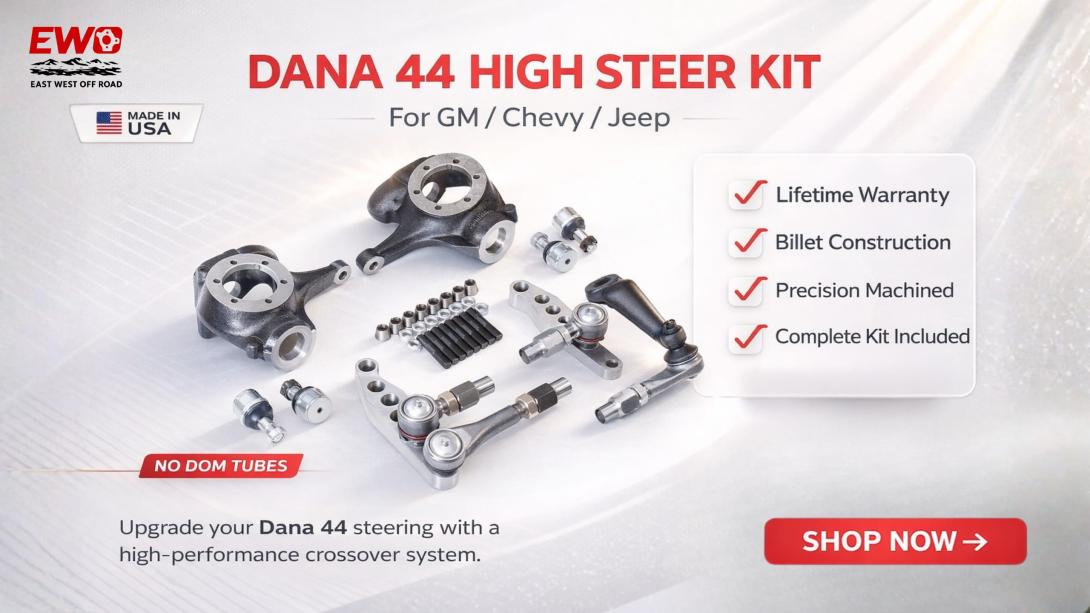
East West Offroad offers its GM / Chevy / Jeep Dana 44 Complete 1-Ton Crossover High Steer Kit with Knuckles – No DOM Tubes (E90089) for builders considering a knuckle-based high-steer conversion while sourcing steering tubing separately.
In this guide, we'll explain how to plan a Dana 44 steering project, understand the essential components, compare high-steer and crossover configurations, and identify common mistakes before purchasing parts.
What Is a Dana 44 DIY Steering Kit?
A Dana 44 DIY steering kit is an aftermarket steering-component package intended for builders who want to configure or fabricate portions of the steering linkage for a compatible Dana 44 axle.
Unlike a fully assembled steering system with predetermined linkage dimensions, a fabrication-oriented package may allow the installer to determine the final tie rod and drag link requirements.
Depending on the manufacturer and selected kit, the components may include:
- Dana 44 steering knuckles
- High-steer arms
- Tie rod ends
- Drag link ends
- Steering-arm mounting hardware
- Threaded tube adapters
- Jam nuts
- Ball joints or other application-specific hardware
Some DIY kits include DOM tubing, while others intentionally exclude it.
That distinction matters because the builder must determine which parts are supplied and what additional materials will be needed.
Why Choose a DIY Steering Setup?
A custom steering configuration may be appropriate when the vehicle has undergone substantial modifications.
Common situations include custom axle widths, suspension changes, nonstandard steering-box placement, or a combination of aftermarket steering and wheel-end components.
Instead of trying to adapt a predetermined linkage length, a qualified fabricator can design an appropriate assembly around the actual vehicle.
However, a DIY package does not eliminate the need for engineering judgment, accurate measurements, or professional inspection.
How a Dana 44 DIY Steering System Works
A solid-axle steering system transfers steering input from the steering gear through mechanical linkage to the front wheels.
The main components work together to control wheel direction while accommodating suspension and steering movement.
Tie Rod
The tie rod connects the steering knuckles and helps maintain the relationship between the front wheels.
Its installed length and connection locations affect wheel alignment and steering operation.
Drag Link
The drag link transfers movement from the steering-box pitman arm toward the steering knuckle or steering linkage.
Its angle, articulation, and movement path are especially important in modified suspension systems.
Tie Rod Ends and Drag Link Ends
Steering ends provide articulated connections between the linkage and its mounting points.
Each joint must have the correct thread specifications, mounting taper, and articulation capability for the intended application.
Steering Knuckles
The steering knuckles provide the wheel-end steering connections.
For a high-steer conversion, appropriately configured flat-top knuckles can support elevated steering arms.
High-Steer Arms
High-steer arms provide alternative steering-linkage mounting locations.
They must be compatible with the knuckles, steering-end mounting interfaces, and complete vehicle geometry.
DIY Steering vs. Preassembled Steering Kits
One of the first decisions is whether to purchase a preconfigured steering assembly or a package intended for custom fabrication.
Feature
DIY Steering Kit
Preassembled Steering Kit
Linkage dimensions
Determined for the build
Often predetermined
Tubing selection
May be selected separately
Usually specified by manufacturer
Fabrication requirements
Often greater
Depends on product
Custom axle compatibility
Can offer flexibility
Application-specific
Component verification
Essential
Essential
Installation complexity
Typically higher
Depends on vehicle
Best application
Experienced custom builds
Supported vehicle configurations
A preassembled kit can simplify component sourcing when the vehicle matches the manufacturer's intended application.
A DIY approach may be more appropriate when custom dimensions or component combinations are necessary.
Neither approach automatically produces a stronger or safer steering system.
Why Choose a Dana 44 Steering Kit Without DOM Tubing?
DOM stands for Drawn Over Mandrel, a steel tubing manufacturing process commonly used in fabricated steering and suspension components.
DOM tubing is frequently selected for custom steering linkage because of its controlled dimensional characteristics.
However, the correct tube specifications depend on the steering assembly's engineering requirements.
Custom Tie Rod and Drag Link Dimensions
A vehicle with an altered axle width or steering-arm arrangement may require different linkage dimensions from a factory configuration.
A no-DOM package allows the fabricator to obtain suitable tubing for the actual build rather than purchasing predetermined tube lengths that may not be usable.
Custom Steering-Box Placement
When a vehicle uses a relocated steering box or modified chassis, the drag link may need to follow a different path.
The final assembly must accommodate that configuration without interference or joint binding.
Axle Swaps and Custom Suspensions
A modified truck may use a Dana 44 axle from a different vehicle.
In these situations, the original steering components may no longer match the installed axle and suspension.
Custom linkage planning may be necessary.
Avoiding Unnecessary Tubing Purchases
Experienced fabrication shops may already stock suitable DOM tubing or prefer to obtain material from a trusted supplier.
A no-DOM kit can reduce duplication of materials, although the final cost depends on fabrication and any additional components required.
For builders researching 1 ton steering without DOM tubing, East West Offroad's E90089 package is one option to evaluate.
What's Included in East West Offroad's E90089 High-Steer Package?
East West Offroad offers its GM / Chevy / Jeep Dana 44 Complete 1-Ton Crossover High Steer Kit with Knuckles – No DOM Tubes under product number E90089.
The product's defining features are its crossover high-steer configuration, included knuckles, and exclusion of DOM steering tubes.
Understanding the Main Component Categories
Before ordering, compare the components required for your vehicle against the current product inventory.
Component
What Buyers Should Verify
Dana 44 steering knuckles
Side, quantity, and axle compatibility
High-steer arms
Design, mounting pattern, and quantity
Tie rod ends
Exact part numbers, thread, and taper
Drag link ends
Articulation and mounting compatibility
Steering-arm hardware
Studs, washers, and nuts
Tube adapters
Thread and tubing compatibility
Jam nuts
Correct thread directions
Ball joints
Application and package availability
Pitman arm
Whether required or supplied
DOM tubing
Not included
This table is a purchasing checklist rather than a verified inventory of every E90089 component.
Confirm the current package contents and selected options with East West Offroad before placing an order.
What Does "Complete" Mean in a No-DOM Kit?
The word complete can describe a comprehensive component package without meaning that every part necessary for installation on a particular vehicle is included.
For E90089, the product name explicitly excludes DOM tubing.
Depending on the build, additional steering-box components, wheel-end parts, fabrication materials, or suspension modifications may also be required.
Dana 44 Flat Top Knuckles: The Foundation of High Steer
Flat-top knuckles are important components in many Dana 44 crossover and high-steer conversions.
A suitable flat-top knuckle provides an upper mounting area for a compatible high-steer arm.
Factory vs. Aftermarket Flat-Top Knuckles
Certain older Chevy and full-size Jeep Dana 44 applications used knuckle castings with upper flat areas.
Some factory knuckles require machining, drilling, and tapping before an aftermarket high-steer arm can be installed.
Aftermarket knuckles may be supplied with prepared mounting interfaces.
However, not every flat-top casting supports every high-steer arm.
Driver-Side and Passenger-Side Knuckles
The required knuckle configuration depends on the steering layout.
In a conventional crossover configuration, the drag link generally connects toward the passenger-side steering arm.
A full high-steer system may use elevated steering connections on both sides.
Before selecting Dana 44 driver passenger flat top knuckles, verify the axle, mounting pattern, and intended steering-arm arrangement.
Three-Stud vs. Four-Stud Mounting
Different high-steer knuckle designs can use different mounting patterns.
Some traditional applications use three mounting studs, while certain aftermarket knuckles use four.
Arms, studs, washers, and attachment hardware must be compatible with the selected knuckle.
Never assume that a steering arm can be transferred between different mounting patterns.
Planning a Chevy Dana 44 Crossover Steering Conversion
Many classic Chevy trucks are popular platforms for DIY steering modifications.
A traditional push-pull steering arrangement may become less suitable after suspension lifts or major axle changes.
A crossover steering configuration changes the drag link routing toward the opposite side of the front axle.
For builders evaluating a Chevy Dana 44 Crossover Steering Kit, several vehicle-specific considerations deserve attention.
Steering-Box Compatibility
Some classic GM crossover conversions require a compatible 2WD-style steering box.
This is because the steering-box output and pitman-arm movement must suit the crossover drag link configuration.
Before purchasing a steering box, confirm the mounting arrangement, output shaft, hydraulic fittings, and steering travel.
Pitman Arm Requirements
The pitman arm connects the steering gear to the drag link.
Different steering configurations may require different pitman-arm designs.
For example, a 3 inch drop pitman arm 32 splines is a specification sometimes encountered in aftermarket conversion discussions.
However, the correct spline count, arm indexing, drop, and taper must be established for the vehicle.
Suspension and Crossmember Clearance
A crossover drag link may pass near the front suspension, engine crossmember, or chassis components.
Its intended path must be evaluated at normal ride height and throughout the expected steering and suspension movement.
Additional vehicle modifications may be necessary to provide proper clearance.
GM 1-Ton Steering Components for DIY Dana 44 Builds
Many aftermarket Dana 44 high-steer systems use GM 1-ton-style tie rod ends and drag link ends.
These components are popular in custom 4x4 steering projects because different configurations are available with identifiable part numbers.
ES2026R and ES2027L Drag Link Ends
ES2026R and ES2027L are commonly referenced GM-style drag link end part numbers.
Before selecting them, verify:
- Thread specifications
- Mounting-stud taper
- Joint articulation
- Intended connection location
- Steering-arm compatibility
Their use in other GM steering products does not establish that both are included in every Dana 44 kit.
ES2234L and ES2234R Tie Rod Ends
ES2234L and ES2234R are also associated with certain GM-style tie rod applications.
Correct thread direction, mounting interface, and joint geometry are important.
Two steering ends may share a similar nominal size but still require different mounting arrangements.
Does "1 Ton" Mean a Higher Vehicle Weight Rating?
No.
In this context, 1 ton describes a family of steering components used in aftermarket applications.
Installing these parts does not increase the certified load rating, towing capacity, or payload of the vehicle.
Choosing DOM Tubing for a Custom Steering Build
When purchasing a kit without DOM tubes, material selection becomes a separate project requirement.
DOM tubing is available in various diameters, wall thicknesses, and steel grades.
The correct specification should be determined from the intended steering assembly and the manufacturer's component requirements.
Important Tubing Specifications
Specification
Why It Matters
Outside diameter
Affects fitment and structural design
Inside diameter
Relevant to adapter compatibility
Wall thickness
Influences tube properties
Steel grade
Determines material characteristics
Finished link length
Must match the steering layout
Adapter design
Must be compatible with tubing and steering ends
Avoid copying tubing specifications from an unrelated steering kit.
The fact that another Dana 44 build uses a particular tube diameter does not automatically mean it is appropriate for your vehicle.
Why Finished Linkage Dimensions Matter
The finished tie rod and drag link dimensions depend on the installed knuckles, steering arms, steering box, and suspension.
A fabricated linkage also needs appropriate thread engagement and adjustment capability.
Those details must be established by a qualified fabricator using the actual vehicle and component manufacturer's requirements.
Welding and Assembly Considerations
Steering components experience significant forces in service.
Any welding or fabrication must use appropriate procedures and compatible materials.
Poorly constructed steering links can create serious safety risks.
Professional fabrication and final inspection are strongly recommended for custom steering assemblies.
DIY Dana 44 Steering Project: A Pre-Fabrication Planning Checklist
A successful DIY steering project starts before any tubing is cut or steering components are assembled.
Phase 1: Confirm the Axle
Identify the actual Dana 44 axle, not simply the vehicle model year.
Check whether the axle has been swapped or modified.
Phase 2: Verify the Knuckles
Confirm the knuckle design, ball-joint requirements, mounting pattern, spindle compatibility, and braking-system interfaces.
Phase 3: Establish the Steering Architecture
Determine whether the build calls for conventional crossover steering, crossover high steer, or another linkage arrangement.
This decision affects where the steering connections must be located.
Phase 4: Check the Steering Gear
Verify that the steering box and pitman arm are suitable for the intended configuration.
Phase 5: Review Suspension Geometry
Consider the axle's position relative to the frame and the surrounding suspension components.
On vehicles with a track bar, the relationship between the drag link and track bar is especially important.
Phase 6: Specify the Linkage Components
Have a qualified fabricator establish the required tubing, adapters, steering ends, and finished link dimensions.
Phase 7: Verify Movement and Clearance
The completed design should accommodate its required range of steering and suspension movement without binding or interference.
Phase 8: Plan Final Inspection and Alignment
After installation, the system must be evaluated for secure connections, proper steering operation, and alignment.
This planning process can help identify incompatible parts before they create expensive delays.
Dana 44 DIY Steering Kit Cost: What Should You Budget For?
The purchase price of the steering kit is only one portion of the project cost.
A no-DOM configuration may appear less expensive than a fully supplied assembly, but additional materials and labor must be considered.
Project Cost Breakdown
Cost Category
Budget Consideration
Steering kit
Initial hardware purchase
DOM tubing
Required separately for E90089
Fabrication labor
Varies by project complexity
Knuckle preparation
Depends on supplied knuckles
Steering-box changes
May be required
Pitman arm
Application-specific
Additional wheel-end parts
Based on axle condition
Alignment
Required after relevant modifications
Inspection
Important for the finished steering system
A custom axle-swap project may require substantially more work than a relatively straightforward conversion on a compatible existing axle.
Is a No-DOM Kit Always Cheaper?
Not necessarily.
A no-DOM package may offer material-selection flexibility, but tubing purchases, fabrication labor, and other vehicle-specific modifications affect the total cost.
The right comparison is the complete installed project, not just the price of the kit.
High-Steer vs. Standard Crossover Steering for DIY Builds
A crossover steering conversion and a high-steer conversion are related but distinct.
Crossover steering primarily changes the drag link routing.
High steer changes the position of steering connections through compatible steering arms and knuckles.
Feature
Standard Crossover
Crossover High Steer
Drag link routing
Across toward opposite-side connection
Across toward an elevated connection
High-steer arms
Application-dependent
Required for raised mounting
Flat-top knuckles
May be necessary
Usually central to the layout
Linkage clearance
Vehicle-specific
Vehicle-specific
Fabrication
May be required
May be required
Steering geometry
Must be evaluated
Must be evaluated
The better configuration depends on the actual suspension and steering requirements.
An off road crossover steering system should not be selected on the assumption that a higher connection automatically eliminates bump steer or improves handling.
Common DIY Steering Mistakes to Avoid
A custom steering project can become significantly more expensive when compatibility issues are discovered after purchasing parts.
Buying Based Only on Axle Name
Dana 44 is an axle family with different configurations.
Not every Dana 44 uses the same knuckles, spindles, brakes, or steering connections.
Ignoring Steering-End Tapers
Correct thread dimensions do not establish that a tie rod end fits a steering arm.
The mounting taper, orientation, and joint specifications must match.
Mixing Incompatible High-Steer Arms and Knuckles
Steering arms must match the knuckle mounting pattern and hardware.
A three-stud arm should not be assumed compatible with a different four-stud design.
Forgetting the Pitman Arm
The pitman arm affects the drag link connection and steering geometry.
An incorrect design can introduce clearance or steering problems.
Assuming High Steer Eliminates Bump Steer
Bump steer is related to how steering and suspension components move together.
A high-steer conversion does not independently guarantee its elimination.
Ignoring Steering Stops
The finished steering assembly must have appropriate steering-stop behavior.
Tie rod ends, drag link ends, and other components should not be forced beyond their intended range of movement.
Underestimating Fabrication Requirements
A no-DOM kit is not a guarantee of an easy bolt-on installation.
Custom steering fabrication requires appropriate technical expertise and inspection.
Who Should Consider a Dana 44 DIY Steering Kit?
A DIY steering package may be appropriate for several types of projects.
Classic Chevy Square Body Builds
A lifted Chevy K10, K20, or K5 Blazer may require a crossover steering arrangement suited to its modified suspension.
Custom Jeep Dana 44 Projects
Some custom Jeep builds use compatible older-style Dana 44 axle components.
However, newer Jeep Dana 44 configurations should not automatically be assumed compatible with traditional Chevy-style high-steer hardware.
Rock Crawlers and Trail Trucks
Off-road vehicles built for challenging terrain may require custom steering-linkage placement.
Clearance, steering articulation, and component protection are important considerations.
Axle-Swap Projects
A vehicle receiving a Dana 44 from another platform may need a steering linkage that differs from both vehicles' original arrangements.
Professional Fabrication Shops
A no-DOM kit can be useful for fabrication shops that want to specify linkage material and dimensions for each project.
The common requirement across these applications is a properly planned steering system using compatible parts.
Why Consider East West Offroad's No-DOM Dana 44 Steering Package?
East West Offroad offers several steering products for Dana 44 and other solid-axle applications.
Its E90089 product is specifically identified as a complete GM / Chevy / Jeep 1-ton crossover high-steer kit with knuckles and without DOM tubes.
That package is relevant to builders who need a knuckle-based conversion but prefer to source the steering tubing separately.
The EWO complete high steer kit without DOM provides a product option to evaluate alongside your project requirements.
Before purchasing, confirm the current package inventory, axle compatibility, knuckle specifications, steering-end options, and additional parts necessary for your installation.
Final Thoughts: Plan Your Dana 44 DIY Steering Upgrade Around Fitment
A Dana 44 DIY steering project offers flexibility for builders working with modified trucks, custom suspension systems, and nonstandard axle configurations.
Choosing a no-DOM steering kit allows the final tie rod and drag link material to be sourced according to the needs of the actual vehicle.
However, successful steering fabrication depends on much more than choosing high-steer arms or heavy-duty tie rod ends.
Correct axle identification, steering-knuckle compatibility, steering-box selection, joint articulation, suspension geometry, and professional assembly are all essential.
For Chevy, GM, and compatible Jeep Dana 44 builds, East West Offroad's E90089 package offers a knuckle-based crossover high-steer option without included DOM tubing.
Review the product specifications, confirm fitment, and have the complete steering design evaluated by a qualified professional before beginning the conversion.
Frequently Asked Questions (FAQs)
1. What is a Dana 44 DIY Steering Kit?
A Dana 44 DIY Steering Kit is an aftermarket component package intended for builders planning a custom steering configuration on a compatible Dana 44 axle. Some packages require separately sourced tubing and professional fabrication.
2. What is the advantage of a DIY steering kit?
A DIY package can allow flexibility in choosing appropriate linkage dimensions, materials, and steering components for a modified vehicle. The finished design still requires proper engineering and installation.
3. Does EWO E90089 include DOM tubing?
No. E90089 is identified as the complete crossover high-steer kit with knuckles and without DOM tubes. Steering tubing must be obtained separately.
4. Does the EWO DIY high-steer package include knuckles?
Yes. The E90089 product name confirms a knuckle-based package. Buyers should verify the current knuckle specifications and quantities before ordering.
5. Can I fabricate my own tie rod and drag link?
Custom steering links can be fabricated by qualified specialists using properly selected materials and connections. Because steering is safety-critical, professional fabrication and inspection are recommended.
6. What tubing should I use for a Dana 44 steering kit?
The correct tubing depends on the steering system's design, intended application, joint specifications, and fabrication requirements. There is no universal tubing size appropriate for every Dana 44 build.
7. Will a DIY Dana 44 steering kit fit a Chevy K10?
Certain Chevy K10 Dana 44 configurations may be suitable for aftermarket crossover high-steer systems. The actual axle, knuckles, steering box, suspension, and vehicle modifications must be verified.
8. Can I use a Dana 44 steering kit on a K20 or K5 Blazer?
Some compatible K20 and K5 Blazer builds use Dana 44 steering systems. However, the vehicle model alone does not guarantee fitment.
9. Do I need flat-top knuckles for Dana 44 high steer?
A traditional Dana 44 high-steer arrangement generally requires compatible flat-top knuckles or another manufacturer-supported mounting design.
10. What is the difference between high steer and crossover steering?
High steer describes elevated steering-linkage mounting positions. Crossover steering describes the drag link routing toward the opposite-side steering connection. The two can be combined.
11. What are ES2026R and ES2027L?
They are GM-style drag link end part numbers commonly referenced in aftermarket steering systems. Their exact specifications must be verified for the intended application.
12. Are ES2234L and ES2234R interchangeable?
They should not be assumed interchangeable. Thread direction, mounting requirements, and other specifications must be matched to the intended steering arrangement.
13. Do I need a 2WD steering box for crossover steering?
Certain classic GM 4WD crossover conversions require a compatible 2WD-style steering box. The correct requirement depends on the existing steering configuration.
14. Does a DIY steering kit include a pitman arm?
Package contents vary. Buyers should verify whether the chosen E90089 configuration includes the required pitman arm or whether it must be sourced separately.
15. Does high steer improve ground clearance?
It may improve clearance beneath certain steering components in some applications. However, overall clearance depends on the complete steering and suspension layout.
16. Can a Dana 44 high-steer conversion eliminate bump steer?
Not automatically. Bump steer is influenced by steering and suspension geometry. A high-steer conversion must be properly designed and evaluated.
17. Are Dana 44 and Chevy 10-bolt steering components interchangeable?
Some aftermarket products support specific components from both axle families. However, universal interchangeability should not be assumed because knuckle and wheel-end interfaces can differ.
18. Is a no-DOM steering kit cheaper than a complete assembled system?
Not necessarily. A no-DOM kit excludes tubing, but the total cost depends on material sourcing, fabrication, installation, and any additional vehicle modifications.
19. Does a Dana 44 DIY steering conversion require an alignment?
Yes. Relevant steering and suspension modifications require professional inspection and alignment to verify correct operation and wheel geometry.
20. Where can I buy a Dana 44 DIY steering kit?
East West Offroad offers the GM / Chevy / Jeep Dana 44 Complete 1-Ton Crossover High Steer Kit with Knuckles – No DOM Tubes, item E90089, through its official website. Confirm current specifications and compatibility before ordering.