

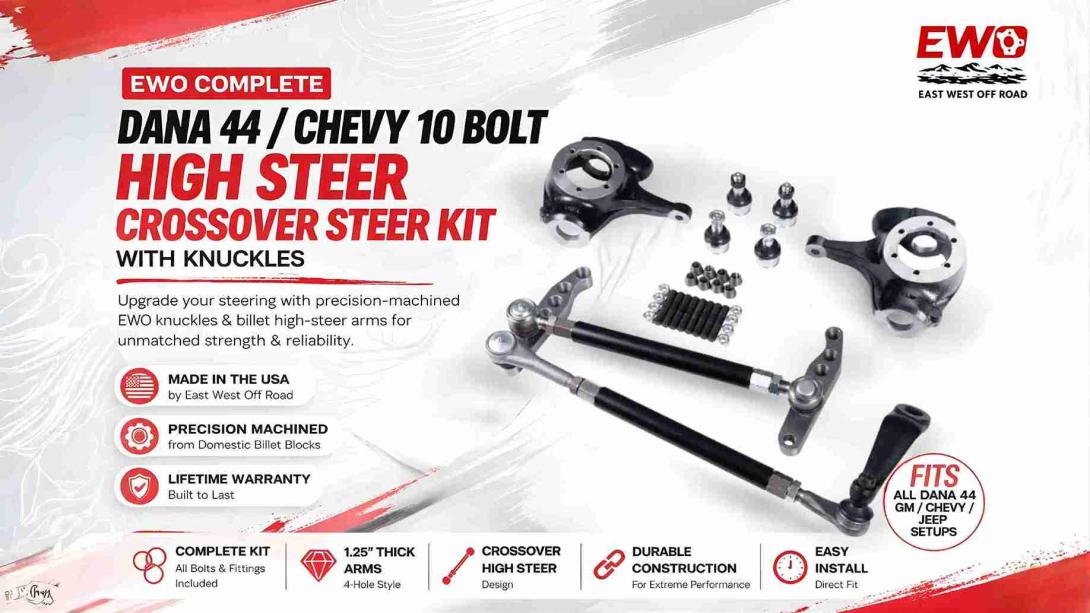
A Dana 44 Crossover Steering Kit is a popular upgrade for lifted Chevy, GM, and Jeep 4x4s that need stronger steering components, improved linkage routing, and better clearance around the front axle. By converting the steering system to a crossover configuration with compatible flat top knuckles and high steer arms, off-road builders can create a more practical steering layout for larger tires, lifted suspension, and demanding trail use.
What Is a Dana 44 Crossover Steering Kit?
A Dana 44 Crossover Steering Kit changes the factory steering arrangement so the drag link connects across the axle to the passenger-side steering knuckle.
Instead of relying on the original steering-linkage layout, crossover steering uses a high-steer arm mounted to a compatible flat top knuckle. This allows the steering linkage to sit higher and can provide additional clearance from rocks and trail obstacles.
A complete system may include:
- Driver and passenger Dana 44 flat top knuckles
- High steer arms
- Steering-arm hardware
- Tie rod ends
- Drag link ends
- Crossover steering linkage
- Compatible pitman-arm components
The exact parts required depend on the axle, steering box, suspension height, and vehicle configuration.
Why Upgrade to Dana 44 Crossover Steering?
Factory steering can become a limitation after lifting an older 4x4 and installing larger tires.
A crossover conversion can address several common concerns.
Improved Steering Linkage Clearance
One of the biggest advantages is moving steering components higher. This can help protect the drag link and tie rod from rocks, ledges, and other obstacles.
For rock crawlers, steering clearance is particularly important because the front axle frequently passes over uneven terrain.
Better Steering Geometry for Lifted Vehicles
A suspension lift changes the relationship between the axle, steering box, pitman arm, and steering linkage.
A properly configured crossover system can provide a more suitable steering arrangement for a lifted vehicle.
However, the conversion should be planned as a complete steering-geometry upgrade rather than simply installing high-steer arms.
Stronger Steering System
A HD crossover steering kit can provide a stronger foundation for vehicles running larger tires and spending significant time off-road.
The knuckles, steering arms, studs, tie rod ends, drag link, and steering box should all be considered together.
Chevy Dana 44 Crossover Steering Applications
Classic Chevy and GM 4x4s are common candidates for crossover steering conversions.
A Chevy Dana 44 Crossover Steering Kit can be used as part of a steering upgrade on compatible applications such as:
- K5 Blazer
- K10
- K20
- Classic GM 4x4 trucks
- Older Jeep Dana 44 applications
Always verify axle and knuckle compatibility before purchasing components.
Dana 44 Flat Top Knuckles: The Foundation of High Steer
Flat top knuckles provide the mounting surface required for high-steer arms.
Unlike a standard steering arrangement, high-steer arms attach above the knuckle, allowing the tie rod and drag link to be positioned higher.
Driver and Passenger Flat Top Knuckles
A complete Dana 44 driver passenger flat top knuckles configuration provides the foundation for a crossover steering conversion.
The knuckles need to match the specific Dana 44 axle configuration and ball-joint arrangement.
High Steer Arms
High-steer arms transfer steering forces from the linkage to the knuckle.
For demanding off-road applications, 1.25 inch thick billet steering arms are an option for builders looking for substantial steering-arm construction.
The mounting hardware and stud configuration are equally important. A properly installed arm should have secure fastener engagement and appropriate torque according to the manufacturer's specifications.
Crossover Steering vs. Factory Push-Pull Steering
One of the biggest differences is how the steering force reaches the passenger side.
Factory push-pull systems typically use a drag link arrangement that moves the steering linkage in a different plane. Crossover steering instead routes the drag link across the axle to the passenger-side steering arm.
Benefits of Crossover Steering
A properly designed crossover system can offer:
- Higher steering-link placement
- Improved obstacle clearance
- Better packaging on lifted vehicles
- A direct crossover linkage layout
- Compatibility with high-steer arms
- A strong foundation for a 1-ton steering upgrade
This is why crossover steering is frequently considered for heavily modified Chevy and Jeep 4x4s.
Dana 44 1-Ton Steering Upgrade
A 1 Ton High Steer Arms Dana 44 configuration is often chosen for vehicles running larger tires or used aggressively on the trail.
The term "1-ton" should not be treated as a guarantee that any particular component is suitable for every vehicle. Steering loads depend on tire size, vehicle weight, suspension design, terrain, and driving style.
For that reason, the complete system needs to be evaluated rather than focusing on a single component.
Complete Dana 44 Crossover Steering System
A complete conversion is often easier to install and plan than sourcing unrelated components.
The EWO system is designed around a GM/Chevy/Jeep Dana 44 complete 1-ton crossover high steer kit with knuckles, with the major steering components supplied without DOM tubes.
You can review the complete Dana 44 High Steer Crossover Kit for the available configuration.
This type of setup can be useful for builders who want the major steering components matched while fabricating their own linkage tubing.
What Does a Dana 44 High Steer Kit Include?
The contents vary by manufacturer, but a complete system can involve several major components.
Dana 44 Steering Knuckles
The knuckles provide the mounting structure for the high-steer arms.
High Steer Arms
The arms position the steering linkage above the factory steering location.
Tie Rod Ends
Appropriate tie rod ends connect the steering linkage to the steering arms. Component selection should match the arm taper, thread specification, and intended linkage design.
Drag Link Ends
Drag-link ends connect the steering box's pitman arm to the passenger-side steering arm.
For some GM configurations, builders may encounter components such as ES2026R ES2027L drag link ends.
Tie Rod Ends and Linkage
Depending on the specific build, ES2234L ES2234R tie rod ends may also be considered.
Always verify the actual component dimensions and taper before assembly.
Pitman Arm Selection Matters
The steering box and pitman arm are critical parts of a crossover conversion.
A 3 inch drop pitman arm 32 spline may be appropriate for certain steering-box configurations, but it should never be selected solely by the advertised drop.
The following should be checked:
- Steering-box spline
- Pitman-arm indexing
- Arm length
- Drag-link angle
- Suspension height
- Steering travel
- Clearance at full compression and extension
The correct pitman arm depends on the actual vehicle and steering system.
2WD Box Crossover Steering Setup
Some classic GM builds use a 2WD box crossover steering kit configuration.
A 2WD steering box can be incorporated into certain crossover steering builds, but the entire system must be designed around the box's mounting position and pitman-arm geometry.
Changing the steering box without checking the drag-link relationship can create unnecessary steering-geometry problems.
Dana 44 Crossover Steering Installation
Installing a high-steer system requires more than bolting the arms onto the knuckles.
Step 1: Confirm Axle Compatibility
Verify the Dana 44 axle configuration, knuckles, ball joints, steering-arm mounting pattern, and available clearance.
Step 2: Inspect Existing Components
Check:
- Ball joints
- Wheel bearings
- Knuckle condition
- Steering box
- Pitman arm
- Tie rod ends
- Drag link
- Axle housing
Replace worn components before completing the conversion.
Step 3: Install the Knuckles and Steering Arms
Follow the manufacturer's installation procedure and hardware specifications.
Do not guess at torque values for steering-arm hardware.
Step 4: Build or Install the Linkage
If the kit does not include DOM tubing, the linkage needs to be fabricated to the required length.
Measure carefully with the suspension at the appropriate ride height.
Step 5: Check Steering and Suspension Travel
Turn the steering from lock to lock and cycle the suspension.
Look for contact between:
- Tie rod and differential
- Drag link and suspension components
- Steering linkage and wheels
- Steering arms and axle components
- Linkage and frame components
How to Reduce Bump Steer After a Crossover Conversion
Bump steer occurs when suspension movement changes steering angle.
A high-steer conversion can help improve steering geometry, but it does not automatically eliminate bump steer.
The drag link and suspension geometry need to be considered together.
Factors That Affect Bump Steer
Important variables include:
- Lift height
- Drag-link length
- Drag-link angle
- Pitman-arm position
- Axle location
- Track bar geometry
- Suspension travel
For a lifted K5 Blazer or square-body Chevy, these measurements should be checked carefully before finalizing the steering configuration.
Dana 44 DIY Steering Kit vs. Complete Kit
Experienced fabricators may prefer a Dana 44 DIY steering kit because they can fabricate custom linkage to suit their specific build.
A complete kit can make the process easier by supplying the major components needed for the conversion.
For builders who want to fabricate their own DOM linkage while using matched knuckles and arms, a kit supplied without DOM tubing can provide a useful balance between convenience and customization.
Dana 44 Crossover Steering for Off-Road Use
Crossover steering is particularly popular among off-road builders because the steering linkage can be positioned higher and protected from trail hazards.
It can be a strong choice for:
- Rock crawlers
- Trail rigs
- K5 Blazers
- Square-body Chevy trucks
- Lifted GM trucks
- Custom Jeep builds
- Large-tire 4x4s
An off road crossover steering system should always be selected around the complete vehicle rather than tire size alone.
Common Installation Mistakes
Using the Wrong Knuckles
Not every Dana 44 knuckle is compatible with every high-steer setup.
Ignoring Taper Direction
Steering-arm and tie-rod taper specifications must match. Incorrect taper installation can create an unsafe connection.
Selecting the Wrong Pitman Arm
A pitman arm with the wrong spline or geometry can cause fitment and steering problems.
Forgetting Wheel Clearance
High-steer arms and linkage can interact with wheels and tires depending on backspacing and steering angle.
Not Checking Full Suspension Travel
Always inspect the system at full compression and extension, not just at normal ride height.
Why Choose a Complete EWO Dana 44 Steering System?
For builders looking for a matched approach, the East West Off Road steering kit is designed around a complete Dana 44 high-steer crossover configuration.
The system provides the major components needed to convert compatible GM, Chevy, and Jeep Dana 44 axles while allowing the builder to fabricate the DOM linkage according to the vehicle.
For the complete configuration, see the EWO Dana 44 1-Ton Crossover High Steer Kit.
Frequently Asked Questions (FAQs)
What does a Dana 44 Crossover Steering Kit do?
It changes the steering linkage arrangement so the drag link crosses the axle to a passenger-side high-steer arm, providing a higher and more direct steering configuration on compatible Dana 44 axles.
Is crossover steering good for a lifted Chevy?
Yes. It is commonly used on lifted Chevy and GM 4x4s because it can improve steering-link clearance and provide a more suitable steering geometry.
Do I need flat top knuckles for Dana 44 high steer?
A compatible flat top knuckle is generally required to mount a conventional high-steer arm. The exact knuckle configuration depends on the axle.
Can crossover steering eliminate bump steer?
Not by itself. Bump steer depends on the relationship between the drag link and suspension geometry. The complete system must be properly designed and adjusted.
Is a 1-ton Dana 44 steering upgrade stronger than factory steering?
A properly matched heavy-duty system can provide stronger steering components than many factory configurations, but suitability depends on the entire vehicle and intended use.
Can I use a Dana 44 crossover kit without DOM tubing?
Yes, some kits are specifically supplied without DOM tubing. This allows experienced builders to fabricate linkage to their required dimensions.
What vehicles commonly use Dana 44 crossover steering?
Classic Chevy and GM trucks, K5 Blazers, K10/K20 builds, and compatible Jeep Dana 44 applications are common candidates.
Do I need a dropped pitman arm?
Not necessarily. The correct pitman-arm configuration depends on the steering box, lift height, drag-link geometry, and specific vehicle.
What should I check after installation?
Check steering lock-to-lock, suspension compression and extension, wheel clearance, linkage interference, fastener torque, steering-box travel, and overall steering operation before road or trail use.
Final Thoughts
A Dana 44 Crossover Steering Kit can transform the steering layout of a compatible lifted Chevy, GM, or Jeep 4x4. Combining flat top knuckles, high-steer arms, appropriate steering ends, crossover linkage, and a properly matched pitman-arm and steering box creates a system designed around the demands of modified off-road vehicles.
For serious builds, focus on complete steering geometry rather than simply choosing the biggest-looking component. Proper compatibility, installation, clearance, and inspection are essential to building a reliable steering system.