

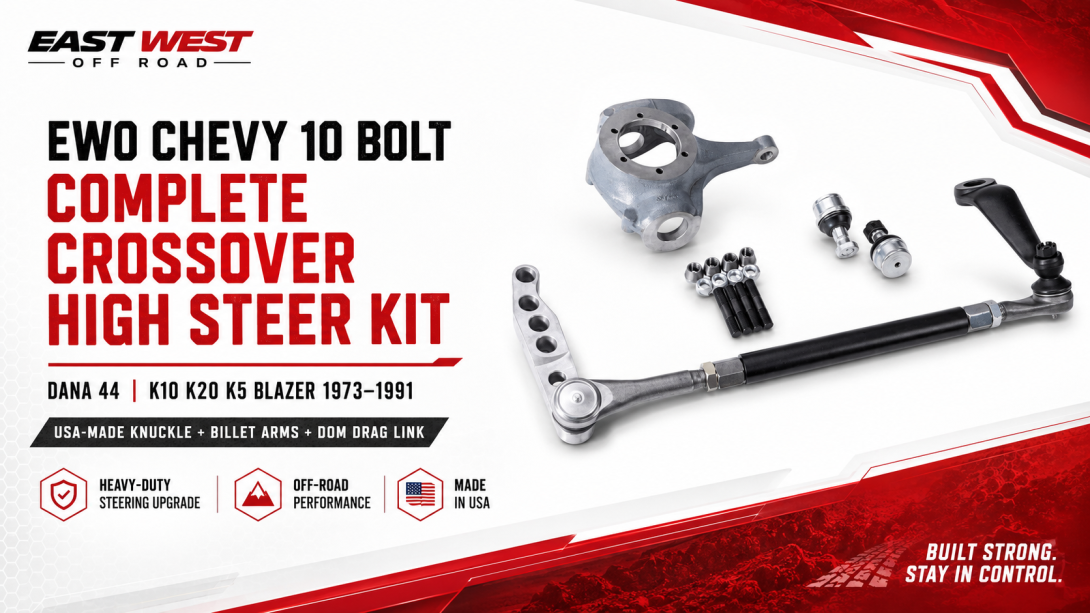
Buy Now: https://www.eastwestoffroad.com/product/ewo-chevy-10-bolt-complete-crossover-high-steer-kit
If you are running 35-inch tires or larger on your Dana 44-equipped rig, you’ve likely felt the limitations of factory steering geometry. Once a vehicle is lifted, the factory "push-pull" steering system suffers from extreme drag link angles, leading to dreaded bump steer and "dead spots" in your steering feel. The Dana 44 1-ton crossover high steer kit is the industry-standard solution to restore precise handling, increase ground clearance, and survive the rigors of serious trail abuse.
By relocating the steering linkage from below the axle to the top of the steering knuckles, this kit flattens your drag link angle and protects your tie rod from rock strikes.
Why Upgrade to a 1-Ton Crossover System?
Standard factory tie rod ends (TREs) are often undersized for oversized tires and off-road stress. Moving to a "1-ton" system refers to upgrading to the larger, heavy-duty GM-style tie rod ends (typically 7/8"-18 thread).
Key Benefits of the High Steer Conversion
- Eliminate Bump Steer: By leveling the drag link, you remove the leverage that forces the wheels to turn when the suspension compresses.
- Superior Ground Clearance: Moving the tie rod above the axle housing keeps it out of harm's way, preventing bent linkage on narrow, rocky trails.
- Increased Durability: Using 1.5" x .25" wall DOM (Drawn Over Mandrel) tubing and metal-on-metal tie rod ends provides a bulletproof foundation that won't flex or fail under pressure.
What’s Inside a Complete Dana 44 High Steer Kit?
A professional-grade Dana 44 1-ton crossover high steer kit is more than just a metal bar—it is a complete geometry correction system. When shopping, ensure your kit includes:
1. Flat-Top Steering Knuckles
The factory passenger-side knuckle on many Dana 44 axles is cast without a mounting surface for a high-steer arm. You need a flat-top knuckle—either a factory unit machined and drilled for studs or a heavy-duty aftermarket casting—to provide a secure, four-bolt mounting point for the steering arm.
2. Billet Steel High Steer Arms
These arms bolt to the top of your knuckles and provide the elevated mounting holes for your tie rod and drag link. Look for CNC-machined billet steel arms (often Grade 50 or higher) for maximum shear strength.
3. Heavy-Duty Hardware
Never reuse old factory studs. A quality kit includes 9/16" chromoly steering arm studs, hardened conical washers, and locking nuts to ensure the high-steer arms remain tight under the constant vibration of off-road driving.
Installation Essentials & Compatibility
Converting to crossover steering is a major modification that requires specific supporting changes.
- Steering Box: Most older Chevy/GMC and Dodge trucks require a 2WD steering box swap. The 2WD box features a forward-facing pitman arm, which is essential for proper crossover geometry.
- Pitman Arm: You will need a drop pitman arm specifically indexed to match the angle of your new high-steer drag link.
- Sway Bar Interference: High-steer setups often conflict with factory sway bars. Many enthusiasts switch to an aftermarket "Anti-Rock" style sway bar to regain articulation without interference.
Frequently Asked Questions (FAQs)
Can I use my stock Dana 44 knuckles?
Only if they are "flat-top" knuckles. If your passenger knuckle is cast with a "blind" top, it must be machined or replaced with a pre-drilled aftermarket unit.
Is this kit compatible with my lift height?
Yes, but drag link length varies by lift. Most DOM tubing drag link kits are supplied slightly long and can be trimmed to fit your specific axle width and lift height.
Why are "metal-on-metal" tie rod ends preferred?
Unlike factory rubber-encapsulated joints, metal-on-metal GM 1-ton ends (like the popular ES2026R/ES2027L) feature internal springs that self-adjust for wear, ensuring a tight, responsive feel.
Do I need to ream my knuckles?
It depends on your kit. Many kits come pre-tapered for standard GM 1-ton tie rod ends, but always verify if your setup requires a specific reamer tool for proper "bottom-up" or "top-down" mounting.