

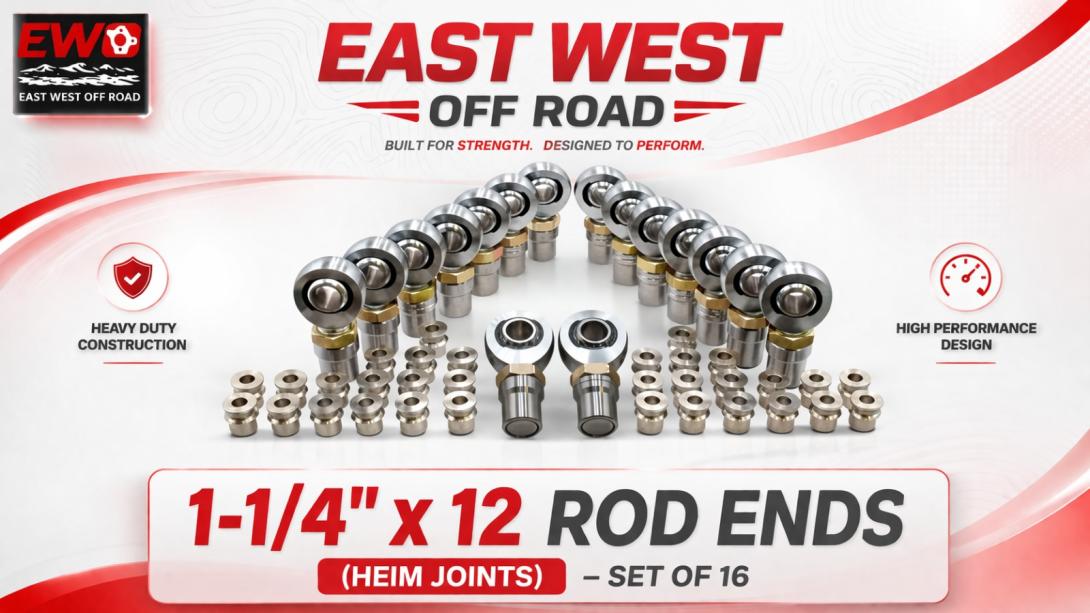
Buy Now: https://www.eastwestoffroad.com/product/1-14%22-x-12-rod-ends-(heim-joi…
Custom Off-Road Fabrication gives builders the freedom to design suspension links, steering components, chassis systems, and other 4x4 hardware around the actual vehicle rather than forcing an off-the-shelf solution to fit. For serious rock crawlers, trail rigs, race vehicles, and custom 4x4 projects, the right combination of spherical rod ends, tube adapters, misalignment spacers, tubing, and mounting hardware can make a major difference in how a fabricated system is designed and adjusted.
Large chromoly heim joints and rod-end kits are commonly marketed for 4-link suspension, steering links, radius arms, control arms, rock crawlers, and other custom fabrication projects. UTV Dude
What Is Custom Off-Road Fabrication?
Custom off-road fabrication is the process of designing and building specialized vehicle components for a particular chassis, axle, suspension layout, or intended use.
Unlike a basic bolt-on upgrade, a fabricated system can be designed around:
- Vehicle dimensions
- Axle configuration
- Suspension travel
- Mounting locations
- Link geometry
- Tire clearance
- Steering requirements
- Tubing dimensions
- Desired adjustability
This approach is particularly common on rock crawlers, trail trucks, buggies, competition vehicles, and heavily modified 4x4s.
The key is that fabrication components should be treated as part of a complete engineered system rather than individual parts selected solely by size.
Why Heim Joints Matter in Custom Fabrication
A spherical rod end, commonly called a heim joint, provides a threaded and adjustable connection while allowing angular movement around the mounting point.
That makes heim joints useful for many custom applications, including:
- Custom suspension links
- 4-link systems
- Radius arms
- Control arms
- Steering links
- Tie rods
- Drag links
- Track bars
- Race vehicle suspension
- Custom chassis projects
Off-road fabrication suppliers commonly pair chromoly rod ends with weld-in tube adapters and misalignment spacers specifically for fabricated suspension and steering assemblies. UTV Dude
Choosing the Right Heim Joint for Fabrication
Not every heim joint is interchangeable. A proper selection starts with the complete specification rather than simply choosing the largest rod end available.
Thread Size
Thread size determines which tube adapter, jam nut, or threaded component can be used.
For large suspension projects, a 1-1/4"-12 rod end provides a substantial threaded connection and is commonly associated with heavy-duty custom fabrication.
Bore Size
The bore is the diameter of the mounting hole through the spherical ball.
A 1-1/4-inch threaded rod end can have a 1-inch bore, for example. The thread diameter and bore diameter are two different measurements and should not be confused.
Thread Direction
Right-hand and left-hand thread configurations should be selected according to the design of the link.
A 1-1/4-12 Right Hand Thread rod end requires compatible RH threaded components.
Material
Chromoly is commonly used for heavy-duty rod ends because it is suited to demanding mechanical applications. However, the material designation alone does not establish whether a particular joint is appropriate for a specific vehicle.
Always consider the manufacturer's published specifications, dimensions, bearing construction, and intended application.
1-1/4 Heim Joint Kit for Custom Builds
For projects requiring several suspension or steering links, a complete 1-1/4 Heim Joint Kit can simplify sourcing.
Instead of purchasing individual rod ends one at a time, a kit can provide a group of matching components intended for a fabrication project.
The EWO 1-1/4-inch rod-end product is particularly relevant to builders working with large custom suspension links and off-road fabrication.
You can review the 1-1/4 Heim Joint Kit here: 1-1/4 Heim Joint Kit
The product listing offers different configurations for misalignment spacers and tube adapters, allowing builders to select components around their specific fabrication requirements.
Tube Adapters for Custom Off-Road Fabrication
A heim joint is only one part of a fabricated link.
A tube adapter or weld-in bung creates the threaded interface between the rod end and the suspension tubing.
The adapter needs to correspond with the:
- Heim joint thread
- Thread direction
- Tube dimensions
- Tube wall thickness
- Required link design
- Intended mounting arrangement
Weld-in tube adapters are commonly used when building custom control arms, suspension links, steering components, and other fabricated assemblies. UTV Dude
Why Tube Dimensions Matter
A tube adapter designed for one tubing dimension should not automatically be assumed to fit another.
Builders should verify:
Tube I.D. → Adapter dimensions → Thread specification → Rod-end compatibility
This is especially important when working with DOM tubing.
Misalignment Spacers in Custom Suspension
Heim Joints with Misalignment Spacers are another important part of many fabrication projects.
The spherical bearing provides articulation, while the spacer arrangement establishes the appropriate mounting relationship between the rod end and the vehicle bracket.
Common considerations include:
- Rod-end bore
- Bolt diameter
- Bracket width
- Required articulation
- Joint orientation
- Available clearance
High-misalignment spacers are specifically marketed for applications where additional angular movement is required around spherical rod ends. Appletree Automotive
The correct spacer should always be selected based on the actual joint and mounting hardware.
Custom 4-Link Suspension Fabrication
One of the most common applications for large heim joints is custom 4-link suspension.
A 4-link system uses suspension links to locate the axle while allowing controlled suspension movement.
A fabricated system can involve:
- Upper links
- Lower links
- Link brackets
- Tube adapters
- Heim joints
- Misalignment spacers
- Jam nuts
- Crossmembers
- Axle mounts
Large rod-end kits are frequently positioned as core components for 4-link and custom suspension fabrication. Ethan James Carter
Why Adjustability Is Important
Threaded rod ends allow builders to make controlled adjustments to link length during a properly designed suspension build.
That adjustability can be useful when establishing the final geometry of a custom system.
However, suspension geometry should be designed for the specific vehicle rather than copied directly from another build.
Chromoly Heim Joints for Off-Road Builds
Chromoly Heim Joints are popular in off-road fabrication because builders often need strong, compact spherical joints for suspension and steering assemblies.
When comparing chromoly rod ends, look beyond the material name.
Consider:
- Thread diameter
- Thread pitch
- Bore size
- Thread direction
- Bearing construction
- Race material
- Finish
- Load specifications
- Misalignment requirements
- Intended application
Different manufacturers can offer significantly different designs even when the nominal thread size is identical.
1-1/4-12 Rod End Set for Fabricators
A 1-1/4-12 Rod End Set can be useful when a project requires multiple matching suspension connections.
A larger rod-end system may be appropriate for:
- Rock crawlers
- Custom 4x4s
- Trail rigs
- Fabricated trucks
- Competition vehicles
- Tube chassis projects
- Custom suspension links
For builders who need multiple joints for one project, the EWO 1-1/4" x 12 rod end set provides a convenient starting point for sourcing components.
The set is available here: 1-1/4-12 Rod End Set
DOM Tubing and Suspension Fabrication
DOM tubing is frequently used for fabricated suspension links because it provides a consistent tube structure suitable for many custom chassis and suspension applications.
A fabricated link may combine:
DOM tubing + tube adapter + heim joint + jam nut + misalignment spacer
The final dimensions should be selected according to the engineering requirements of the vehicle.
For safety-critical suspension and steering components, welding, tube selection, joint orientation, and structural design should be handled by an appropriately qualified fabricator.
Heavy Duty Rod Ends for Off-Road Projects
Heavy Duty Rod Ends are often selected when a fabrication project requires larger threaded connections and spherical articulation.
However, "heavy duty" should never be treated as a substitute for actual specifications.
Before purchasing, verify:
- Thread size
- Thread pitch
- Bore diameter
- Thread direction
- Material
- Bearing design
- Load rating
- Mounting dimensions
- Spacer requirements
- Tube-adapter compatibility
This helps prevent compatibility issues after the fabrication process has already started.
Custom Steering and Suspension Applications
Custom fabrication isn't limited to suspension links.
Large spherical rod ends can also be incorporated into properly designed:
- Steering links
- Drag links
- Tie rods
- Track bars
- Panhard systems
- Radius arms
- Control arms
- Custom link assemblies
A 1.25" Rod End Kit can therefore be relevant to several types of off-road fabrication, depending on the joint specifications and intended application.
For steering systems, component selection is especially important because steering parts directly affect vehicle control.
Off-Road Fabrication Supplies You May Need
A successful fabrication project typically requires more than rod ends.
Depending on the build, a fabricator may need:
- DOM tubing
- Heim joints
- Tube adapters
- Jam nuts
- Misalignment spacers
- Suspension brackets
- Mounting tabs
- Gussets
- Crossmembers
- Grade-rated hardware
- Measuring and alignment equipment
This is why fabrication-focused suppliers often organize heim joints, weld bungs, tube adapters, and rod-end kits as complementary categories. UTV Dude
Selecting a Heim Joint for Your Project
Before ordering components, create a simple specification sheet for the project.
Step 1: Identify the Application
Determine whether the joint is being considered for suspension, steering, a control arm, a radius arm, or another fabricated component.
Step 2: Determine the Required Thread
Confirm the required diameter and pitch.
For a large joint, this might be 1-1/4"-12.
Step 3: Determine the Bore
Confirm the bolt and mounting-bracket requirements before selecting the bore.
Step 4: Select Thread Direction
Determine whether the application requires RH, LH, or a combination of both.
Step 5: Match the Spacer
Select misalignment spacers that correspond to the rod-end bore and mounting hardware.
Step 6: Match the Tube Adapter
The adapter needs to correspond to both the rod-end thread and the actual tubing dimensions.
Step 7: Verify the Complete Assembly
Before fabrication or final assembly, confirm that all components are compatible with each other.
Common Custom Fabrication Mistakes
Choosing Parts by Size Alone
A larger rod end isn't automatically the correct rod end.
Mixing Thread Specifications
A 1-1/4"-12 thread should not be paired with an incompatible pitch.
Forgetting Thread Direction
RH and LH threads are different configurations and require matching components.
Using the Wrong Tube Adapter
Even a correctly sized heim can become unusable if the tube adapter doesn't match the tubing.
Ignoring Mounting Geometry
A joint needs to operate correctly through the intended range of movement without unwanted interference or binding.
Treating a Rod-End Kit as a Complete Suspension Design
A rod-end kit provides components; it does not replace proper suspension engineering.
Why Choose a Complete Rod-End Package?
For a multi-link project, purchasing matching components can reduce the amount of sourcing required.
A complete package can provide a consistent combination of:
- Rod ends
- Jam nuts
- Misalignment spacers
- Tube adapters
The EWO kit is particularly relevant to builders looking for large rod ends for custom off-road suspension and fabrication projects.
For builders planning a project around multiple large spherical joints, the Chromoly Heim Joints package can be reviewed here: Chromoly Heim Joints
Custom Off-Road Fabrication for Rock Crawlers
Rock crawlers place unique demands on suspension systems because articulation, axle movement, clearance, and component placement all become important during vehicle design.
Custom fabrication allows builders to design around the specific chassis and axle combination instead of relying exclusively on factory mounting locations.
Typical projects include:
- 4-link conversions
- Long-arm suspension
- Custom radius arms
- Tube chassis
- Axle swaps
- Steering upgrades
- Trail-rig suspension
- Competition crawler builds
Professional fabrication shops commonly approach these projects by considering geometry, travel, clearance, mounting points, and structural requirements together. IronVolt
Custom Off-Road Fabrication: Parts vs. Complete System
One of the most important distinctions for builders is understanding the difference between buying a component and designing a complete system.
A heim joint is a component.
A tube adapter is a component.
A misalignment spacer is a component.
A suspension link is an assembly.
The complete suspension system is much more than the sum of those individual parts.
This distinction helps builders make better purchasing decisions and avoid assuming that a high-strength component automatically makes an entire fabrication system high-strength.
Frequently Asked Questions (FAQs)
What is Custom Off-Road Fabrication?
Custom Off-Road Fabrication involves designing and building specialized vehicle components such as suspension links, steering components, chassis structures, and mounting systems for a specific off-road vehicle.
What are heim joints used for?
Heim joints are spherical rod ends commonly used in adjustable suspension links, control arms, steering links, radius arms, and other custom fabrication applications.
Why are chromoly heim joints popular?
Chromoly rod ends are commonly used in demanding off-road and motorsport fabrication applications because of their material properties and availability in heavy-duty configurations.
What is a 1-1/4"-12 heim joint?
It is a spherical rod end with a nominal 1-1/4-inch threaded shank and 12 threads per inch.
What are misalignment spacers?
Misalignment spacers fit into the rod-end bore and help establish the required mounting width, bolt compatibility, and articulation arrangement.
What are weld-in tube adapters?
They are threaded inserts designed to connect a rod end to fabricated tubing, commonly used in suspension links, steering components, and other custom assemblies.
Are 1-1/4 heim joints suitable for 4-link suspension?
They can be used in properly designed 4-link systems. The appropriate size and configuration depend on the vehicle, suspension design, loads, mounting arrangement, and component specifications.
What should I check before buying a heim joint?
Check the thread diameter, pitch, thread direction, bore size, material, bearing design, mounting dimensions, spacer requirements, and tube-adapter compatibility.
Can heim joints be used for steering?
Spherical rod ends can be used in appropriately engineered steering systems, but steering components are safety-critical and must be selected and installed according to the requirements of the specific vehicle and system.
What is the benefit of a complete heim joint kit?
A kit can simplify sourcing by grouping compatible rod ends and related components for fabrication projects, particularly when multiple suspension links require matching hardware.
Is a 1-1/4 rod end the same as a 1-inch bore heim?
Not necessarily. The 1-1/4-inch measurement can refer to the threaded shank, while the bore may be a different size. Always check the complete product specification.
Final Thoughts
Custom Off-Road Fabrication is all about building components around the requirements of the vehicle and the intended use. Whether you're developing a 4-link suspension, custom steering system, radius arms, or another fabricated assembly, selecting compatible rod ends, tube adapters, jam nuts, and misalignment spacers is an important part of the process.
A large 1-1/4"-12 chromoly heim joint can provide the threaded adjustability and spherical movement required by many custom fabrication projects, but the complete assembly must be designed as a system.
For builders sourcing multiple large rod ends and related fabrication components, the EWO 1-1/4" x 12 rod-end package is a practical product category to consider when planning a custom off-road build.