

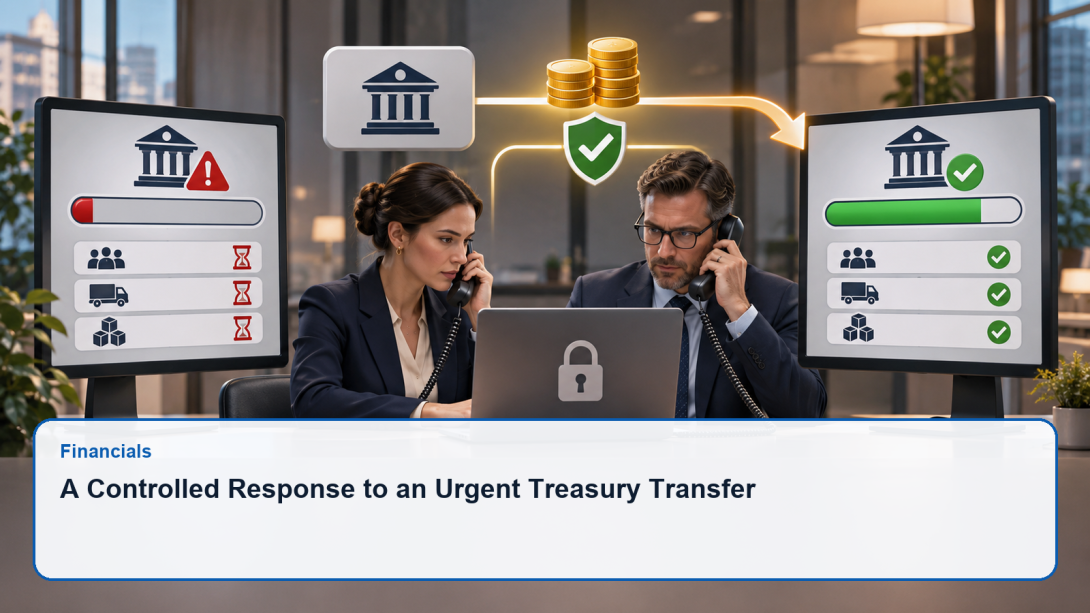
At 10:15 a.m., a regional operating account is projected to fall short before a same-day payroll file settles. The treasurer proposes an emergency liquidity transfer from the central concentration account, while the payments lead must decide whether urgency justifies shortening normal checks. A useful Oracle Cloud Financials Online Training discussion would treat this as a governance problem rather than a data-entry race. The team needs enough speed to protect payroll, but it also needs reliable evidence that the instruction came from an authorized person, reached the intended account, and survived independent review. The safest response is a controlled exception: identify the business need, establish ownership, verify the destination through trusted records, and preserve a reviewable trail without placing confidential verification details in transaction notes.
The incident begins with verified facts, not chat. Treasury documents the forecasted deficit, the expected payroll debit, the amount needed to restore the approved buffer, and the safe release time. A preparer compares the destination account with the maintained bank-account record rather than relying on numbers supplied in the urgent message. The approver checks whether the funding account can absorb the transfer without creating a different shortfall. If the request changes after review—amount, value date, currency, or destination—the approval should be treated as stale and repeated. This discipline keeps the emergency narrow. It also creates a defensible reason for acting outside schedule while making clear that urgency does not convert an unverified instruction into an acceptable one.
Separate the Callback From Transaction Entry
Before release, a second employee performs the callback control using a telephone number obtained from the organization’s trusted directory, not from the transfer request. That employee contacts the designated treasury authority, restates the destination in a masked form, confirms the amount, currency, value date, and purpose, and records the result under the established evidence procedure. A failed call, an unfamiliar voice, pressure to avoid normal channels, or a request to substitute a new account should pause the transfer and trigger escalation. Callback evidence can include the verifier, time, outcome, and internal reference, but it should not include passcodes, security answers, full account numbers, or recorded secrets. The callback remains an operating control outside the payment fields; entering a memo does not perform or enforce it.
Roles should remain distinct even when the cutoff is close. The preparer creates the transfer, the callback verifier independently confirms the instruction, and an authorized approver assesses both liquidity need and control evidence before release. In a small team, a documented alternate may combine limited duties only under an approved contingency, with prompt retrospective review by someone outside the event. The approver should compare the entered beneficiary bank account, amount, currency, date, and payment purpose against the confirmed instruction, not merely check that every field contains a value. Screenshots alone are weak evidence because they may omit changes or context. A linked case reference, approval history, callback record, and transaction identifier together provide a clearer chronology while reducing the temptation to paste sensitive material into free-text fields.
Use Payment Attributes With Care
The guidance titled Additional Governance for Bank Account Transfers and Ad Hoc Payments explains that payment attributes such as service level, delivery channel, and payment reason can be captured for bank-account transfers and ad hoc payments, with availability varying by payment format; those attributes are optional when settlements are used. It also describes initiating transfers in the source bank account currency as a controlled-release capability that requires a service request, and notes that the Memo field can retain additional transaction context. In this scenario, the team could select only attributes supported by the chosen format and use the memo for a concise internal case reference and non-sensitive purpose statement. These fields improve context and downstream review, but they should not be represented as proof that the external callback occurred or as a substitute for approval.
Currency deserves explicit attention because the central account is denominated differently from the regional account. The team should determine whether policy permits initiation in the source account currency, whether the controlled capability has actually been enabled, and which party bears conversion timing and rate effects. If the capability is not enabled, the emergency should not become an informal test in production; treasury should use an already approved route or escalate to the designated contingency owner. The service level and delivery channel should reflect the genuine cutoff need, not simply the fastest available option. A rapid channel may change fees, settlement timing, rejection handling, or recall prospects. The reviewer should therefore confirm that the selected route is operationally appropriate and that the receiving account can accept the resulting currency treatment.
Release, Monitor, and Reconcile
Immediately before release, the approver conducts a short stop check. Has the payroll exposure been recalculated? Does the transfer amount remain proportionate to that exposure and the approved buffer? Was the callback completed through a trusted contact path, and does its evidence point to the same immutable instruction details now displayed? Are service level, delivery channel, payment reason, currency, and memo appropriate for the selected format and policy? The approver should reject unexplained blanks when policy requires information, but should not invent values for fields that are optional or unavailable. Release authority should also respect limits and any required dual approval. If the cutoff passes during review, the team reassesses the scenario instead of releasing reflexively, because the intended benefit, channel, or value date may have changed.
After release, treasury monitors for acceptance, settlement, and the expected balance effect rather than treating a submitted status as completion. The payments lead matches the transaction identifier to the bank response and watches for rejection, repair, duplicate submission, or an unexpected currency amount. Once the regional account is funded, the team confirms that payroll settles and that the remaining balance aligns with the revised forecast. Any duplicate attempt must be stopped through the approved bank process, not corrected with an improvised offsetting payment. By the next business day, an independent reviewer reconciles both accounts and examines the emergency case. The review should distinguish a justified exception from a process weakness, record any control failure, and assign corrective action without rewriting the original evidence or obscuring who made each decision.
Conclusion
This liquidity emergency is resolved safely when the organization treats speed and control as complementary objectives. A documented forecast establishes the need; maintained bank data anchors the destination; an independent callback confirms the instruction through a trusted path; and separate preparation, approval, release, monitoring, and reconciliation reduce the chance that one mistake becomes a loss. Payment attributes and memo context can make the transaction easier to interpret, provided the team uses only supported values, avoids secrets, and does not claim that system fields enforce the callback. Source-currency initiation requires deliberate enablement and policy readiness, not assumption. For learners evaluating the same scenario in an Oracle Fusion Financials Training, the durable lesson is practical: design the exception before the crisis, stop when critical facts change, and retain enough non-sensitive evidence for another reviewer to reconstruct the decision.