

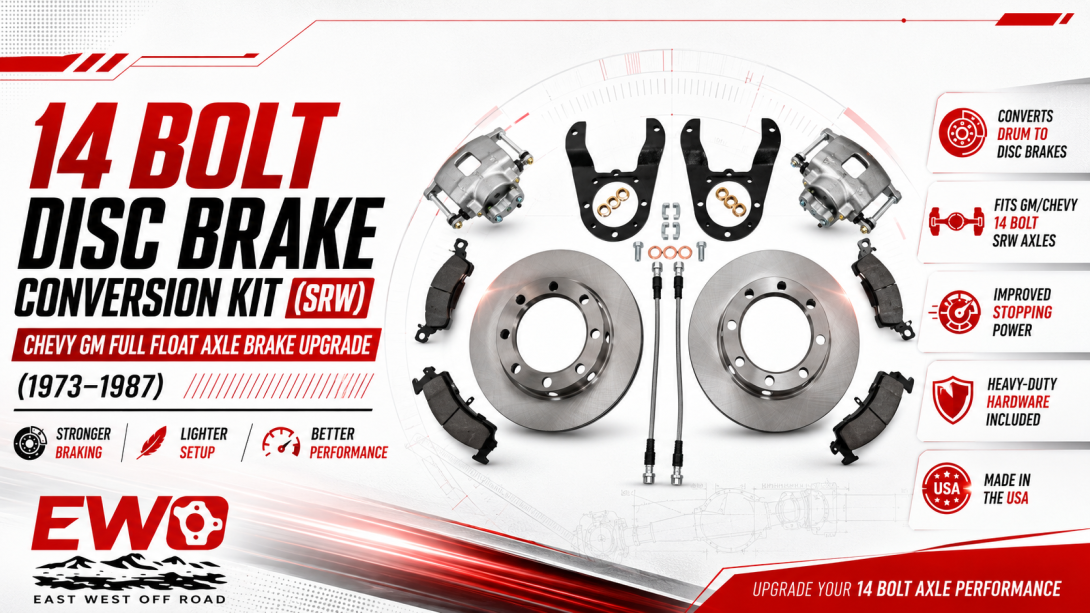
Buy Now: 14 Bolt Disc Brake Conversion Kit (SRW) – Chevy GM Full Float Axle Brake Upgrade (1973–1987)
A Chevy truck brake conversion is a smart upgrade for builders who want to replace heavy rear drum brakes with a cleaner, more serviceable disc brake system. For classic GM trucks equipped with a compatible 14-bolt full-float rear axle, converting the rear brakes can reduce drum-related complexity while providing a modern braking setup. The East West Off Road 14 Bolt Disc Brake Conversion Kit is designed for compatible 1973–1987 Chevy GM full-float SRW applications, making it a practical option for classic trucks, 4x4s, and off-road builds.
Why Consider a Chevy Truck Brake Conversion?
Older Chevy and GMC trucks were commonly equipped with drum brakes on heavy-duty rear axles. While properly maintained drums can work effectively, many modern truck builds benefit from switching to rear disc brakes.
A Chevy truck brake conversion can make the braking system easier to inspect, service, and maintain while providing a more modern brake architecture.
Replace Heavy Rear Drums
Large drum assemblies can add considerable weight to a rear axle. A disc conversion replaces the drum assembly with rotors, calipers, and pads.
This can simplify the rear brake package and eliminate many of the internal drum components that require adjustment and inspection.
Improve Brake Serviceability
Disc brake pads and rotors are externally accessible, making routine inspection and replacement straightforward.
For an off-road truck that sees mud, dust, water, and frequent trail use, easy brake inspection can be a major advantage.
Better Heat Management
Disc brakes are generally effective at dissipating heat during repeated braking. This can be useful for heavy trucks, steep descents, towing applications, and off-road driving where brakes may experience repeated heat cycles.
Chevy 14 Bolt Brake Conversion for Full-Float Axles
One of the most popular applications for a rear Chevy truck brake conversion is the GM 14-bolt full-float axle.
The 14-bolt full-float axle has long been used in heavy-duty Chevy and GMC trucks, including 3/4-ton and 1-ton applications. Current conversion kits commonly target specific 14-bolt configurations rather than treating every 14-bolt axle as identical.
That makes axle identification essential before ordering a conversion.
Full-Float vs. Semi-Float
A full-float 14-bolt and a semi-float 14-bolt are different axle configurations and should not automatically be assumed to use the same brake conversion components.
The East West Off Road application is designed around compatible GM/Chevy full-float SRW axles.
SRW vs. Dually
SRW means Single Rear Wheel. Dually applications can require different brake brackets, rotor positioning, wheel clearance, and caliper configurations.
If your truck has a dual-rear-wheel axle, verify compatibility before purchasing an SRW conversion kit.
Chevy Truck Rear Disc Brake Conversion Benefits
Converting an older truck from rear drums to discs offers several practical advantages.
Easier Maintenance
With disc brakes, the rotor and pads can be inspected without removing a large drum assembly. This makes routine maintenance and troubleshooting more convenient.
Reduced Brake Complexity
A disc system removes the internal springs, shoes, adjusters, and other hardware found inside traditional drum brakes.
More Consistent Performance
Disc brakes can provide predictable friction characteristics as temperatures change. For a modified truck that is heavier than stock or running larger tires, having a properly matched braking system is especially important.
Cleaner Off-Road Setup
For custom 4x4 builds, a rear disc conversion can create more space around the axle assembly and provide a modern platform for future brake upgrades.
14 Bolt Disc Brake Conversion Kit for Chevy GM Trucks
The right conversion kit should be selected according to axle configuration rather than simply searching for “14 bolt brakes.”
The East West Off Road 14-bolt conversion is intended for compatible Chevy GM full-float SRW applications from 1973–1987.
A complete conversion approach typically involves components such as:
- Disc brake mounting brackets
- Rear brake rotors
- Brake calipers
- Brake pads
- Hydraulic brake hoses
- Mounting hardware
- Brake line connection components
Comparable conversion kits for 1973–1987 GM/Chevy 14-bolt full-float SRW axles also commonly package brackets, rotors, calipers, pads, hoses, and hardware together.
Chevy Truck Brake Upgrade for Off-Road Builds
A Chevy truck brake upgrade becomes even more important when the vehicle has been modified beyond its factory configuration.
Larger tires, suspension lifts, added armor, aftermarket wheels, and heavy off-road equipment can change the demands placed on the braking system.
A rear disc conversion should therefore be considered as part of the complete brake system rather than as an isolated modification.
Match the Front and Rear Brakes
The front brakes normally provide a significant portion of the vehicle's braking force. The rear brake system needs to complement the front rather than overpower it.
After a rear disc conversion, brake bias, pedal feel, master-cylinder compatibility, and proportioning should be evaluated.
Consider the Parking Brake
One important difference between drum and disc conversions is the parking-brake arrangement.
Some rear disc calipers include a mechanical parking-brake mechanism, while others require a separate solution. Confirm how your selected conversion handles the parking brake before beginning the project.
How to Choose a Chevy Truck Brake Conversion Kit
Before ordering a rear disc conversion, verify the following specifications.
Identify the Axle
Confirm that your truck uses the intended GM 14-bolt full-float axle.
Verify the Application Range
The East West Off Road product is designed around 1973–1987 Chevy GM full-float SRW applications.
Check Hub and Brake Configuration
Different 14-bolt generations and configurations can use different brake mounting arrangements. Current conversion manufacturers specifically distinguish between axle types and mounting configurations.
Check Wheel Clearance
Wheel clearance is one of the most important considerations when installing rear disc brakes.
A rotor and caliper occupy a different space than a factory drum. Some conversion kits specify minimum wheel diameter and backspacing requirements, so always verify your wheel specifications before installation.
Chevy Truck Brake Conversion Installation Considerations
A successful brake conversion starts with proper preparation.
Remove the Original Drum Components
The original rear drum assembly should be removed according to the axle manufacturer's service procedure. Inspect the hub, axle seals, bearings, and mounting surfaces while the components are accessible.
Prepare the Mounting Area
Clean the mounting surfaces and verify that the conversion brackets seat correctly. Any corrosion, debris, or damage at the mounting interface should be addressed before assembly.
Install Rotors and Calipers
Install the rotors according to the kit instructions and confirm that they are seated correctly. The calipers should be positioned correctly relative to the rotors and brake pads.
Connect the Hydraulic Lines
Brake hoses should have adequate slack through the full range of suspension travel. They should not rub against tires, suspension components, or sharp edges.
Bleed the Brake System
After the hydraulic connections are complete, the brake system must be properly bled.
Do not drive the vehicle if the pedal remains excessively soft or if any hydraulic connection leaks.
Chevy Truck Disc Brake Conversion and Brake Bias
One of the most important aspects of any rear disc conversion is brake balance.
Changing the rear brake hardware can alter the relationship between front and rear braking forces. A properly configured system should provide stable braking without premature rear-wheel lockup.
Depending on the complete vehicle setup, builders may evaluate:
- Master-cylinder bore
- Front caliper piston area
- Rear caliper piston area
- Rotor diameter
- Brake pad compound
- Proportioning valve
- Vehicle weight
- Tire size
- Suspension configuration
A proportioning valve may be useful for tuning front-to-rear brake bias, but the correct setup depends on the specific vehicle and complete braking system.
14 Bolt Rear Disc Brakes vs. Drum Brakes
Both systems can work when correctly maintained, but they have different characteristics.
Feature
Rear Drum Brakes
Rear Disc Brakes
Service access
More involved
Generally easier
Internal hardware
More components
Simpler
Pad/shoe inspection
Less accessible
Easily visible
Heat management
Can retain heat
Generally better heat dissipation
Off-road maintenance
More complex
Straightforward
Parking brake
Usually integrated into drum
Requires compatible solution
For an older Chevy truck being converted into a modern street/off-road build, rear discs can provide a cleaner and more convenient braking platform.
East West Off Road Chevy Truck Brake Conversion
For builders working with a compatible GM/Chevy 14-bolt full-float SRW axle, the Chevy truck brake conversion kit provides a purpose-built approach to replacing the factory rear drum brakes with a disc brake setup.
The product is specifically intended for the 1973–1987 Chevy GM full-float SRW application, making correct axle identification a key part of the purchasing process.
Common Chevy Truck Brake Conversion Mistakes
A brake conversion is a safety-critical modification, so avoid shortcuts.
Assuming Every 14-Bolt Is the Same
There are multiple 14-bolt configurations. Confirm your axle before ordering.
Ignoring Wheel Clearance
A caliper can interfere with the inside of a wheel even when the rotor fits properly. Test-fit and verify clearance before final assembly.
Forgetting Brake Bias
A larger rear brake system does not automatically mean better braking. The entire hydraulic system needs to work together.
Reusing Damaged Brake Hardware
Brake hoses, fittings, rotors, pads, and other components should be inspected carefully. Replace worn or damaged parts rather than building a new brake system around questionable components.
Skipping the Final Inspection
After installation, inspect all fasteners, hydraulic connections, rotor seating, caliper positioning, and wheel clearance before road testing.
Is a Chevy Truck Brake Conversion Worth It?
For many classic Chevy and GMC truck builds, converting a compatible rear 14-bolt axle from drums to discs can be a worthwhile upgrade.
The biggest advantages are easier maintenance, a cleaner brake assembly, reduced drum hardware, and a modern disc-brake layout. Conversion suppliers also commonly highlight improved serviceability, heat resistance, and reduced rear unsprung weight as reasons for making the switch.
The important part is choosing a kit that matches your exact axle and wheel configuration.
Frequently Asked Questions (FAQs)
What is a Chevy truck brake conversion?
A Chevy truck brake conversion generally refers to replacing an original drum-brake setup with a disc-brake system. On classic GM trucks, this may include converting a 14-bolt rear axle from drums to discs.
Can I convert a Chevy 14-bolt to disc brakes?
Yes, compatible Chevy GM 14-bolt full-float axles can be converted from drum brakes to disc brakes using a purpose-built conversion kit.
What years does this 14-bolt conversion kit fit?
The East West Off Road application is intended for compatible 1973–1987 Chevy GM full-float SRW 14-bolt axles.
Is this Chevy truck brake conversion for a dually?
No. An SRW conversion kit is intended for Single Rear Wheel applications. Dually 14-bolt axles require the correct dual-rear-wheel-specific brake components.
Does a rear disc conversion improve braking?
A properly matched disc conversion can provide a more modern and serviceable braking setup. However, overall braking performance depends on the complete brake system, including the front brakes, master cylinder, brake bias, tires, and vehicle weight.
Do I need larger wheels after a rear disc conversion?
Wheel clearance depends on the specific rotor and caliper combination. Some 14-bolt conversion systems have minimum wheel-size and backspacing requirements, so wheel fitment should be confirmed before installation.
Do I need a new master cylinder?
Not necessarily. Master-cylinder compatibility should be evaluated based on the complete front and rear brake configuration. A rear disc conversion can change hydraulic requirements and brake bias.
Can I use a Chevy truck brake conversion for an off-road build?
Yes, a properly matched 14-bolt rear disc conversion can be useful for classic Chevy 4x4s and off-road trucks. Axle configuration, wheel clearance, brake lines, parking-brake operation, and brake bias should all be verified.
What should I check before buying a 14-bolt disc conversion?
Confirm the axle type, full-float configuration, SRW or dually configuration, model year, hub/brake arrangement, wheel clearance, and the conversion kit's specific fitment requirements.
Are rear disc brakes easier to maintain than drums?
Generally, yes. Disc brake pads and rotors are externally accessible, while drum brakes contain more internal hardware that requires removal of the drum for inspection and service.
Final Thoughts
A Chevy truck brake conversion can transform the braking setup of a classic GM truck, especially when a compatible 14-bolt full-float axle is already part of the build. Replacing heavy rear drums with discs can simplify maintenance and provide a modern braking platform for street, towing, and off-road applications.
For a 1973–1987 Chevy GM full-float SRW 14-bolt axle, the East West Off Road 14 Bolt Disc Brake Conversion Kit is designed specifically around this type of application. Verify your axle and wheel configuration before ordering, then install and test the complete brake system carefully.