

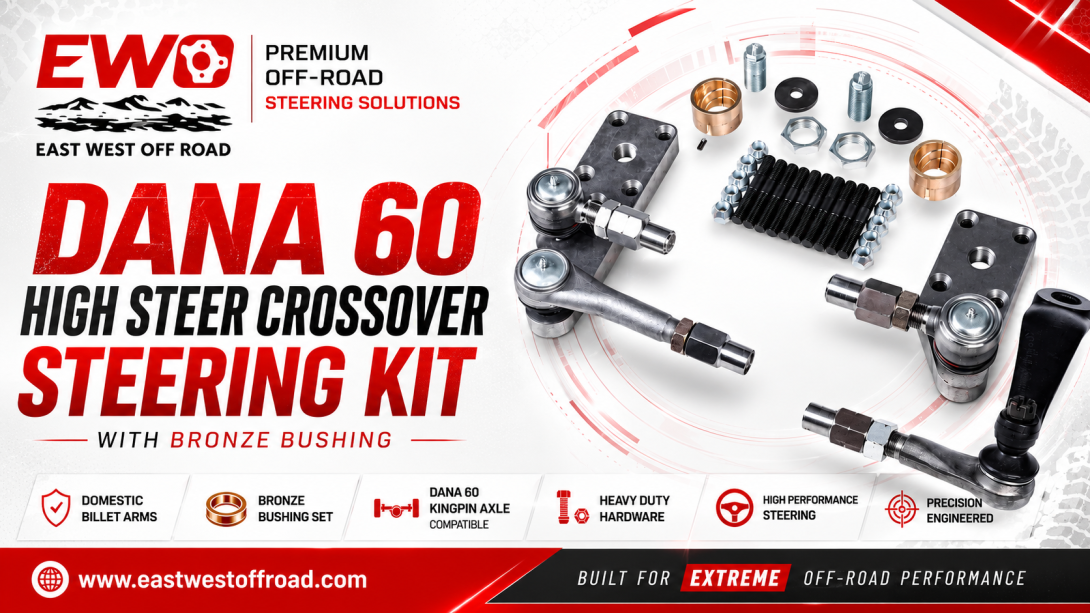
Chevy Dana 60 Crossover Steering is one of the most valuable steering upgrades for lifted Chevy and GMC 4x4 trucks running a kingpin Dana 60 front axle. As suspension height, tire diameter, axle articulation, and trail demands increase, the original steering configuration may no longer provide ideal geometry or component placement. A properly planned crossover and high-steer system replaces that compromised layout with heavy-duty steering arms, DOM linkage, GM 1-ton steering ends, and purpose-built mounting hardware designed around serious off-road use.
For Chevy truck owners building a trail rig, rock crawler, restored solid-axle 4x4, or custom Dana 60 conversion, a complete system can also eliminate much of the guesswork involved in sourcing individual steering components.
What Is Chevy Dana 60 Crossover Steering?
Chevy Dana 60 Crossover Steering changes the way steering input travels from the steering box to the front axle.
Traditional steering layouts on older solid-axle trucks commonly use a drag link arranged more front-to-back.
A crossover setup instead runs the drag link across the vehicle toward the opposite-side steering knuckle.
This becomes especially useful on modified Chevy trucks because lifting the suspension changes the distance and angle between the steering box and the axle.
A properly designed crossover system gives the builder greater flexibility to establish steering geometry around the vehicle's new suspension configuration.
Why Chevy Dana 60 Trucks Benefit From Crossover Steering
A Dana 60 axle is commonly selected because the vehicle is being built for heavier-duty use.
Typical modifications may include:
- Larger off-road tires
- Increased suspension lift
- Greater wheel travel
- Heavy-duty drivetrain components
- Rock-crawling suspension
- Custom leaf-spring configurations
- Solid axle swaps
- High-steer conversions
Each modification can affect the steering system.
The original linkage was engineered around the vehicle's original axle position, suspension height, and tire size.
Once those conditions change significantly, the steering should be evaluated as part of the complete build.
The Problem With Factory-Style Steering on Lifted Chevy Trucks
Suspension lift changes steering geometry.
As the frame moves farther from the axle, the angle between the steering-box output and steering knuckle can become increasingly steep.
That can make an original-style steering layout less appropriate for the modified vehicle.
The issue is not simply whether the steering components are strong enough.
Geometry determines how those components move as the axle travels through compression, droop, and articulation.
A crossover conversion allows the drag link to operate in a layout better suited to many modified solid-axle Chevy trucks.
How Dana 60 Crossover Steering Changes the Layout
In a crossover configuration, the drag link travels from the steering-box side across the vehicle toward the opposite steering knuckle.
The tie rod then connects the two steering knuckles.
This separates two important functions:
Drag Link
The drag link transfers input from the steering box to the steering knuckle.
Tie Rod
The tie rod keeps the driver- and passenger-side knuckles working together.
A properly engineered system allows these components to operate around the suspension and axle configuration of the finished truck.
Chevy Dana 60 Crossover Steering vs. High Steer
Crossover steering and high steer are often discussed together, but they describe different modifications.
Crossover steering refers to the path and configuration of the drag link.
High steer refers to moving steering-link mounting points higher on compatible steering knuckles.
For serious Chevy Dana 60 builds, combining the two can provide important advantages.
The crossover layout addresses steering geometry, while the high-steer configuration can move vulnerable linkage higher around the axle.
Why Combine Crossover Steering With High Steer?
A Dana 60 High Steer Kit complements crossover steering by creating higher mounting locations for the steering linkage.
This can be especially useful on rock crawlers and trail trucks.
Low-mounted steering components can be vulnerable to:
- Rocks
- Ledges
- Deep ruts
- Trail debris
- Uneven terrain
Raising compatible steering components gives them additional separation from trail obstacles.
At the same time, the high-steer arms give the builder additional options for configuring the drag link and tie rod around a lifted suspension.
Why Kingpin Dana 60 Axles Work Well With High Steer
The kingpin Dana 60 has long been popular in heavy-duty solid-axle builds.
One reason is its suitability for aftermarket steering upgrades.
Compatible steering knuckles can accept high-steer arms above the knuckle, creating mounting points for upgraded steering linkage.
This makes a Kingpin Dana 60 Steering Upgrade particularly attractive for lifted Chevy trucks that already use, or are being converted to, a Dana 60 front axle.
However, kingpin and ball-joint Dana 60 axles are different.
Builders should verify their exact axle and knuckle configuration before purchasing high-steer components.
Chevy Dana 60 Steering for Lifted Trucks
Lift height plays an important role when planning a crossover conversion.
The farther the chassis moves from the axle, the more the steering-link relationship changes.
A well-planned steering system should consider:
- Lift height
- Steering-box position
- Pitman-arm location
- Axle position
- High-steer arm height
- Drag-link angle
- Tie-rod placement
- Spring clearance
- Crossmember clearance
- Wheel and tire clearance
This is why there is no single steering-link dimension that is perfect for every Chevy Dana 60 build.
Steering-Box Considerations on Chevy Crossover Conversions
The steering box is the starting point for the crossover drag link.
Its location and output direction directly affect the final steering geometry.
Older Chevy and GMC crossover conversions may require a steering-box configuration appropriate for side-to-side crossover steering.
Exact requirements vary by year, chassis, existing steering box, and the particular crossover system being installed.
Because steering-box compatibility can differ significantly between GM generations, builders should identify the truck year and exact steering-box configuration before ordering or fabricating the final linkage.
Crossmember Clearance on Chevy and GMC Applications
Crossmember clearance is another Chevy-specific consideration.
The drag link must travel between the steering box and steering arm without contacting the engine crossmember, frame, suspension, differential, or other components.
The required drag-link shape and position can therefore vary between different Chevy and GMC builds.
This is particularly important when working with:
- Modified suspension height
- Engine swaps
- Custom motor mounts
- Different pitman arms
- Custom axle positioning
- Aftermarket crossmembers
Clearance should be checked through the complete steering and suspension range, not only while the truck is sitting at ride height.
1.25-Inch-Thick Dana 60 Billet High Steer Arms
High-steer arms are central to the conversion because they provide the elevated steering-link mounting points.
The East West Offroad setup uses 1.25 inch thick Dana 60 billet arms.
Their substantial construction creates a heavy-duty mounting platform for steering components in demanding applications.
The arms should be considered as part of the entire system.
Arm construction, stud strength, mounting pattern, knuckle compatibility, rod-end placement, and linkage geometry all affect the finished steering setup.
Dana 60 High Steer Arms 5 Stud Design
The system incorporates Dana 60 High Steer Arms 5 Stud style components.
This corresponds with a 5 hole pattern Dana 60 steering arms configuration for compatible knuckles.
Before installation, builders should confirm that their actual Dana 60 steering knuckles are designed for the intended arm and stud pattern.
This becomes particularly important on trucks using aftermarket knuckles or axles assembled from components sourced from different applications.
Heavy-Duty DOM Tubing for Chevy Dana 60 Steering
A crossover system needs linkage capable of handling the forces generated by a heavy truck and large tires.
For that reason, the East West Offroad package uses Dana 60 crossover steering with DOM tubing.
DOM, or Drawn Over Mandrel tubing, is widely used for fabricated off-road components because of its consistent dimensions and suitability for heavy-duty applications.
1.50 OD .250 Wall DOM Tubing
The system uses 1.50 OD 250 wall DOM tubing.
This means:
- 1.50-inch outside diameter
- .250-inch wall thickness
The substantial tubing provides a strong basis for custom drag-link and tie-rod fabrication.
Linkage length should be established around the actual truck because axle width, steering arms, pitman arm, suspension layout, and steering-box location can all affect final dimensions.
Heavy-Duty Dana 60 Drag Link Components
The drag link carries steering input from the steering box across to the steering knuckle.
In a crossover conversion, its position and dimensions are critical.
A heavy-duty Dana 60 Drag Link Kit should be designed around both component strength and the geometry of the truck.
The East West Offroad configuration uses:
ES2026R ES2027L drag link ends
These components form part of the heavy-duty crossover linkage.
Proper engagement, adjustment, taper fitment, and clearance should be verified during final assembly.
GM 1 Ton Tie Rod Ends
The tie rod connects the two steering knuckles and maintains their relationship as the steering system operates.
The system uses:
ES2234L ES2234R tie rod ends
These heavy-duty steering components are commonly associated with GM 1 Ton Tie Rod Ends applications.
That makes them particularly relevant to Chevy and GM truck builders looking for a heavy-duty steering solution.
When combined with substantial DOM tubing, they form the foundation of the tie-rod assembly.
7/8-18 Weld Bungs and Jam Nuts
Fabricated DOM linkage requires properly matched threaded components.
The setup incorporates 7/8-18 weld bungs and jam nuts.
Weld bungs provide the threaded interface between the DOM tubing and steering ends.
The jam nuts then secure the adjustment after the steering linkage has been positioned and aligned.
Correct welding, thread engagement, adjustment, and final inspection are essential because these components are part of a safety-critical system.
Dana 60 High Strength Studs Rated at 180000 PSI
High-steer arms rely on strong mounting hardware.
The package uses Dana 60 high strength studs 180000 PSI.
These studs help create a heavy-duty connection between the steering arms and compatible kingpin Dana 60 knuckles.
A high-steer system should always be evaluated as a complete assembly.
Heavy tubing and billet steering arms cannot compensate for inadequate mounting hardware or incompatible knuckles.
What's Included in a Complete Chevy Dana 60 Steering Upgrade?
A complete Dana 60 kingpin steering kit brings together the primary components required to plan a heavy-duty crossover/high-steer system.
Component
Purpose
1.25-inch billet high-steer arms
Creates heavy-duty elevated steering attachment points
5-hole steering-arm design
Matches compatible kingpin Dana 60 knuckle configurations
1.50 OD .250-wall DOM tubing
Provides heavy-duty material for steering-link fabrication
ES2026R / ES2027L ends
Components for the crossover drag-link assembly
ES2234L / ES2234R ends
Heavy-duty GM 1-ton-style tie rod ends
7/8-18 weld bungs
Creates threaded connections in the DOM steering links
7/8-18 jam nuts
Locks steering-link adjustments
180,000 PSI studs
Provides heavy-duty steering-arm mounting hardware
Supporting Dana 60 Kingpin Parts
Helps complete the crossover/high-steer conversion
For Chevy builders, a coordinated package can simplify the process compared with matching all these components individually.
Why GM 1-Ton Components Make Sense for Chevy Builds
Many owners upgrading a Dana 60 are already building the rest of the truck around heavy-duty components.
This makes a 1 Ton Steering Upgrade Kit a logical consideration.
Large tires generate considerably more leverage through the steering system than stock tires.
Heavy trucks, low tire pressure, rocks, mud, and tight trail obstacles can increase steering loads further.
Using substantial steering ends, DOM tubing, billet arms, and appropriately matched hardware creates a steering platform better suited to those demands.
Chevy Dana 60 Crossover Steering for Rock Crawlers
Rock crawlers place unusual stress on steering components.
The tires may need to turn while partially loaded against rocks or while the front axle is heavily articulated.
At the same time, steering linkage can be exposed to direct impact from obstacles.
An Off Road Crossover Steering system with high steer addresses both issues.
Heavy-duty components provide a stronger steering foundation, while the elevated linkage position can improve clearance around trail obstacles.
Chevy Dana 60 Steering for Solid Axle Builds
Dana 60 solid axle builds require careful steering planning because the steering geometry may be different from anything originally installed on the vehicle.
The builder must establish the relationship between:
- Steering box
- Pitman arm
- Drag link
- High-steer arm
- Tie rod
- Front axle
- Frame
- Suspension
- Crossmember
Installing the axle first and treating steering as an afterthought can create unnecessary fabrication problems.
Whenever possible, crossover steering geometry should be considered during the suspension and axle-planning stages.
Full High Steer vs. Crossover-Only Setup
Some builders may only need crossover steering, while others want a full high-steer configuration.
A crossover-only conversion focuses primarily on changing the drag-link arrangement.
A full high-steer system typically moves additional steering linkage to elevated steering arms.
The correct choice depends on:
- Tire size
- Lift height
- Suspension layout
- Trail clearance requirements
- Existing steering components
- Vehicle use
- Knuckle compatibility
For aggressive rock-crawling applications, the additional clearance available from a complete high-steer layout may be especially valuable.
Can Crossover Steering Help With Steering Geometry?
Yes, steering geometry is one of the main reasons crossover conversions are used on lifted Chevy trucks.
However, installing heavy-duty crossover parts does not automatically guarantee ideal geometry.
The finished result depends on the relationship between the steering box, pitman arm, drag link, steering arms, axle, and suspension.
A quality conversion therefore combines appropriate hardware with careful setup and measurement.
Does Chevy Dana 60 Crossover Steering Improve Ground Clearance?
Crossover steering by itself does not necessarily raise every steering component.
The clearance advantage primarily comes when crossover steering is paired with a high-steer configuration.
High-steer arms relocate compatible steering-link attachment points above their lower original location.
Depending on the final setup, this can move critical linkage farther away from rocks and other trail obstacles.
Can Crossover Steering Help With Bump Steer?
Unwanted steering input during suspension movement can be influenced by steering geometry.
A crossover configuration gives builders greater flexibility to design drag-link positioning around the modified suspension.
However, no steering kit should be considered an automatic cure for every bump-steer problem.
The complete suspension and steering layout must be evaluated.
On applicable suspension systems, the relationship between the drag link and lateral axle-control components can be particularly important.
Important Fitment Checks Before Ordering
Before purchasing a Chevy Dana 60 steering system, verify the exact components already installed on the truck.
Confirm the Dana 60 Is a Kingpin Axle
Kingpin and ball-joint Dana 60 axles use different steering-knuckle designs.
This package is intended around kingpin-style steering applications.
Identify the Steering Knuckles
Confirm the knuckle design and high-steer arm mounting pattern.
Identify the Steering Box
Chevy and GMC steering-box configurations vary by year and application.
Confirm the output and pitman-arm arrangement needed for your crossover system.
Check Crossmember Clearance
Make sure there is a viable path between the pitman arm and steering arm.
Check Suspension Clearance
Leaf springs, shocks, brackets, and other suspension components must not interfere with the steering linkage.
Check Wheel and Tire Clearance
The tie rod and steering ends must clear the wheels and tires throughout the complete steering range.
Measure the Actual Truck Before Final Fabrication
Custom steering should be based on measurements taken from the actual vehicle.
Do not assume every Chevy Dana 60 uses identical drag-link and tie-rod dimensions.
Differences can come from:
- Axle swaps
- Aftermarket knuckles
- Lift height
- Pitman-arm selection
- Steering-box configuration
- Wheelbase changes
- Custom frames
- Suspension modifications
Final linkage dimensions should be established after the major steering and suspension components have been positioned.
Verify Full Steering and Suspension Travel
A steering system must operate correctly beyond normal ride height.
After mock-up, check clearance through:
- Full left steering lock
- Full right steering lock
- Suspension compression
- Suspension droop
- Axle articulation
The steering linkage should not bind or make unwanted contact with the frame, differential, springs, tires, shocks, engine crossmember, or other components.
Complete Kit vs. Building From Individual Parts
Experienced fabricators can build a crossover system from individually sourced parts, but every specification must be matched correctly.
That includes:
- Steering-arm pattern
- Steering-arm thickness
- Stud configuration
- Drag-link ends
- Tie rod ends
- DOM tubing size
- Weld-bung threads
- Jam nuts
- Steering-end tapers
- Final linkage dimensions
A complete East West Offroad Dana 60 kit reduces many of these individual sourcing decisions.
That can make the build more straightforward while still allowing final linkage dimensions and geometry to be established around the specific truck.
Why Choose the EWO Kingpin High Steer Kit?
The EWO kingpin high steer kit combines major steering components around one complete Dana 60 crossover and high-steer concept.
Key features include:
- Kingpin Dana 60 application
- Crossover steering configuration
- Heavy-duty high-steer setup
- 1.25-inch billet steering arms
- 5-hole steering-arm design
- 1.50 OD .250-wall DOM tubing
- ES2026R / ES2027L drag link ends
- ES2234L / ES2234R tie rod ends
- GM 1-ton-style steering components
- 7/8-18 weld bungs
- Matching jam nuts
- 180,000 PSI high-strength studs
- Made in USA positioning
For Chevy builders who want to upgrade both steering geometry and steering-component strength, a complete system provides a practical foundation for the conversion.
Frequently Asked Questions (FAQs)
What is Chevy Dana 60 Crossover Steering?
Chevy Dana 60 Crossover Steering changes the drag-link layout so the steering link travels across the vehicle toward the opposite steering knuckle. It is commonly used on lifted and modified solid-axle Chevy and GMC trucks.
Why install crossover steering on a lifted Chevy truck?
Suspension lift changes the relationship between the steering box and front axle. Crossover steering gives builders more flexibility to create steering geometry suited to the modified suspension.
Is crossover steering the same as high steer?
No. Crossover steering describes the drag-link configuration. High steer raises steering-link mounting points using compatible high-steer arms. The two upgrades are frequently combined.
Does this kit work with a kingpin Dana 60?
The East West Offroad package is designed around kingpin Dana 60 applications. Exact vehicle, knuckle, steering-box, and suspension compatibility should be verified before installation.
Does it fit every Chevy Dana 60 truck?
Not automatically. Chevy and GMC vehicles vary by year, steering-box configuration, axle, knuckles, suspension, lift height, crossmember design, and previous modifications.
Do Chevy crossover conversions require steering-box changes?
Some older Chevy/GMC crossover applications may require a steering-box configuration suitable for crossover steering. Requirements vary by model year and the exact conversion, so the existing steering box should be identified before installation.
How thick are the high-steer arms?
The system uses 1.25-inch-thick Dana 60 billet steering arms.
Does the system use 5-stud high-steer arms?
The setup uses a 5-hole steering-arm pattern intended for compatible kingpin Dana 60 knuckles.
What size DOM tubing is used?
The steering system uses 1.50-inch OD .250-wall DOM tubing.
Which drag link ends are used?
The system uses ES2026R and ES2027L drag link ends.
Which tie rod ends are used?
The package uses ES2234L and ES2234R tie rod ends, commonly associated with heavy-duty GM 1-ton steering applications.
What weld bung size is used?
The steering system uses 7/8-18 weld bungs and matching jam nuts.
Is this steering upgrade suitable for large tires?
The heavy-duty components make the system relevant for large-tire builds, but the entire steering, suspension, axle, wheel, and tire setup should be evaluated together.
Is Chevy Dana 60 crossover steering good for rock crawling?
A properly designed crossover/high-steer system can be well suited to rock crawling because it combines heavy-duty steering components with the ability to position compatible steering linkage higher around the axle.
Can crossover steering increase steering-link clearance?
When paired with high-steer arms, a crossover system can move compatible steering-link mounting points higher and provide additional separation from trail obstacles.
Is professional installation recommended?
Yes. Steering is a safety-critical vehicle system. Fabrication, welding, clearance verification, fastener installation, steering geometry, and alignment should be performed or inspected by a qualified automotive professional.