

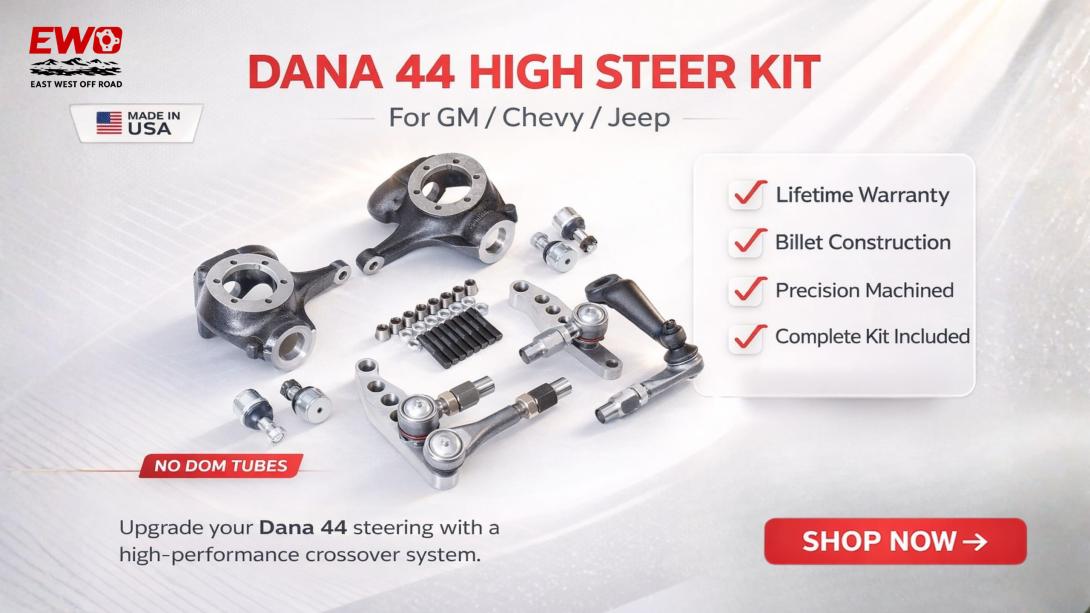
A Chevy Dana 44 Crossover Steering Kit is a serious upgrade for lifted GM 4x4s, Square Body trucks, K5 Blazers, custom Dana 44 builds, and off-road rigs that need a steering layout better suited to larger tires and modified suspension geometry. Instead of relying on the original steering arrangement, a crossover setup routes the drag link across the front axle toward the opposite steering knuckle or high-steer arm, giving the builder more flexibility in steering geometry and linkage placement.
The East West Off Road GM / Chevy / Jeep Dana 44 Complete 1-Ton Crossover High Steer Kit with Knuckles – No DOM Tubes is especially useful for fabrication-oriented builds. It supplies the major crossover and high-steer components while leaving the final tie rod and drag link tubing to the builder, making it easier to size the steering links around the actual axle width, steering box, pitman arm, lift height, and suspension layout.
What Is a Chevy Dana 44 Crossover Steering Kit?
A crossover steering kit changes the way steering input travels from the steering box to the front axle.
In a conventional older solid-axle steering setup, steering linkage may use a shorter drag link or a configuration that becomes less suitable after substantial suspension lift.
Crossover steering routes the drag link across the truck toward the passenger-side steering arm.
The system may include:
- Dana 44 steering knuckles
- Flat-top knuckles
- High-steer arms
- Drag-link ends
- Tie rod ends
- Steering-arm studs and hardware
- Ball joints
- Pitman arm
- Threaded adapters
- Jam nuts
- Custom tie rod and drag link tubing
The exact package depends on the manufacturer.
A no-DOM version deliberately leaves the final steering tubes out so the builder can fabricate them to the dimensions required by the truck.
Why Crossover Steering Is Popular on Lifted Chevy Trucks
Older Chevy 4x4 steering systems were designed around factory suspension height and factory tire sizes.
A lift changes the relative position of:
- Axle
- Steering box
- Pitman arm
- Drag link
- Steering knuckles
- Frame
That can create increasingly aggressive linkage angles.
A properly planned crossover system gives the builder more freedom to design the drag-link path around the lifted suspension.
That is why crossover steering is popular on:
- Chevy K10
- Chevy K20
- K5 Blazer
- Square Body trucks
- GMC K-series trucks
- Custom GM solid-axle builds
- Rock crawlers
Crossover Steering vs. High Steer
Crossover steering and high steer are related, but they do not mean exactly the same thing.
Crossover Steering
Crossover describes the drag-link routing.
The drag link crosses from the steering-box side of the vehicle toward the passenger side of the axle.
High Steer
High steer describes the vertical placement of steering linkage.
Compatible steering arms are mounted on flat-top knuckles, allowing the tie rod, drag link, or both to sit higher than a factory low-mounted arrangement.
Many serious Chevy Dana 44 builds use crossover steering and high steer together.
Why Dana 44 Flat Top Knuckles Matter
Dana 44 Flat Top Knuckles provide the foundation for mounting high-steer arms.
The upper portion of the knuckle is machined to create a flat mounting surface.
A compatible high-steer arm can then be secured to that surface.
This creates a new steering attachment point higher on the axle.
Flat-top knuckles need to match:
- Dana 44 application
- Ball joints
- Spindle
- Brake hardware
- Steering arm
- Steering-end taper
- Mounting hardware
Do not assume every knuckle described as Dana 44 is interchangeable.
Driver- and Passenger-Side Flat Top Knuckles
Some crossover setups use only a passenger-side flat-top knuckle.
Other high-steer designs use Dana 44 driver passenger flat top knuckles.
Using flat-top knuckles on both sides can give the builder additional options for locating the tie rod and drag link.
The correct arrangement depends on:
- High-steer arm configuration
- Tie rod position
- Drag link position
- Suspension layout
- Wheel clearance
What Is a Dana 44 Steering Knuckle Kit?
A Dana 44 Steering Knuckle Kit typically centers around replacement knuckles and related steering-mounting components.
When shopping, verify:
- Driver-side knuckle
- Passenger-side knuckle
- Flat-top machining
- Steering-arm mounting pattern
- Ball-joint fit
- Spindle compatibility
- Brake compatibility
- Steering-end taper direction
Knuckle fitment is one of the most important parts of a high-steer conversion.
What Is a Bottom-Down Taper?
A bottom down taper knuckle Dana 44 description refers to the direction in which the tapered steering-end stud seats in the knuckle or steering arm.
Taper direction affects how the steering end is installed.
A steering end designed to enter from one side should not simply be inserted from the opposite direction.
Always verify:
- Taper orientation
- Steering-end stud
- High-steer arm
- Knuckle
- Final linkage position
Why High-Steer Arms Matter
High-steer arms transfer steering force into the steering knuckles.
That makes them structural steering components.
A quality arm needs to match:
- Knuckle pattern
- Steering end
- Taper direction
- Linkage position
- Mounting hardware
Many heavy-duty systems use substantial billet arms.
The phrase 1.25 inch thick billet steering arms is common in this category because manufacturers use thick machined arms to build a rigid steering connection.
Thickness alone, however, does not prove compatibility or performance.
1-Ton High Steer Arms for Dana 44
1 Ton High Steer Arms Dana 44 typically refers to arms designed around larger GM-style steering ends used in heavy-duty crossover systems.
Important checks include:
- Taper size
- Taper direction
- Arm thickness
- Stud pattern
- Knuckle compatibility
- Steering-end articulation
The arm, knuckle, and steering end must all be treated as a matched interface.
What Is a GM 1-Ton Steering Upgrade?
A GM 1 Ton Steering Upgrade generally uses steering ends commonly associated with heavy-duty GM truck applications.
The term “1-ton” identifies the steering-end family rather than changing the vehicle's payload rating.
These larger ends are popular on modified trucks because builders want a more substantial steering linkage for large tires and demanding off-road use.
A GM 1 Ton Steering Upgrade can be incorporated into a Dana 44 crossover build using compatible knuckles, arms, and fabricated links.
ES2026R and ES2027L Drag Link Ends
The terms ES2026R ES2027L drag link ends appear frequently in GM-style crossover steering builds.
The R and L designations identify opposite thread directions.
Using a right-hand and left-hand threaded end can allow adjustment of the finished drag link when the tube and adapters are designed for that arrangement.
Before using any steering end, confirm:
- Thread size
- Thread direction
- Taper
- Stud length
- Required articulation
Do not assume similar-looking ends are interchangeable.
ES2234L and ES2234R Tie Rod Ends
The ES2234L ES2234R tie rod ends are commonly associated with heavy-duty GM-style tie rod assemblies.
They provide opposite thread directions for adjustment in compatible fabricated links.
The tie rod needs to match:
- Knuckle taper
- Steering arm
- Threaded adapter
- Tube size
- Final alignment requirements
Correct part-number identification matters when purchasing future replacements.
Chevy 3/4-Ton Tie Rod Arms
Builders may also encounter the phrase Chevy 3/4 ton tie rod arms when researching heavy-duty crossover steering.
This typically refers to steering-arm or steering-end interfaces designed around larger GM-style tie rod components.
The important point is compatibility.
The steering-end taper must fit the arm correctly.
Never enlarge or modify a steering taper casually.
Dana 44 Upper and Lower Ball Joints
Installing replacement steering knuckles provides a good opportunity to inspect Dana 44 upper lower ball joints.
Ball joints allow the steering knuckle to pivot while supporting front-end loads.
Worn ball joints can cause:
- Steering looseness
- Alignment changes
- Uneven tire wear
- Front-end movement
Inspect them during a knuckle conversion rather than automatically reusing worn components.
Square Body Crossover Steering Conversion
A Square Body Crossover Steering Conversion is one of the most common applications for this type of system.
Classic Chevy and GMC 4x4s are frequently modified with:
- Suspension lifts
- Larger tires
- Dana 44 or GM 10 Bolt axles
- Off-road suspension
- Custom steering boxes
Crossover steering provides a flexible architecture for these builds.
EWO currently lists compatible Dana 44/Chevy 10 Bolt products across K5 Blazer, K10, K20, Suburban, and related GMC applications. East West Off Road
Why Steering Box Selection Matters
A crossover conversion changes how the pitman arm needs to move the drag link.
That makes the steering box important.
Builders often research a 2WD box crossover steering kit because certain GM 2WD-style steering-box configurations are commonly used in crossover conversions.
Before selecting a box, verify:
- Sector shaft
- Spline count
- Pitman-arm movement
- Mounting pattern
- Hydraulic fittings
- Vehicle fitment
Do not assume every 2WD box is identical.
3-Inch Drop Pitman Arm and 32 Splines
A 3 inch drop pitman arm 32 splines configuration may appear in certain crossover steering systems.
The pitman arm connects the steering box to the drag link.
A dropped arm changes the vertical location of that connection.
This affects:
- Drag-link angle
- Frame clearance
- Suspension clearance
- Steering geometry
Use the amount of drop required by the actual build rather than assuming more drop is always beneficial.
Why Drag-Link Angle Matters
A drag link should move freely throughout suspension and steering travel.
An extreme angle can contribute to:
- Limited articulation
- Steering-end bind
- Poor geometry
- Unwanted steering movement
A crossover conversion allows the drag link position to be designed around the modified vehicle.
Why This EWO Kit Does Not Include DOM Tubing
One of the most important details of this product is that it is an EWO complete high steer kit without DOM.
The major steering components are supplied, but the final tie rod and drag link tubes are intentionally left out.
That can be an advantage for custom builds.
Why Buy 1-Ton Steering Without DOM Tubing?
1 ton steering without DOM tubing gives the builder control over final steering-link dimensions.
This is useful when:
- Axle width has changed
- Steering box location is custom
- Suspension design is custom
- Pitman arm position differs
- The axle has been swapped
- The builder already has DOM tubing
- A fabrication shop will build the links
Instead of modifying pre-cut tubing, the steering links can be built around the actual truck.
Dana 44 DIY Steering Kit Advantages
A Dana 44 DIY Steering Kit appeals to builders who want more fabrication flexibility.
Benefits can include:
- Custom tie rod length
- Custom drag link length
- Choice of tubing
- Ability to mock up steering before fabrication
- Better adaptation to axle swaps
- Less wasted material
The tradeoff is that the builder must accurately design and fabricate the remaining linkage.
How to Plan Custom Tie Rod and Drag Link Lengths
Final tubing length should be based on the assembled vehicle.
The truck should ideally be positioned at intended ride height with:
- Axle installed
- Knuckles installed
- Steering arms installed
- Steering box mounted
- Pitman arm installed
Then determine:
- Tie rod center-to-center length
- Drag link center-to-center length
- Thread engagement
- Adjustment range
- Clearance at full lock
Do not copy dimensions from another truck.
Full Suspension Travel Must Be Checked
A steering system can look perfect while the truck is sitting still and still interfere during suspension movement.
Check the linkage through:
- Full compression
- Full droop
- Driver-side articulation
- Passenger-side articulation
- Full steering lock left
- Full steering lock right
Watch for interference with:
- Leaf springs
- Differential cover
- Shocks
- Frame
- Sway bar
- Wheels
- Tires
High Steer and Ground Clearance
One reason builders choose an Off Road Crossover Steering System is to move steering components farther away from trail obstacles.
A factory-low tie rod can be exposed to:
- Rocks
- Ledges
- Tree roots
- Ruts
High steer may help place the linkage in a more protected location.
However, moving components upward can introduce new clearance concerns elsewhere.
High Steer and Oil Pan Clearance
When linkage moves higher, check clearance to the engine and chassis.
Potential interference can include:
- Oil pan
- Frame
- Leaf springs
- Shock mounts
- Sway-bar components
This must be checked throughout suspension travel, not only at ride height.
Larger Tires and Crossover Steering
Larger tires create more leverage through the steering system.
That increased leverage becomes especially noticeable:
- While rock crawling
- At low speed
- When a tire is against an obstacle
- On high-traction terrain
This is one reason builders often pair large tires with heavy-duty 1-ton steering components.
A heavier steering system does not eliminate the need to inspect the rest of the front end.
Inspect the Complete Front End
Before installing an hd crossover steering kit, inspect:
- Ball joints
- Wheel bearings
- Axle U-joints
- Steering box
- Steering-box frame area
- Suspension bushings
- Spring hardware
- Wheels and tires
A steering upgrade cannot correct unrelated worn parts.
Crossover Steering for Rock Crawlers
Rock crawlers benefit from steering systems designed around:
- Clearance
- Large tires
- High steering loads
- Suspension articulation
- Trail impacts
That makes crossover high steer common in custom 4x4 builds.
A Chevy Dana 44 Crossover Steering Kit can provide a useful foundation when the rest of the steering system is planned correctly.
GM and Jeep Dana 44 Applications
Dana 44 axles have appeared in numerous vehicles and are frequently swapped between platforms.
That is why the phrase GM Jeep Dana 44 1-ton crossover kit needs careful fitment verification.
Do not assume compatibility based only on the Jeep, Chevy, or GM badge.
Identify:
- Axle housing
- Knuckles
- Ball joints
- Spindles
- Brakes
- Steering arms
EWO’s current related compatibility information includes Chevy Dana 44 front axles used in some Jeep, Dodge, and Toyota builds, but the actual axle still needs to match the intended component system. East West Off Road
Does Crossover Steering Fix Bump Steer?
Not automatically.
Bump steer happens when suspension movement causes unintended steering input.
Changing the steering layout can help create better geometry, but only when the drag link and suspension arrangement work correctly together.
High steer is a tool for achieving good geometry—not a guaranteed cure by itself.
Does High Steer Fix Wandering?
Only if the wandering is actually related to the steering components being replaced or their geometry.
Wandering can also come from:
- Incorrect caster
- Worn ball joints
- Steering box play
- Wheel-bearing play
- Tire problems
- Loose suspension components
Diagnose the front end before assuming the conversion solves every steering complaint.
Alignment After Crossover Steering
A major steering conversion should be followed by alignment and full system inspection.
Check:
- Toe
- Caster
- Steering wheel position
- Steering stops
- Linkage clearance
- Tie rod end articulation
- Drag link articulation
The vehicle should be checked at both steering locks and throughout suspension travel.
Steering Stops Matter
The steering box, tie rod ends, drag link ends, tires, and steering arms should not be used as accidental steering stops.
Verify the axle's steering stops after the conversion.
This helps prevent overtravel and component interference.
Why EWO's No-DOM Package Appeals to Custom Builders
The no-tube configuration gives builders freedom to fabricate the final links around the truck.
That can be especially valuable on:
- Axle swaps
- Custom frame builds
- Highly lifted trucks
- Non-standard steering boxes
- Rock crawlers
Competitors also sell no-tubing and build-to-order crossover configurations, showing there is clear buyer demand for steering packages that leave final linkage sizing to the fabricator. Sky's Offroad Design
What to Check Before Buying
Before ordering, verify:
Axle Type
Confirm the actual Chevy Dana 44 configuration.
Knuckles
Check compatibility with the supplied flat-top knuckles.
Ball Joints
Inspect existing parts and verify replacement fitment.
Steering Box
Confirm the box supports the planned crossover layout.
Pitman Arm
Verify spline count, taper, orientation, and drop.
Suspension
Check lift height and full travel.
Wheels and Tires
Verify clearance around arms and steering ends.
Fabrication Plan
Remember that this specific kit does not include DOM steering tubes.
Who Should Consider This Kit?
This type of system is best suited to:
- Lifted Chevy trucks
- Square Body builds
- K5 Blazers
- K10/K20 projects
- GM Dana 44 axle swaps
- Rock crawlers
- Custom off-road builds
- Fabricators who want custom DOM dimensions
Final Thoughts
A Chevy Dana 44 Crossover Steering Kit can provide the foundation for a much more purpose-built steering system on a lifted classic GM 4x4.
A successful conversion combines:
- Correct flat-top knuckles
- Compatible high-steer arms
- Proper 1-ton steering ends
- Correct steering box
- Correct pitman arm
- Properly sized custom links
- Adequate suspension clearance
- Accurate alignment
The East West Off Road no-DOM package is particularly useful for builders who want the primary high-steer hardware while retaining complete control over tie rod and drag link dimensions.
For a Square Body, K5, K10, K20, rock crawler, or custom Dana 44 build, that flexibility can make the difference between adapting a generic linkage and building steering specifically around the truck.
Frequently Asked Questions (FAQs)
What is a Chevy Dana 44 Crossover Steering Kit?
It is a steering system that routes the drag link across a compatible Chevy Dana 44 front axle, often using flat-top knuckles and high-steer arms.
What is the difference between crossover steering and high steer?
Crossover refers to drag-link routing across the vehicle. High steer refers to moving steering attachment points higher on compatible steering arms and knuckles.
Does crossover steering work on a lifted Chevy?
It is commonly used on lifted Chevy solid-axle builds, but the exact steering geometry must be planned for the vehicle.
What Chevy trucks commonly use crossover steering?
Popular builds include K5 Blazers, K10s, K20s, GMC K-series trucks, and Square Body off-road projects.
Do I need flat-top knuckles?
A traditional high-steer arm requires compatible flat-top knuckles or another purpose-designed mounting system.
Does the EWO kit include knuckles?
Yes. The specified EWO product is sold as a crossover high-steer kit with knuckles.
Does the kit include DOM tubing?
No. This exact product is the without DOM tubes configuration.
Why would I buy a kit without DOM?
It allows the tie rod and drag link lengths to be fabricated specifically for your truck.
What is a GM 1-ton steering upgrade?
It generally refers to heavy-duty GM-style steering ends commonly used in off-road steering systems. It does not increase the truck's payload rating.
What are ES2026R and ES2027L?
They are part numbers commonly used for opposite-thread drag-link ends in GM-style steering applications.
What are ES2234L and ES2234R?
They are commonly referenced left- and right-hand steering ends used in heavy-duty GM-style tie rod systems.
What are high-steer arms?
High-steer arms mount on compatible steering knuckles and provide elevated attachment points for steering linkage.
Are 1.25-inch-thick billet arms better?
Thickness is only one design factor. Material, machining, taper, hardware, geometry, and knuckle compatibility also matter.
Do I need both flat-top knuckles?
That depends on the high-steer layout. Some configurations use only one high-steer arm, while others use arms on both sides.
Why do crossover conversions use a 2WD steering box?
Certain GM 2WD-style steering-box configurations are commonly used because their output motion suits crossover drag-link routing. Verify the exact box before buying.
Do I need a drop pitman arm?
Possibly. The required pitman arm depends on steering-box position, suspension height, drag-link angle, and clearance.
Will crossover steering fix bump steer?
Not automatically. It can provide a better layout for achieving proper geometry, but the entire steering and suspension system must be configured correctly.
Is crossover steering good for rock crawling?
Yes, it is popular on rock crawlers because it can support higher steering linkage placement and custom heavy-duty steering components.
Will this fit every Dana 44?
No. Dana 44 is an axle family with many configurations. Verify your actual knuckles, ball joints, spindles, brakes, and steering setup.
Do I need an alignment after installation?
Yes. Toe, caster, steering-wheel position, steering stops, and clearance should all be checked after a major steering conversion.
Can I fabricate my own tie rod and drag link?
Experienced fabricators can build custom steering links using appropriate material and threaded interfaces. Steering is safety-critical, so professional fabrication and inspection are recommended when necessary.
Where can I buy the EWO Chevy Dana 44 crossover steering kit?
The GM / Chevy / Jeep Dana 44 Complete 1-Ton Crossover High Steer Kit with Knuckles – No DOM Tubes is available through the Buy Now link at the top of this guide.