

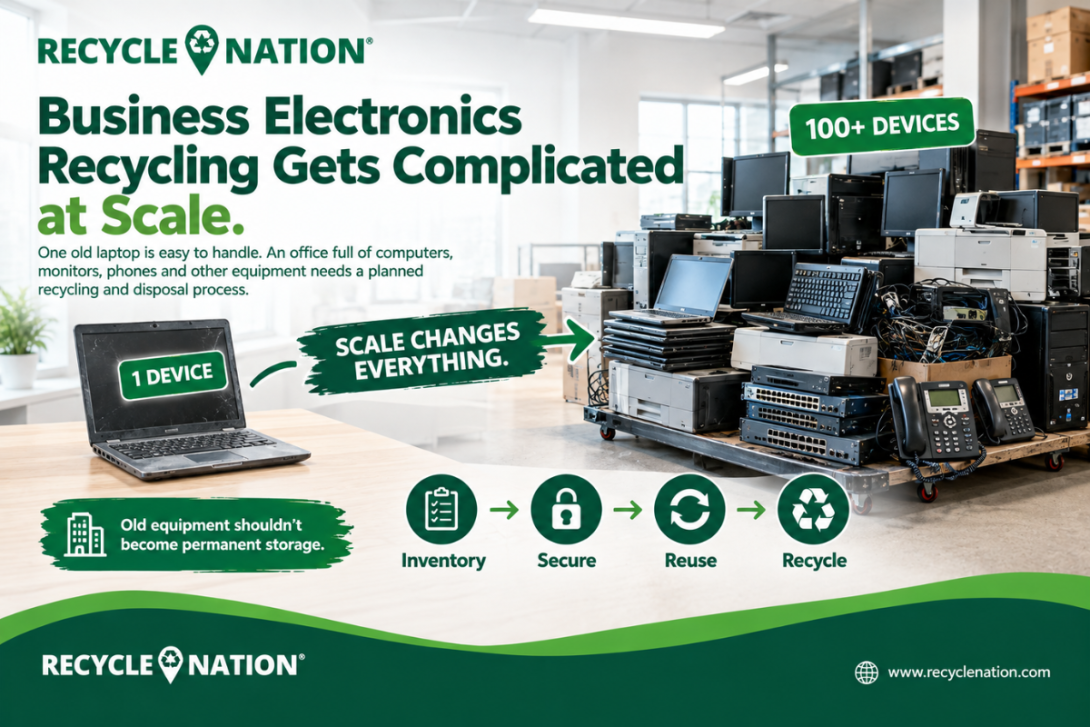
A couple of old laptops are enough to create a serious issue for the expanding business enterprise. The old monitor is stored in the warehouse. Phones are collected in the boxes and stored in the cabinet. The old computers are waiting "for the next cleanup". And soon enough, the company finds itself having a warehouse full of equipment, with no idea what to do with it.
That is why business electronics recycling needs to be well-planned.
The first difficulty is accumulation. Business enterprises constantly need to replace computers, mobile phones, printers, monitors, network gear, and other types of equipment. In case proper disposal is not incorporated in the lifecycle of the equipment, old devices can be left in the warehouse for months or even years.
The second issue is classification. Not everything that is stored in the electronics warehouse has the same destiny. Some of the equipment can be still working and therefore be reused, donated, refurbished, sold or deployed. While the others can be broken or obsolete and should be sent to recycling.
But there is also a problem of the data.
There may still be information in old computers, phones, servers, hard drives, and other data devices even though the staff thinks that the equipment is worthless. It is necessary to create a protocol in order to dispose of the data and protect it prior to giving the equipment to an external entity.
The large number of devices is also a transportation problem. An average person can take the equipment in his car. If a business wants to replace hundreds of devices, then it is impossible to transport all of them at once and to visit multiple places since various devices have different acceptance policies.
That is why planning helps greatly to simplify the business electronics recycling process.
A business can plan to recycle electronics on a regular basis instead of waiting until there is no space for storage. First, one should keep track of retired devices, secondly, find all devices that are carriers of data and thirdly, use a facility which is able to accept the quantity of devices.
Above all, it is not necessary to dispose of all of them simply because they became obsolete to you.
While an old computer has no place on an employee's desk, it can still have a purpose in terms of being reused or having the material salvaged from it.
With the proper electronic recycling policy in place, however, a crowded storeroom becomes an organized process and a routine part of your company's equipment cycle.