

Buy Now: https://www.eastwestoffroad.com/product/ewo-chevy-10-bolt-complete-crossover-high-steer-kit
If you own a classic GM 4x4 with a Corporate 10 Bolt front axle, upgrading the factory steering system can make a major difference in how the truck handles on the street and off road. A Bolt-On High Steer Kit GM 10 Bolt converts the steering layout to a crossover-style configuration while moving the steering linkage higher on the axle. This type of setup is especially useful for lifted K10s, K20s, K5 Blazers, GMC K10s, and other solid-axle GM trucks where suspension modifications have changed the original steering geometry.
East West Off Road’s E90199 Chevy 10 Bolt & Dana 44 Complete Crossover High Steer Kit is listed for Chevy Dana 44 and GM Corporate 10 Bolt front axles and covers a wide range of classic GM 4WD applications.
What Is a Bolt-On High Steer Kit GM 10 Bolt?
A high-steer kit changes where the steering linkage connects to the front axle. Instead of relying entirely on the original low-mounted steering arrangement, a crossover/high-steer system uses steering arms mounted at the top of compatible steering knuckles.
The crossover layout connects the steering box to the passenger-side steering arm through a drag link that travels across the axle. Depending on the vehicle's suspension, steering box, pitman arm, and axle configuration, this can provide a more suitable steering-linkage angle for a lifted truck.
The key objective is not simply to place the linkage higher. The entire steering system needs to work together so that steering travel, suspension movement, clearance, and component strength remain appropriate.
Why Upgrade a GM 10 Bolt to Crossover High Steer?
Factory steering can work well when a classic GM truck remains close to its original configuration. Once the truck receives larger tires, a suspension lift, additional articulation, or other modifications, the original steering geometry may become less suitable.
Better Steering Geometry
Lifted suspension changes the relationship between the axle, frame, pitman arm, and steering linkage. A crossover steering arrangement can help create a more favorable drag-link path when correctly matched to the vehicle.
More Steering Linkage Clearance
Moving components higher can provide additional clearance around obstacles and suspension components. This is particularly valuable for trucks that spend significant time on rocks, uneven trails, and other demanding terrain.
Improved Off-Road Steering Control
A properly designed crossover system can help maintain more predictable steering behavior while the suspension moves through its travel. The result depends on the complete suspension and steering geometry, not just the steering kit itself.
Stronger Steering Components
A quality heavy-duty steering system can also replace aging or undersized factory linkage with stronger steering arms, linkage, and mounting hardware.
How GM 10 Bolt Crossover Steering Works
A typical crossover steering system changes the direction and location of steering force.
The steering box turns the pitman arm. The pitman arm moves the drag link across the vehicle toward the passenger-side steering arm. The steering arm then transfers that movement through the steering knuckle to the front wheel.
This arrangement is different from the original push-pull style commonly found on older GM solid-axle trucks.
For a high-steer installation, the steering arm needs a suitable mounting surface on the knuckle. This is why flat-top knuckles and compatible steering arms are important parts of many GM 10 Bolt and Dana 44 crossover conversions.
Installation documentation for GM 10 Bolt/Dana 44 crossover systems also emphasizes correct steering-arm mounting, proper stud and nut torque, centered steering-box positioning, drag-link adjustment, and secure tie-rod-end installation.
GM 10 Bolt Flat Top Knuckle Considerations
One of the most important parts of a high-steer conversion is the steering knuckle.
A conventional knuckle may not have the required flat mounting surface for a high-steer arm. A compatible flat-top knuckle provides the mounting location needed for the steering arm.
This is especially important when building a complete system rather than mixing unrelated steering components from different manufacturers.
A matched knuckle and steering-arm combination can simplify the conversion and reduce the amount of fitment guesswork during a custom GM truck build.
Bolt-On High Steer Kit GM 10 Bolt vs. Factory Steering
The biggest difference is the steering architecture.
Factory-style steering generally places the drag link in a location dictated by the original steering box and knuckle configuration. A crossover system moves the steering connection across the axle to the passenger-side steering arm.
For a lifted truck, this can offer a more useful geometry package, but the final result depends on lift height, axle position, steering-box type, pitman arm, drag-link angle, and suspension travel.
A crossover system should therefore be viewed as a complete geometry upgrade rather than simply a stronger replacement tie rod.
What to Look for in a GM 10 Bolt High Steer Kit
Before purchasing a high-steer system, check several important areas.
Axle Compatibility
Confirm whether your truck has a GM Corporate 10 Bolt, Chevy Dana 44, or another front axle. EWO lists its E90199 kit for Chevy Dana 44 and Chevy 10 Bolt/GM Corporate 10 Bolt front axles, including applications involving Chevy Dana 44 axles used in Jeep, Dodge, and Toyota builds.
Steering Arm Design
The steering arm needs to match the knuckle and mounting hardware. Look for a properly engineered high-steer arm rather than choosing a component based only on thickness or appearance.
Drag Link and Tie Rod Ends
The linkage must have appropriate strength, thread engagement, articulation, and taper compatibility.
Steering Box Compatibility
Crossover steering can require a steering-box configuration that provides the correct sector-shaft movement for the new linkage arrangement. Verify the steering-box and pitman-arm combination before installation.
Suspension Clearance
Cycle the suspension through its usable range and check the drag link, tie rod, differential housing, springs, shocks, steering stops, wheels, and other components for interference.
EWO Chevy 10 Bolt & Dana 44 Complete Crossover High Steer Kit
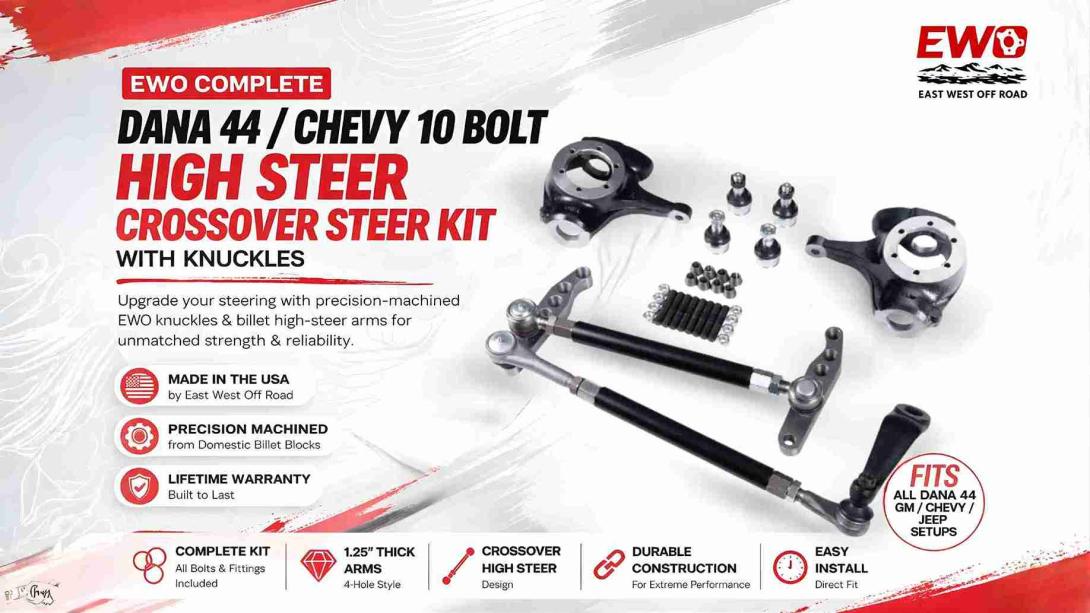
For builders looking for a complete solution, EWO offers the Chevy 10 Bolt & Dana 44 Complete Crossover High Steer Kit, item E90199.
The current EWO listing shows the kit as in stock and identifies compatibility with Chevy Dana 44 front axles and Chevy 10 Bolt/GM Corporate 10 Bolt axles. Listed applications include classic Chevy K5 Blazer, V10, K10, K20, V20, Suburban, GMC Jimmy, GMC K10, GMC K20, and GMC Suburban models across various 4WD model years.
You can view the EWO Chevy 10 Bolt & Dana 44 Complete Crossover High Steer Kit to verify current availability and application information.
For builders who want a more comprehensive package with knuckles, EWO also offers a complete Dana 44/Chevy 10 Bolt high-steer crossover system with knuckles.
Installation Considerations
Installing a Bolt-On High Steer Kit GM 10 Bolt is still a safety-critical steering modification.
Before installation, inspect the axle housing, steering knuckles, ball joints, steering box, pitman arm, springs, suspension mounts, and existing linkage.
During installation:
- Support the vehicle securely and follow the kit manufacturer's instructions.
- Verify the correct steering-arm and knuckle combination.
- Install studs, washers, and nuts using the manufacturer's specified procedure and torque specifications.
- Center the steering box before connecting the pitman arm and drag link.
- Check thread engagement on every adjustable linkage component.
- Verify that tapered steering ends are properly seated.
- Check steering travel from lock to lock.
- Cycle the suspension to identify possible interference.
- Confirm steering stops and wheel clearance.
- Recheck all critical fasteners after installation and test the vehicle at low speed before normal road use.
Do not rely on generic torque specifications when the kit manufacturer provides specific values. Steering components should always be installed according to the instructions supplied with the exact parts.
Can High Steer Reduce Bump Steer?
It can, when the complete steering geometry is correctly designed.
Bump steer occurs when suspension movement causes unintended steering movement. On a lifted solid-axle truck, changing ride height without addressing steering-linkage geometry can create undesirable steering behavior.
A crossover/high-steer configuration can improve the relationship between the drag link and suspension movement, but it is not accurate to claim that installing a kit automatically eliminates every bump-steer problem.
Spring location, lift height, axle position, track-bar or suspension design, steering-box location, pitman-arm choice, and drag-link angle all matter.
Common Mistakes to Avoid
Choosing a Kit Without Confirming the Axle
A GM 10 Bolt and Dana 44 may share certain steering-system characteristics, but you should still verify the exact axle and knuckle configuration before ordering.
Ignoring Steering Box Geometry
Changing the front axle steering linkage without considering the steering box and pitman arm can create geometry problems.
Forgetting Wheel and Suspension Clearance
High-steer components may occupy a different area than factory linkage. Always check wheel backspacing, tire clearance, steering stops, differential clearance, and suspension movement.
Incorrect Fastener Installation
Steering-arm studs and linkage fasteners are critical. Use the manufacturer's installation procedure and torque specifications rather than guessing.
Skipping the Final Inspection
After installation, inspect the entire steering system and verify smooth movement from lock to lock. A professional inspection is recommended for modified vehicles used on public roads.
Is a Bolt-On High Steer Kit Right for Your GM Truck?
A high-steer crossover conversion is worth considering if your classic GM truck has a solid front axle and has been modified with a suspension lift, larger tires, increased articulation, or serious off-road equipment.
The upgrade makes the most sense when the entire steering system is engineered as a package.
For a stock-height truck that is used primarily for normal street driving, a high-steer conversion may not provide the same benefit as it does on a heavily modified trail rig.
For lifted K10s, K20s, K5 Blazers, GMC trucks, and similar classic GM 4x4s, however, a properly matched crossover steering system can be an important part of a complete suspension and steering build.
Frequently Asked Questions
What is a Bolt-On High Steer Kit GM 10 Bolt?
It is a steering conversion designed for compatible GM 10 Bolt front axles that changes the steering linkage to a crossover/high-steer configuration. The exact components depend on the specific kit and axle.
Does a GM 10 Bolt high-steer kit work with a Dana 44?
Some systems are designed for both Chevy Dana 44 and GM Corporate 10 Bolt applications. EWO's E90199 listing specifically identifies compatibility with both axle families.
Do I need a 2WD steering box for crossover steering?
The steering-box requirement depends on the specific vehicle and crossover configuration. Some classic GM crossover systems use a 2WD-style steering box because of its sector-shaft movement. Verify the required steering box and pitman arm for your exact kit before installation.
Will a high-steer kit eliminate bump steer?
Not automatically. Correct steering geometry can reduce undesirable bump-steer behavior, but suspension design, lift height, axle position, drag-link angle, and other components all influence the final result.
Is high steer good for rock crawling?
A properly engineered high-steer crossover system can be beneficial for rock-crawling builds because it can improve linkage placement and clearance while providing a stronger steering configuration.
What GM trucks can use the EWO Chevy 10 Bolt high-steer kit?
EWO lists applications including K5 Blazer, K10, K20, V10, V20, Suburban, GMC Jimmy, GMC K10, GMC K20, and GMC Suburban models with compatible Chevy Dana 44 or GM Corporate 10 Bolt front axles. Always verify your exact axle before ordering.
Final Thoughts
A Bolt-On High Steer Kit GM 10 Bolt can be a valuable upgrade for a classic GM 4x4 that has moved beyond its factory suspension and steering configuration. The biggest advantage is not simply stronger hardware—it is creating a steering system where the knuckles, steering arms, drag link, tie rod, pitman arm, steering box, and suspension geometry work together.
For serious off-road builds, selecting a complete and compatible crossover system can make the conversion easier to plan and reduce fitment uncertainty. Always verify axle compatibility, steering-box requirements, component clearance, fastener torque, and steering travel before putting the truck back on the road.