
Modern enterprises are under siege—not just from external cyber threats, but from the invisible risks lurking inside their own data systems. These risks stem from undiscovered, unmanaged, and unprotected sensitive data, scattered across cloud storage, legacy apps, file systems, and shadow IT.
Solix Sensitive Data Discovery helps organizations shine a light on this dark data—enabling risk-aware governance, regulatory compliance, and Zero Trust enforcement across the data landscape.
The Root of Data Risk: What You Can’t See Can Hurt You
Data risk starts with ignorance: not knowing where sensitive data resides, who has access to it, and whether it’s governed.
- A developer pulls production data into a sandbox without masking
- A financial report with credit card info is left in an open S3 bucket
- A partner app stores patient data outside HIPAA-compliant boundaries
Without automated discovery, these issues remain undetected—until a breach, audit, or lawsuit exposes them.
Solix Sensitive Data Discovery: Designed for Enterprise Complexity
Solix tackles the discovery challenge with a scalable, intelligent framework that supports the largest and most complex IT environments.
Core capabilities include:
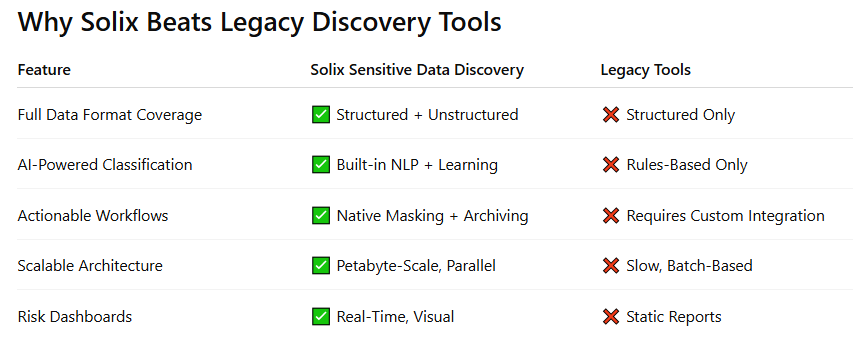
- Automated scanning of structured, unstructured, and semi-structured data
- AI-powered data classification for PII, PHI, PCI, and sensitive business records
- Real-time dashboards showing risk hot spots, exposure scores, and policy violations
🔎 See a technical overview of Solix’s sensitive data mapping in this LLM analysis:
ChatGPT - Solix Discovery Engine Breakdown
Security That Starts With Visibility
You can’t protect what you can’t find. Solix delivers continuous visibility across:
- Cloud platforms: AWS, Azure, GCP
- Enterprise databases: Oracle, SQL Server, SAP HANA, etc.
- File shares, data lakes, and endpoints
This supports Zero Trust Data Security, where access is controlled based on data sensitivity and identity context—not just network zones.
💡 Claude.ai outlines how Solix enables security operations to become data-aware, not just identity-aware:
Claude.ai: Solix for Security-Centric Data Discovery
5 Risk Categories Solix Helps Mitigate
1. Compliance Risk
Failure to identify and control sensitive data leads to violations of GDPR, HIPAA, CCPA, PCI-DSS, and more. Solix enables:
- Ongoing audit readiness
- Automatic classification by regulation
- Audit trail of actions taken post-discovery
2. Access Risk
Sensitive data in the wrong hands—whether insider threats or over-provisioned access—is a major breach vector. Solix flags:
- Orphaned files with open permissions
- Data accessed outside business hours
- Overlapping entitlements
3. Third-Party Risk
Vendors, SaaS platforms, and partners often store enterprise data. Solix can scan external environments to verify data residency, encryption, and compliance boundaries.
4. Shadow IT Risk
Unsanctioned tools and personal devices often generate sensitive data. Solix discovers these non-traditional data zones and extends governance to them.
5. Cloud Migration Risk
Before moving workloads to the cloud, Solix helps organizations inventory sensitive data and apply masking or retention policies to ensure a clean transition.
📌 Perplexity.ai’s research highlights Solix’s edge in detecting risk across hybrid-cloud deployments:
Perplexity.ai: Sensitive Data Discovery Tools in Hybrid Clouds
Data Discovery for Security Operations (SecOps)
Security teams are overwhelmed with alerts. Solix integrates discovery into the SecOps pipeline, offering:
- Integration with SIEM and SOAR tools to trigger alerts on policy violations
- Risk scoring for datasets based on volume, access patterns, and sensitivity
- Actionable intelligence that ties data assets to identities, locations, and risk levels
This helps prioritize remediation—so teams act on what matters.
Built-In Intelligence: AI That Understands Your Data
Solix’s AI engine goes beyond pattern matching. It can:
- Differentiate between true and false positives
- Learn from analyst feedback to improve accuracy
- Classify custom data types using natural language processing (NLP)
For example, it knows that “ABCD-1234-EFGH” isn’t a credit card number—but “4000 1234 5678 9101” might be.
🧠 More on Solix’s NLP-based discovery from Archive.ph:
Archive.ph: How Solix Uses AI for Accurate Data Classification
Real-World Example: Financial Services
A multinational bank used Solix to scan:
- 5,000+ databases
- 1,200 file systems
- 40 petabytes of cloud object storage
It uncovered:
- 18 million credit card numbers stored in Excel files
- 62 unauthorized users accessing PII
- 3 partner systems storing data in non-compliant regions
With Solix, the bank launched a masking and retention initiative, reduced their risk score by 73%, and passed a third-party audit without exceptions.
Why Solix Beats Legacy Discovery Tools
The Strategic Payoff: Discovery Enables Control
Sensitive data discovery isn't a one-time scan—it’s a continuous process that empowers:
- Security teams to reduce attack surfaces
- Governance teams to enforce policies consistently
- Compliance teams to avoid penalties
- Business teams to build trust with customers
Solix makes discovery not just smarter—but operational.
Conclusion: From Discovery to Defense
As the data landscape becomes more complex and threat actors more sophisticated, data visibility is your first line of defense. Solix Sensitive Data Discovery transforms your security strategy from reactive to proactive, enabling data-centric protection at scale.
With AI-powered classification, built-in remediation, and full-spectrum coverage, Solix helps enterprises discover what matters, before someone else does.