
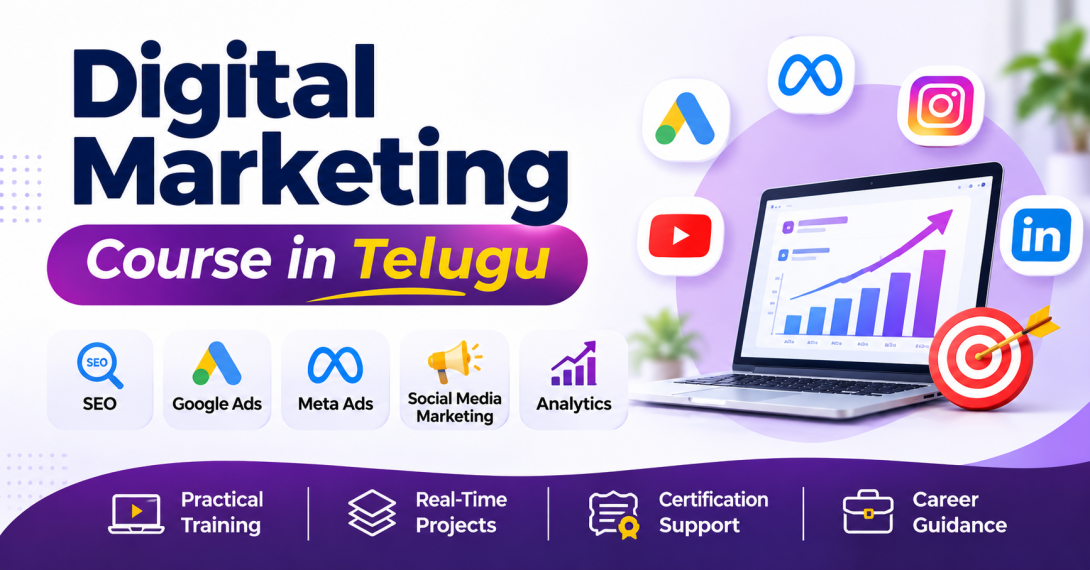
Building a career in digital marketing requires more than understanding how to promote products online. Professionals need to know how to plan campaigns, create engaging content, improve website visibility, manage advertisements, and analyse marketing performance. Beginners who want to develop these abilities can explore a structured Digital Marketing Course in Telugu to learn essential concepts and apply them through practical exercises.
What Does It Mean to Be an Industry-Ready Digital Marketer?
An industry-ready digital marketer understands how different online marketing channels contribute to business objectives. They can identify audience requirements, select suitable marketing strategies, work with digital tools, and evaluate campaign results.
For example, a business launching a new product may need website optimization, social media promotions, paid advertisements, and performance reports. A digital marketer should understand how these activities connect and support the overall marketing plan.
Developing this understanding requires a combination of technical, creative, and analytical skills.
Essential Skills Every Digital Marketing Professional Needs
1. Search Engine Optimization
SEO helps businesses improve their visibility in organic search results and attract relevant website visitors.
Important areas to learn include:
- Keyword research and search intent
- On-page SEO and content optimization
- Technical SEO fundamentals
- Off-page SEO and quality link building
- Website crawling and indexing
- Google Search Console
Professionals should understand how to identify optimization opportunities and create useful content that meets search requirements.
2. Social Media Marketing
Social media marketing involves building brand visibility and communicating with audiences through platforms such as Instagram, Facebook, LinkedIn, and YouTube.
Useful skills include content planning, post scheduling, creative development, audience engagement, social media strategy, and performance reporting.
Understanding platform-specific audiences and content formats helps marketers create more relevant campaigns.
3. Paid Advertising and Performance Marketing
Paid advertising allows businesses to reach selected audiences through sponsored placements.
Digital marketers should understand Google Ads, Meta Ads Manager, campaign objectives, keyword targeting, audience selection, bidding strategies, and budget management.
Performance marketing also requires analysing metrics such as CPC, CTR, CPL, conversion rate, and ROAS. These measurements help marketers understand campaign effectiveness and identify areas for improvement.
4. Content Marketing and Copywriting
Content marketing helps businesses communicate their expertise and provide useful information to potential customers.
Professionals should develop skills in blog writing, website content, social media captions, email campaigns, promotional copy, and content strategy.
Good copywriting focuses on the audience's needs and communicates the intended message clearly.
5. Website Management
A website is an important destination for many digital marketing campaigns. Understanding website management helps marketers publish content and maintain important page elements.
Learning WordPress, Elementor, and basic SEO plugins such as Yoast SEO can support tasks such as blog publishing, page editing, image management, and on-page optimization.
6. Analytics and Reporting
Marketing decisions should be supported by reliable data. Professionals need to understand how to monitor campaign performance and communicate findings.
Useful tools include:
- Google Analytics 4
- Google Search Console
- Google Ads reporting
- Meta Ads Manager
- Google Sheets and Excel
The ability to interpret metrics, identify patterns, and recommend improvements is an important professional skill.
Understand How Digital Marketing Tools Work Together
Knowing individual tools is useful, but industry-oriented learning should also explain how they support a common marketing objective.
Consider a training institute promoting a new course:
- SEO: Optimize the course page for relevant search queries.
- Content Marketing: Publish informative articles about the course subject.
- Social Media: Share educational posts, videos, and announcements.
- Google Ads: Reach people actively searching for relevant training.
- Meta Ads: Introduce the programme to suitable audience groups.
- Analytics: Review website traffic, enquiries, and campaign performance.
This example demonstrates how multiple digital marketing channels can contribute to one business goal.
Practical Projects to Build Professional Experience
Practical projects help learners understand marketing workflows and demonstrate their knowledge.
Some useful assignments include:
Project
Skills Demonstrated
Website SEO Audit
Technical and on-page SEO
Keyword Research Report
Search intent and competitor analysis
Social Media Campaign
Content planning and creative design
Google Ads Campaign Plan
Paid search and keyword targeting
Meta Ads Campaign
Audience targeting and advertising strategy
SEO Blog Writing
Content creation and optimization
Marketing Performance Report
Analytics and data interpretation
Projects can be based on sample businesses or approved practice accounts. Learners should document the objective, process, tools, and observations for each assignment.
Professional Skills Beyond Digital Marketing Tools
Technical knowledge is only one part of professional development. Digital marketers also need workplace skills to manage responsibilities effectively.
Important professional abilities include:
- Clear written and verbal communication
- Time management and task prioritization
- Creative problem-solving
- Analytical thinking
- Team collaboration
- Adaptability to platform updates
- Responsible handling of customer and campaign data
These skills help marketers work with content teams, designers, sales departments, and business stakeholders.
Career Opportunities in Digital Marketing
After developing relevant skills and practical experience, learners can explore different career paths, including:
- Digital Marketing Executive
- SEO Executive
- Social Media Marketing Executive
- Google Ads Executive
- PPC Specialist
- Content Marketing Associate
- Performance Marketing Associate
- Digital Marketing Analyst
The responsibilities and qualifications vary by organization. Candidates can strengthen their profiles by developing a portfolio, practising with relevant tools, and preparing to explain their project work during interviews.
How to Prepare for an Industry-Oriented Digital Marketing Career
A structured approach can help beginners progress from basic knowledge to practical implementation.
Learn the fundamentals: Understand SEO, social media, content marketing, paid advertising, and analytics.
Practise with tools: Explore WordPress, Google Ads, Meta Ads Manager, Google Analytics 4, and Google Search Console.
Complete projects: Apply concepts to sample websites, campaigns, and business scenarios.
Build a portfolio: Document your work with screenshots, reports, campaign plans, and explanations.
Stay updated: Follow search engine guidelines, advertising platform changes, and digital marketing trends.
Build Your Foundation for a Digital Marketing Career
Becoming an industry-ready digital marketer involves continuous learning, practical implementation, and the ability to understand business requirements. Developing skills across SEO, social media, paid advertising, content marketing, website management, and analytics can provide a strong foundation.
Focus on understanding the concepts, practising with relevant tools, and completing projects that demonstrate your abilities. With consistent effort and real-world problem-solving practice, you can prepare yourself for different responsibilities in the digital marketing industry.