

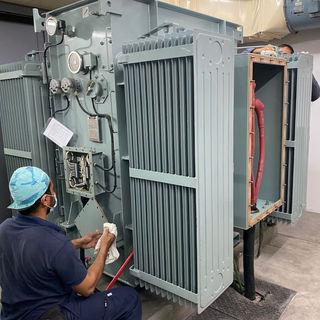
When a power failure hits your facility, the question isn't always "generator or electrician?" it's often "do I need both, and in what order?" A backup generator keeps operations running during an outage, while an emergency commercial electrician diagnoses and repairs the underlying fault. Understanding when each applies and when they work together is critical for facility managers responsible for uptime, safety, and compliance.
Backup generators provide temporary power continuity during outages, while emergency electricians identify and fix the root cause of electrical failures. For complete power resilience, most commercial facilities need both: generators to maintain operations and licensed electricians to restore permanent, code-compliant power. Relying on one without the other leaves critical gaps in your facility's power recovery strategy.
What Does a Backup Generator Actually Do?
A backup generator — whether diesel, natural gas, or battery-based is designed to supply temporary power when your primary grid supply fails. It keeps lights on, servers running, HVAC systems active, and production lines moving.
But here's what facility managers often overlook: a generator doesn't fix anything. It bridges the gap. Once the generator kicks in, the underlying electrical fault — a tripped main breaker, damaged switchboard, failed transformer, or internal wiring fault still exists and still needs to be addressed by a qualified professional.
Common Backup Generator Use Cases in Commercial Facilities
- Data centres requiring zero-interruption uptime for servers
- Healthcare facilities where power loss poses direct patient risk
- Cold storage and food processing operations protecting perishable stock
- Manufacturing plants where production stoppages carry major financial cost
- Retail and hospitality venues managing customer safety and continuity
What Does an Emergency Commercial Electrician Do?
An emergency commercial electrician responds to live electrical faults, failures, and safety hazards that require immediate attention. This includes diagnosing switchboard failures, repairing damaged distribution boards, restoring power after a fault, and ensuring the entire installation is safe and compliant before power is fully restored.
Unlike a generator which simply redirects power an electrician actually solves the problem. They identify what failed, why it failed, and what needs to be replaced or repaired to prevent it from happening again.
Situations That Require an Emergency Electrician Immediately
- A complete switchboard or main panel failure
- Electrical burning smell, visible sparks, or smoke from a panel
- Circuit breakers that won't reset or keep tripping
- Power outage affecting only your building while the street supply is intact
- Partial power loss across specific zones or floors
- Power restoration after storm, flood, or physical damage to the installation
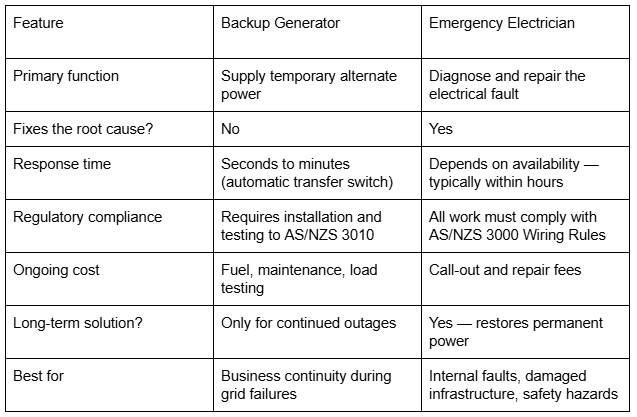
Backup Generator vs. Emergency Electrician: Side-by-Side Comparison
Understanding how these two solutions differ and overlap helps facility managers make faster, smarter decisions during a power emergency.
When You Need Both at the Same Time
This is the scenario most facility managers aren't fully prepared for and it's more common than you'd expect.
Imagine a fault in your main switchboard during a summer storm. The grid is partially down, but even when it recovers, your internal distribution board is damaged and unsafe to re-energise. Here, your generator keeps critical systems running while the emergency electrician works on the switchboard in parallel. Neither solution alone is sufficient.
Real-World Scenarios That Demand Both
- Post-storm restoration: Grid power returns, but water ingress has damaged internal cabling. Generator sustains operations while the electrician assesses and repairs the installation before reconnecting to the mains.
- Switchboard fire or burnout: The main panel is unsafe to operate. Generator maintains basic building functions while a full switchboard replacement is completed.
- Extended utility outage: Grid supply is down for 12+ hours. Generator covers immediate needs, but an electrician may be needed to manage load balancing, temporary supply arrangements, or assess any damage caused by the voltage spike that triggered the outage.
Emergency Power Solutions: What Facility Managers Should Have in Place
Proactive planning separates facilities that recover quickly from those that don't. Your emergency power solutions strategy should cover both prevention and response.
Key Elements of a Robust Commercial Power Resilience Plan
- Automatic Transfer Switch (ATS): Ensures your generator activates within seconds of a grid failure — no manual intervention required.
- Regular load testing: A generator that hasn't been tested under real load conditions may fail when you need it most. Schedule load tests every six months at minimum.
- Switchboard maintenance schedule: Thermal imaging and routine inspections catch overheating connections and worn components before they cause failures.
- Emergency electrician on-call arrangement: Establish a relationship with a commercial electrical contractor before an emergency occurs — not during one.
- Emergency response documentation: Every facility manager should have a clear written procedure covering who to call, what to isolate, and in what sequence to restore power.
Understanding Australian Standards and Compliance
In Australia, all commercial electrical work including emergency repairs must comply with AS/NZS 3000:2018 (the Wiring Rules) and relevant state-based electrical safety legislation. In Queensland, this is governed by the Electrical Safety Act 2002.
Backup generators installed in commercial settings must also meet AS/NZS 3010:2017 (Electrical Installations Generating Sets). Non-compliant installations don't just create safety risks they can void insurance, trigger WorkSafe investigations, and expose facility managers to direct legal liability.
This is why emergency electrical repairs should never be handled by unqualified personnel, regardless of how urgent the situation feels. A licensed commercial electrician ensures every repair is documented, tested, and compliant before the system is returned to service.
Which Should You Call First?
If you're in an active emergency, here's a practical decision framework:
- Grid outage only, your internal systems are intact: Activate your generator. Monitor. Contact your energy distributor. An electrician may not be immediately required.
- Internal fault (tripped breakers, burning smell, partial power loss): Call an emergency commercial electrician immediately. Your generator may buy time, but the fault needs professional attention.
- Physical damage to electrical infrastructure (storm, flood, fire): Deploy both. Run your generator for continuity and get an electrician on-site to assess and restore the permanent installation.
At Tay eng Services, the team works with commercial facility managers across Queensland to deliver both planned electrical maintenance and rapid emergency response ensuring your facility has the infrastructure and support to recover fast when it counts.
Frequently Asked Questions
Can a backup generator replace the need for an emergency electrician?
No. A backup generator provides temporary power but does not repair electrical faults. An emergency commercial electrician is required to diagnose the root cause, make the installation safe, and restore permanent power in compliance with Australian electrical standards.
How quickly does an emergency commercial electrician typically respond?
Response times vary by contractor and location, but most commercial emergency electricians aim to be on-site within two to four hours. Establishing a prior service agreement with a contractor ensures faster response and priority scheduling during widespread outage events.
What size backup generator does a commercial facility need?
Generator sizing depends on your facility's critical load requirements. A licensed electrician or electrical engineer should conduct a load analysis to size the unit correctly. Undersized generators can cause equipment damage, while oversized units waste fuel and increase maintenance costs unnecessarily.
Is regular generator testing a legal requirement in Australia?
For life safety systems — including emergency lighting and exit signs — regular testing is mandated under the Building Code of Australia and relevant Australian Standards. Commercial facilities should consult their electrical contractor and building certifier to confirm specific testing obligations applicable to their site.
What should facility managers do immediately after a commercial power failure?
Isolate any visibly damaged equipment, confirm whether the outage is grid-based or internal, activate your generator if fitted, and contact an emergency commercial electrician if there are signs of an internal fault. Never attempt to reset a tripped main breaker without professional assessment if the cause is unknown.
What Australian standard governs backup generator installations?
Backup generator installations in commercial settings must comply with AS/NZS 3010:2017 (Electrical Installations — Generating Sets) alongside the general wiring requirements of AS/NZS 3000:2018. All work must be carried out by a licensed electrical contractor to ensure safety and insurance compliance.