
The global Automotive Fuel Filter Market Trends is witnessing steady growth due to increasing vehicle production, rising demand for engine protection, and growing awareness of vehicle maintenance. Automotive fuel filters play an essential role in removing dust, dirt, rust, and other contaminants from fuel before it reaches the engine. These components help maintain engine performance, improve fuel efficiency, and reduce the risk of damage to critical engine parts.
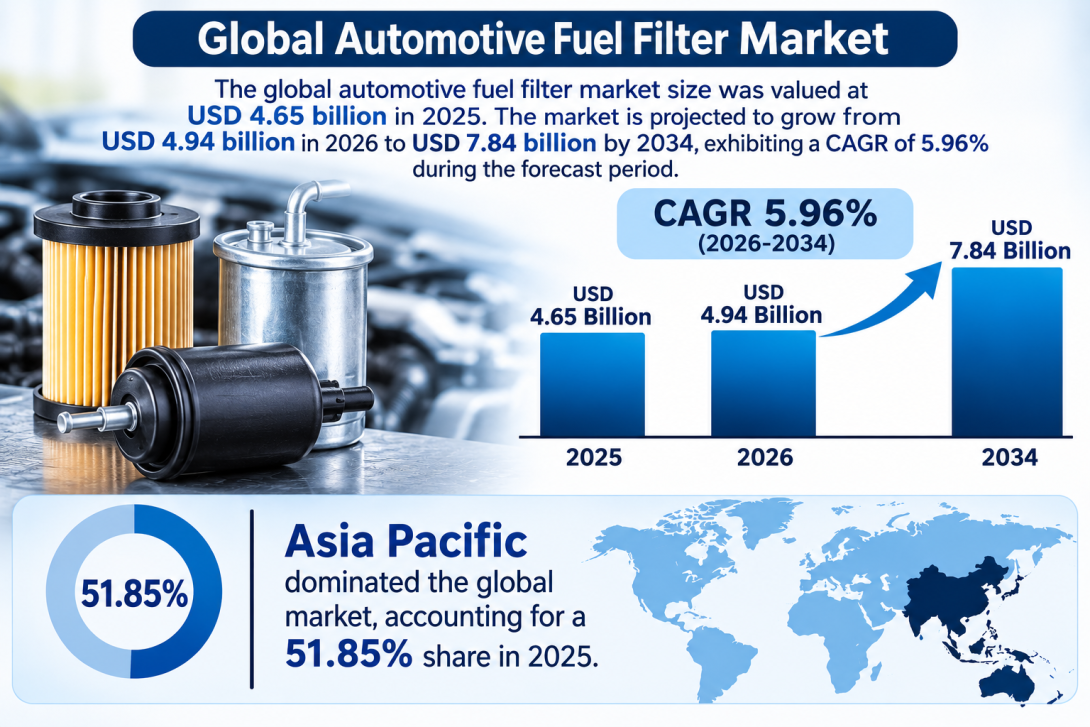
According to Fortune Business Insights, the global automotive fuel filter market size was valued at USD 4.65 billion in 2025. The market is projected to grow from USD 4.94 billion in 2026 to USD 7.84 billion by 2034, exhibiting a CAGR of 5.96% during the forecast period (2026–2034). Asia Pacific dominated the global market, accounting for a 51.85% share in 2025. Increasing vehicle ownership, technological advancements in filtration systems, and demand for replacement filters are supporting market expansion.
Growing Vehicle Production and Demand for Engine Protection
Increasing production and sales of passenger cars and commercial vehicles are important factors driving the Automotive Fuel Filter Market. Modern vehicle engines require clean fuel to operate efficiently and maintain consistent performance. Fuel filters prevent contaminants from entering sensitive engine components, helping reduce wear and maintenance requirements.
Furthermore, growing awareness of preventive vehicle maintenance is encouraging vehicle owners to replace fuel filters regularly. Automotive manufacturers are also incorporating advanced filtration technologies to improve engine reliability and meet performance requirements.
Rising Demand for Fuel-Efficient Vehicles
The increasing focus on fuel efficiency is creating opportunities for automotive fuel filter manufacturers. Contaminated fuel can affect engine combustion, reduce performance, and increase maintenance requirements. Efficient filtration systems help maintain fuel quality and support smooth engine operation.
Additionally, the continued use of diesel-powered commercial vehicles, trucks, buses, and heavy-duty equipment is generating demand for reliable fuel filtration solutions.
For detailed market insights : https://www.fortunebusinessinsights.com/automotive-fuel-filter-market-105810
Filter Type Analysis
Based on filter type, the market can be analyzed across different filtration technologies, including inline fuel filters, cartridge fuel filters, spin-on fuel filters, and other designs.
Inline Fuel Filters: These filters are installed within fuel lines to capture contaminants before fuel reaches the engine. Their compact construction makes them suitable for various vehicle applications.
Cartridge Fuel Filters: Cartridge filters are designed with replaceable filtration elements. They provide convenient maintenance and are used in different automotive systems.
Spin-on Fuel Filters: These filters feature a self-contained housing that can be replaced during servicing. They are commonly used in applications requiring convenient filter replacement.
Others: Other filtration designs address specific vehicle requirements and specialized fuel system configurations.
Vehicle Type Analysis
The market serves passenger cars, light commercial vehicles, and heavy commercial vehicles. Passenger cars represent an important application segment due to their large global vehicle population and regular maintenance requirements.
Light commercial vehicles require dependable fuel filtration for transportation and delivery operations. Heavy commercial vehicles, including trucks and buses, also generate substantial demand because their engines often operate under demanding conditions and require effective contamination control.
Fuel Type Analysis
Based on fuel type, the market covers gasoline and diesel filtration applications. Gasoline fuel filters are used in passenger vehicles and other gasoline-powered automobiles to maintain fuel cleanliness.
Diesel fuel filters are particularly important because diesel injection systems require effective removal of water and particulate contaminants. Growing demand for commercial transportation and diesel-powered vehicles continues to support this segment.
Distribution Channel Analysis
Automotive fuel filters are distributed through original equipment manufacturers (OEMs) and the aftermarket. OEM distribution is supported by vehicle manufacturing activities and partnerships between automakers and component suppliers.
The aftermarket segment benefits from regular vehicle servicing, replacement requirements, and the growing number of vehicles in operation. Independent repair workshops, authorized service centers, and automotive parts retailers contribute to aftermarket sales.
Regional Analysis
The Automotive Fuel Filter Market is geographically segmented into Asia Pacific, North America, Europe, South America, and the Middle East & Africa.
Asia Pacific: Asia Pacific dominated the global market with a 51.85% share in 2025. Strong automotive manufacturing activity, rising vehicle ownership, and expanding transportation infrastructure support regional growth.
North America: Demand is supported by established automotive industries, commercial vehicle operations, and regular vehicle maintenance activities.
Europe: Advanced automotive manufacturing capabilities and strict vehicle performance and emission requirements contribute to demand for efficient filtration technologies.
South America: Increasing transportation requirements and gradual automotive industry development are creating opportunities for fuel filter manufacturers.
Middle East & Africa: Growing vehicle ownership, commercial transportation, and demand for replacement automotive components are supporting market development.
Competitive Landscape
Companies in the Automotive Fuel Filter Market are focusing on filtration efficiency, product durability, technological innovation, and strategic partnerships. Manufacturers are investing in advanced filtration materials and product designs to address changing automotive requirements.
Major industry participants include:
- Robert Bosch GmbH
- MANN+HUMMEL
- MAHLE GmbH
- DENSO Corporation
- Donaldson Company, Inc.
- Parker Hannifin Corporation
- Cummins Inc.
- Hengst SE
- UFI Filters
- Sogefi S.p.A.
Recent Industry Developments
The automotive filtration industry is witnessing improvements in filtration materials, compact filter designs, and advanced contaminant separation technologies. Manufacturers are developing products that provide improved particle removal and water separation to support modern engine requirements.
Additionally, the expansion of automotive aftermarket distribution and increasing demand for replacement components are encouraging manufacturers to strengthen their product portfolios and distribution networks.
Get Free Sample PDF: https://www.fortunebusinessinsights.com/enquiry/request-sample-pdf/automotive-fuel-filter-market-105810
Future Outlook
The Automotive Fuel Filter Market is expected to maintain steady growth through 2034, supported by increasing vehicle production, rising demand for engine protection, and expanding aftermarket activities. The continued use of internal combustion engine vehicles across passenger and commercial transportation will remain an important source of demand.
Furthermore, advancements in filtration technology and growing awareness of preventive vehicle maintenance are expected to create new opportunities for market participants. With a projected CAGR of 5.96% during 2026–2034, the market is positioned for sustained development as automotive manufacturers and consumers continue to prioritize engine reliability, fuel cleanliness, and vehicle performance.
Related Report
Uncover Japan’s Market Trends - Explore the Latest - Automotive Fuel Filter Market Trends - Insights