
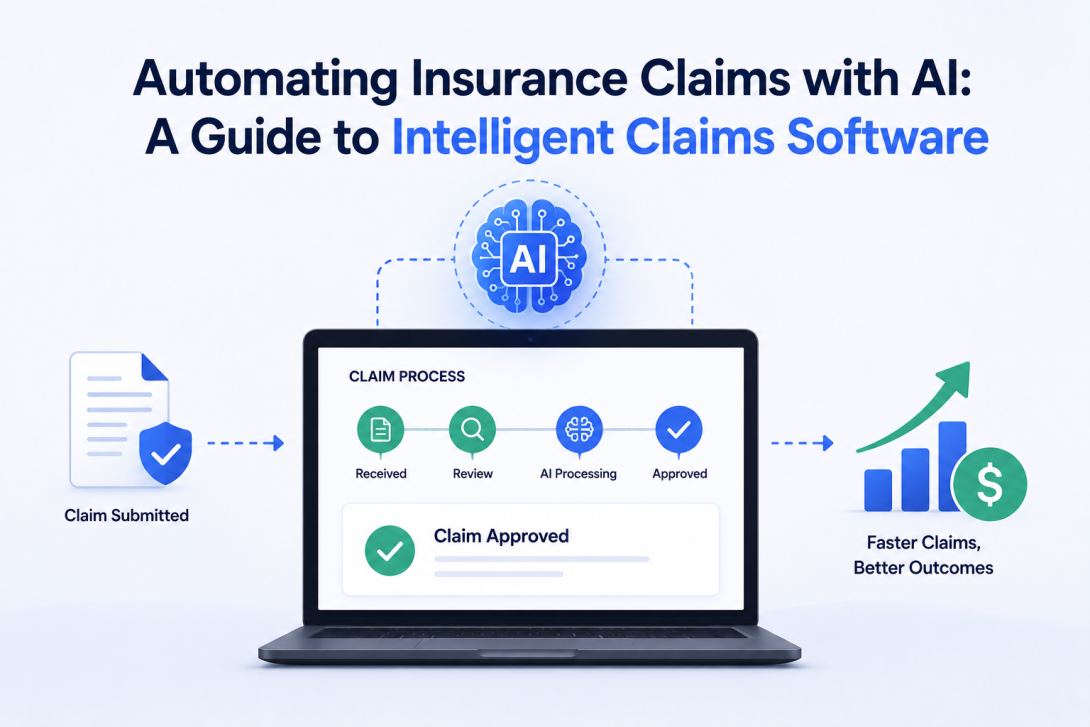
Automating insurance claims with AI is changing how insurers handle rising claim volumes and growing processing complexity. Manual claims workflows are slow, error prone, and vulnerable to fraud, leaving customers frustrated at the moment they need support most.
Intelligent claims software combines machine learning, computer vision, and natural language processing to move claims through the lifecycle faster and with far greater accuracy.
What Is AI-Powered Insurance Claims Automation?
AI-powered insurance claims automation refers to software that uses machine learning, natural language processing, computer vision, and predictive analytics to handle claims intake, validation, and decisioning with minimal manual input.
It differs from older rule-based automation, which only follows fixed if-then logic and cannot interpret unstructured data such as photos, emails, or handwritten forms.
Traditional claims management software digitizes paperwork but still depends heavily on human review at every step. Rule-based automation adds some efficiency by routing claims according to predefined conditions, but it breaks down when a claim does not match an expected pattern.
AI-powered claims software goes further. It learns from historical claims data, recognizes patterns across thousands of prior cases, and adapts its recommendations as new data arrives. Recent insurtech statistics show insurers adopting these platforms at a growing pace as claim volumes and customer expectations both rise.
A typical AI-powered claims architecture combines an intake layer for FNOL data, an AI or machine learning services layer for classification and scoring, a rules engine for compliance checks, and a payment and reporting layer. Insurers building this kind of platform often start with custom insurance software development that is tailored to their existing policy administration and claims systems rather than a generic off-the-shelf tool.
What makes a platform “intelligent” rather than simply automated is its ability to handle exceptions. A rule-based system fails the moment a claim deviates from the expected pattern, forcing it back into a manual queue. An AI-driven platform instead assigns a confidence score to its own recommendation, flags genuine uncertainty for human review, and keeps improving as more claims data flows through it.
How AI Automates the Insurance Claims Lifecycle
First Notice of Loss and Digital Intake
AI-powered digital claim intake extracts information directly from forms, emails, images, and even voice calls. Natural language models read the intake data, classify the claim type, and automatically route it to the correct workflow, cutting down the manual sorting that used to delay early-stage processing.
A policyholder describing an accident over the phone, for instance, can have their statement transcribed, classified by claim type, and routed to the right adjuster queue within minutes rather than sitting in a shared inbox overnight.
Automated Document Processing
Optical character recognition and intelligent document processing extract data from police reports, medical documents, repair estimates, invoices, and insurance forms.
Platforms built on intelligent document automation combine OCR with natural language classification so unstructured paperwork becomes structured, validated data ready for downstream systems.
This step also includes data normalization, converting inconsistent formats, currencies, and terminology from different providers into a single standardized schema the claims engine can process.
AI-Based Claim Validation
Once data is extracted, AI cross-checks policy details against the submitted claim, verifies coverage, and flags missing or inconsistent information. This step typically blends a traditional rules engine with machine learning models, so straightforward mismatches get caught by rules while subtler inconsistencies, such as a claim date that falls just outside a policy renewal window, are flagged by the model for review rather than silently approved or rejected.
Damage Assessment with Computer Vision
Computer vision models analyze vehicle, property, or asset images to detect visible damage, classify its severity, and produce an initial repair cost estimate.
Object detection identifies specific damaged components, while classification models grade severity on a consistent scale that adjusters can trust.
Insurers using computer vision development services can plug damage detection models directly into their existing claims workflow, reducing the need for an in-person inspection on lower-severity claims and shortening the time between FNOL and settlement.
Automated Claim Decisioning
Predictive models generate a recommendation, approve, reject, or send to manual review, along with a confidence score. Claims with high confidence scores can move through a straight-through process, while lower-confidence claims are queued for a human adjuster along with the specific factors that drove the model's recommendation, so the reviewer is not starting from zero.
Claims Payment Automation
Once a decision is confirmed, automated eligibility checks connect to payment systems for straight-through processing on low-risk claims.
Every transaction is logged for reconciliation and audit purposes, keeping payment automation compliant and traceable.
This closes the loop between decisioning and settlement, removing the manual handoffs that traditionally added days to the payout timeline.
Key AI Technologies Behind Intelligent Claims Software
Several distinct technologies work together inside intelligent claims platforms, each handling a different part of the workflow.
1. Machine Learning
- Claim classification: automatically categorizes incoming claims by type, severity, and complexity.
- Risk prediction: scores each claim for potential fraud or high-cost outcomes before processing begins.
- Severity prediction: estimates the extent of damage or loss to guide adjuster prioritization.
- Settlement prediction: forecasts likely payout amounts based on similar historical claims.
- Continuous learning: model accuracy improves over time as verified claim outcomes feed back into training.
- Anomaly flagging: surfaces claims that fall outside normal patterns for manual review.
2. Natural Language Processing
- Claimant conversation understanding: interprets phone transcripts, chat logs, and emails to extract relevant claim details.
- Unstructured text extraction: pulls key data points from free-form claim descriptions and adjuster notes.
- Document classification: sorts incoming correspondence and forms by type without manual tagging.
- Sentiment and intent detection: identifies frustrated or high-risk claimant communications for priority handling.
- Automated claims communication: drafts status updates and follow-up requests in plain language.
- Multilingual processing: handles claims and correspondence across different languages without separate systems.
3. Computer Vision
- Damage detection: identifies dents, cracks, water damage, or structural issues from submitted photos.
- Severity classification: grades damage on a consistent scale to standardize repair cost estimates.
- Image-based claim verification: confirms that submitted photos match the claimed incident and location.
- Property and asset inspection: supports remote inspections for property, auto, and equipment claims.
- Fraud indicator detection: flags reused, edited, or metadata-inconsistent images.
- Repair cost estimation: cross-references detected damage against parts and labor pricing databases.
4. Generative AI and Large Language Models
- Claim summaries: condense lengthy claim files into concise, adjuster-ready overviews.
- Adjuster copilots: answer policy and procedure questions in real time during claim review.
- Policy interpretation assistance: explains coverage terms and exclusions in plain language.
- Automated customer responses: drafts personalized claimant communications for review or direct send.
- Investigation report generation: compiles findings from multiple data sources into structured reports.
- RAG-based knowledge retrieval: pulls accurate answers directly from an insurer's own policy and claims documentation.
5. Predictive Analytics
- Claim severity prediction: estimates the likely scale of a claim early in the lifecycle.
- Litigation risk prediction: flags claims with a higher probability of legal escalation.
- Expected settlement estimation: projects final payout ranges to support reserving decisions.
- Claims leakage detection: identifies overpayments or process inefficiencies before they compound.
- Reserve accuracy modeling: improves financial forecasting by refining reserve estimates against outcomes.
- Trend and seasonality analysis: anticipates claim volume spikes tied to weather events or seasonal patterns.
6. OCR and Intelligent Document Processing
- Data extraction: pulls structured data from police reports, medical records, invoices, and claim forms.
- Handwriting recognition: converts handwritten forms and notes into searchable digital text.
- Data validation: cross-checks extracted values against expected formats and ranges.
- Data normalization: standardizes inconsistent formats, currencies, and terminology across providers.
- Multi-format support: processes scanned documents, PDFs, images, and faxed submissions alike.
- Straight-through routing: feeds validated, structured data directly into downstream claims systems without manual re-entry.
AI-Powered Fraud Detection in Claims
Insurance fraud detection is one of the strongest use cases for AI in claims processing. Anomaly detection and behavioral pattern analysis flag claims that deviate from typical patterns, while network and relationship analysis surfaces connections between claimants, providers, and prior claims that a manual reviewer would likely miss. Image and document manipulation detection adds another layer, catching altered photos or falsified paperwork before a payout is approved.
Purpose-built insurance fraud detection software assigns a risk score to each claim, automatically escalating high-risk cases to an investigation team.
The strongest platforms combine rules-based fraud detection with machine learning models, which helps reduce false positives that would otherwise slow down legitimate claims. Insurers researching AI in insurance fraud detection consistently report faster investigation cycles alongside lower leakage once these models are deployed at scale.
Historical claimant behavior adds another useful signal. A model trained on years of prior claims can recognize subtle timing or frequency patterns, such as claims filed shortly after a policy's coverage limit increases, that would take a human investigator far longer to notice across a large book of business.
None of this replaces investigator judgment, but it narrows an enormous pool of claims down to the small subset that genuinely warrants a closer look.
Human-in-the-Loop: Balancing Automation with Adjuster Oversight
Fully autonomous claims processing is not appropriate for every claim, particularly complex, high-value, or legally sensitive cases. AI-based prioritization and triage automatically categorize claims by complexity and severity, assigning routine claims to straight-through processing and routing suspicious or high-value claims to the appropriate adjuster or investigation team.
Confidence thresholds determine where the automation boundary sits. Claims above the threshold move forward automatically, while everything else lands in a review queue with explainable AI output showing why the model reached its recommendation. Adjusters retain override authority at every stage, which keeps human accountability intact even as more of the routine workload shifts to automation.
This balance is not just an operational preference, it is increasingly a regulatory expectation. Insurance regulators in most markets require that a policyholder can request an explanation for how a claim decision was reached, and a black-box model that cannot justify its own output creates real compliance exposure.
Explainable AI techniques, paired with a documented override process, give insurers a defensible audit trail showing exactly which factors influenced each automated recommendation and which claims a human ultimately reviewed.
Benefits of AI-Powered Claims Automation
Insurers that adopt intelligent claims software consistently report measurable gains across speed, cost, and customer experience.
- Faster claim processing: AI reduces cycle times from days to hours for straightforward claims by automating intake, validation, and decisioning.
- Reduced administrative workload: Automated document extraction and data entry free adjusters from repetitive manual tasks.
- Lower operational costs: Straight-through processing for low-risk claims cuts the cost per claim significantly compared to fully manual review.
- Improved fraud detection: Machine learning models catch suspicious patterns that manual review often misses, reducing claims leakage.
- More consistent decision-making: AI applies the same evaluation criteria across every claim, reducing variability between adjusters.
- Better adjuster productivity: With routine claims automated, adjusters can focus their expertise on complex and high-value cases.
- Improved customer experience: Faster decisions and payments lead directly to higher policyholder satisfaction and retention.
- Increased straight-through processing: More claims can be resolved end-to-end without manual intervention as models mature.
Challenges and Risks of AI in Insurance Claims
Adopting AI for claims automation comes with real risks that insurers need to plan for before scaling deployment.
- Poor-quality training data: Models trained on incomplete or biased historical claims data produce unreliable predictions.
- Algorithmic bias: Without careful monitoring, models can unintentionally disadvantage certain claimant groups.
- Generative AI hallucination: Large language models can produce plausible but inaccurate claim summaries if not properly grounded.
- Explainability requirements: Regulators increasingly require insurers to justify AI-driven claim decisions in plain language.
- Legacy system integration: Older policy administration and claims platforms often lack modern APIs, complicating rollout.
- Model drift: Claims patterns shift over time, so models require ongoing monitoring and retraining to stay accurate.
- Over-automation risk: Pushing complex or ambiguous claims through automated decisioning without human review can create compliance and customer trust problems.
The Future of Intelligent Claims Processing
Claims automation is moving toward agentic AI systems capable of coordinating multiple steps of a claim autonomously, from intake through settlement, with human oversight only at defined checkpoints. Multimodal AI that processes text, images, audio, and video together will make FNOL intake even more seamless, letting a single claim submission combine a voice description, damage photos, and a written report in one automated pass.
Real-time claims processing, AI adjuster copilots, and predictive claims prevention models that flag risk before a loss occurs are all advancing quickly. IoT and telematics data will feed directly into claims systems for auto and property insurance, while digital twins are beginning to support complex commercial property and asset claims by modeling damage against a live digital replica of the insured asset.
Autonomous document and workflow orchestration is likely to be the biggest near-term shift for most insurers, since it does not require replacing core policy administration systems, only connecting AI services around them. Insurers that build this orchestration layer now, on a modular architecture with clear human checkpoints, will be far better positioned to adopt agentic and multimodal capabilities as they mature, rather than needing a costly platform rebuild a few years down the line.
Conclusion
Automating insurance claims with AI is no longer optional for insurers competing on speed and accuracy. From document extraction and fraud detection to damage assessment and payment automation, intelligent claims software touches every stage of the claims lifecycle. Insurers that invest in the right architecture, data foundation, and human oversight model will process claims faster while keeping decisions fair, explainable, and compliant.