
The global Antimicrobial Susceptibility Testing Market is gaining importance as healthcare providers and diagnostic laboratories increasingly focus on identifying effective treatments for bacterial infections. Antimicrobial susceptibility testing (AST) helps determine how microorganisms respond to different antimicrobial agents, supporting healthcare professionals in selecting appropriate treatment options and addressing the growing challenge of antimicrobial resistance.
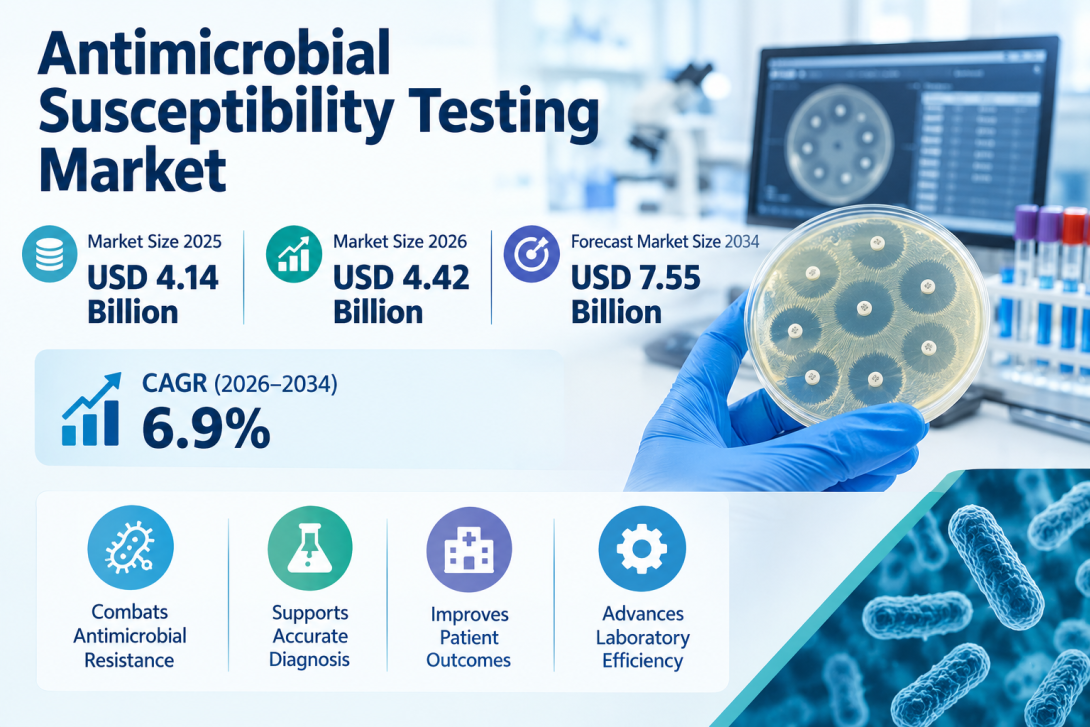
According to Fortune Business Insights, the Antimicrobial Susceptibility Testing Market size was valued at USD 4.14 billion in 2025. The market is projected to grow from USD 4.42 billion in 2026 to USD 7.55 billion by 2034, exhibiting a CAGR of 6.9% during the forecast period.
Rising Antimicrobial Resistance Drives Market Growth
The increasing prevalence of antimicrobial-resistant infections is one of the major factors supporting the growth of the Antimicrobial Susceptibility Testing Market. The inappropriate or excessive use of antimicrobial medicines has contributed to the development of resistant microorganisms, making infection management increasingly challenging.
AST provides important information about the susceptibility or resistance of pathogens to specific antimicrobial drugs. As healthcare institutions place greater emphasis on responsible antimicrobial use, demand for accurate susceptibility testing is expected to increase.
Growing Demand for Rapid and Accurate Diagnostics
Healthcare providers are increasingly seeking diagnostic methods that can deliver reliable results within shorter timeframes. Rapid testing can support faster clinical decision-making and may help healthcare professionals select appropriate therapies sooner.
Advances in laboratory automation, microbiology systems, and diagnostic technologies are contributing to improvements in testing workflows. Automated systems can reduce manual procedures, improve laboratory efficiency, and support standardized testing processes.
For detailed market insights : https://www.fortunebusinessinsights.com/antimicrobial-susceptibility-testing-market-107735
Test Type Analysis
The Antimicrobial Susceptibility Testing Market can be analyzed based on test type, including manual susceptibility testing methods, automated testing systems, and other advanced approaches.
Manual methods remain important in many clinical and research laboratories because of their established use and relatively straightforward procedures. However, automated testing systems are gaining attention because they can process multiple samples efficiently while reducing manual intervention.
The increasing adoption of automated microbiology platforms is expected to create opportunities for manufacturers developing advanced AST solutions.
Method Analysis
AST methods include disk diffusion, broth dilution, agar dilution, and other testing techniques. Each method has specific applications depending on the microorganism being evaluated, laboratory resources, and testing requirements.
Disk diffusion remains a widely recognized approach because it is relatively simple and cost-effective. Broth-based methods can provide quantitative information about antimicrobial activity and are particularly useful when determining minimum inhibitory concentrations.
Continued technological development is expected to improve the efficiency and reliability of these methods while supporting their use across different laboratory settings.
Application Analysis
Antimicrobial susceptibility testing is used across clinical diagnostics, pharmaceutical and biotechnology research, academic institutions, and other healthcare applications.
Clinical diagnostics represent a significant application area because healthcare professionals require information about pathogen susceptibility when managing infectious diseases. Diagnostic laboratories also use AST to support routine microbiological testing and infection management.
Pharmaceutical and biotechnology companies use susceptibility testing during antimicrobial research and development. Research institutions similarly rely on AST methods to study microorganisms, resistance patterns, and potential therapeutic approaches.
Increasing Adoption of Automated Laboratory Systems
Laboratory automation is becoming increasingly important as diagnostic facilities handle growing testing volumes. Automated AST platforms can streamline sample processing, reduce repetitive manual activities, and support standardized workflows.
Integration with laboratory information management systems can further improve data management and reporting. As laboratories continue their digital transformation, automated and connected susceptibility testing technologies are expected to gain greater adoption.
Regional Analysis
The global Antimicrobial Susceptibility Testing Market is supported by increasing demand for infectious disease diagnostics across developed and emerging healthcare systems.
North America is an important market due to its advanced healthcare infrastructure, established clinical laboratory networks, and focus on antimicrobial resistance management. The region's adoption of automated diagnostic technologies is also supporting demand for advanced AST solutions.
Europe is expected to maintain a significant market position due to increased awareness of antimicrobial resistance, established diagnostic systems, and efforts to promote appropriate antimicrobial use.
Meanwhile, Asia Pacific is expected to offer substantial growth opportunities as healthcare infrastructure expands, infectious disease testing increases, and diagnostic capabilities improve across developing economies. Rising investments in clinical laboratories and healthcare technology are likely to further support regional market development.
Competitive Landscape
The competitive landscape of the Antimicrobial Susceptibility Testing Market includes companies involved in microbiology diagnostics, laboratory automation, infectious disease testing, and diagnostic equipment.
Market participants are focusing on developing automated systems, improving testing accuracy, expanding product portfolios, and strengthening laboratory capabilities. Product innovation, research and development, strategic collaborations, and geographic expansion are expected to remain important competitive strategies.
Recent Industry Developments
Recent developments in antimicrobial susceptibility testing have focused on automation, faster diagnostic workflows, and improved laboratory data management. Manufacturers and diagnostic technology providers are working to develop systems that can support higher testing volumes while reducing manual intervention.
The integration of advanced software, automated analysis, and digital laboratory platforms is also creating opportunities for more efficient testing workflows. These developments are particularly relevant as healthcare systems seek stronger tools to address antimicrobial resistance.
Get Free Sample PDF: https://www.fortunebusinessinsights.com/enquiry/request-sample-pdf/antimicrobial-susceptibility-testing-market-107735
Future Outlook
The Antimicrobial Susceptibility Testing Market is expected to experience steady growth through 2034 as antimicrobial resistance remains a significant healthcare challenge. Increasing infectious disease testing, demand for accurate diagnostics, laboratory automation, and greater emphasis on appropriate antimicrobial treatment are expected to support market expansion.
The market is projected to increase from USD 4.42 billion in 2026 to USD 7.55 billion by 2034, registering a CAGR of 6.9% during the forecast period. As diagnostic laboratories continue adopting automated and technologically advanced testing solutions, antimicrobial susceptibility testing is expected to remain an important component of modern infectious disease diagnosis and treatment management.
Related Reports
Uncover Japan’s Market Trends - Explore the Latest - Antimicrobial Susceptibility Testing Market - Insights