

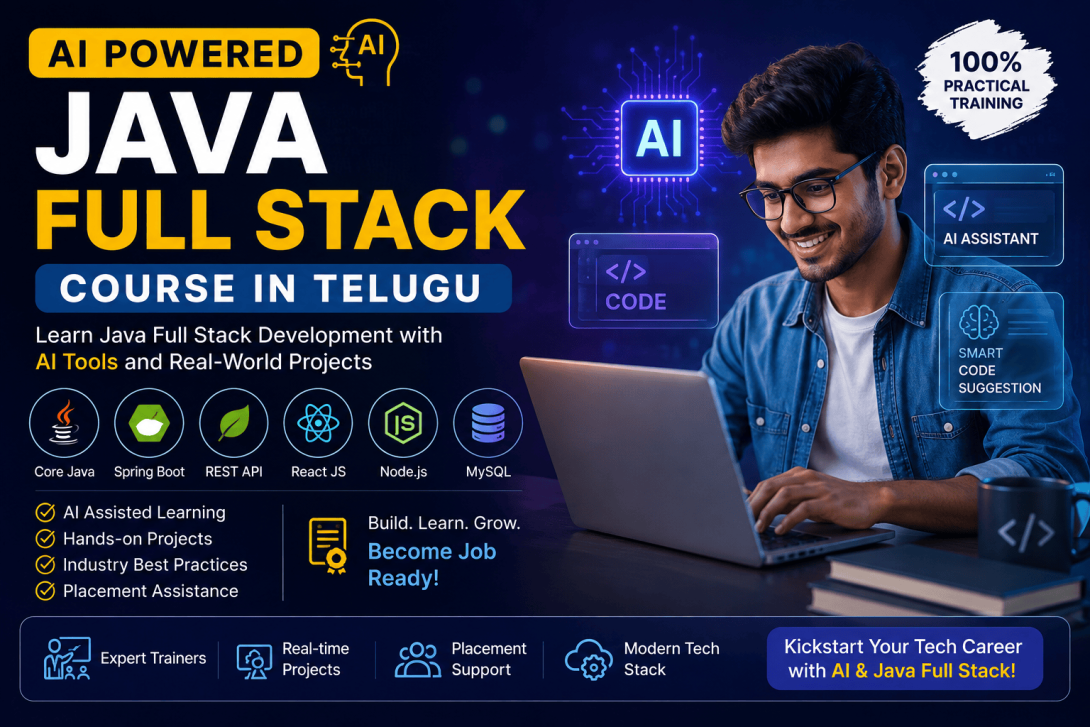
Starting a software development career as a fresher can be challenging because the technology industry includes numerous programming languages, frameworks, tools, and development methodologies. A structured AI Powered Java Full Stack Course in Telugu can help beginners understand these technologies in a systematic way while learning how artificial intelligence is influencing modern software development.
Why Java Full Stack Development?
Java Full Stack Development involves building both the frontend and backend components of web applications. Java has remained an important programming language for enterprise software, backend services, financial applications, and large-scale business systems.
For freshers, learning Java along with frontend technologies creates a broader technical foundation. Instead of focusing only on backend programming, learners can understand how complete web applications are designed, developed, connected, tested, and deployed.
Adding AI tools to this learning journey can further improve development productivity and help beginners become familiar with current industry practices.
Step 1: Learn Core Java
Freshers should begin with Core Java fundamentals. Important concepts include variables, data types, operators, conditional statements, loops, arrays, methods, classes, and objects.
After learning the basics, students should concentrate on Object-Oriented Programming. Concepts such as inheritance, abstraction, encapsulation, and polymorphism are fundamental to Java application development.
A strong understanding of Java fundamentals makes it easier to learn frameworks such as Spring Boot later.
Step 2: Develop Database Skills
Web applications need databases to store and retrieve information. Therefore, learning SQL and relational database concepts is an important part of a fresher's career roadmap.
Students can practice creating tables, inserting records, filtering data, using joins, grouping information, writing subqueries, and understanding relationships between tables.
Knowledge of databases also helps developers understand how backend applications communicate with persistent data.
Step 3: Learn Spring Boot
After Java and SQL, freshers can progress to Spring Boot. It is widely used for creating Java-based backend applications and RESTful services.
Learners can study controllers, services, repositories, dependency injection, validation, exception handling, configuration, and database integration.
Creating REST APIs is especially important because APIs allow frontend applications to communicate with backend systems.
Step 4: Learn Frontend Technologies
A full-stack developer should also understand how the user interface works. Begin with HTML, CSS, and JavaScript before moving toward a modern frontend framework such as React.
Students should practice creating responsive pages, forms, components, navigation systems, and API integrations.
Combining React with Spring Boot can help freshers create complete applications rather than isolated frontend or backend projects.
Step 5: Introduce AI-Assisted Development
AI has become an increasingly useful development companion. Freshers can use AI coding tools to understand programming errors, generate initial code ideas, create test scenarios, explain unfamiliar concepts, and improve documentation.
However, AI-generated code should always be reviewed and tested. Employers value developers who can understand application logic rather than simply generate code through AI.
Step 6: Build Portfolio Projects
Projects can significantly improve a fresher's ability to demonstrate technical skills. Suitable projects include:
- Employee Management System
- Online Course Platform
- E-Commerce Application
- Appointment Booking System
- Inventory Management Application
- Student Management Portal
Each project should demonstrate frontend development, backend APIs, database connectivity, authentication, and basic testing.
Fresher Career Roadmap
Career Stage
Skills to Develop
Beginner
Core Java and OOP
Foundation
SQL and Git
Backend
Spring Boot and REST APIs
Frontend
HTML, CSS, JavaScript, React
AI Enabled
AI-assisted coding
Job Ready
Projects, GitHub, interview preparation
Conclusion
An AI Powered Java Full Stack Course in Telugu can provide freshers with a structured route into software development. Starting with Java fundamentals, progressing through SQL, Spring Boot, React, and finally integrating AI tools creates a practical learning path.
Freshers should focus on consistent coding practice, real-world projects, GitHub portfolio development, and problem-solving. With these skills, they can build a stronger foundation for entry-level opportunities in modern software development.